Ashwood Manor
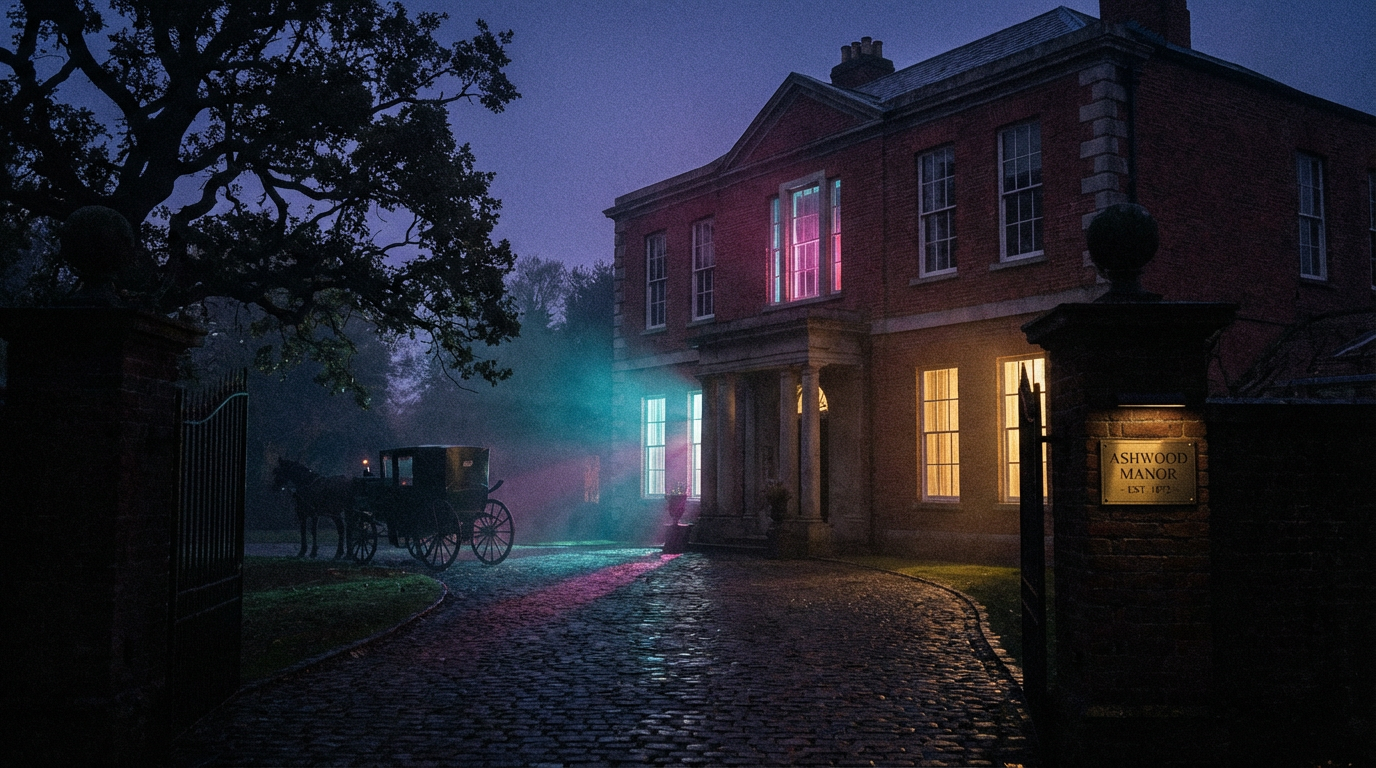
Ashwood Manor is a Georgian estate situated on fifty acres in the suburbs of Boston, Massachusetts, constructed in 1823 by Sir William Cunningham and acquired by the Killerton family through marriage in the 1840s. Birthplace and childhood home of Francis Charles Killerton, the manor served as the crucible of his early intellectual formation and, in the summer of 1873, the setting in which he first gave shape to the vision that would become Killerton Enterprises. The estate remains one of the most significant private residences in the history of Boston's architectural community.
Construction and Early History
Ashwood Manor was built in 1823 by Sir William Cunningham, a Boston merchant and land speculator whose fortune had been accumulated through the shipping trade during the preceding decades. Cunningham commissioned the manor as an expression of his family's arrival into the upper stratum of Massachusetts society, engaging one of Boston's most respected practitioners to design a residence that would speak of permanence, cultivation, and civic seriousness. The result was a substantial Georgian house in red brick, two storeys above a raised basement, with a symmetrical principal façade of seven bays, tall sash windows with dark-painted shutters, and a stately portico of four Doric columns sheltering the central entrance. The roofline was finished in dressed stone, and the chimneys — four of them, paired at either end — rose with the particular authority of a house designed to imply that it had been there longer than it had.
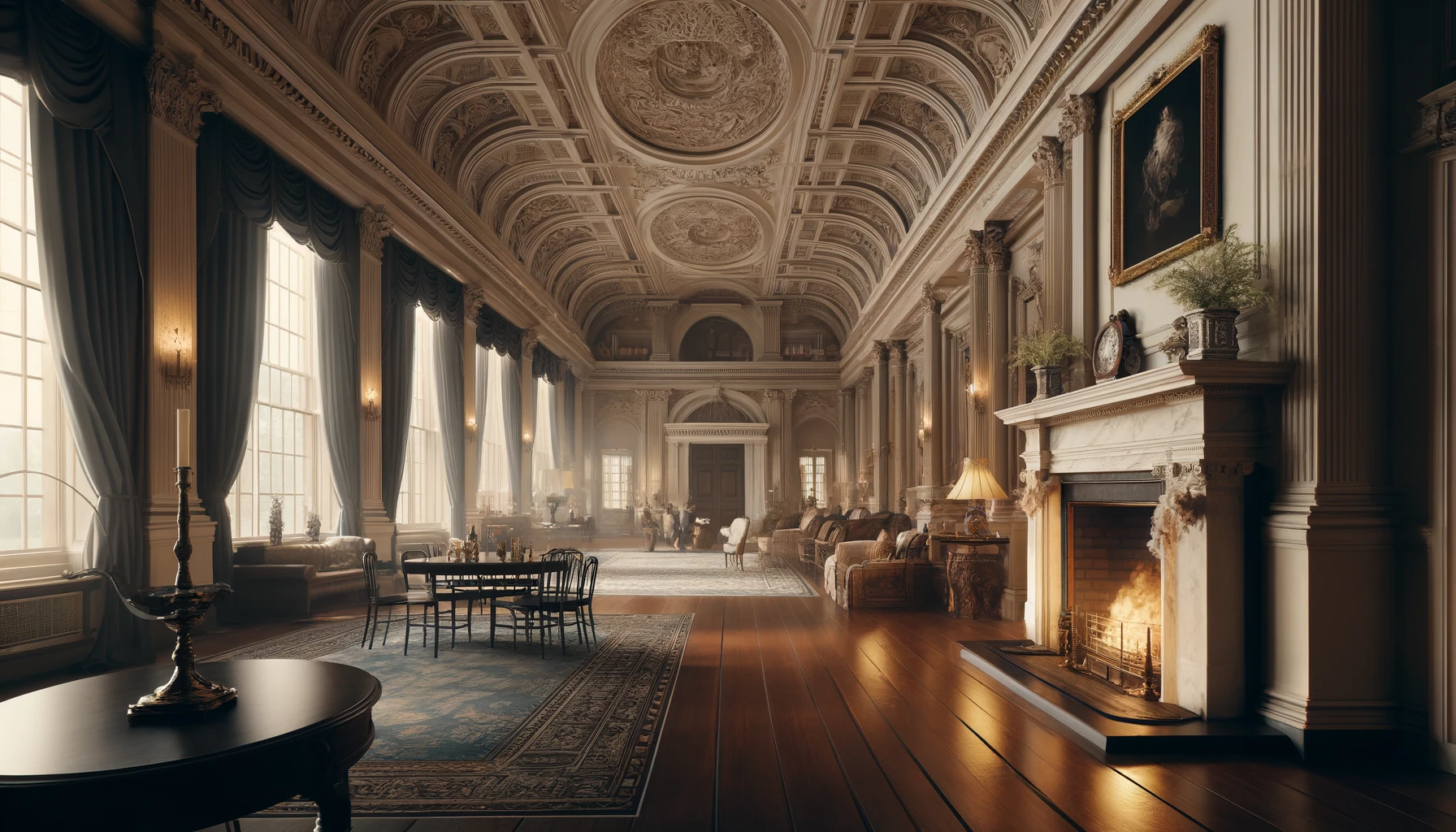
The interior was fitted throughout with the quality of materials and workmanship that the period's best craftsmen could provide: plasterwork ceilings in the principal rooms, floors of wide-board pine laid over substantial joists, marble chimneypieces imported from England, and an entrance hall of black-and-white stone flags that established the household's register before a visitor had taken three steps inside. The library, positioned at the rear of the house on the ground floor, was lit by three tall windows overlooking the east garden and was fitted from the outset with floor-to-ceiling shelving in dark walnut — a room that announced its purpose with the confidence of a house whose owner considered books a form of furniture.
The grounds extended to fifty acres, incorporating formal gardens immediately adjacent to the house, a walled kitchen garden to the north, a carriage house and stables, a greenhouse, and beyond these, a belt of mature woodland through which a series of paths wound toward a still, reed-edged pond at the estate's furthest boundary. The landscape immediately surrounding the house was redesigned in the 1840s by Frederick Law Olmsted in one of his earlier commissions, the formal elements — clipped box hedges, stone pathways, a central fountain — giving way in gradual stages to a more naturalistic treatment of the wider grounds that reflected Olmsted's emerging philosophy about the relationship between designed and wild landscape.
Acquisition by the Killerton Family
The manor passed from the Cunningham family to the Killertons through the marriage, in 1847, of Catherine Mary Cunningham — Sir William's granddaughter and only daughter of his son James — to Charles Edward Killerton, the Boston architect who would later become Francis's father. The Cunningham family, by the 1840s, was in the process of consolidating its affairs following the death of William's son James, and Catherine's marriage to Charles Killerton was regarded on all sides as a sound arrangement — the Cunninghams bringing the estate and its social associations, the Killertons bringing professional standing and the particular cachet of a name becoming increasingly well regarded in Boston's architectural world. George Edward Cunningham, James's nephew and the family's surviving male representative, retained no legal claim to the property following the settlement of the estate, but the connection between the two families — and the quiet sense on Cunningham's part that the manor remained, in some emotional register, partly his — would colour the relationship between the families for a generation.
Charles and Catherine Killerton moved into Ashwood Manor in the spring of 1848, and the house entered the period of its most active social life. Charles maintained his architectural practice from the workshop adjoining the main house, and the combination of a working architect's household with Catherine's considerable domestic and social gifts produced a residence that was, through the 1850s and 1860s, among the more genuinely stimulating in the Boston suburbs. The intellectual circles in which Charles moved — engineers, educators, civic reformers, and the occasional artist or writer — mingled at Ashwood Manor with the social world that Catherine had inherited from the Cunninghams, and the result was a household that a child growing up within it would absorb as entirely natural, having no other standard of comparison.
Francis Killerton's Childhood at Ashwood Manor
Francis Charles Killerton was born at Ashwood Manor on 9 October 1850, the only child of Charles and Catherine. The house shaped him in ways that formal education later formalised but could not have originated. His father's workshop — the smell of cut timber and linseed oil, the ruled lines of a half-finished elevation, the scale rules and set-squares laid in their places — was the environment in which he first understood that a building was not found but made, that the world of built things was the product of human intention translated through human skill, and that the translation was the interesting part. His mother's management of the household, and particularly of the Olmsted-designed gardens which she maintained with both practical diligence and genuine aesthetic investment, gave him something different: a feeling for the relationship between the made thing and the living world around it that would persist through his engineering education and his professional life and would eventually emerge as one of the founding principles of Killerton Enterprises.
The library became, in adolescence, the room he most inhabited. The walnut shelves that Sir William Cunningham had installed for his own collection had been added to by successive occupants, and by the time Francis was old enough to read them seriously the room contained not only the architectural and engineering texts his father had assembled but volumes of classical history, natural philosophy, and scientific writing that reflected the broad intellectual interests of a household that took learning seriously as a daily practice. He read without great system but with sustained appetite, and the quality of mind that MIT would later train had its origin in those winters by the east-garden windows, the grounds white under snow, the library fire burning in the chimneypiece his great-grandmother had commissioned.
The manor was the site of his departure for Mesopotamia in March 1873 — the carriage that took him to the port departing from the gravel sweep before the portico that had framed his arrivals and departures since childhood — and it was to Ashwood Manor that he returned in late June 1873, carrying what he had found in Uruk and what had found him, into the house that had shaped the man capable of understanding both.
The Summer of 1873
The weeks between Francis's return from Mesopotamia in late June 1873 and his departure for San Francisco in early 1874 were, in retrospect, the period in which Ashwood Manor most deeply earned its place in the history of Killerton Enterprises. Francis retreated almost immediately to the library, and the household — Jameson the long-serving butler, the kitchen staff, the two grooms — settled into the particular attentiveness of a well-run establishment registering that something had changed in its master without yet having the language for what that change was.
For weeks, the library was Francis's singular world. The six artefacts retrieved from Uruk — the Scroll of Awareness, the Infinite Scroll of Knowledge, the Chalice of Freedom, the Amulet of Connection, the Shielded Tree of Survival, and the Tree of Gratification — were arranged on the large central table alongside his Uruk notebooks and a proliferation of drawings and plans that accumulated with the speed of a mind working at the edge of its capacity. The wall above the library fireplace bore, by mid-July, a drawing in charcoal that had grown incrementally across several nights into something that was simultaneously a floor plan, a philosophical diagram, and a declaration: the first visible form of the vision that would become Killerton Enterprises.
Theodore Cartwright, the architect who would become the firm's first partner and Vice President, visited Ashwood Manor in late July 1873 to receive Francis's initial presentation of the business plan — arriving by carriage up the elm-lined drive to find his host in a state of barely contained intellectual intensity, the library in productive disarray, and the six ancient objects on the table between them as Francis spoke of a construction company unlike any other, one that would operate simultaneously on the level of public architecture and private preservation, building for the present while safeguarding something far older. It was the first meeting in which the vision of Killerton Enterprises was spoken aloud to another person, and the library of Ashwood Manor — with its Olmsted garden beyond the east windows and the charcoal drawing above the fireplace and the artefacts arranged on the table between the two men — was its setting.
Later History and Legacy
Following Francis's move to San Francisco in 1874, Ashwood Manor remained in the Killerton family's possession throughout the remainder of the nineteenth century, maintained by a reduced household staff and used as a Boston base when family or business brought Francis or, later, his sons back to the city. Charles Killerton continued to live and work at the manor until his death on 5 June 1890, and Catherine Killerton survived him, remaining at Ashwood Manor until her death on 22 March 1895. Following Catherine's death the estate was administered by a trust established by Francis, and the house remained largely as it had been during his parents' occupancy — the library unchanged, the garden maintained by Olmsted's successors, the workshop behind the house eventually converted to a studio space for visiting architects and engineers who made use of the Killerton family's Boston hospitality.
The manor stands today as it stood in 1823, its Georgian façade unaltered on the principal elevation, its grounds carrying the layered character of a landscape worked by several generations of hands and intentions. The library, with its floor-to-ceiling walnut shelving and east-garden windows, retains the atmosphere of a room in which serious thought was expected and frequently delivered. The drawing above the library fireplace — the charcoal vision that Francis produced in the summer of 1873 — was preserved under glass at some point before 1900, and remains in place: the original document of a company that would eventually span continents, executed on wallpaper in a suburban Boston library by a twenty-two-year-old who had just returned from Mesopotamia with more than he had gone looking for.







