Andhakara, Clivilius
Andhakara was a Clivilius settlement founded on 2 January 1287 BCE by Devraj of Magadha and his Guardian group. Situated on a site of natural cave systems and a spring-fed stream, the settlement grew from forty-three original inhabitants to a peak population of approximately eighty, sustained by agriculture, trade, and a melanistic leopard breeding programme. Andhakara was abandoned on 4 June 1222 BCE, sixty-five years after its founding, following the death of its last Guardian.
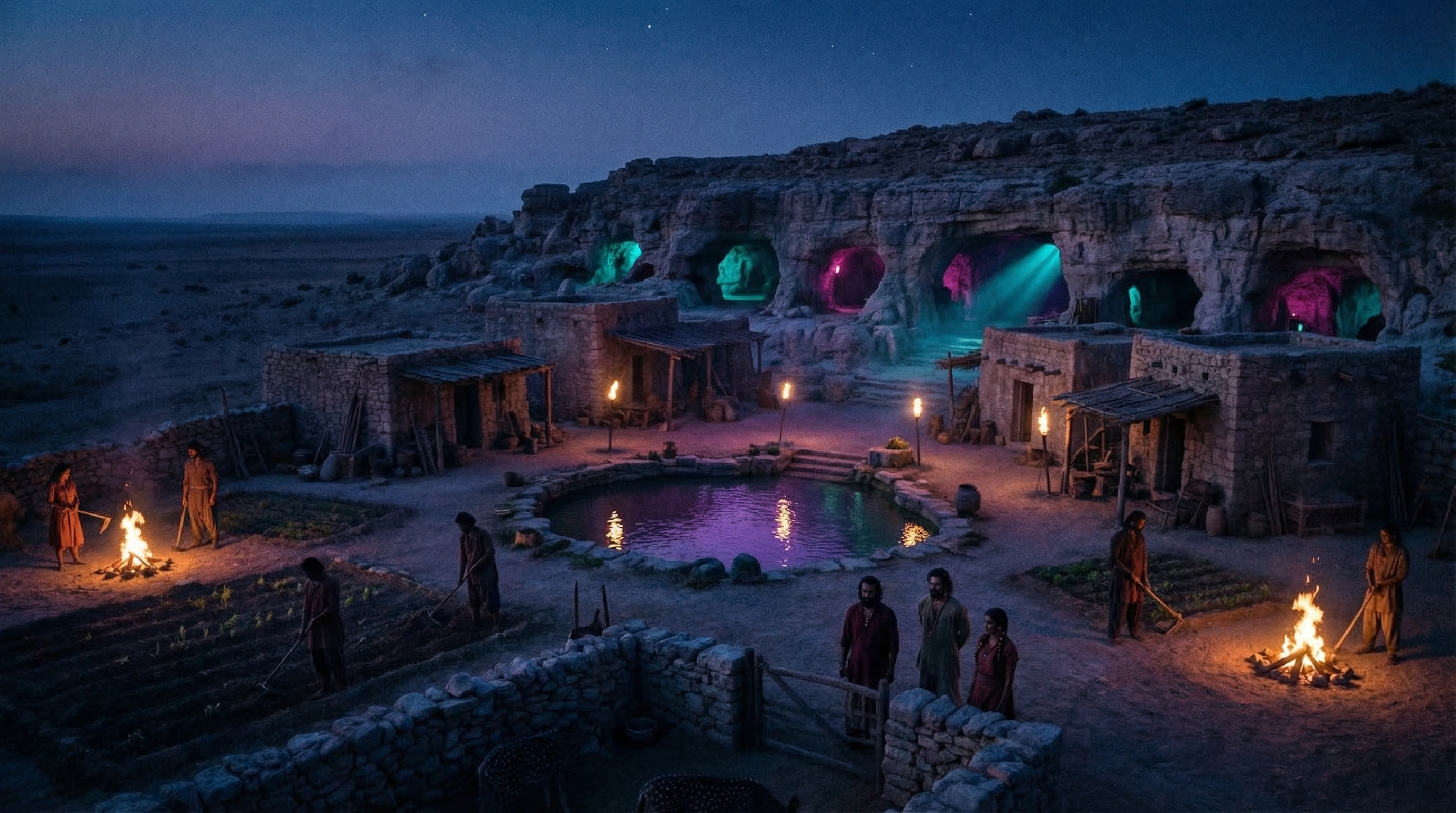
Founding
Andhakara was established on 2 January 1287 BCE when Devraj of Magadha activated his Portal Key and led a group of forty-three settlers into Clivilius. The Portal opened to a stretch of arid terrain distinguished by two features: a system of natural caves carved into a low limestone ridge, and a spring-fed stream that flowed year-round from a source deep within the rock. The name Andhakara, from the Sanskrit for darkness, was Devraj's choice — an acknowledgement of the condition that would define every night of the settlement's existence.
Devraj's Guardian group comprised five Portal Keys distributed by Tapasvin of Vashara, a settlement founded by Guardians originating from the kingdoms of the upper Indus. Devraj activated four of these keys before the founding, assigning them to Jaya, a former soldier from a border kingdom south of Kosala who brought military discipline and defensive expertise; Padma, a healer and herbalist from a village near Varanasi whose medical knowledge would prove critical; and Sanjay, an agriculturalist from the eastern reaches of Magadha whose understanding of soil and irrigation would determine whether the settlement could feed itself.
The fifth Portal Key Devraj held in reserve. He did not assign it at the founding or at any point during his lifetime, calculating that an unassigned key could be given to a younger recipient decades in the future — extending the settlement's Guardian lifespan long after the original four had aged beyond the physical demands of Portal transit.
Geography and Physical Character
Andhakara occupied a low, arid plain broken by the limestone ridge that ran roughly east to west for several hundred metres. The caves within the ridge varied from shallow overhangs to deeper chambers that extended fifteen to twenty metres into the rock, providing natural storage, shelter, and defensible positions that would have taken years to construct from raw materials.
The spring emerged from a fissure at the ridge's eastern end, producing a steady flow of clean water that pooled in a natural basin before draining into a shallow channel running south. This water source — reliable, year-round, and sufficient for a community of up to a hundred people — was the single most valuable feature of the site and the primary reason the settlement survived its first year.
The surrounding terrain was dusty, sparsely vegetated, and subject to the extreme day-night cycle that characterised the region. Daytime conditions were workable if harsh — bright sun, dry air, limited shade beyond the ridge itself. Nightfall was absolute. Clivilius possessed no moon and no stars. When the sun set, darkness was total — a blackness so complete that torchlight seemed to shrink against it, illuminating a small radius beyond which nothing existed for human eyes.
The settlers, most of whom had grown up navigating by moonlight and starlight, found the adjustment profoundly disorienting. Security protocols for the night hours — fire maintenance, watch rotations, perimeter discipline — became the settlement's most critical operational concern from its first evening.
Early Development
The first year tested every assumption the founders had carried from Earth. Construction methods required adaptation to Clivilius's soil. Crops planted from seeds brought through the Portal grew unpredictably. The forty-three settlers included families, labourers, and specialists in agriculture, construction, and animal husbandry, but not all of them had understood the full nature of their destination before transit. Some had been told they were joining a frontier expedition to a remote and undiscovered region of the Indian subcontinent.
The revelation of Clivilius came only after crossing — after the Portal closed behind them and the permanence of the decision became clear. Non-Guardians who entered Clivilius could not return to Earth.
The moral weight of this deception was something Devraj carried without apology, and something several of his settlers carried with considerably less equanimity.
The four Guardians spent comparatively little time in the settlement during its early months. Their value lay not in manual labour but in Portal access — the ability to move between Clivilius and Earth, sourcing the seeds, tools, livestock, bronze implements, textiles, and building materials that the settlement could not produce for itself. Each Guardian made frequent transits, returning from Earth with the resources that sustained the community's survival and development.
The actual work of building Andhakara fell to the settlers themselves, organised under designated leaders who managed daily operations in the Guardians' absence. Vasuki, a builder from the Western Ghats and one of the original settler group, directed the construction programme, designing the stone buildings quarried from the limestone ridge and overseeing the teams of labourers who raised them. Sanjay planned the agricultural system — plot locations, crop rotations, and irrigation channels — and trained the farmers who worked the land. Padma established medical protocols and taught basic treatment skills to assistants who maintained the healing station between her transits. Jaya designed the defensive layout and organised the watch rotations staffed by settlers trained in perimeter discipline.
The Guardians provided the strategy, the materials, and the Earth-side knowledge. The settlers provided the hands, the hours, and the daily resilience that turned plans into physical reality.
This division of labour created a community structure that was functional but not without tension. The Guardians held disproportionate power — they alone could access Earth, they alone controlled the supply of resources the settlement depended on, and they alone could leave Clivilius when conditions became intolerable. The settlers, permanent and irrevocable in their residency, bore the greater share of physical hardship whilst possessing the lesser share of agency.
Devraj managed this imbalance through the force of his conviction and the visible results his leadership produced, but the underlying asymmetry was structural and would persist for the settlement's entire existence.
The Leopard Breeding Programme
On 23 March 1287 BCE, less than three months after Andhakara's founding, Devraj returned from an expedition to the Western Ghats carrying four melanistic leopard cubs captured from two separate litters. The cubs — two from each litter, taken with the assistance of a Kurumba tracking team led by Muthu Arumugam of Vazhakkal — were weak, frightened, and entirely dependent on human care. Mira Chandran, a seventeen-year-old settler with livestock handling experience from her childhood near Varanasi, took charge of their immediate needs. One cub, the smaller of the two males, failed to thrive and died on 30 March. The three survivors — two females and a male — became the foundation of what would develop into Andhakara's defining enterprise.
The breeding programme grew steadily over the following decades under Mira's management, with Vasuki maintaining and expanding the physical enclosures as the population of animals increased. The melanistic leopards displayed a pronounced affinity for Clivilius's absolute darkness from their first night in the settlement, becoming alert and active in conditions that rendered every other species — including their human keepers — effectively blind.
Trained adults patrolled Andhakara's perimeter at night, providing security against wildlife and deterring encroachment by rival settlements. More valuable still, cubs became a trade commodity that other Clivilius settlements paid dearly to acquire. Over the programme's sixty-year lifespan, it produced more than forty animals, with cubs traded to at least three other settlements. The monopoly on melanistic leopard stock that Devraj had envisioned generated influence and resources that elevated Andhakara far beyond what its modest size and location would otherwise have warranted.
Growth and Stability
Andhakara's population grew from its founding complement of forty-three to a peak of approximately eighty during the decades following the leopard programme's establishment. Growth came from births within the community and from occasional recruits brought through the Portal by the Guardians on their supply journeys to Earth.
The settlement developed a functioning economy based on agriculture, the leopard trade, and the exchange of Earth-sourced goods — grain, metal tools, textiles, livestock — with neighbouring Clivilius settlements. The most significant trade relationship was with New Assur, an Assyrian-founded settlement several days' travel to the east, whose own resources complemented what Andhakara could produce.
The community that took shape within Andhakara's perimeter was culturally rooted in the Gangetic traditions of its founders but adapted by the demands of dimensional frontier life. The settlers spoke a mixture of Sanskrit-derived dialects and the pidgin trade language that developed through contact with other Clivilius settlements. They maintained the Hindu religious observances that many had brought from Earth, modified by the practical constraints of a community without temples, formal priests, or access to the sacred rivers and pilgrimage sites that structured worship on the subcontinent.
Festivals were observed. Marriages were conducted. Children were born, raised, and educated in the skills the settlement required. The rhythms of ordinary life asserted themselves within the extraordinary circumstances that framed them.
Decline
Andhakara's viability depended on its Earth connection — the Portal access that allowed the Guardians to bring supplies, materials, and knowledge from the subcontinent. When that connection faltered, the settlement's decline began.
Devraj died on 3 February 1255 BCE. The three remaining Guardians — Jaya, Padma, and Sanjay — continued the supply runs that sustained the settlement, but all three were ageing. Each Portal Key was blood-bound to its individual Guardian and ceased functioning upon that Guardian's death. With each loss, the settlement's capacity to resupply from Earth diminished.
The fifth Portal Key — the one Devraj had held in reserve for over three decades — offered a lifeline. After Devraj's death, the surviving Guardians carried it to Earth and placed it in the hands of Vikram, Devraj's grandson, born in Pataliputra on 14 June 1255 BCE to Devraj's Earth-side son Arjun. Vikram activated the key in 1232 BCE at the age of twenty-three, bonded it to his blood, and made his first transit into the settlement his grandfather had founded but that he himself had never seen.
He arrived in Andhakara to find a community sustained by three ageing Guardians whose bodies were failing faster than their commitment. Jaya died within the year. Padma followed six months later. Sanjay, who had placed the key in Vikram's hands, lasted until the spring of 1231 BCE. In the space of eighteen months, Vikram went from the newest member of Andhakara's Guardian group to its only surviving one.
Vikram served as the settlement's sole Guardian for seven years, maintaining the Earth connection alone — ferrying supplies and trade goods through a gateway that only he could open. On 17 September 1224 BCE, he entered the enclosure of a six-year-old male leopard he had raised from a cub, an animal he had known since its birth and trusted as no other handler dared. The leopard killed him. With his death, Andhakara lost its Portal access permanently.
Abandonment
The two years following Vikram's death saw Andhakara's slow, irreversible collapse. Without Portal access, the settlement could no longer receive Earth resources — the grain, tools, textiles, and livestock supplements that had sustained it for six decades. The trade leverage that the leopard programme had provided depended on the ability to resupply and maintain the programme's infrastructure; without Earth-sourced materials, that capacity eroded. The population dwindled from eighty to thirty-one as families departed for other settlements that still maintained Guardian connections.
On 3 June 1222 BCE, the remaining inhabitants made the decision to abandon the settlement. The leopard enclosures were opened and fifteen adult animals, along with an unknown number of cubs, were released into the surrounding wilderness. The following morning, 4 June, thirty-one refugees gathered in Andhakara's central plaza and departed under the informal leadership of Kiran, the settlement's head animal handler, walking east along the trade route toward New Assur. The journey took four days. On 10 June, the refugees were processed by New Assur's integration administrator, Ishtar-nadin, and assigned housing in the settlement's refugee quarter.
Among the thirty-one were Vasuki — the last surviving Earth-born member of the original founding group, seventy-three years old and frail but mentally capable — along with families, craftsmen, handlers, guards, and children who had known no home other than the one they had just abandoned. The youngest was Hari, an infant of eight months born in Andhakara's final year, who would carry no memory of the settlement where he entered the world.
Aftermath
Andhakara stood empty after 4 June 1222 BCE. Its stone buildings, quarried from the limestone ridge under Vasuki's direction, remained standing. Its agricultural plots returned to dust. Its enclosures, their gates opened for the last time, held nothing but the scent of animals that had already vanished into the darkness.
The leopards released during the abandonment dispersed into the Clivilius wilderness. Sufficient prey existed in the surrounding territory — cattle, goats, and horses introduced by Andhakara and acquired through decades of trade — to sustain them. The dimension's absolute darkness suited their melanistic colouration. No competing apex predators challenged their expansion.
Within a century, their descendants had spread across hundreds of miles. Over more than three thousand years of adaptation, they evolved coordinated pack-hunting behaviour, developed eyes restructured for absolute blackness, and became the shadow panthers — the most feared predators in the region, and the most enduring consequence of the sixty-five years that Andhakara existed.







