Amar-Sin village, western Euphrates
Amar-Sin was a small agricultural village on the western Euphrates, approximately 25 kilometres northwest of Ur in Early Bronze Age Mesopotamia. Home to perhaps 300 people, it served as Azariel Tiberius Voshtar's birthplace and childhood home from 2510 to 2493 BCE. The village combined subsistence agriculture with craft specialisation, sending tribute to Ur's temple complex whilst maintaining relative autonomy. A devastating flood in 2496 BCE killed Azariel's mother and fundamentally shaped his worldview about humanity's relationship with nature and knowledge.
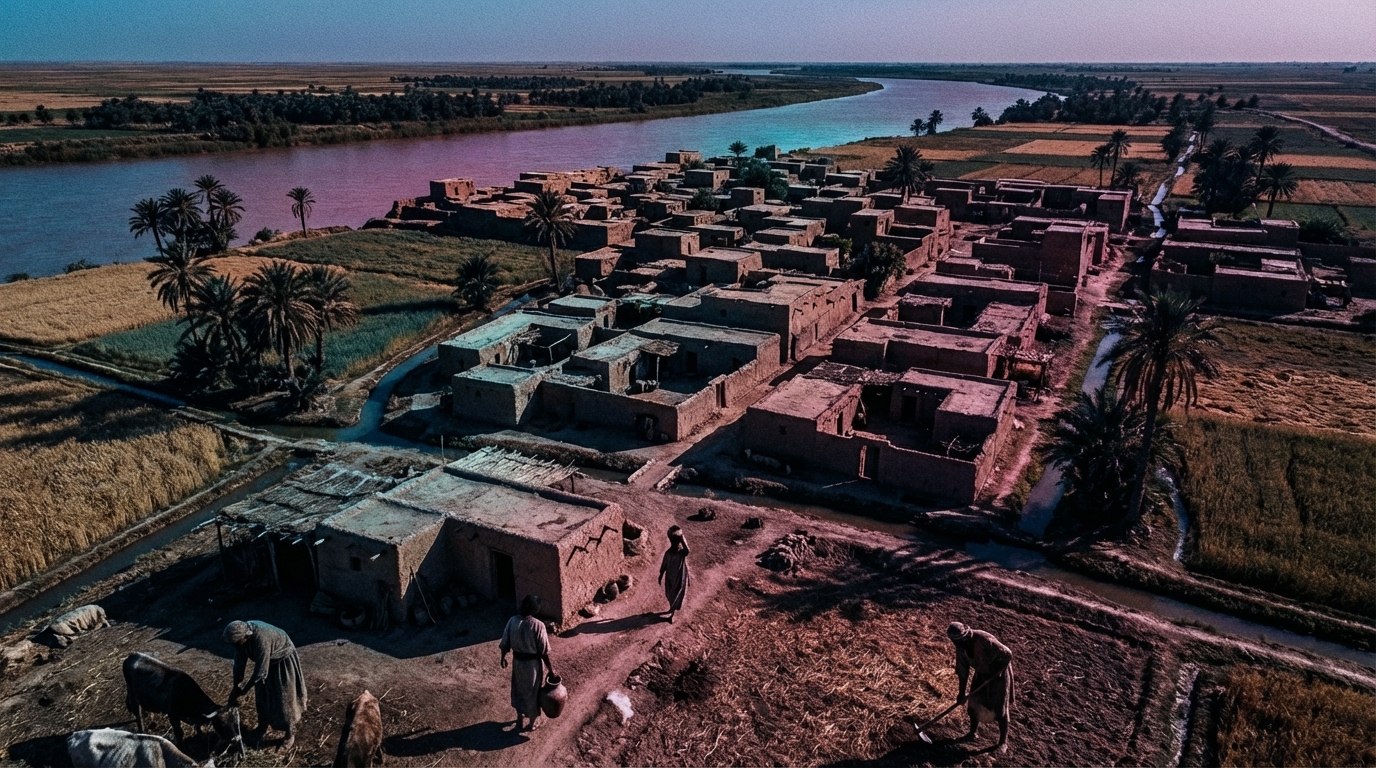
Geographic Location and Physical Setting
Amar-Sin occupied a modest elevation on the western bank of the Buranuna (Euphrates River), approximately 25 kilometres northwest of Ur in the region that would later become southern Iraq. The coordinates place it in territory that in 2510 BCE formed part of the Mesopotamian floodplain where the Buranuna's annual cycles dictated agricultural rhythms and settlement patterns.
The village's position on slightly elevated ground provided some protection from ordinary seasonal flooding whilst maintaining access to the river's water and fertile deposits. A natural levee created by centuries of silt accumulation gave Amar-Sin marginally better drainage than surrounding lowlands, though the catastrophic flood of 2496 BCE demonstrated that even this modest elevation couldn't withstand exceptional inundations.
The landscape around Amar-Sin was characteristically Mesopotamian—flat alluvial plain stretching toward distant horizons, interrupted only by irrigation channels, date palm groves, and the occasional low mound marking ancient settlements that had risen and fallen in cycles stretching back millennia. The sky dominated vision in ways that urban dwellers rarely experienced, making celestial observations—tracking Nanna's phases, noting Inanna's position, watching Shamash's daily journey—integral to daily life rather than abstract priestly knowledge.
Population and Social Structure (circa 2510 BCE)
Amar-Sin's population at Azariel's birth was approximately 300 people organised into roughly forty extended family households. This size was typical for secondary agricultural settlements in Ur's economic orbit—large enough to maintain necessary craft specialists and communal infrastructure, small enough that everyone knew everyone else's business with the thoroughness that characterised village life.
The social structure reflected broader Mesopotamian hierarchies whilst maintaining the relative egalitarianism characteristic of smaller settlements. At the top were several families with scribal connections to Ur's temple administration, including the Voshtar household through Tiberius's position. Below them were successful farmers who controlled larger plots and owned their own ploughs and oxen. The majority were smallholders working family plots supplemented by communal labour obligations. At the bottom were a handful of debt slaves working off obligations to creditors—not the chattel slavery that characterised Ur's construction projects, but temporary bondage that in theory could be escaped through debt repayment.
No palace or ziggurat dominated Amar-Sin's landscape. Authority resided in the village council—informal gathering of senior household heads who adjudicated disputes, organised communal projects, and liaised with Ur's officials regarding tribute obligations. Real power lay with those who controlled grain stores and irrigation access, making administrative position and agricultural success practically inseparable.
Economic Base and Relationship with Ur
Amar-Sin's economy centred on cereal agriculture—primarily barley, with some emmer wheat—supplemented by date cultivation, small-scale sheep and goat herding, and fishing from the Buranuna. The village's agricultural surplus, after accounting for seed grain and subsistence needs, flowed to Ur as tribute supporting the temple complex's personnel, building projects, and the bureaucratic apparatus that administered the city-state's territories.
This tributary relationship meant Amar-Sin existed within Ur's economic orbit without being directly controlled by it. Temple officials visited periodically to assess harvests and collect tribute, but day-to-day governance remained local. The arrangement provided stability—Ur's military might protected villages like Amar-Sin from raiders—whilst extracting resources that built ziggurats most villagers would never see and supported priests whose theological sophistication remained largely irrelevant to agricultural rhythms.
Beyond basic agriculture, Amar-Sin supported several craft specialists whose skills served both village needs and provided trade goods for exchange with Ur. Larya Voshtar's weaving represented the most prestigious craft—her geometric designs on ceremonial garments commanded prices that provided the Voshtar household with status beyond what Tiberius's scribal position alone would have granted. Other specialists included a potter whose vessels were traded throughout the region, a blacksmith who maintained agricultural implements and produced copper tools, and Kishar the midwife whose knowledge spanned forty years of delivering the village's next generation.
Religious Life and Ritual Practice
Amar-Sin's religious practice reflected the broader Mesopotamian pantheon whilst emphasising deities particularly relevant to agricultural existence. Nanna-Sīn, the moon god whose phases governed the calendar, received regular attention. Inanna, whose star rose bright in evening and morning sky, was invoked by women during pregnancy and childbirth. Shamash, the sun god, witnessed oaths and regulated justice. Enki, lord of fresh waters, received offerings during irrigation channel openings.
The village maintained a small shrine—nothing approaching Ur's magnificent temples, just a modest structure where offerings could be made and where travelling priests from Ur occasionally conducted more elaborate rituals. Most religious practice was domestic and practical: prayers for successful harvests, offerings at household altars, invocations of divine favour during childbirth or illness, curses against thieves and oath-breakers.
This religiosity was sincere but pragmatic. The gods were understood as powerful forces requiring proper propitiation but not necessarily benevolent. They could help or harm according to inscrutable divine whims that humans could influence through offerings and prayers but never fully control. When Larya named her newborn son Azariel—"helped by god"—the ambiguity about which god reflected standard theological vagueness. Divine assistance came from wherever it came from; one took what help one could get and didn't interrogate the source too closely.
Daily Life and Material Culture
Houses in Amar-Sin were constructed from mud brick—the ubiquitous building material in a region lacking stone or timber. Rectangular structures organised around small courtyards, with flat roofs providing sleeping space during summer's oppressive heat. Wealthier households like the Voshtars' might have multiple rooms and separate storage areas; poorer families made do with single-room structures where all activities occurred in minimal privacy.
The village's physical layout reflected functional necessity rather than planning. Houses clustered near the river where water access was easiest, with agricultural plots extending outward in irregular patterns determined by irrigation channel networks and historical land claims. Narrow lanes wound between structures just wide enough for a loaded donkey to pass. A communal threshing floor occupied central space where harvest processing occurred under collective supervision that prevented cheating on tribute obligations.
Material culture was modest but functional. Pottery vessels for storage and cooking, stone grinding implements for processing grain, copper and bronze tools for agricultural work, wooden ploughs pulled by oxen, fishing nets woven from flax, baskets of woven reeds for carrying produce. Wealthier households might possess luxury items—Larya's loom representing a significant capital investment, Tiberius's clay tablets and styluses marking scribal status, perhaps some bronze jewelry or decorative vessels traded from Ur.
Clothing was simple: linen tunics for both sexes, supplemented by woollen garments during cooler months. Bare feet were standard except for special occasions when reed sandals might be worn. Social distinction manifested more in textile quality and decoration than in garment type—the geometric patterns Larya wove into ceremonial cloth represented wealth and status that crude functional weaving could never achieve.
The Voshtar Household
The Voshtar family occupied a modest but respectable position in Amar-Sin's social hierarchy. Tiberius Zalik Voshtar's scribal work for Ur's temple administration provided regular income and status that literacy always commanded in a largely illiterate society. Larya Ehnar Voshtar's weaving skills generated additional income whilst demonstrating artistic capability that separated her work from ordinary textile production.
Their house stood on Amar-Sin's western edge—a deliberate choice reflecting Tiberius's preference for relative privacy and Larya's need for good light for weaving work. The structure included separate areas for sleeping, cooking, and storage, plus a courtyard where Larya's loom occupied prominent position. This spatial organisation reflected modest prosperity—not wealthy by Ur's standards, but comfortable by village measures.
The household expanded with the birth of three children: Azariel in 2510 BCE, Nialus in 2502 BCE, and Seliah in 2498 BCE. The twelve-year span between first and last child was typical for the period, though infant mortality meant many couples produced more births than surviving children. That all three Voshtar children survived infancy represented better-than-average luck, though Seliah's death at age five from fever would devastate the family and prove particularly formative for Azariel.
The Flood of 2496 BCE
In spring 2496 BCE, when Azariel was fourteen, the Buranuna experienced an exceptional flood that would become a defining memory for that generation. Unusually heavy upstream rains combined with rapid snowmelt created a surge that overwhelmed even Amar-Sin's elevated position. The disaster unfolded over several days as water rose inexorably, forcing evacuation to higher ground whilst the village watched their homes and fields disappear beneath muddy torrents.
The flood killed approximately thirty people in Amar-Sin—some drowning in the initial inundation, others dying from injuries sustained during evacuation or succumbing to infections in the chaotic aftermath when normal sanitation collapsed. Among the dead was Larya Voshtar, who sustained severe injuries whilst trying to salvage her loom and household possessions. She survived long enough to develop infections that Amar-Sin's limited medical knowledge couldn't treat, dying slowly whilst her family watched helplessly.
For Azariel, watching his mother's agonising death transformed abstract knowledge about nature's power into visceral conviction that humanity's submission to such cruelty was neither inevitable nor acceptable. His father Tiberius, left to raise three children alone, withdrew into stoic practicality that provided material stability but little emotional warmth. The household that had been moderately prosperous and emotionally intact became damaged and diminished, functioning adequately but never recovering the coherence it had possessed before the flood took Larya.
The village itself recovered over subsequent years. Mud brick walls were rebuilt, irrigation channels re-dug, fields replanted. Physical reconstruction proceeded with the resigned efficiency that characterised societies familiar with periodic disasters. But psychological scars remained—confidence in Amar-Sin's safety permanently shaken, awareness that elevation providing protection from ordinary floods couldn't withstand exceptional ones, understanding that the Buranuna that gave life could also take it with indifferent power.
Azariel's Departure (2493 BCE)
In autumn 2493 BCE, seven years after the flood and seven months after Seliah's death from fever, seventeen-year-old Azariel experienced his first contact with the Anunnaki Collective during an apparently routine census conducted by an Akkadian official named Enlil-shar-usur. The encounter occurred privately whilst Azariel assisted with record-keeping, the official's demeanour transforming to reveal geometries that shouldn't exist in three-dimensional space and knowledge that resonated with patterns Azariel had sensed but couldn't articulate.
Three months later, in early 2494 BCE, Azariel announced his intention to leave Amar-Sin. His father Tiberius, already devastated by the losses of Larya and Seliah, responded with angry incomprehension that his surviving son—the one who had demonstrated scribal aptitude that could have secured comfortable position in Ur's temple bureaucracy—was abandoning family, security, and sensible prospects to pursue some vague vision he couldn't adequately explain.
Arguments echoed through the Voshtar household for weeks. Azariel offered only certainty that he had to leave, had to follow the knowledge pressing against his consciousness toward purposes he didn't yet fully comprehend. Tiberius couldn't understand how his son could privilege abstract visions over concrete family obligations. Neither could bridge the gap between Tiberius's need for stability and Azariel's compulsion toward purpose neither fully understood.
In early winter 2494 BCE, Azariel departed before dawn, carrying basic supplies, his stylus case, and clay tablets. He left a message for his father expressing gratitude and regret, promising to return when he had something worth showing. He would never see Tiberius again. His father died in 2455 BCE whilst Azariel was immersed in building Fordingrad, the news reaching the Anḫu valley months too late for any reconciliation.
Amar-Sin's Continuing Story
After Azariel's departure, Amar-Sin continued its existence as a minor agricultural settlement in Ur's economic orbit. Tiberius remained in the village until his death in 2455 BCE, maintaining his scribal position whilst raising Nialus and managing household affairs with grim practicality. Nialus eventually became a trader between Ur and Lagash, moving away from Amar-Sin in his twenties. The Voshtar house was eventually occupied by other families as demographic changes constantly reshaped village composition.
The village itself persisted for several more generations before succumbing to one of the periodic collapses that characterised Mesopotamian settlement patterns—perhaps absorbed into expanding urban centrs, perhaps abandoned when irrigation systems failed or political turmoil disrupted agricultural rhythms, perhaps simply declining gradually as younger generations migrated toward urban opportunities that villages couldn't provide.
No archaeological evidence of Amar-Sin has yet been discovered by modern scholars. The coordinates provided place the village's likely location beneath modern agricultural development that has obliterated surface traces of the ancient settlement. If excavated, it would reveal the typical patterns of Early Bronze Age Mesopotamian village life: mud brick foundations, pottery sherds, grinding stones, perhaps clay tablets recording grain transactions, cemetery areas with burials in simple graves with minimal grave goods beyond pottery vessels and personal ornaments.
Historical Significance
Amar-Sin's significance lies entirely in its role as Azariel Tiberius Voshtar's birthplace and childhood home. Without that connection, it would be simply another forgotten agricultural village among hundreds that supported Mesopotamian urban civilisation's elaborate superstructure. The settlement itself possessed nothing particularly distinctive—typical size, typical economy, typical social organisation that characterised secondary settlements throughout the region.
But the experiences Azariel accumulated during his first seventeen years in Amar-Sin fundamentally shaped the vision he would eventually articulate in Ur's marketplace in 2470 BCE and implement in Fordingrad thereafter. Witnessing his mother's death in the flood convinced him that proper knowledge could prevent such tragedies. Growing up in a village hierarchy taught him how stratification limited human potential. Observing his father's scribal work showed him how literacy and record-keeping created power. Watching his mother weave demonstrated how disparate elements could combine into greater patterns.
The village also shaped what Azariel would ultimately reject. Amar-Sin's comfortable acceptance of tributary relationship with Ur, its pragmatic religious practices that propitiated gods without questioning divine justice, its social hierarchies that seemed natural because they'd always existed—all this represented a world Azariel would spend his adult life trying to transcend. The vision he developed wasn't built from abstract philosophy but from concrete observation of how villages like Amar-Sin functioned and the limitations those functions imposed on human flourishing.
When Azariel stood on that merchant's platform in Ur's marketplace on 28 July 2470 BCE and invited people to join him in building a city without slaves where knowledge would flow freely, he was offering the antithesis of everything Amar-Sin represented—not because the village was particularly oppressive by contemporary standards, but because it embodied ordinary hierarchies and ordinary limitations that Azariel had come to believe humanity could transcend if given proper knowledge and social organisation.
The small agricultural settlement on the western Buranuna where a scribe and weaver raised three children, where floods periodically demonstrated nature's power, where life proceeded according to rhythms established over millennia—this unremarkable village accidentally became the birthplace of the man who would found Fordingrad, whose vision would ultimately enable CLIVE's creation in 2320 BCE, whose impossible dream would establish Clivilius and echo through four millennia to present-day dimensional conflicts. Amar-Sin didn't know it was incubating revolution. It was simply a village where people lived and died according to patterns they thought would endure forever.







