4193.211 · July 30, 1873 AD
You Hide the River Inside the Flood
Miriam Ashcroft has attended dinners like this one before — in other cities, other decades, other candlelit rooms where carefully chosen people were about to discover that the world was considerably larger than they had been told. She has learned to read a table the way a good architect reads a building: structurally, from the foundation up, with professional respect for what will bear weight. These four, she decides by the soup course, will bear considerably more than they know.
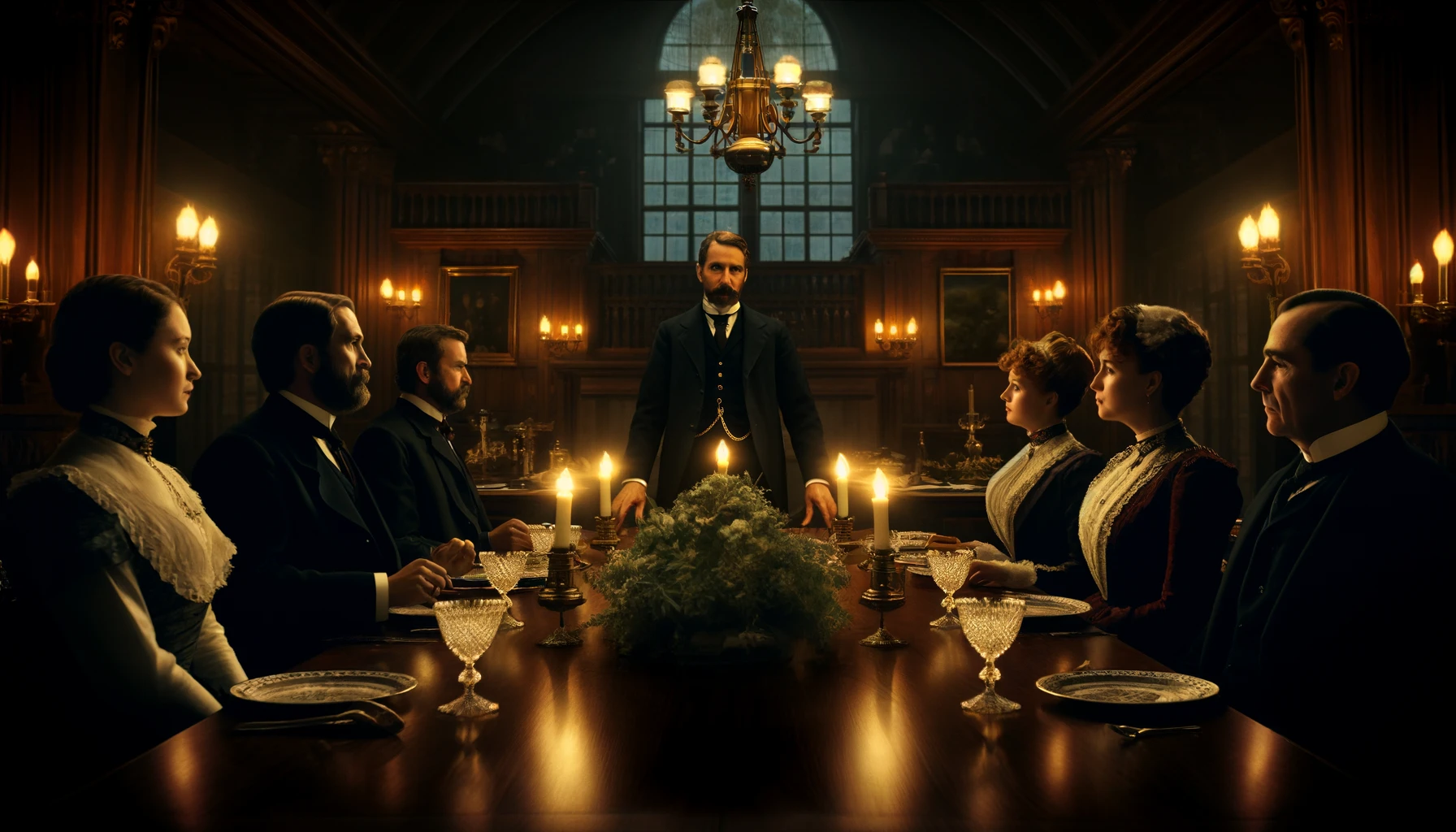
"A dinner table is a remarkably efficient instrument. In three hours it tells you everything a year of correspondence cannot." — Miriam Ashcroft
The east corridor was quiet.
Jameson moved through it at the end of the day's last round, past the three elevation studies in Charles Killerton's hand that had hung on that wall since before Francis was born. Through the dining room door at the far end of the house came the low, warm sound of voices — Mr Cartwright holding forth about something, Miss Stanton's response cutting across it, Mr Holloway's single contribution settling beneath both of them like a foundation stone finding its bed. Francis's voice underneath all of it, steady.
Jameson turned toward the library.
He was two paces from the door when the hair rose along his forearms. Along the back of his neck. The fine hairs at his wrists. He stopped walking. Stood quite still for a moment in the corridor with the evening light coming thin through the window at the far end, and the smell of Mrs Holt's lamb drifting up from the kitchen below, and the voices continuing behind the dining room door as though nothing had shifted in the air of the house at all.
He straightened his cuffs. Knocked once. Opened the door.
She was at the long table, her back to him, the Amulet in both hands. No coat. No gloves, no hat, no bag. She turned the Amulet once more, set it down among the other five with the care of someone returning a thing to its exact place, and turned to face him.
"Miss Ashcroft."
"Jameson." She looked at him in the way she had of looking — directly, without social preliminary, as though the introductory portion of most conversations was a formality she had long since decided not to perform. "How are they getting on?"
"Mr Cartwright has been making points," Jameson said. "Miss Stanton has been declining to accept them. Mr Holloway has been listening." He paused for one beat. "I've been holding the first course."
The corner of her mouth moved. "Then we shouldn't keep it waiting any longer."
He held the door. She preceded him into the corridor and he fell into step behind her, slightly to the left, the arrangement that the width of the corridor and the occasion required. She walked without hesitation — she had been in this house before, knew the route — and he watched her pace slow as they came level with the elevation studies on the wall. She stopped before the largest, the west façade at midday, Charles Killerton's line still precise after all the years the paper had been giving itself back to the wall.
"His father's work," Jameson said.
She looked at it a moment longer. "I know. I've encountered his drawings before." A pause. "In other contexts."
They continued to the entrance hall. The fanlight above the front door held the last of the July evening — the particular bronze light of a summer day finishing itself — and the lamps along the hall were already burning against its retreat. From somewhere beyond the tall windows the elm trees moved in the first breath of the evening air, their shadows shifting on the polished floor.
At the dining room door Jameson's hand found the frame. Inside, Mr Cartwright had arrived at his conclusion and was waiting, with some impatience, for it to be acknowledged. Miss Stanton was not acknowledging it. Mr Holloway said something that neither advanced nor retreated but simply stood, and the room briefly reorganised itself around it. Francis spoke, two sentences, and the temperature settled.
Jameson opened the door.
"Miss Ashcroft," he said.
The conversation stopped. The room turned. Francis rose. Mr Cartwright pushed back his chair. Mr Holloway turned in his seat with the full, unhurried attention he brought to everything he considered worth attending to. Miss Stanton turned last — not with the courtesy of a social introduction but with the direct, unguarded look of someone taking a measurement.
Through the open door, standing at the threshold, she heard the silence of the room receiving her. Four people, four different qualities of attention, and beneath them the smell of beeswax and candlewax and the last warmth of a summer evening soaked into old stone walls. Francis was crossing toward her. She read the room in the time it took him to do it.
Theodore: she had him in the first few seconds. The architectural confidence he wore without noticing he wore it. The wariness converting itself into professional courtesy at a rate that told her his respect was not given but demonstrated to. She moved past him and on.
Samuel: wrong. The files had given her a capable engineer with a conservative record and a reputation for structural precision. What was sitting in that chair was something the files had not prepared her for — a man occupying his exact ground with such completeness, such absence of surplus, that the quality of his attention felt almost physical across the room. She moved him considerably upward and noted, without sentiment, that the Order's intelligence had failed her.
Emily: still looking at her. Two people reading each other simultaneously across a dining room, neither dropping the gaze, neither softening it into courtesy. Something in Miriam recognised the symmetry of it before she had consciously registered what it was. She filed it as the most consequential thing the evening had yet produced and found, with mild surprise, that she approved of it entirely.
"Miss Ashcroft." Francis reached her, took her hand — warmth in it, and beneath the warmth a relief she doubted he knew he was showing. "I'm very glad you're here. May I introduce Mr Theodore Cartwright, Miss Emily Stanton, and Mr Samuel Holloway." The smallest pause, the pause of a man selecting his words carefully because the words were load-bearing. "Miss Ashcroft serves as legal advisor to the enterprise — and as a representative of interests that align closely with our own."
"That is one way of putting it," Miriam said pleasantly, and took her seat.
Behind her, Jameson gave William a single nod. The footman moved toward the kitchen door, and within two minutes the tureen was on the table — the kitchen announcing itself without fanfare — and the evening's first course was poured.
The room settled into the particular ease of a meal properly begun, the candlelight finding the silver and the crystal and the faces of five people who had not, until this evening, occupied the same room.
Miriam lifted her spoon.
Around her the conversation had resumed. Theodore had picked up whatever thread Jameson's announcement had interrupted, pressing it forward with the same momentum it had apparently carried before she arrived. Emily ate her soup without appearing to eat it, her attention on Theodore's words rather than her spoon. Samuel sat with both hands on the cloth, his eyes moving between the two of them and then back, and then between them again. Francis, at the head of the table, was watching Miriam. She returned her attention to her consommé.
The consommé was excellent. Clear and deep, the kind of broth that a kitchen produces when it has decided to take an occasion seriously — not the watery gesture of a household going through motions, but something that had been given time and attention and showed it. She noted it and moved on.
"The problem with the Harrison Street elevation," Theodore said, his spoon moving in small absent circles while his attention was elsewhere entirely, "is that whoever specified the window spacing had never stood on the pavement and looked at it. It reads as arbitrary from the street. There's no logic the eye can follow."
"The logic is interior," Emily said. She had not looked up from her bowl. "The spacing follows the floor plan, not the façade. Whoever specified it was working from the inside out."
Theodore's spoon stopped. "That's not a defence."
"It isn't meant to be. I said it was the logic, not that the logic was correct." She lifted her gaze to his for the first time in the exchange, briefly and directly, then returned to her soup. "The building knows what it is. It simply doesn't care whether you can read it from the pavement."
A silence of perhaps three seconds, which in a dinner table conversation was long enough to mean something.
"That," Theodore said, "is either a very sophisticated observation or a very elegant excuse for poor draughtsmanship, and I'm not yet certain which."
"Give it some thought," Emily said pleasantly. "There's no hurry."
Samuel picked up his spoon for the first time since the soup had been poured. He did not look at either of them. He looked at his bowl, and something in the angle of his head suggested he had just filed something away in a place he intended to return to.
Francis, at the end of the table, caught Miriam's eye for a fraction of a second. She returned her attention to her consommé.
The room had found its temperature before she arrived — she had heard it through the door, felt the shift in it when Jameson spoke her name. Theodore and Emily had been at this for the better part of an hour, she could tell — the ease with which they picked up their positions after her entrance, the slight compression of Emily's response that suggested it had been redirected rather than begun. Between them, Samuel sat with his hands on the cloth and his eyes moving from one to the other and back, unhurried, saying nothing. At the head of the table Francis caught her eye for a moment, then looked away. He had been holding the room together all evening. She could see it in the set of his shoulders.
"Miss Ashcroft." Theodore set his spoon down and turned to her. "Francis tells us you've been involved with the enterprise from its earliest stages. In what capacity, prior to the legal work?"
Miriam set her spoon down. "In the capacity of someone who understood what the enterprise was before it had a name," she said, "and who has been working to ensure that what it becomes is adequate to what it needs to be."
Theodore set his spoon down. "That's a rather broad answer."
"It's a rather broad capacity."
Emily looked up from her bowl. Not at Miriam — at the space between Miriam and Theodore, as though she were reading the geometry of the exchange rather than its content. Then she looked at Miriam directly. "You're not from Boston."
"No."
"The accent is — I can't place it."
"Most people can't." Miriam lifted her wine glass. "My father was English. My mother was Viennese. I was educated in Paris. I have lived in London, Vienna, and Boston, in that order, for long enough in each city to have absorbed something of it." She set the glass down. "The result is an accent that belongs entirely to no one place, which I have found, over the years, to be more useful than belonging entirely to one."
Emily considered this for a moment. "Useful how?"
"People spend less time deciding what category I fit into," Miriam said, "and more time listening to what I say."
The table received this in its various ways. Theodore with a slight inclination of his head that suggested, without committing to, the acknowledgement of a point. Samuel with the small, contained shift of expression that she was beginning to understand was his most unreserved form of approval. Francis with the look of a man watching something he had arranged go exactly as he had arranged it and feeling, despite himself, the particular pleasure of that.
From the edge of the room Jameson moved to the sideboard to check the bread, confirmed it needed no attention, and moved back. None of the four noticed. Miriam did.
"I studied in Paris," she continued, addressing the table generally, which was to say addressing Theodore, since he was the one whose professional formation the observation was most likely to engage. "The École des Beaux-Arts. In 1847."
Theodore looked at her. "They admitted women in 1847?"
"They did not, as a rule," Miriam said. "I was not, as a rule, easy to decline."
Theodore laughed — short, genuine, surprised out of him. It moved around the table, and the room was warmer for it.
"I know Ferstel's work," Emily said, into the ease that followed. "The Votivkirche. The University building. I didn't know he had written on the colonnade question specifically."
"He hadn't, in print," Miriam said. "It was a conversation. In his studio, in 1856, on an evening not entirely unlike this one — a group of people who had been thinking hard about the same problems from different angles and had decided to eat dinner together and see what happened." She turned her glass on the cloth. "He was arguing against a colleague who believed that a building's relationship to the street was its primary obligation. Ferstel's position was that the building's obligation was to the full range of the human experience of it — which included the street, but was not exhausted by it. The colleague was unconvinced. I have always thought Ferstel was right."
Emily set her spoon down. "The full range of the human experience of a building," she said. "That's a considerable scope."
"It is. It includes things that current architectural practice doesn't typically account for." Miriam held Emily's gaze. "Things that the enterprise Francis is proposing will need to account for. Which is part of why I'm here."
The dining room settled into a moment of stillness — the candles, the silver, the smell of the consommé and beneath it the first thread of the lamb beginning to find its way up from the kitchen. Somewhere beyond the windows the elm trees shifted in the evening air. Samuel had his hands flat on the cloth on either side of his bowl, and he was looking at Miriam with the full weight of his attention.
"The interests you represent," he said. "The ones that align closely with the enterprise. What are they, specifically?"
Francis drew breath at the head of the table. Miriam did not look at him.
"Mr Holloway," she said, "I will tell you everything you need to know, and I will tell it to you tonight. But I think it will land better after the lamb than before it." She picked up her spoon, finished the last of the consommé, and set it down cleanly. "Mrs Holt's kitchen deserves our full attention while it has it.
Samuel looked at her for a moment. Then he looked at his bowl, and then he picked up his own spoon and finished his soup, and said nothing further, and the dining room held its breath and continued.
William came for the soup bowls with the timing of someone who had been watching the table from the doorway and had judged the moment correctly. Agnes followed with the bread plates, her eyes at the middle distance. The sole arrived — two fillets apiece, dressed simply with butter and a few capers, the kitchen making no argument about what it was — and the room shifted with it, the way rooms shift when a meal moves from its opening to its body and the people in it feel, without remarking on it, that the evening has properly begun.
Samuel set his fork down almost before it had reached the table and turned to Theodore. "You worked on the Meridian Street warehouse conversion. The reinforced foundation work in the east wing."
Theodore looked up with something new in his face. "Three years ago. You know it?"
"I examined the drainage when the owners were considering the loading bay extension. The gravel bed sequence — I went back twice to look at it." Samuel picked up his fork, turned it once, set it down again. "I wanted to know whether it was deliberate."
"Entirely deliberate." Something settled in Theodore's expression — quiet and satisfied, the expression of a craftsman who has been waiting three years for a specific person to notice a specific thing. "The conventional specification would have given them standing water within five years. My sequence cost eleven additional days on site and approximately forty dollars more in materials."
"The client objected," Samuel said.
"Strenuously."
"They always do."
It lasted perhaps four seconds — that brief, warm current that ran between them across the table — and then it was done, filed, and the conversation continued. But it had happened, and the room had a slightly different quality afterward, the way a room does when two people in it have quietly confirmed something about each other that will not need to be confirmed again.
Emily had been eating her sole with her attention elsewhere. She set her fork down and looked at Samuel directly. "The Wentworth and Clarke site on Milk Street — the new counting house. They've specified cast iron columns for the internal load bearing. What's your reading of the foundation depth relative to the column spacing?"
Theodore's fork stopped moving. He looked at her.
Samuel, for his part, did not look surprised. He looked at his plate for a moment, then back at her. "Insufficient, if they're running the columns at the spacing I saw on the elevation. They'll need another eighteen inches on the north-east corner at minimum, possibly two feet — the water table on that block runs shallow. Has the clerk of works been on site?"
"Every Tuesday," Emily said. "He hasn't raised it."
"He will," Samuel said, "when the ground settles in autumn." He picked up his fork. "Who's the engineer of record?"
"Parsons and Webb."
Samuel made no comment. He returned to his fish, but something had shifted in the angle of his attention toward Emily — a small, quiet recalibration, there and then gone, that Miriam noted.
"The counting house on Milk Street," Theodore said. He set his fork down and was quiet for a moment. "I've seen the elevation drawings. The column spacing is —" He stopped. Looked at Emily. "How do you know the foundation depth?"
"I asked Connelly to pace the excavation when they were digging last month," Emily said. "He knows how to read a dig."
Theodore set his fork down entirely. He appeared to be revising something at some speed.
Miriam lifted her wine glass. "There is a counting house on the Ringstrasse," she said, to the table generally, though she let her eyes rest briefly on Theodore as she said it, "completed in 1861. Ferstel's office, though not one of his major works — a commission he took to keep two good draftsmen employed through a quiet year. The foundation work is unremarkable. What is not unremarkable is the internal column arrangement — he ran the load path through the building's core rather than its perimeter, which at the time was considered either very advanced or very eccentric depending on who you asked." She set the glass down. "The building has settled less than two millimetres in fifteen years. The neighbouring building, conventionally specified, has settled nine."
The table received this. Theodore had his wine glass in his hand but was not drinking from it. Samuel had gone still in the way he went still when something had arrived that he intended to examine fully before he responded to it. Emily was looking at Miriam with the same quality of direct attention she had brought to the moment of introduction, and there was something else in it now — a slight tightening of focus, the look of someone adjusting the aperture on something they want to see more clearly.
Nobody asked how she knew the settlement figures for a building in Vienna. Nobody asked what she had been doing on the Ringstrasse in 1861, or how she came to know Ferstel's office from the inside. The questions were there — Miriam could see them, sitting just behind the professional courtesy of the table — but not one of the four reached for them, and the conversation moved on, and the sole continued to be eaten, and Jameson appeared briefly at the sideboard to check the decanter levels and disappeared again, and the evening's body continued to find its shape around the things that had just been quietly established and not remarked upon.
Francis set his wine glass down and looked around the table. "The Boston building programme," he said. "The scale of what is being planned over the next decade. I'd be interested in each of your readings of it — where the real opportunities are, and where the real problems are likely to emerge."
"The Back Bay," Theodore said, and pushed his wine glass aside to make room for his elbows on the table. "The landfill lots. Everyone is looking at the architecture — the façades, the streetscape — and nobody is asking hard enough questions about what those buildings are sitting on. You are building on made ground. Made ground that is still settling. The foundations going in on Marlborough Street right now are going to be someone else's problem in twenty years, and the someone else is going to be us — the next generation of engineers and architects trying to correct what is being done wrong today because it was cheaper to do it wrong today."
"The labour question," Emily said. She had finished her sole and set her cutlery together with the neat precision she brought to everything. "The building boom is creating an enormous demand for skilled tradesmen that the city cannot supply from its existing workforce. What is coming in to fill that gap is undertrained and overworked, and the pressure from clients to move fast and move cheap is producing conditions on sites that no one with a conscience should be comfortable with." She paused. "That is also going to be someone else's problem. Except the someone else in that case is the men doing the work."
A silence settled. Not uncomfortable — the silence of a table that has just been given something real to sit with. Samuel turned his glass on the cloth and said nothing for a moment.
"The material supply chains," he said finally. "The iron foundries cannot keep pace with demand. What is arriving on site is inconsistent — batch variations that wouldn't pass specification in a slower market, passing because the inspectors are stretched and the contractors are behind schedule." He looked at Francis. "The buildings going up in this city right now are not all the buildings they appear to be on paper. Some of them will stand for a century. Some of them will not stand for thirty years." He picked up his glass. "That is the problem nobody is saying aloud in any room I have sat in. Until this one."
Francis looked down the table at Miriam.
She lifted her own glass and said nothing, and let the weight of what Samuel had just placed on the table settle fully before the lamb arrived to carry them forward.
William came for the fish plates with Agnes behind him, and the table was briefly its own surface again before the lamb arrived. It came up from the kitchen on a wide platter — a dressed rack, the bones clean and white, rosemary tucked into the joints — and the smell of it filled the room before William had cleared the doorway. Mrs Holt had been feeding this house for twenty-two years and she understood, without being told, that this was not an evening for flourishes. The lamb was simply itself, and it was enough.
The business of serving settled the room. The platter went round, the gravy followed, Agnes set the bread sauce at the table's centre and withdrew. For a few minutes the conversation gave way to the agreeable sounds of a meal being attended to by people who were hungry and knew it, and the candles burned at their evening height, and outside the tall windows the elm trees moved in the warm July dark.
Francis waited until the first cuts had been made. Then he set his knife across the rim of his plate and looked at the table.
"I want to tell you something about the work," he said. "Not the public account. The thing beneath it."
Nobody reached for their cutlery. The dining room held the sentence, and the elm trees moved outside, and the candlelight shifted across four faces that had been waiting, without quite knowing it, for exactly this.
"The construction philosophy is real," Francis said. "Everything I described in our individual conversations — the building techniques, the sustainable principles, the integration of ancient and modern practice — all of it is genuine and all of it will define what Killerton Enterprises does publicly. I want to be clear about that. What I am about to tell you sits beneath that work, not instead of it." He paused. "When I was in Mesopotamia, I encountered something. Not in the archaeological record — not in anything the expedition's official account will ever contain. Something that has no adequate name in the professional vocabulary of any of us, and which I have spent the better part of this year attempting to understand." Another pause, shorter. "I have not been attempting to understand it alone."
He looked at Miriam.
The table looked at Miriam.
She set her wine glass down and looked back at them. Four faces, four different qualities of readiness — Theodore with his elbows already on the table, Samuel with his hands flat on the cloth, Emily with her wine glass still raised and forgotten, Francis watching from the head of the table with the expression of a man who has lit a fuse and is now waiting. The composure she held was not performance. It was simply what twenty years of this particular work had produced in her, and she let it do its job.
"There is an organisation," she said, "called the Guardian Order. It has existed, in various forms, for considerably longer than this republic. Longer than most of the institutions any of you encountered in your education. Its purpose, stated simply, is the protection of certain knowledge and certain — interests — that the ordinary course of history tends, left to itself, to destroy or suppress." She let that settle for a moment. "I am a member of that Order. My role with this enterprise is not limited to its legal architecture. I am here because what Francis encountered in Mesopotamia, and what he brought back from it, is of direct significance to the Order's work. And because the infrastructure he is proposing to build is well suited to what the Order currently requires."
Theodore had both elbows on the table. "What did he bring back?"
"Six objects," Francis said. "Found in a sealed chamber below the main excavation. Objects that had survived in a condition that had no business being possible. Our team's archaeologist catalogued them as ritual items and moved on, because ritual items was the only category available to him that didn't require him to ask questions he wasn't equipped to answer." He looked at his plate for a moment. "I asked them."
"And what did they answer?" Emily said.
Francis looked at Miriam.
"The objects are — connective," Miriam said, choosing the word with care. "They are connected to something larger than their physical form suggests. To a body of knowledge, and to a body of — activity — that has been ongoing for a very long time, in ways and in places that do not appear in any map or any record accessible to conventional scholarship." She looked at each of them in turn. "The Guardian Order exists, in part, to protect that activity. To ensure that the people engaged in it have what they need. Resources. Infrastructure. Legitimacy. A reason to exist in the world that the world accepts without question." She picked up her wine glass, turned it once. "That is what Killerton Enterprises will provide. Publicly it will be exactly what Francis described — a revolutionary construction company, genuinely innovative, genuinely excellent, a credit to every person at this table. And beneath that surface it will serve purposes that most of its workforce, most of its clients, and most of the world will never know about."
The dining room was very quiet. The lamb sat on its platter at the table's centre, largely forgotten. Agnes appeared briefly at the door, read the room, and withdrew without a sound.
It was Samuel who broke the silence, in the way Samuel broke silences — without drama, without preamble, placing his words the way he placed everything. "These purposes," he said. "The things the company will serve beneath the surface. Are they lawful?"
"By the laws of this country, yes," Miriam said. "By the laws of conventional morality, yes. By the laws of" — she paused, and what passed across her face in that pause was brief and not entirely legible — "other frameworks, the question is more complicated. But nothing that will be asked of anyone at this table will require them to act against their conscience or against the law of this land."
Samuel looked at her for a long moment. "You said other frameworks."
"I did."
"What does that mean?"
Miriam set her glass down. "Mr Holloway, I will answer that question. Not entirely tonight, because some of what the answer contains requires a degree of trust between us that one evening cannot establish, however well it has gone." She held his gaze directly. "What I will tell you tonight is that the world is larger than what is visible from where we are sitting. Considerably larger. And that the Guardian Order has been operating in the full extent of that larger world for a very long time. And that the people at this table are being asked to build something that serves not only the Boston of 1873 but something that extends — in ways I will explain in time, with your patience — considerably beyond it."
Theodore had gone quiet. He was looking at the drawings spread between the candelabras — the concealed chambers woven into structural plans for buildings not yet built — and then he looked up at Francis.
"The hidden spaces in the buildings," he said. "They're not just for the objects."
"No," Francis said.
"They're for people."
"Among other things. Yes."
Theodore sat with this. "People who need to move without being seen."
"People who need resources, and shelter, and access to certain things, and the cover of a legitimate operation," Francis said. "People who are doing work that matters and who cannot do it openly."
"Guardians," Emily said quietly. It was not quite a question.
"Yes," Miriam said.
Emily looked at the drawings for a long moment. Then she looked at Miriam. "And the lead architect needs to design spaces adequate to that. Not just structurally. Functionally. Spaces that work for the people who will use them, that protect them, that give them what they need."
"Yes," Miriam said. "Which is why" —
"Which is why the lead architect needs to know everything," Emily said. "Yes. I understand." She picked up her wine glass. "Then you had better make certain you have the right one."
Something moved around the table — not quite laughter, but warmer than silence, the breath of a room that has been handed a moment of relief in the middle of something heavy and has taken it gratefully.
"The financial projections," Samuel said. He had not touched his lamb since Francis began speaking. "The capital requirements for the construction programme. Those figures covered the public work."
"Yes," Francis said.
"The covert infrastructure has additional requirements."
"It does. The full scope depends on the buildings that contain it, and those buildings don't yet exist."
"Which depends on the design," Samuel said. "Which depends on the architect knowing everything." He glanced at Emily. Something passed between them — brief and dry and entirely mutual.
"The materials," Samuel continued, his attention back on Francis. "The supply chains for the hidden spaces. The sourcing of whatever the — the Guardians — require. That needs to be managed so that it's invisible inside the legitimate procurement. No separate accounts, no separate suppliers that can be traced. Everything moves through the public company."
"Yes," Francis said, and looked at Samuel. "Exactly that."
"Then the financial architecture of the enterprise is more complex than what you showed me at the site." Samuel cut a piece of lamb and ate it. "I'll need to see the full picture before I put anything in writing. But the structural logic of it is sound. You hide the river inside the flood."
Miriam looked at him. He had arrived at that formulation himself, from first principles, in the course of a single dinner. She revised him upward for the third time that evening and wondered, not for the first time, what the Order had been doing spending its intelligence resources on anyone else.
Jameson moved to the table without a word, the decanter in hand, refilling each glass in turn — Theodore's first, then Samuel's, then Emily's, then Francis's, a fractional pause before Miriam's, then hers — and withdrew to the sideboard and was still, and nobody at the table looked at him, and Miriam, without turning her head, watched him complete the round and return to his place and stand there in the warm edge of the candlelight with his hands at his sides and his attention, quiet and complete, on the room.
Theodore pulled one of the drawings toward him across the cloth and looked at it in the candlelight — the concealed chambers, the load-bearing hidden spaces, the structural logic of buildings designed to be two things at once.
"I have several hundred questions," he said.
"You will have time for all of them," Miriam said.
He lifted his glass. "I appear to be in."
"As am I," Emily said. Simply, without ceremony, in the tone of someone for whom the decision had been made some time before this moment and this was merely the stating of it aloud.
Samuel looked down the table at Francis. Francis looked back and waited. The candles burned. The elm trees moved in the dark beyond the windows.
"I'll review the documents," Samuel said. "And then yes."
Miriam reached for her wine glass and drank, and said nothing, and the dining room held the particular quality of a room in which something has just been decided that cannot be undecided, and knew it.
Agnes came to clear the lamb with William behind her, and the table was returned to its linen and its candles and the drawings still spread between them, and Jameson brought the syllabub from the sideboard — four glasses, pale and cool, with the small shortbread biscuits that Mrs Holt produced as though they required no effort and which Miriam, who had eaten in a great many houses across two continents, understood required considerable effort. The port came round. The candles had burned to their late-evening height, the shadows on the mahogany deeper and warmer than they had been at the start, and the dining room had acquired the particular quality of a room that has been well used and knows it.
Theodore looked at his syllabub as though he had forgotten that dessert was a thing that happened.
"The organisation," he said. "The Guardian Order. How many members?"
"Enough," Miriam said.
"That's not an answer."
"It's the answer I'm giving you this evening." She lifted her port glass. "You'll find, Mr Cartwright, that some questions about the Order have precise answers and some have answers that depend entirely on what you intend to do with the information. The size of the membership falls into the second category."
Theodore picked up his syllabub spoon, tasted it, and set it down. "Fair enough," he said, and pushed his wine glass aside to make room for his elbows on the table.
Emily had both hands around her port glass and was looking at the drawing nearest to her — the floor plan with the concealed circulation route running beneath the visible one, the hidden stair that was also a load-bearing element. "The Guardians who will use these spaces," she said. "How do they move between buildings? The hidden infrastructure only works if the network is connected."
"That," Miriam said, "is an excellent question and one that will shape the design of every building in the programme from the foundation up." She looked at Emily directly. "The answer requires a conversation that goes rather beyond what this table is ready for tonight. But the fact that you have asked it tells me everything I need to know about whether you are the right person to be designing those buildings."
Emily considered this. "You're going to tell me something that I'm not going to have an adequate framework for."
"Almost certainly."
"And you're going to ask me to proceed on the basis of incomplete information until I do."
"For a short time. Yes."
Emily looked at her port. Then she looked at Miriam. "How short?"
"Short enough," Miriam said, "that the question will seem, in retrospect, considerably less alarming than it does right now."
Emily turned her glass once on the cloth. "That is either reassuring or entirely meaningless."
"Give it some thought," Miriam said pleasantly. "There's no hurry."
Theodore made a sound that was not quite a laugh but was in the same neighbourhood, and Samuel, who had been attending to his port with focused patience, looked up.
"Miss Ashcroft," he said. "The Order's operations — the resources, the supply chains, the infrastructure. Who funds it?"
"The Order funds itself," Miriam said. "Through the enterprises it sustains and through the returns those enterprises generate over time. Killerton Enterprises will be one such enterprise. It will not be the only one."
"And the returns flow back to the Order."
"A portion. The public company operates as a public company — its investors receive what they are entitled to receive, its workforce is paid what it is owed, its accounts are kept to the standard the law requires and then some. The Order's portion comes from the covert operations, not the public ones, and it is managed through channels that are entirely separate from anything that would appear in Killerton's books."
Samuel was quiet for a moment. Outside the tall windows the elm trees moved in the warm dark, and the candles threw their late light across the cloth, and the syllabub glasses sat in their varying states of attention.
"You've done this before," Samuel said. "This specific arrangement. A public company, a hidden operation inside it."
"Yes," Miriam said.
"More than once."
"Several times. In several countries. Over a considerable period."
"And those arrangements — are they still operating?"
Miriam set her port glass down. "Some of them," she said, "have been operating for longer than this country has existed."
The dining room held this for a moment. Theodore had stopped eating his syllabub. Agnes appeared at the door, took one look at the table, and withdrew without entering — the third time she had done this in the past hour, and Miriam had noted each one.
Francis set his wine glass down and looked around the table.
"I want to be clear about what I'm asking of each of you," he said. He looked at Theodore, at Emily, at Samuel, each in turn. "The public work is real and it is significant and it will stand on its own. The buildings we design and build will be genuinely excellent — they will be the best work of everyone at this table, done to the highest standard, with full professional integrity. That is not a cover. That is not a performance. That is what Killerton Enterprises is." He paused. "The other thing — the deeper thing — sits inside that work. It does not replace it or diminish it. It gives it a second purpose that none of the world will know about, and that you will carry alongside the first purpose for as long as you are part of this enterprise." He looked at his port glass. "I am not asking you to compromise your professional lives. I am asking you to use them for something larger than you knew when you arrived this evening."
The room was very still.
Theodore picked up his syllabub spoon, looked at it, set it down again. "The buildings I design," he said slowly, "will outlast everyone at this table. Probably by a century or more." He looked at the drawings. "The hidden spaces inside them — the people who use them, the things they protect — those will still be there."
"Yes," Francis said.
Theodore sat with this. Then he looked at the drawings.
"Then they had better," he said, "be exceptionally well built."
Emily's mouth curved. It was the first time all evening that her face had done something that was not entirely composed, and it lasted perhaps two seconds, and then it was gone, and she was herself again, her port glass in both hands, her attention on the drawings.
"Mr Holloway," she said, without looking up. "The financial architecture. You said you hide the river inside the flood. How do you account for the flood when it rains?"
Samuel looked at her. "You mean how do we handle excess — when the covert operations generate more resource than the public accounts can absorb without attracting attention."
"Yes."
"You move it upstream," Samuel said. "New projects. Capital expenditure on the next building. Equipment procurement brought forward. A careful reading of the accounts will show a company that is very busy and very ambitious and spending heavily on its own future." He picked up his port. "Which will be entirely accurate."
Emily nodded, satisfied. She ate a shortbread biscuit. Then she looked at Miriam.
"All right," she said. "Tell me about the hidden circulation between buildings."
"Not tonight," Miriam said.
"Tomorrow, then."
Miriam looked at her across the candles and the drawings and the late-evening warmth of a dining room that had become, over the course of several hours, a different kind of room than it had been at the start.
"Tomorrow," she said.
The decanters went round again. The syllabub glasses were mostly empty. The shortbread biscuits had been attended to — all except the two that remained in their arrangement at the centre of the cloth, which Miriam thought Mrs Holt would find diplomatically complex in the morning. The candles had burned to their lowest comfortable height, the shadows long and warm on the mahogany, and outside the windows the July night pressed its full summer darkness against the glass.
Francis looked around the table at these four people who had arrived as individuals and were leaving as something else — not yet a team, not yet fully formed, but pointed in the same direction with the particular quality of people who have chosen a direction rather than been assigned one.
The decanters had made their last round when Francis set his glass down and rose, and the table rose with him in the natural way of a long evening that has reached its conclusion without anyone needing to announce it. Chairs pushed back, napkins set aside, the small collective stirring of five people who have been seated for several hours and feel the standing as a relief. William appeared with coats, Agnes behind him, and the dining room acquired the particular warmth of an occasion ending well — voices overlapping, the business of departure, Theodore already talking to Francis about the drawings he wanted to take away and study, Samuel pulling on his coat with the unhurried efficiency he brought to everything.
Miriam remained at the table for a moment, her port glass in her hand, and watched them move toward the door.
Theodore shook her hand across the back of a chair — brief, firm — and looked at her.
"Miss Ashcroft," he said.
"Mr Cartwright," she said.
He held her gaze for a moment, then turned for the door.
Samuel paused beside her chair, his coat already on. "I'll give you my answer tomorrow," he said. Then he picked up his port glass, finished what remained in it, and set it down on the cloth with the same deliberate care he brought to everything, and walked to the door.
Emily was last. She had the drawing she had been studying rolled loosely in one hand, taken without asking and not challenged, and she came level with Miriam's chair and stopped. They looked at each other. The drawing hung between them, a loose cylinder of paper containing the hidden circulation routes and the concealed spaces and the dual logic of buildings not yet built, and both of them knew what it meant that Emily was taking it home.
Neither of them said anything. Emily gave the smallest nod — not social, not deferential, something more like the acknowledgement between two people who have recognised something in each other that will need to be properly examined when there is more time and more privacy — and then she was at the door with the others, and Jameson was there with her coat, and Francis was seeing them out into the summer night.
The voices carried back through the open door — Theodore's already turning architectural, gesturing at something about the manor's east elevation as he crossed the gravel, Samuel's brief responses, Emily saying something that made Francis laugh. Then the sound of footsteps diminishing, and carriages, and the elm trees closing over the drive, and the front door pulled shut, and the manor settling back into the warm quiet of a house that has just finished something significant.
The dining room breathed.
The candles burned at their last inch. The drawings lay across the mahogany, the decanters half-empty, the two shortbread biscuits that nobody had eaten still at the cloth's centre, patient and untouched. Miriam set her port glass down and looked at the room — at the artefacts on the sideboard that she had been examining when Jameson opened the library door, at the drawings that Emily had taken one of and left the rest, at the particular quality of a room that has held something and is now holding its memory of it.
Jameson came back through the door.
He moved to the sideboard first — the natural order of things, the clearing that the end of an evening required. The syllabub glasses were gathered onto the tray, the port decanter stoppered, the bread sauce dish lifted and set aside. The drawings he left where they were. That was not his to decide.
Miriam had not moved from her chair. She sat with both hands flat on the cloth in front of her, looking ahead with the particular quality of attention she had brought to everything all evening — complete, unhurried, giving nothing away. Jameson worked around the table's edges and said nothing, and she said nothing, and the dining room held its late warmth around them both.
He was reaching for the nearest candlestick when she spoke.
"You managed this evening very well, Jameson."
He set the candlestick back. "The kitchen deserves the credit. Mrs Holt's lamb was excellent."
"It was," Miriam said. "That isn't what I meant."
He looked at her across the table. She looked back at him with the same directness she had brought to every exchange of the evening, and the candlelight moved between them, and outside the elm trees shifted in the summer dark.
"No," he said. "I expect it isn't."
She rose from the chair — unhurried, entirely composed. She straightened the drawing nearest to her on the table, aligning it with the edge of the mahogany with the same care she had used to set the Amulet down in the library. Then she reached into the inner pocket of her jacket and produced the device.
Jameson went still.
It was smaller than he had imagined, in the moments across the past several months when he had imagined it at all — no larger than a pen case, heavier-looking than its size suggested, its surface carrying a quality that was neither metal nor wood nor anything else he had a name for. She held it without ceremony, the way she held everything, as though its weight were simply its weight and nothing more required to be made of it.
She pressed the button.
The orb that leapt from it was small — no larger than a marble, brilliant in a way that had nothing to do with the candlelight it briefly eclipsed — and it crossed the room with a purpose that made the word travel feel entirely inadequate. It struck the dining room wall between the two tall windows and did not bounce and did not mark the plaster and did not do anything that an object striking a wall in a Boston dining room in 1873 ought to have done.
Instead the wall opened.
There was no other word for it. The colours came as they came — sapphire first, then the deep liquid green, then the crimson threading through both of them, and the gold running beneath everything like a current beneath a river's surface — and they moved the way no light Jameson had ever seen moved, breathing rather than shining, alive in a way that made the candlelight behind him feel suddenly very small and very still. They filled the space between the windows completely. They were — he would not find the word for several days, and when he found it he would feel it was insufficient — they were patient. As though they had been here before. As though the wall was simply where they lived when they were not being looked at.
Miriam turned back to him.
She looked at him for a moment across the half-cleared table — the decanters and the drawings and the two shortbread biscuits still in their arrangement on the cloth — and what was in her face was not warmth exactly, and not the professional acknowledgement she had offered Theodore and Samuel at the door. It was something more considered than either. The look of a woman who has been assessing a room all evening and is, at the last moment, offering her final assessment to the one person in it she had not been required to assess.
"There will be evenings like this one again," she said. "More of them than you may currently anticipate." A pause, brief and deliberate. "You should know that your presence in this house is not incidental to what is being built here."
Then she turned, and stepped through, and was gone.
The colours held for a moment — sapphire and emerald and crimson and gold, breathing against the wall between the windows, entirely wrong for a Boston dining room and entirely themselves — and then they folded inward, quickly and completely, the way a flame folds when a hand passes over it, and the wall was a wall, and the plaster was unmarked, and the summer dark pressed unchanged against the glass of the tall windows.
The candles burned.
Jameson stood in the quiet room for a moment. Then he reached for the nearest candlestick, carried it to the sideboard, and began to extinguish the remaining lights one by one.







