4128.62 · March 2, 1808 AD
Without Looking Back
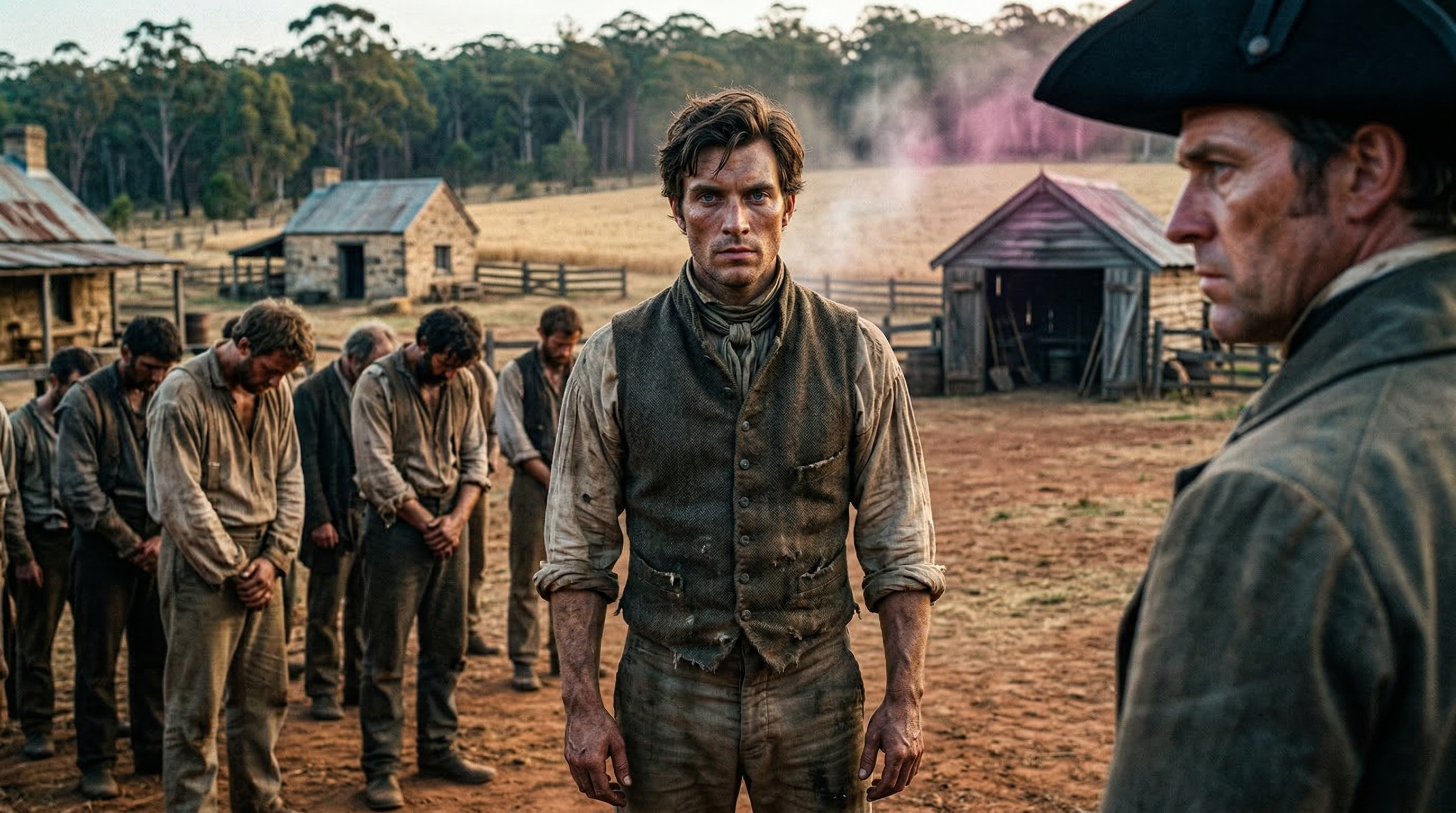
As the bush gives way to golden wheat fields and the government farm rises from the landscape like a promise or a prison, William learns the full measure of what this country can take from a man—and standing in the dusty yard beneath Overseer Garrett's assessing gaze, he makes a silent vow that seven years will transform him into something the system never intended to create.
"Fair enough, they say. They always say that. Fair enough until you're too sick to meet your quota." — Convict at the Fire
William woke to voices—not the cries of nocturnal creatures that had punctuated his dreams, but human speech, low and careful, drifting from the direction of the nearest fire. He lay still for a moment, letting his eyes adjust to the darkness, letting his mind separate the threads of conversation from the ambient sounds of the bush.
Three men sat huddled near the flames, their faces underlit by the fire's glow, their features rendered strange and almost demonic by the play of light and shadow. William recognised none of them from the voyage—they must have come from different transports, different holds, different ships that had deposited their human cargo in Sydney's harbour at various points throughout the year. Yet they spoke now with the easy familiarity of men who had found common ground in their shared circumstances.
"...heard the overseer at Parramatta is a man named Garrett," one was saying, his voice barely above a whisper. "They say he's fair enough, if you work hard. Doesn't use the lash unless you give him cause."
"They all say that," another replied, his tone carrying the weariness of experience. "Fair enough until you cross them. Fair enough until you're too sick to meet your quota. Fair enough until they decide they don't like the way you looked at them."
"Better than the quarries, though. Better than the road gangs." The third man spat into the fire, the moisture hissing as it struck the coals. "My brother went to the quarries at Newcastle. Lasted fourteen months before a rockfall took his legs. They shipped what was left of him back to Sydney, and he died in the hospital three days later. At least on a farm you're not likely to be crushed by a bloody mountain."
William listened without moving, absorbing the information, filing it away with everything else he had learned since his arrival. Garrett. The overseer's name was Garrett. A man who was fair enough, if the rumours could be trusted—though rumours, as the second speaker had implied, often proved unreliable when tested against reality.
"You're awake." Flint's voice came from nearby, quiet enough not to carry beyond William's ears. The older man had settled against a neighbouring tree, his position allowing him to observe both the fire and the surrounding darkness.
"Couldn't sleep," William admitted, though this was only partially true. He had slept—deeply, dreamlessly, with the totality of true exhaustion—but something had pulled him back to consciousness, some instinct that refused to let him rest while information was being exchanged nearby.
"Smart, in a way. The night hours are when men speak freely. Guards get tired, convicts get careless, and truths come out that daylight would never permit." Flint shifted against his tree, the movement accompanied by the soft clink of his chains. "I've learned more about this colony from midnight conversations than from any official pronouncement."
"What happened to your farm?" William asked. The question had been forming since Flint first mentioned his history, and the cover of darkness made it easier to voice. "You said drought and fire, but there must be more to it than that."
Flint was silent for a long moment. When he spoke, his voice had changed—flattened somehow, as though the emotions that might have coloured it had been deliberately removed. "Three years of drought. You can't understand what that means until you've lived through it—watching the creek beds turn to dust, watching the crops wither no matter how much you water them from what little remains in the wells, watching the livestock grow thin and then thinner and then die where they stand because there's nothing left to feed them."
He paused, and William heard him take a breath that seemed to carry the weight of years. "I borrowed money. Everyone did, during those times—the banks were happy to lend when they could see your land as collateral. I thought if I could just hold on until the rains came, I could pay it back and keep what I'd built. The rains did come, eventually. And then the fire came with them."
"Lightning?"
"Lightning. Struck a gum tree half a mile from my boundary, and the whole bloody countryside went up like kindling. The drought had left everything dead and dry, and when the flames caught, there was nothing to stop them. I lost the house, the barn, the fences, most of the livestock I'd managed to keep alive. Lost my wife too—she went back for something, some keepsake or other, and the roof came down before she could get out." Flint's voice remained flat, but William could hear the effort that flatness required. "After that, the drinking seemed like the only sensible response."
William said nothing. There was nothing to say. The story was one of countless such stories, he suspected—lives built and lost in this harsh country, fortunes made and unmade by forces no human effort could control. Flint had done everything right and still been destroyed. The knowledge sat uneasily in William's chest, a reminder that survival in this colony depended on more than wisdom and will.
Sleep reclaimed William eventually, though it came in fragments rather than the deep unconsciousness of earlier. He drifted in and out, catching snatches of conversation from the fire, feeling the hard ground pressing against his back, hearing the endless commentary of the bush as it conducted its nocturnal business.
In one of these half-waking intervals, he became aware that the quality of the darkness had changed. The stars overhead had shifted—the patterns he had observed before sleeping now displaced, rotated by the earth's turning through hours he had not consciously experienced. The fires had burned low, their glow reduced to embers that pulsed orange and red like the hearts of sleeping dragons. The air had grown cooler, carrying a hint of moisture that suggested the approach of dawn.
He lay still and listened to the changing sounds. The insect chorus had diminished, individual voices dropping out as the night aged, until what remained was sparser, less overwhelming. New sounds had taken their place—rustlings in the undergrowth that might have been small creatures beginning their morning activities, the first tentative calls of birds testing whether the sun was truly on its way.
A kookaburra broke the pre-dawn stillness with a laugh that seemed designed to mock the very concept of sleep. The sound rolled through the clearing like a declaration of war against rest, rising and falling in cadences that were almost human in their expressiveness. Other birds took up the call, adding their own voices to the growing chorus, until the bush rang with a cacophony that made the previous night's noises seem restrained by comparison.
"Dawn," Flint observed from his position against the tree. "The bloody birds announce it like they're being paid by the hour. You'll get used to it eventually, or you'll go mad. Those are the only options."
The camp stirred to life with the reluctant movements of men who had not slept enough and knew that the day ahead would demand more than their bodies wished to give. William rose from the ground in stages, first sitting, then kneeling, then finally standing on feet that screamed their protest at being asked to bear weight once more. The wounds he had washed the previous evening had scabbed over during the night, and the scabs cracked and wept as he shifted his stance.
Rations were distributed—the same bread, the same meat, the same inadequate portions that seemed designed to sustain life without actually satisfying hunger. William ate slowly, washing down each bite with water from his canteen, already dreading the moment when the march would resume. His feet. His back. His shoulders, where the sun had burned through his shirt the day before. Every part of him carried its own specific complaint, and together they formed a chorus of misery that rivalled the birds for persistence.
The convict who had collapsed the previous day was still on the supply cart, his condition apparently unchanged. William caught a glimpse of him as the cart was prepared for departure—a pale figure lying motionless among the barrels, his chest rising and falling with the shallow rhythm of unconsciousness. Whether he would recover or join the many who had died during the voyage remained to be seen. The colony, William was learning, did not waste sentiment on such questions.
"Form up!" The sergeant's voice cut through the morning air, sharp and uncompromising. "Same order as yesterday. Any man who falls behind gets left behind. We reach Parramatta by nightfall, and I'll not have stragglers slowing the pace."
The road stretched before them, unchanged in its essential character—the same red dust, the same grey-green bush pressing close on either side, the same promise of heat building as the sun climbed toward its daily assault. Yet something felt different to William as he took his place in the column and began the shuffling march westward. Perhaps it was merely the knowledge that this was the final leg of the journey, that Parramatta waited somewhere ahead, that the next sunset would find him in the place where his sentence would truly begin.
His feet hurt less than he had expected—or rather, they hurt differently, the sharp agony of yesterday's fresh wounds replaced by a duller ache that seemed more sustainable. The scabs held, mostly, though he could feel them threatening to break with each step. He had wrapped strips torn from the hem of his shirt around the worst of the damage, a makeshift bandaging that provided minimal protection but at least kept the dust from grinding directly into open flesh.
Flint walked beside him once more, having somehow arranged to be chained in proximity despite the guards' random assignments. The older man moved with a steadiness that William envied, his gait suggesting reserves of endurance that the younger convicts around him clearly lacked. Fifteen years in the colony had taught his body lessons that newcomers could only learn through suffering.
"Last stretch," Flint observed. "Ten miles, perhaps twelve. We'll be there before the sun reaches its peak if we keep pace."
"And then what?"
"And then you begin. The real sentence, I mean—not the waiting and the travelling, but the actual work. Day after day of it, from first light to last, with nothing to show for your labour but the knowledge that you're one day closer to freedom." Flint's voice held neither bitterness nor encouragement, merely the neutral tone of a man stating facts. "Some men break under that. Others find something in themselves they didn't know was there. Which you'll be, I can't say. That's for you to discover."
As the morning advanced, William began to notice changes in the country through which they passed. The dense bush that had characterised yesterday's march was giving way to something more open—wider spaces between the trees, longer views across undulating terrain, patches of cleared ground that spoke of human intervention in the landscape. They were approaching the colony's agricultural heartland, the farms and settlements that produced the food on which Sydney depended.
He saw his first cultivated field shortly after the sun cleared the treetops—a stretch of wheat that rippled gold and green in the morning breeze, its ordered rows a stark contrast to the chaotic vegetation of the bush. A figure moved among the stalks, bent to some task William could not identify from this distance. Man or woman, free settler or convict, there was no way to tell. But the sight kindled something in him—a recognition, perhaps, that this land could be made to yield, that the wilderness was not entirely unconquerable.
More farms appeared as they continued westward. Cattle grazed in paddocks bounded by rough wooden fences. Smoke rose from chimneys of houses that ranged from substantial homesteads to crude huts barely deserving the name. Children paused in their play to watch the convict column pass, their expressions holding the same mixture of curiosity and wariness William had observed in Sydney. Dogs barked from doorways, their challenges ignored by guards who had clearly heard such protests countless times before.
"The Parramatta district," Flint said, gesturing toward the scattered habitations. "Best farming land in the colony, or so they claim. Rich soil, reliable water, close enough to Sydney for trade but far enough to avoid the worst of the harbour's troubles. Every free settler with ambitions wants a grant out here, and most of them will do anything to get it."
"Anything?"
"Anything. This colony runs on ambition and desperation in roughly equal measure. Men who were nothing in England come here and become lords of their own little domains. Men who were something in England come here and discover that their titles and connections mean nothing when there's land to be cleared and crops to be planted." Flint's gaze swept across the farms they were passing, something complicated moving behind his eyes. "It's the great equaliser, this country. Doesn't care where you came from or what you were. Only cares what you can do, and whether you can survive while doing it."
The sergeant called a halt at mid-morning, beside a creek that ran clearer and faster than the one where they had camped. The water came from the hills to the west, Flint explained—mountains that caught the rain and fed it down through countless small streams that eventually found their way to the rivers and thence to the sea. The Parramatta River itself lay somewhere ahead, the waterway that gave the settlement its name and its reason for existence.
William drank deeply, refilling his canteen twice before the guards called them back to the march. The water was sweet after the brackish stuff they had rationed the previous day, carrying hints of eucalyptus and stone that made it taste almost medicinal. He splashed handfuls across his face and neck, washing away some of the accumulated dust, feeling almost human for the first time since leaving Sydney.
Around him, the other convicts were doing the same—drinking, washing, taking whatever small pleasures the brief respite allowed. Conversations had revived with the improvement in spirits, voices comparing notes on what they had seen, speculating about what awaited them at their destination. The man who had collapsed the previous day had apparently regained consciousness, though he remained on the cart, too weak to walk but no longer hovering at death's threshold.
"An hour more," the sergeant announced, swinging back onto his horse. "Perhaps less if you keep pace. I can see the river from here, and where there's river, there's Parramatta."
The bush fell away entirely as they covered the final miles, replaced by a patchwork of farms and orchards that stretched toward the horizon in every direction. The road improved as well—still dusty, still rutted in places, but clearly maintained by labour that the wilderness track had never received. They passed carts travelling in both directions, their drivers nodding acknowledgment of the convict column with the casual familiarity of men who had seen such processions countless times.
Buildings began to appear with increasing frequency—not just farmhouses now, but structures that suggested commerce and administration. A smithy, its forge sending sparks into the morning air. A store, its windows displaying goods that must have come all the way from England. A church, smaller than Sydney's but unmistakably ecclesiastical, its cross catching the light atop a modest steeple. The markers of civilisation, planted in soil that had known only wilderness mere decades before.
And then, rounding a bend in the road, William saw the river.
The Parramatta stretched before them, wider than he had expected, its waters brown with the sediment of the lands through which it had passed. Boats moved along its surface—rowboats and small sailing craft, carrying passengers and cargo between the settlement and Sydney's harbour. The river served as highway and boundary both, defining the town that had grown along its banks with the particular logic of water-dependent communities everywhere.
Beyond the river, Parramatta proper came into view. It was smaller than Sydney—a single main street, perhaps, with offshoots that petered out into farmland within a few hundred yards—but it possessed a solidity that the coastal settlement had lacked. These buildings had been here longer, had weathered more seasons, had acquired the particular character that came from sustained occupation. This was not a camp or a waystation, but a town, with all the permanence that word implied.
The column did not enter the town itself. Instead, the road forked just before the river crossing, and the sergeant guided them along the western branch, following the water upstream toward their actual destination. The government farm lay beyond the settlement proper, William learned—a separate domain where convict labour produced the food that kept the colony alive.
He saw it first as a fence line in the distance, a boundary of wooden stakes that marked the edge of crown land. Then the buildings emerged from behind a stand of trees—a cluster of structures arranged around a central yard, their forms utilitarian but substantial. Barns and storehouses. A building that might have been an administrative centre. And, set somewhat apart from the rest, the long, low shapes of convict barracks that would be his home for the next seven years.
The fields surrounding the compound stretched in every direction, their crops representing the full range of what Australian soil could be persuaded to produce. Wheat and maize grew in orderly rows, their colours ranging from the gold of approaching harvest to the green of recent planting. Vegetable gardens occupied a section closer to the buildings, their produce presumably destined for the tables of overseers and officials. Orchards lined one boundary, their trees heavy with fruit that would ripen in the weeks ahead.
Convicts were visible throughout the landscape—small figures bent to various tasks, their movements carrying the slow, steady rhythm of labour performed under supervision. They did not look up as the column approached, did not pause in their work to observe the arrival of new additions to their ranks. Perhaps they had learned that such curiosity was punished, or perhaps they had simply ceased to care. Either way, their indifference spoke eloquently of what awaited those about to join them.
The gate stood open—a practical necessity given the constant traffic of the working day—but guards flanked it nonetheless, their presence declaring that this openness was permission rather than oversight. They watched the column approach with the same bored attention William had observed in every official he had encountered since his arrest, their eyes cataloguing the new arrivals without apparent interest in what they saw.
William passed between them and entered the compound. The dust of the road gave way to hard-packed earth that had been trodden by countless feet over countless years, worn smooth as stone in the most travelled areas, cracked and uneven where traffic was lighter. The smell of the place struck him immediately—livestock and hay, wood smoke and cooking food, the particular odour of human habitation concentrated in a space not quite large enough to contain it comfortably.
The yard opened before him, larger than it had appeared from outside the fence. To his left, the administrative building rose two stories, its windows reflecting the afternoon sun. To his right, the barracks stretched in a line that seemed to go on forever, door after identical door marking the entrances to whatever cramped quarters lay within. Ahead, across the bare expanse of the yard, a man had emerged from the administrative building and was walking toward them with the purposeful stride of authority.
"That'll be Garrett," Flint murmured. "The overseer. Watch his face when he looks at us—you can learn a lot about a man from how he regards those he has power over."
Garrett was younger than William had expected—perhaps forty, perhaps less, with the weathered complexion of a man who spent his days outdoors but the bearing of one accustomed to command. He moved with efficiency rather than haste, each step carrying him forward without wasted motion, his eyes already assessing the column before he had covered half the distance.
His face, as Flint had suggested, told a story. It was not a cruel face—William had seen cruelty often enough during his journey through the justice system to recognise its markers—but neither was it kind. It was the face of a man who had made peace with difficult necessities, who understood that his position required him to extract labour from men who had every reason to resist, and who had developed whatever internal accommodations such work demanded. He would be fair, perhaps, within the limits of his role. But his fairness would serve the colony's needs, not the convicts' welfare.
The sergeant had dismounted and was conferring with Garrett in tones too low to carry. Papers changed hands—the documentation of their delivery, presumably, the official records that would transfer responsibility for these men from the transport service to the farm administration. Garrett glanced at the documents, nodded once, and turned to address the assembled convicts.
"I am Overseer Garrett," he announced, his voice carrying clearly across the yard. "You are now assigned to the Parramatta government farm, where you will serve out your sentences in labour that benefits the Crown. The rules here are simple: work hard, obey orders, cause no trouble, and you will be treated fairly. Shirk your duties, defy authority, or attempt to escape, and you will discover that this colony's punishments are not gentle."
He paused, letting the words settle over the assembled men. "Some of you will complete your sentences and go on to build lives in this colony. Others will not. The difference lies in the choices you make, beginning now." His gaze swept across them, lingering on no one in particular yet somehow managing to meet every eye. "You will be assigned bunks in the barracks. Rations at sundown. Work assignments in the morning. Welcome to Parramatta."
The welcome held no warmth, but William had expected none. He stood in the yard of the government farm as the late afternoon sun beat down upon his head and shoulders, as the guards began directing convicts toward the barracks, as Jeremiah Flint offered him a final nod before being led away to whatever accommodation awaited men of his experience and age. The journey from Sydney was over. The journey that would define the next seven years of his life was about to begin.
He looked at the fields stretching away on every side, at the convicts bent to their endless labour, at the barracks that would be his home, at the overseer who would control his existence with a power more absolute than any English magistrate had ever wielded. This was his fate—not chosen, not deserved, but inescapably his. A stolen watch, a copper-haired betrayer, a system that cared nothing for truth when conviction was so much more convenient. And now this: red dust and brutal sun, chains and quotas, seven years measured out in days of toil.
He thought of Tom, already breaking rocks at Castle Hill, already dying by inches in a quarry that would claim whatever remained of his life. He thought of Flint, who had built and lost and now began again at an age when starting over should have been impossible. He thought of his mother in Portsmouth, his father on the docks, the life he had been torn from by forces beyond his comprehension or control.
And he thought, with a cold clarity that surprised him, of what he would do with these seven years.
He would not merely survive them. Survival was what the system expected, what the overseers planned for, what the colony required of its convict population. He would do more than survive. He would learn—every skill the farm could teach him, every secret the land would reveal, every rule both written and unwritten that governed success in this strange society. He would watch and listen and remember. He would make himself useful, then valuable, then indispensable.
And when his sentence ended—when the seven years had passed and he stood free beneath this alien sky—he would be someone else entirely. Not the frightened young dockworker who had trembled before the magistrate's bench. Not the broken convict the system intended to produce. Something harder. Something smarter. Something that could never again be destroyed by a thief's whim and a court's indifference.
A guard's hand touched his shoulder, directing him toward the barracks. William went without resistance, his feet carrying him across the hard-packed earth of the yard, his eyes fixed on the doorway that waited ahead. The threshold of his new existence. The beginning of everything that would follow.
He crossed it without looking back.






