William Jeffries IV
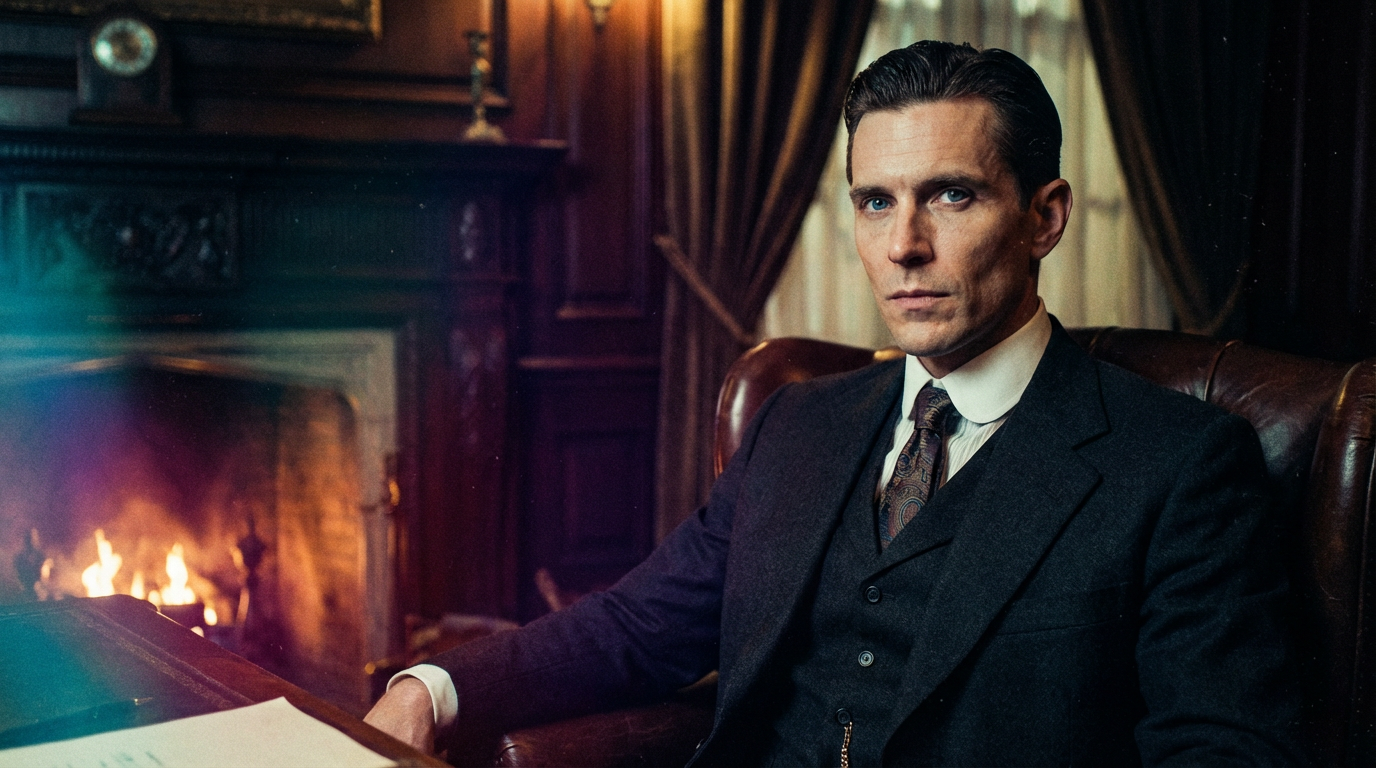
William Jeffries IV (1873–1948), eldest child of William Jeffries III and Jane Amelia Barwick, inherited Tasmania's most powerful industrial dynasty and transformed it through ruthless modernisation, hydroelectric innovation, and political manipulation into unprecedented wealth. His marriage to shopkeeper's daughter Grace Matilda Woolley produced six children — four daughters he scarcely acknowledged and two sons whose fates he determined through the shocking decision to disinherit his eldest in favour of his younger, fracturing the Jeffries legacy irrevocably.
Birth and Shadow Childhood (1873–1889)
William Jeffries IV arrived on 12 August 1873 at Jeffries Manor in Granton, the first child and heir apparent of William Jeffries III and Jane Amelia Barwick. His birth, occurring just fourteen months after his parents' wedding, brought relief to a family desperate for continuation of the male line — four generations of Jeffries ambition converging upon the small form christened at St. David's Cathedral three weeks later, whilst Tasmania's colonial elite noted approvingly that the dynasty had secured its future. What none of them could have anticipated was that the infant whose arrival so gratified their expectations would spend the next seventy-four years attempting to break the patterns that had consumed his forefathers, only to discover that some inheritances resist even the most determined repudiation.
His earliest memories centred upon contrasts that would define his understanding of family itself. His mother Jane's gentle presence — her careful management of the household, her quiet philanthropy, her measured responses to the crises that Jeffries Manor seemed to generate with seasonal regularity — competed for his attention with his father's increasing absences. By the age of three, William had learned to wait by the library window for his father's return from mysterious investigations into the disappearance of his great-grandfather William Jeffries Senior, reading the particular slump of William III's shoulders that signified another dead end. These vigils taught him that love in the Jeffries family was measured in patience for absence rather than joy in presence — a lesson whose accuracy would prove as enduring as it was corrosive.
His brother Edward's arrival in 1875 introduced competition into what had been a solitary kingdom. The nursery became a battlefield of subtle hierarchy, with William claiming precedence through birthright and Edward contesting it through temperament. Their nurse's habitual reminder that "Master William is the heir" simultaneously elevated and isolated the elder brother, establishing a dynamic of entitlement and resentment that would poison their relationship for the remainder of their lives. Alice, born in 1878 with a slight facial asymmetry resulting from a difficult delivery, softened the household briefly. In his sister, five-year-old William found someone who neither competed nor judged, and his fierce protection of her against the cruel comments of visiting children revealed a capacity for tenderness that the Jeffries inheritance would subsequently labour to extinguish. Henry's birth in 1881 completed the family, though by then their mother's health had begun the decline that would shadow the remainder of William's childhood.
From the age of ten, William understood that the laudanum bottle concealed in his mother's writing desk was simultaneously medicine and poison. He learned to gauge her dosage by the brightness of her eyes and the steadiness of her hands, becoming expert at managing household staff during the periods when Jane was "indisposed" — a euphemism whose transparency fooled no one but whose maintenance the entire household conspired to preserve. This early apprenticeship in the management of visible normality over concealed dysfunction would serve him throughout his career, though the emotional cost of that education would prove impossible to calculate.
His tutor, Mr. Charles Pemberton — a Cambridge man with carefully concealed socialist sympathies who served from 1879 to 1889 — provided intellectual structure amidst the family's gathering chaos. Their discussions of Marx and Darwin, conducted in Latin to prevent the servants from reporting radical ideas to William III, planted seeds of intellectual rebellion that would manifest not as humanitarian conviction but as the cold pragmatism that characterised William's later approach to both politics and commerce. Pemberton taught him to think systematically; the Jeffries household taught him to feel as little as possible.
English Education and Emotional Exile (1889–1895)
Departing for Harrow School in September 1889, sixteen-year-old William carried the accumulated weight of four generations of Jeffries expectations across the ocean. The school that had polished his father and grandfather proved more hostile than anticipated. His fellow pupils quickly identified him as "colonial money" — wealthy but lacking authentic aristocratic pedigree — and the whispered knowledge of his great-great-grandfather's convict origins provided material for the persistent, understated cruelty at which English schoolboys excelled. William responded not with charm or aggression but with cold efficiency, excelling academically in mathematics and economics whilst playing rugby with a calculated brutality that earned respect without generating friendship. His housemaster's assessment — that young Jeffries possessed remarkable intelligence but appeared incapable of genuine warmth — described with unwitting precision the emotional architecture that childhood had constructed.
The Christmas holiday of 1891, when he returned to find his mother increasingly frail and his father wholly absorbed in genealogical obsession, confirmed what distance had begun to suggest: that Jeffries Manor was less a home than a monument to inherited dysfunction, and that warmth was a commodity the family could not afford. His siblings had changed in his absence — Edward grown rebellious, Alice retreated into charitable work, Henry barely recognising the brother who had departed two years earlier. William volunteered for summer terms rather than return, preferring Harrow's honest hostility to the manor's dishonest domesticity.
Cambridge University, which William entered in October 1892 to read law, provided the only genuine liberation he would experience before his marriage. Away from both English social hierarchies and Tasmanian expectations, he discovered intellectual peers whose company he could tolerate. His friendship with David Goldsmith, a brilliant Jewish student facing his own forms of exclusion, introduced perspectives beyond the Anglo-Christian worldview that four generations of Jeffries prosperity had cemented as natural law. Together they attended Fabian Society meetings — William using an assumed name — where he found himself drawn to ideas about rational governance and social engineering, attracted not by humanitarian impulse but by the conviction that society, like a business, could be optimised for efficiency.
A brief affair with Margaret Thornton, daughter of a London banker, ended when her father discovered William's colonial origins and convict ancestry. The rejection stung with an intensity that alarmed William, triggering a three-day collapse that ended with David finding him unconscious in his rooms. The incident taught him that emotion was liability, and thereafter he approached matters of the heart with the same calculation he applied to economics — a resolution that would hold for fifteen years until a shopkeeper's daughter in New Norfolk demolished it with an argument about flour.
Return and Family Crisis (1895–1910)
William returned to Tasmania in June 1895 carrying his law degree and the expectation of gradual assumption into the family business. Instead, he found chaos. His mother Jane was dying, his father was lost in paranoid investigations, and Jeffries Industries was functioning only through the efforts of unsupervised managers whose loyalty had been neither tested nor rewarded. Jane's death on 8 September 1895 thrust twenty-two-year-old William into premature authority. His father's incoherent eulogy humiliated the family publicly, but William's composed management of funeral arrangements and immediate assumption of business oversight prevented complete dissolution. Within days of the burial, he had dismissed corrupt managers, restructured debt payments, and established reporting procedures whose rigour reflected Pemberton's systematic training rather than any inherited Jeffries instinct.
He arranged for his siblings as best he could — Edward sent to university in Melbourne in hopes that distance might curb his destructive tendencies, Alice provided funds for her charitable work, Henry given competent tutors to replace the education their father now neglected. These actions were practical rather than affectionate, the gestures of a man already constructing the emotional fortification that would characterise the next half-century of his life. His father's death on 18 November 1905 brought grief that William neither displayed nor, perhaps, fully experienced — the relationship having deteriorated so thoroughly that the loss registered primarily as administrative transition rather than personal bereavement.
The decade between Jane's death and William III's proved transformative for Jeffries Industries under William's management. He introduced American-style efficiency techniques, mechanised agricultural operations, and — in a demonstration of foresight that his competitors initially derided — invested massively in hydroelectric power generation in 1899. By 1904, Jeffries Power supplied sixty per cent of Hobart's electricity, generating profits that dwarfed the traditional agricultural returns upon which the family fortune had been built. Yet the methods that produced this prosperity — the investigation of competitors' private lives for leverage, the manipulation of stock prices through coordinated rumours, the ruthless acquisition of rival enterprises — established a reputation for cold-blooded efficiency that would shadow William's remaining decades.
His election to the Legislative Council in 1908, achieved through a combination of wealth, strategic intelligence, and the judicious deployment of damaging information about opponents, preceded the most unexpected development of his life: the encounter with Grace Matilda Woolley, which began in February 1910 when William visited her family's shop in New Norfolk.
Marriage and the Daughters (1910–1923)
The courtship that followed confounded Tasmanian society. At thirty-seven, William was expected to make a strategic alliance; instead, he pursued a nineteen-year-old shopkeeper's daughter whose understanding of grain economics and supply chain management exceeded that of many of his university-educated managers. Grace served him with typical efficiency during his first visit, and when he complained about the quality of flour, she delivered a detailed explanation of milling processes that left him, for perhaps the first time in his adult life, genuinely speechless. Their subsequent conversations — conducted during carefully arranged walks beyond New Norfolk, where neither reputation would suffer from discovery — evolved from commercial transactions into intellectual exchanges that William found as stimulating as anything Cambridge had offered and considerably more unsettling.
The engagement, announced in May 1910 after barely three months of acquaintance, created scandal precisely because of the vast social gulf it bridged. The wedding at Jeffries Manor on 12 June 1910 was deliberately small, limiting opportunities for society to insult his bride. Grace's large family attended in their Sunday best — her father Thomas somewhat overcome by expensive champagne, her mother Elizabeth weeping throughout — whilst William's political associates calculated what the mésalliance might cost him and concluded, incorrectly, that it would end his career.
Eleanor Jane arrived in 1911, the first of six children whose births mapped the emotional geography of the marriage with uncomfortable precision. William received his firstborn daughter with polite interest that failed to conceal his disappointment — not in the child herself but in the chromosome she carried. The Jeffries dynasty required a male heir; a daughter, however healthy and however loved by Grace, represented a postponement rather than a fulfilment of that requirement. Amelia Catherine, born in 1913, deepened the disappointment without resolving it, and Charlotte Grace's arrival in 1916, during the war years that consumed William's political attention, was greeted with barely maintained courtesy. Grace bore his indifference towards the girls with quiet fury, pouring into her daughters the intellectual ambition and self-sufficiency she had cultivated in herself, ensuring they understood that their value existed independently of their father's recognition of it.
The seven-year gap between Charlotte's birth and the arrival of William V on 9 March 1923 represented the period during which William had privately concluded that the dynasty would end with him — that the pattern of male succession stretching back to the original convict would terminate in a generation of daughters whom he loved, after his fashion, but in whom he could not see the continuation of the Jeffries name. William V's birth, when William was nearly fifty, reversed this resignation with an intensity that disturbed even Grace. His visible relief at the arrival of a male heir confirmed what the daughters had sensed throughout their childhoods: that their father measured their worth against an absence rather than a presence.
Late Fatherhood and Fraternal Rupture (1923–1946)
James III's birth on 17 November 1925 completed what William considered the essential family — two male heirs to secure the succession. Florence Mary, arriving in 1928 when William was fifty-five, was received with near-total disinterest, the dynasty question having been settled and William's emotional bandwidth, never generous, having been exhausted by the demands of late fatherhood. Grace managed this final slight with the same composed determination she brought to everything, though her correspondence from the period — preserved in letters that William never read — suggests a woman whose patience had been refined past endurance into something closer to contempt.
The brothers' contrasting temperaments introduced complications that William had not anticipated. William V inherited his father's cold pragmatism and commercial instinct, displaying from childhood the calculating intelligence that made him a natural successor. James, however, carried an artistic sensibility and emotional warmth that reminded William uncomfortably of his long-dead mother Jane — not merely in temperament but in the specific quality of gentle perception that the Jeffries inheritance had always sought to eliminate and never quite succeeded in destroying. This recognition triggered something in William that resisted his own analysis — not affection exactly, but an awareness of sacrificed possibilities that grew more acute as his own mortality approached.
His relationship with his brother Edward deteriorated completely during this period, political ambitions colliding with commercial interests in confrontations that delighted Tasmanian gossip. Edward's death in 1925 — officially a hunting accident, though rumour supplied alternatives ranging from suicide to murder — produced in William no observable grief. He attended the funeral only because Grace insisted, his composure throughout the service suggesting either extraordinary self-control or the absence of anything requiring control.
The Inheritance Betrayal and Death (1946–1948)
William's decision to name James as his heir, formalised in a will signed in 1946, represented the most dramatic rupture with Jeffries tradition in the family's history. Primogeniture had governed succession for four generations; William's choice to bypass William V violated family custom, contemporary expectation, and the assumptions upon which his eldest son had constructed his entire adult identity. His motivations remained opaque even to Grace, who learned of the decision only after its completion. Some suspected encroaching mental instability — William had begun displaying his father's obsessive tendencies, spending nights reading documents about his great-grandfather's disappearance. Others believed he recognised in William V the same cold ambition that had ultimately destroyed William III, and saw in James's artistic nature the possibility of breaking patterns that had consumed four generations.
The family dinner in March 1947 where he announced the decision became legendary. William V listened in silence, then departed Jeffries Manor without speaking, not returning during his father's lifetime. James attempted to refuse the inheritance, arguing for joint succession, but William threatened to leave everything to charity if his decision was challenged. Grace mediated with the determination that had sustained the family through decades of accumulated dysfunction, though even her resources were strained by the scale of the breach her husband had created.
William's final year was marked by accelerating mental deterioration — lucid business meetings alternating with hours spent convinced his great-grandfather was hiding somewhere within the manor's walls. He installed new locks on rooms sealed for decades, hired investigators to pursue increasingly fantastical theories, and began carrying a loaded revolver. Grace managed his condition with the discretion she had applied to everything since arriving at Jeffries Manor as a nineteen-year-old bride, enlisting James's assistance whilst William V remained estranged.
The stroke came on 15 June 1948 in his study — the same room where his father had died pursuing the same mystery. He lingered for thirteen days, sometimes lucid, more often lost in the confusion that had claimed the Jeffries men with the reliability of a family curse. In clearer moments he would grip Grace's hand and apologise for "the burden of the choice," though whether he meant his marriage, the inheritance decision, or the accumulated weight of everything the Jeffries name carried remained, characteristically, unclear.
William Jeffries IV died at 3:15 in the morning on 28 June 1948, with Grace and James present. William V was deliberately absent. His final words — "The pattern breaks with James" — suggested hope that his younger son might escape the obsession consuming four generations, though whether the pattern could be broken by fiat rather than transformed through understanding remained the question his death bequeathed to those who survived him.
The funeral on 2 July drew Tasmania's entire political and business establishment. The eulogy avoided mentioning either the inheritance controversy or William's mental decline — maintaining, even in death, the façade of controlled authority that William had spent his life constructing and his final years inadvertently demolishing. William V attended but stood apart from the family, his presence a reminder that the fracture William had created was not the kind that funerals resolve. The will's execution triggered immediate legal challenges, beginning a bitter contest that would divide the Jeffries family permanently and ensure that William's attempt to break the pattern succeeded only in creating new ones.







