William Jeffries III
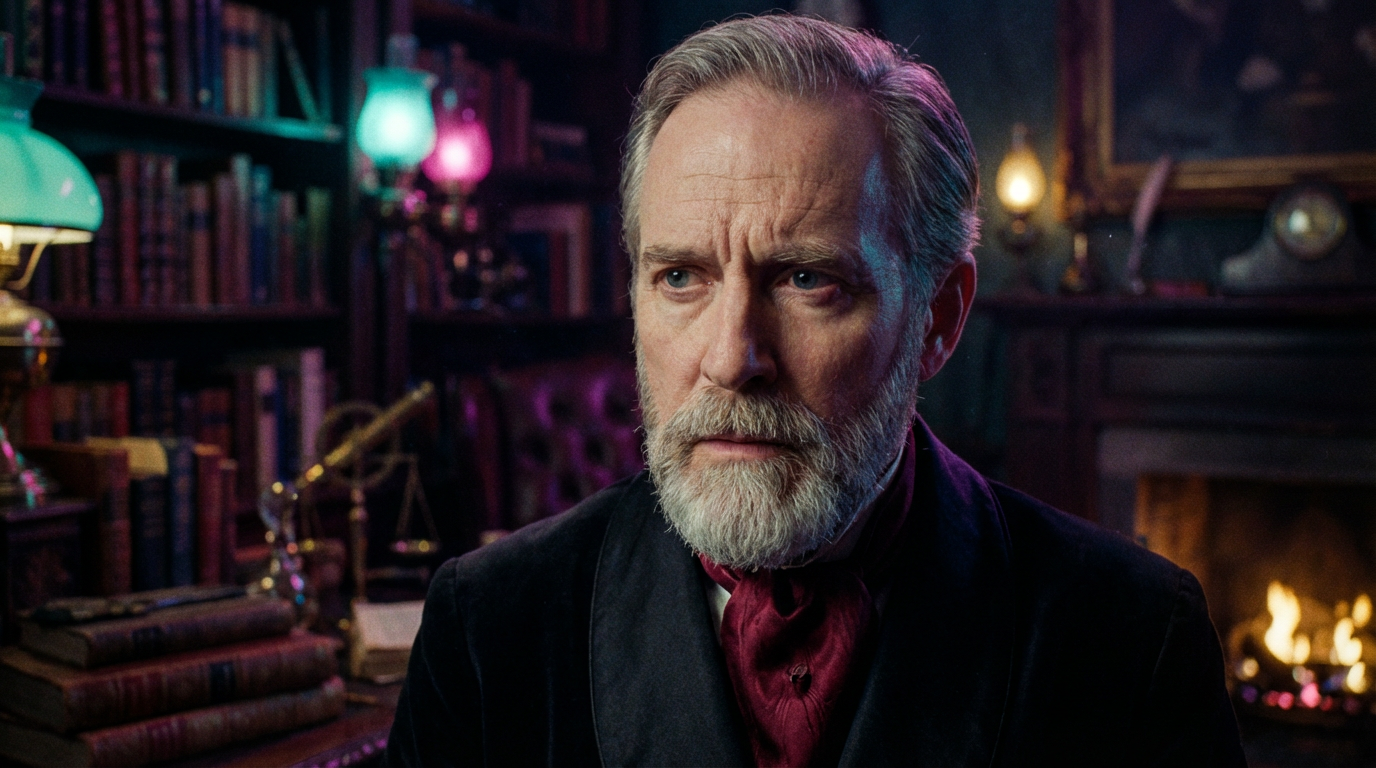
William Jeffries III (1847–1905), the eldest son of William Edward Jeffries Jr. and Ellen Amelia Cross, was born at Jeffries Manor in Granton, Tasmania. Groomed from childhood to inherit the family empire, he transformed Jeffries Industries through agricultural innovation and mining expansion, generating unprecedented wealth. His marriage to Jane Amelia Barwick produced four children. Yet the mystery of his grandfather's disappearance consumed his later decades, and the obsession that had haunted his father claimed him in turn.
Birth and Early Childhood (1847–1858)
William Jeffries III entered the world on 23 May 1847 at Jeffries Manor in Granton, Tasmania, the second child and eldest son of William Edward Jeffries Jr. and Ellen Amelia Jeffries (née Cross). His elder sister Madelyn had arrived two years before, and his birth brought particular relief to his father, who had waited anxiously for the male heir who would one day continue the Jeffries name and enterprises. The christening three weeks later at St. David's Cathedral drew Tasmania's colonial elite, each guest noting the healthy infant who would eventually control one of the colony's largest fortunes.
The boy's earliest years unfolded within Jeffries Manor's peculiar atmosphere — a grand estate built by a grandfather who had vanished before William Jr. could form memories of him, maintained by a father whose relentless ambition masked a private obsession with that very disappearance, and softened by his mother Ellen's determined cultivation of domestic warmth. The house held contradictions that even a young child could sense: magnificent reception rooms where Hobart's finest gathered for elegant dinners, alongside corridors that fell silent when certain subjects arose, and a locked study where his father retreated for hours with papers and brandy. At age three, William pressed his eye to the keyhole of that forbidden room, straining to glimpse the dusty documents and mysterious objects within. The childhood curiosity about sealed spaces and withheld knowledge would evolve, over the course of a lifetime, into the consuming fixation that defined his final decades.
His relationship with Madelyn established patterns that persisted throughout their lives. She served initially as playmate and protector, though William's emerging competitive temperament complicated their bond. He insisted upon winning every nursery game, responded with frustration when Madelyn's watercolours received more praise than his sketches, and displayed the possessiveness that their mother Ellen noted with quiet concern — what she described as an "unfortunate tendency toward claiming exclusive possession" that would later fracture family unity. Yet beneath the rivalry lay genuine affection; Madelyn understood her brother's anxieties in ways that their younger siblings, arriving in steady succession, could not.
The household expanded with Elizabeth in 1849, Thomas in 1851, and Edwin in 1853, each new arrival subtly shifting the domestic dynamics. William, as eldest son and heir apparent, received treatment distinct from his siblings despite Ellen's efforts at equality. His father took him on estate tours from the age of five, explaining agricultural operations and introducing him to the tenant farmers who would one day be his responsibility. These early lessons emphasised ownership and authority — the vocabulary of dominion rather than the stewardship that Ellen attempted to instil through her charitable visits. The boy absorbed his father's language of power with a fluency that both pleased William Jr. and troubled Ellen, who recognised in her son's developing temperament an amplification of her husband's least generous qualities.
Education and Formation (1853–1869)
Private tutors arrived when William turned six, beginning an education designed to prepare him for English public schooling. Mr. James Cartwright, imported from Sydney at considerable expense, proved particularly influential. A Cambridge man himself, Cartwright recognised William's quick intelligence but also the dangerous combination of privilege and insecurity that shaped the boy's character. William excelled at mathematics and demonstrated aptitude for languages, mastering Latin and beginning Greek, yet struggled with literature and philosophy — subjects that demanded empathy and imaginative engagement with perspectives other than one's own. His academic strengths reflected a mind more comfortable with systems that could be mastered than with ambiguities that resisted resolution.
The tensions between commerce and conscience that defined the Jeffries household shaped William's developing worldview. He accompanied his mother to charitable events but absorbed his father's pragmatism more readily than Ellen's compassion. During an orphanage visit in 1856, nine-year-old William was overheard telling another child that "poor people simply didn't work hard enough" — a remark that horrified Ellen but drew approving nods from his father, who regarded it as evidence of realistic thinking. The incident illustrated a pattern that would intensify throughout William's life: his instinct to interpret the world through the lens of capability and weakness, of deserving and undeserving, rather than through the more nuanced moral framework his mother laboured to provide.
William entered The Hutchins School in February 1861, following his father's footsteps into Tasmania's most prestigious Anglican institution. At thirteen, he was small for his age but compensated through academic achievement and careful social positioning. He identified swiftly which boys came from the most influential families and cultivated their friendship, whilst showing less interest in peers whose connections offered no strategic advantage. His academic record revealed brilliance in mathematics and natural sciences alongside mediocrity in classics and divinity. Masters noted his tendency to challenge instructors he deemed intellectually inferior — a habit that earned a complex mixture of respect and resentment from those around him.
On the cricket pitch, William displayed tactical acumen as captain, reading the game with an analytical precision that consistently outwitted opposing sides. Yet his approach to sport, like his approach to social relationships, prioritised personal achievement over collective endeavour. Teammates valued his strategic mind whilst finding his manner somewhat isolating — a dynamic that foreshadowed the leadership style he would bring to Jeffries Industries in later decades.
His departure for Eton in September 1864 carried expectations of both academic distinction and social advancement. The English school environment proved challenging in ways that Hutchins had not — colonial boys, regardless of wealth, faced condescension from the established aristocracy. William responded with characteristic determination, excelling academically whilst studying British social hierarchies with the attention to detail he might have applied to a natural sciences thesis. He learned to modulate his accent and mannerisms, developing the capacity to move between colonial directness and English gentility that would serve him throughout his adult life.
At Eton, he forged a lasting friendship with Alexander Morrison, the son of a prominent London banking family. Morrison's insights into international finance opened William's eyes to commercial possibilities that extended far beyond Tasmania's shores, and their correspondence — maintained throughout their lives — charts the evolution of William's ambitions from colonial landowner to industrial innovator. Oxford followed in 1866, where William read natural sciences at Christ Church. His thesis on agricultural chemistry demonstrated genuine intellectual originality, proposing fertiliser combinations that would later transform Tasmanian crop yields. Yet his university years were marked by concerning behaviour alongside academic achievement — twice disciplined for excessive gambling debts, though his father's wealth ensured that consequences remained negligible.
The continental tour of 1869, ostensibly educational, became William's introduction to the broader world. In Paris, he encountered pleasures unavailable in Oxford's regulated environment. In Vienna, he studied not merely culture but the intricate mechanics of the Austro-Hungarian Empire's financial systems, recognising parallels with the economic structures that governed Tasmania's colonial economy. In Rome, he purchased antiquities of uncertain provenance, beginning a collection that would eventually fill Jeffries Manor's galleries. He returned to Tasmania in December 1869, aged twenty-two, carrying himself with a sophistication that impressed Hobart society whilst concerning his mother. Ellen observed that her son had acquired "all the polish of a gentleman but none of the substance" — a judgement whose prescience would become apparent only gradually.
Courtship and Marriage (1870–1872)
William's pursuit of eligible young women upon his return became noted for its calculating character. He courted Margaret Henderson, the daughter of a prominent judge, until discovering that her father's debts might require financial support from a son-in-law. He shifted his attention to Catherine Walsh, whose family's shipping connections offered commercial advantages, but abandoned this pursuit when Catherine displayed more independent spirit than he found comfortable. These manoeuvres earned him a reputation as charming but unreliable in matters of the heart — a young man who assessed potential wives with the same analytical detachment he applied to investment opportunities.
The Government House ball of March 1871 disrupted this pattern entirely. Jane Amelia Barwick, the daughter of shipping magnate Edward Francis Barwick, possessed a beauty that transcended conventional prettiness — one contemporary described her as having "an air of tragedy that made men want to rescue her." William, who had approached every previous courtship as a strategic calculation, found himself experiencing something he had not anticipated: genuine attraction to a woman whose appeal operated at a level deeper than social advantage.
Jane's background echoed his own complicated heritage in ways that created unexpected intimacy. Her mother's laudanum dependency and her father's emotional remoteness had produced in Jane a combination of vulnerability and quiet resilience that William recognised instinctively, though he might not have been able to articulate why. Their courtship over the following year revealed William at his most authentic — intellectually engaged, emotionally present, willing for once to lower the defences that governed his interactions with the rest of the world. His proposal in February 1872 was, according to Jane's diary, "the first completely honest thing William had ever said," acknowledging that neither came from perfect families but together they might build something better than what either had inherited.
They married on 15 June 1872 at St. David's Cathedral, in a ceremony that united two of Tasmania's most prominent yet troubled dynasties. Edward Barwick's drunken speech about loyalty and abandonment embarrassed the assembled guests, whilst William Jr. sat stone-faced in the front pew, perhaps recognising patterns repeating across generations. Ellen worked to smooth the event's tensions, but the undercurrents that surfaced during the reception — wealth shadowed by dysfunction, public elegance masking private damage — would characterise the marriage that followed.
Jeffries Manor transformed under Jane's influence. She brought light and music to spaces that had harboured shadows for decades, redecorating with a sensitivity that managed to modernise without offending the elder Jeffries. The house became, for the first time in its history, a genuinely warm domestic space rather than merely an impressive one. Yet William noticed that Jane accomplished this transformation partly through her own carefully managed laudanum use — a dependency inherited from her mother that she tried desperately to control. Their early marriage balanced genuine affection with a mutual understanding of each other's damages, each partner recognising in the other the particular loneliness that comes from growing up in families whose public success concealed private anguish.
Fatherhood and Business Expansion (1873–1885)
The birth of William Jeffries IV on 12 August 1873 triggered emotions that caught William III by surprise. Holding his son for the first time, he experienced simultaneous pride and terror — pride at producing an heir, terror at the possibility of repeating his father's emotional distance. He responded, characteristically, by channelling his unsettled feelings into action, throwing himself into the expansion of Jeffries Industries with renewed intensity. Convincing himself that building wealth was the most meaningful form of paternal care allowed him to avoid the more uncomfortable truth that he lacked his mother's instinct for emotional nurture and his father's excuse of genuine obsession.
The 1870s saw William transform the family business through a combination of innovation and ruthless pragmatism. He introduced mechanised farming equipment that tripled crop yields across the Jeffries agricultural holdings but displaced dozens of workers who had depended upon the estate for their livelihoods. When labourers protested, William hired Irish immigrants at lower wages, creating ethnic tensions that erupted into riots in 1876. His response — deploying private security forces to suppress the unrest — disturbed even his business partners, who recognised in his actions a callousness that exceeded what commercial self-interest required.
His mining ventures proved equally profitable and equally problematic. The Jeffries Consolidated Mining Company, established in 1874, revolutionised ore extraction through innovative blasting techniques that dramatically increased yields whilst also increasing accident rates. When seven miners died in a preventable collapse in 1877, William's initial public statement focused upon production delays rather than the loss of life — a response so tone-deaf that Jane intervened, insisting upon compensation payments that William privately resented but publicly endorsed. The episode illustrated a tension that ran through William's commercial career: his instinct for efficiency and profit conflicted with the social obligations that his mother had championed and that Jane now pressed upon him, creating a pattern of belated decency that satisfied neither his conscience nor his ambition.
Edward's birth in 1875, Alice's in 1878, and Henry's in 1881 expanded the family, but William struggled to connect with his younger children in the way that Jane achieved naturally. He regarded William IV as his successor and invested heavily in the boy's preparation for that role, discussing business strategy with an adolescent who absorbed his father's pragmatism along with the coldness that accompanied it. Edward, desperate for the paternal attention lavished upon his elder brother, responded with increasingly reckless behaviour. Alice retreated into her mother's world of books and charitable work. Henry, the youngest, gravitated toward the servants' quarters, developing an outsider's perspective on his own family that would serve him well in later life.
The Inheritance of Obsession (1880–1895)
William's father died on 18 August 1880, leaving his eldest son in control of both the Jeffries fortune and the accumulated research into William Sr.'s disappearance that William Jr. had amassed over decades. At thirty-three, William III inherited not merely an estate and business empire but a psychological legacy — the unresolved mystery that had consumed his father's final years, passed intact to a son whose temperament was, if anything, less equipped to resist its pull.
Initially, William dismissed his father's papers as the obsessive record-keeping of a man in decline. He had an empire to manage, children to raise, and a wife whose health increasingly demanded attention. The mystery of his grandfather's vanishing in 1821 belonged to another era, irrelevant to the commercial challenges of the 1880s. This pragmatic assessment held for perhaps a year. Then, whilst sorting through his father's desk, William discovered a hidden compartment containing documents that suggested William Thomas Jeffries Sr. had been murdered by agents connected to the colonial government. The revelation — or its possibility — ignited something in William that he had not known was combustible.
The investigation began rationally enough. William hired private investigators, consulted historical records, and corresponded with anyone who might possess knowledge of the events of 1821. He travelled to Sydney in 1882, Melbourne in 1883, and London in 1884, following leads that grew increasingly tenuous with each journey. Each trip lasted longer than planned, and Jane found herself managing both the family and the business during William's absences — a burden that exacerbated the physical fragility her laudanum dependency had already established.
By 1885, the investigation had evolved from methodical inquiry into something darker. William became convinced that servants were spying on him, that government officials were actively suppressing evidence, that even members of his own family might be complicit in concealing the truth. He installed locks on doors that had stood open for generations, hired guards to patrol the estate, and began carrying a revolver — behaviour that frightened his children and strained Jane's capacity for diplomatic management. The transformation was incremental enough that those closest to William could not identify the precise moment when determined curiosity crossed into obsession, but by the mid-1880s the change was unmistakable.
Yet his business ventures continued to thrive, perhaps because the paranoid attention to detail that made him an increasingly difficult husband and father served him well in commercial matters. The Jeffries Agricultural Corporation controlled forty per cent of Tasmania's wool exports. The mining operations expanded to copper and tin, generating enormous profits. His investment in railway development, initially dismissed by competitors as impractical, proved visionary when government contracts transformed it into Tasmania's most profitable infrastructure project.
Political Ambitions and Social Isolation (1890–1895)
The 1890s brought William's foray into politics. His election to the Legislative Council in 1891 was secured through strategic donations and implied obligations — methods that reflected his commercial instincts rather than any genuine civic calling. He used the position primarily to access government records about his grandfather, alienating colleagues with his single-minded focus and parliamentary speeches that drifted into conspiracy theories. The man who had once commanded social gatherings with easy sophistication now tested the patience of even sympathetic listeners.
Society gradually distanced itself. Invitations to Jeffries Manor declined as guests grew uncomfortable with their host's erratic behaviour. During a dinner party in 1893, William accused the Attorney-General of hiding documents pertaining to William Sr.'s disappearance, creating a scene that sent several guests fleeing. Ellen, now widowed and in her seventies, remained one of the few who visited regularly, though even she struggled to reach her son through the walls his obsession had built. Her visits carried a particular poignancy — the woman who had spent a lifetime as the Jeffries family's moral compass watching her eldest son replicate the destructive patterns she had worked so hard to counteract in her husband.
Jane's health declined precipitously through these years. Her laudanum dependency, compounded by the stress of managing William's deterioration whilst shielding their children from its worst manifestations, progressively weakened her constitution. William, absorbed in his investigations, barely registered the decline until Dr. Harrison warned that Jane might not survive another winter. Even then, his response was to engage better physicians rather than address the domestic circumstances that were eroding her will to endure.
Loss and Unravelling (1895–1905)
Jane Amelia Jeffries died on 8 September 1895, at the age of forty-five. Her final words — "The performance is finished" — carried an ambiguity that would haunt William for the remainder of his life. Had she meant her own exhausting performance of domestic normality? Was she commenting upon the elaborate pretence that had sustained their public reputation? Or — and this was the interpretation that consumed William — had she been revealing knowledge about the conspiracy he believed had claimed his grandfather? The possibility, however irrational, that Jane had concealed vital information from him transformed his grief into a frantic search through her belongings, her correspondence, even — in an act that horrified his family — the temporary exhumation of a locket he believed she had been buried with, which he suspected contained coded messages.
The funeral itself became a spectacle of William's disintegration. His eulogy, rather than celebrating Jane's life, veered into his grandfather's mystery, suggesting connections between Jane's death and the conspiracy he believed had operated for eight decades. William IV had to physically guide his father from the pulpit when the monologue became incoherent. For Hobart's assembled elite, the scene confirmed what many had suspected: the master of Tasmania's most powerful commercial dynasty had lost his grip on reality.
Without Jane's steadying presence, William's behaviour became unmoored. He vanished for days at a time, pursuing leads mentioned in obscure documents. He engaged spiritualists who claimed to commune with William Sr.'s ghost. He accused his own children of withholding information, provoking a confrontation in which William IV threatened to have his father declared mentally incompetent — a prospect that temporarily shocked William into approximate rationality but could not sustain any lasting recovery.
His mother Ellen's death on 5 September 1898 removed the last figure whose influence might have anchored him. Madelyn, his eldest sister, attempted to maintain contact and provide the familial warmth that had characterised their mother's approach, but William's paranoia made sustained connection impossible. He interpreted concern as surveillance, kindness as manipulation, and fraternal duty as an attempt to access information he believed only he possessed. His sister Elizabeth's visits grew less frequent, though her husband Charles Bennett continued to provide legal counsel when estate matters demanded it. Thomas, consumed by his own engineering projects, maintained a respectful but wary distance. Edwin, whose political ambitions William had always regarded with suspicion, became in his brother's disordered thinking yet another agent of the imagined conspiracy.
Final Years and Death (1900–1905)
The new century found William increasingly isolated within Jeffries Manor, inhabiting the very spaces that had fascinated and frightened him as a child. His children visited rarely — William IV for business matters only, Edward when he needed money, Alice to tend her mother's grave, Henry not at all. William spent his days in the locked study that had once belonged to his grandfather, surrounded by papers, maps, and artefacts accumulated across twenty-five years of investigation.
His health deteriorated rapidly after 1902. Decades of stress, periodic heavy drinking, and sustained neglect of physical well-being manifested in symptoms that Dr. Mitchell attributed to both liver disease and neurological decline, though William refused most treatment, convinced that physicians formed part of the network he believed was concealing the truth. He grew thin and dishevelled, a figure barely recognisable as the polished young man who had once charmed Eton masters and Vienna socialites.
The final year of his life oscillated between periods of startling lucidity and stretches of complete dissociation. He would sometimes emerge from his study apparently rational, discussing quarterly reports with William IV or inquiring about Alice's charitable initiatives with genuine interest. Then he would retreat again, mumbling about codes and conspiracies, leaving his children to wonder which version of their father represented the man he truly was — or whether the answer was that both did, and that the tragedy lay in the impossibility of separating one from the other.
William Jeffries III died on 18 November 1905, found slumped over his desk in the locked study, surrounded by the papers that had consumed his final decades. The official cause was recorded as heart failure. William IV later admitted to destroying certain documents found near the body — pages that appeared to suggest his father had finally uncovered something significant about William Sr.'s fate, though the precise nature of the discovery, if discovery it was, remained unclear and would torment the fourth William in his turn.
The funeral on 22 November drew a modest congregation, many attending out of respect for Jane's memory or the family's historical standing rather than for William himself. Reverend Patterson's eulogy focused carefully upon business achievements and agricultural innovations, avoiding entirely the obsession that had defined the deceased's final quarter-century. William IV's composure throughout the proceedings suggested a complicated amalgam of grief and relief — sorrow for the father he had once admired, liberation from the burden of managing his deterioration.
The reading of William's will contained one final surprise. Rather than leaving the entirety of the estate to William IV as primogeniture would have dictated, he had divided it among all four children, attaching specific instructions that they should continue investigating their great-grandfather's disappearance. This provision, almost certainly drafted during one of his more disordered periods, generated legal disputes that lasted years and ensured that the family divisions William III had deepened throughout his adult life became, in death, permanent. The mystery he had inherited from his father passed, unresolved, to the next generation — carrying with it the corrosive lesson that some questions, once allowed to dominate a life, consume everything else of value within it.







