William “Bill” Richard Mitchell
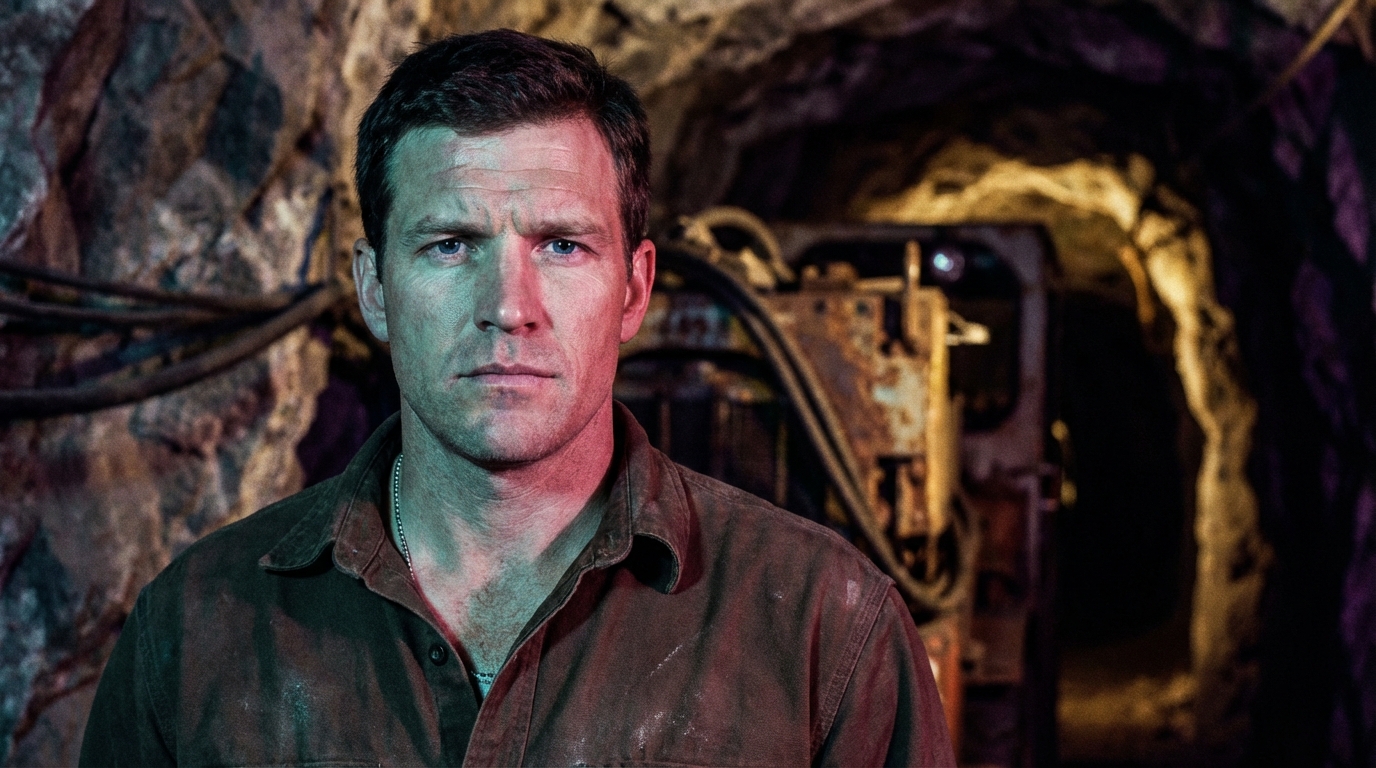
William "Bill" Mitchell (born 1960) is the eldest child of Richard and Margaret Mitchell, a mining engineer who inherited his father's pragmatic worldview and dedication to the industry that built Broken Hill. Where his mother collected folklore and his brother Ethan heard whispers from the dead, Bill anchored himself in the tangible certainties of geology, mathematics, and mechanical systems. His career spanning four decades saw him rise from graduate engineer to operations manager, earning respect for technical expertise and uncompromising standards. He maintains the family home on Garnet Street and remains a fixture of Broken Hill's mining community—steady, reliable, and forever puzzled by the brother he could never understand.
Birth and Early Childhood
William Richard Mitchell was born on 3 March 1960 at Broken Hill District Hospital, the first child of Richard and Margaret Mitchell. His arrival transformed the young couple's rented cottage on Garnet Street into a family home, and Richard—twenty-four years old, already established as a reliable shift supervisor—felt the weight of fatherhood settle onto shoulders that seemed built for bearing such loads.
From his earliest months, Bill displayed the temperament that would define his life. He was a quiet baby, content to observe his surroundings with serious eyes that seemed to calculate rather than simply see. He reached developmental milestones with methodical precision—crawling, walking, speaking—each accomplishment approached as a problem to be solved rather than a spontaneous emergence. Margaret, watching her son dismantle his wooden blocks only to rebuild them in different configurations, recognised that she had produced a child whose mind worked very differently from her own.
The cottage on Garnet Street sat within sight of the mine headframes that dominated Broken Hill's skyline, their silhouettes as familiar to young Bill as the faces of his parents. He grew up with the rhythms of shift changes, the distant rumble of machinery, and the perpetual presence of red dust that settled on every surface despite Margaret's constant cleaning. The mines were not abstract concepts but immediate realities—the source of his father's income, the subject of adult conversations, the ever-present backdrop against which childhood unfolded.
Richard proved a natural father to his firstborn son in ways that would later prove impossible with Ethan. He understood Bill instinctively—the boy's fascination with how things worked, his preference for building over imagining, his satisfaction in tasks completed correctly. On weekends, father and son would work together in the small shed behind the cottage, Richard explaining the principles behind simple machines while Bill listened with focused attention that belied his young age.
A Practical Education
Bill attended Broken Hill Public School from 1965, walking the dusty streets each morning with the same purposeful stride his father brought to everything. He proved an excellent student in subjects that rewarded logical thinking—mathematics, science, technical drawing—while showing less enthusiasm for the creative pursuits his mother valued. His essays were competent but uninspired; his drawings technically accurate but lacking imagination; his reading focused on factual texts rather than the stories Margaret pressed upon him.
This divergence from his mother's interests created no conflict during his childhood. Margaret understood that her eldest son had inherited his father's mental architecture, and she loved him no less for it. She continued sharing her stories and her folklore, accepting Bill's polite disinterest as simply who he was rather than a rejection of who she was. The household accommodated both perspectives without requiring either to change.
At Broken Hill High School, Bill's academic strengths crystallised into clear direction. He excelled in physics and advanced mathematics, won prizes in technical drawing competitions, and began speaking seriously about engineering as a career. His teachers recognised a student whose abilities matched his ambitions—someone who would not merely follow in his father's mining footsteps but would elevate the family's involvement in the industry to professional rather than labour status.
Richard watched his son's academic achievements with quiet pride that he struggled to express verbally. Everything he had hoped for—a son who valued practical work, who understood the importance of industry, who would carry the Mitchell name forward with distinction—seemed to be materialising in Bill's steady progress. The gap between labourer and engineer was one Richard had never bridged himself; watching his son prepare to cross it felt like a vindication of everything he had worked for.
The Middle Child and the Youngest
Sarah's arrival in 1963 expanded Bill's world without threatening his place within it. He was three years old when his sister was born, old enough to understand that the new baby required attention but secure enough in his parents' affection not to resent the redistribution. He approached Sarah with the same analytical curiosity he brought to everything—observing her development, helping when permitted, maintaining a protective distance that would characterise their relationship throughout their lives.
Ethan's birth in 1968 was different. Bill was eight years old, already firmly established in his identity as the practical son, when this unexpected third child arrived. From the beginning, something about his youngest brother unsettled him in ways he couldn't articulate. Ethan seemed to look through things rather than at them, seemed to respond to stimuli that Bill couldn't detect, seemed fundamentally disconnected from the solid world Bill inhabited.
As the years passed and Ethan's peculiarities became more pronounced, Bill's discomfort hardened into dismissal. He had no framework for understanding a brother who claimed to hear voices, who spent hours in cemeteries, who seemed more interested in the dead than the living. Their father's frustration with Ethan mirrored Bill's own feelings, creating an unspoken alliance of pragmatists against the incomprehensible youngest Mitchell.
"He's not right," Bill told Sarah once, during their teenage years, after witnessing Ethan conduct one of his strange conversations with empty air. "There's something wrong with him. Mum encourages it, but she's making it worse."
Sarah, ever the mediator, tried to explain that Ethan was simply different, not damaged. Bill listened politely and remained unconvinced. Some differences were too fundamental to bridge, and his brother's apparent connection to the supernatural was one of them.
University and Professional Training
In 1978, Bill enrolled at the University of New South Wales to study mining engineering, becoming the first Mitchell to pursue tertiary education. The decision represented both continuation and elevation—he would work in the same industry that had employed his father and grandfather, but from a position of professional expertise rather than manual labour. Richard contributed what he could toward the expenses, supplemented by scholarships Bill had earned through academic excellence.
Sydney proved initially overwhelming for a young man who had never left the outback. The scale of the city, the pace of its rhythms, the anonymity of its crowds—everything contrasted sharply with Broken Hill's familiar intimacy. But Bill adapted with characteristic determination, channelling his discomfort into focused study and emerging from each semester with results that justified his family's investment.
His engineering training provided the intellectual framework he had always craved. Geology, mineralogy, structural mechanics, extraction processes—each subject offered systematic understanding of phenomena he had observed throughout childhood without fully comprehending. He learned to read rock formations like texts, to calculate load tolerances and failure points, to design systems that would function safely under conditions that killed the careless or unprepared.
During summer breaks, Bill returned to Broken Hill and worked at the mines where his father served as foreman. These periods bridged theory and practice, allowing him to apply classroom knowledge to real-world operations while learning the unwritten rules that no textbook could teach. The workers respected young Bill Mitchell—not merely because of his father's position, but because he approached the work with genuine competence and showed none of the arrogance that sometimes afflicted university graduates.
Return to Broken Hill
Bill graduated in 1982 with first-class honours and multiple job offers from mining companies across Australia. He could have pursued opportunities in Western Australia's booming iron ore sector, in Queensland's coal fields, in corporate offices far removed from the underground operations where his father had spent his life. Instead, he accepted a position with Broken Hill Associated Smelters, returning to the town where he had been born.
The decision surprised some of his university colleagues, who viewed Broken Hill as a declining town whose best days lay behind it. But Bill understood something they didn't: that home was not merely a location but a network of relationships, responsibilities, and roots that couldn't be replicated elsewhere. His parents were ageing; his siblings needed the stability of his presence; the community that had shaped him deserved whatever expertise he could offer in return.
His early career focused on ore processing and extraction efficiency—technical challenges that allowed him to demonstrate his capabilities while avoiding the political complexities of management. He developed a reputation for thoroughness, for solutions that worked reliably rather than impressively, for an unwillingness to cut corners even when schedules demanded it. His father's influence was obvious to anyone who knew both men; Bill had inherited not just Richard's worldview but his professional standards.
By the late 1980s, Bill had advanced to senior engineer, responsible for significant aspects of operations at multiple sites. His salary allowed him to purchase a modest house on Chloride Street, close enough to his parents' cottage for regular visits but separate enough to maintain the independence appropriate to a man approaching thirty. He was establishing himself as a permanent fixture of Broken Hill's professional class—respected, reliable, and increasingly essential.
Marriage and Family
Bill met Christine Hayes at a mining industry conference in Adelaide in 1985. She was a geologist working for a mineral exploration company, possessing the same practical intelligence and professional dedication that characterised Bill himself. Their courtship was measured and methodical—dinners when work brought them to the same cities, letters exchanged between visits, a gradual building of connection that neither rushed nor dramatised.
They married in December 1987 at St Peter's Anglican Church in Broken Hill, the ceremony attended by both families and numerous colleagues. Richard served as best man for his son, his pride evident despite his difficulty expressing it verbally. Margaret watched the union of two pragmatic souls with affection tempered by recognition that Christine would never share her interest in the unseen dimensions of existence. Ethan attended but remained peripheral, his presence acknowledged rather than integrated into the celebration.
Christine relocated to Broken Hill following the wedding, accepting a position with a local exploration company that valued her expertise. The marriage proved as stable as both parties had anticipated—built on shared values, mutual respect, and complementary professional ambitions rather than romantic intensity. They understood each other in ways that Bill's parents, despite their decades together, never quite achieved.
Their daughter Emma was born in 1990, followed by son Daniel in 1993. Bill approached fatherhood with the same methodical competence he brought to engineering—reading parenting guides, establishing routines, providing the structure and stability he believed children required. He was not an effusive father, any more than Richard had been, but his children never doubted his commitment to their welfare or his pride in their achievements.
The Tragedy of Violet Dallow
When news broke in October 1988 that Ethan had been conducting a secret relationship with sixteen-year-old Violet Dallow—the girl murdered by the Silverton Strangler—Bill's reaction combined horror with grim confirmation. Everything he had feared about his brother seemed validated: Ethan's obsession with death and darkness had drawn an innocent girl into his orbit, and now she was dead.
He knew, intellectually, that Ethan hadn't killed Violet. The police investigation established that clearly enough, and even Bill's suspicions didn't extend to believing his brother capable of murder. But the circumstances surrounding the relationship—the clandestine meetings in cemeteries, the shared fascination with the supernatural, the age gap that bordered on inappropriate—reinforced Bill's conviction that Ethan's lifestyle was fundamentally unhealthy and potentially dangerous to those around him.
The weeks following Violet's murder strained the family to its limits. Richard retreated into disappointed silence; Margaret tried to comfort a son whose grief exceeded any consolation she could offer; Sarah attempted to mediate between factions that couldn't find common ground. Bill kept his distance, visiting the family home less frequently, focusing on work and his own nascent family as if increased separation could somehow protect them from the contamination of tragedy.
He never discussed Violet Dallow with Ethan directly. The subject remained untouched in the few conversations they shared over subsequent years, a void around which they carefully navigated. Bill didn't know what he would say if the topic arose—whether he would express sympathy or criticism, whether he would acknowledge his brother's loss or condemn the circumstances that led to it. Silence proved easier than confrontation.
Career Advancement
The 1990s brought both professional advancement and industry transformation. Bill rose through management ranks as Broken Hill's mining operations consolidated under changing corporate ownership, his technical expertise complemented by developing administrative capabilities. By 1995, he had been appointed operations manager for a significant portion of local extraction activities—a position that placed him among the town's industrial leadership.
The role brought challenges beyond the purely technical. He navigated workforce reductions as mechanisation reduced labour requirements, maintaining morale among remaining employees while implementing efficiencies demanded by distant corporate offices. He advocated for safety improvements that honoured his father's legacy, sometimes clashing with accountants who viewed every protocol as an unnecessary expense. He represented the company at community meetings, absorbing criticism for decisions he hadn't made while defending standards he genuinely believed in.
Richard's declining health through the late 1990s and early 2000s added personal weight to professional pressures. Bill visited his parents regularly, watching his father diminish as lung disease claimed the vitality that had once seemed inexhaustible. He took over maintenance tasks around the Garnet Street cottage, ensuring that the home his parents had occupied for four decades remained functional even as its original custodian lost the capacity to maintain it.
When Richard entered hospital for the final time in October 2002, Bill was there alongside Margaret and Sarah. Ethan visited too, his presence awkward and his grief private, but it was Bill who delivered the eulogy at St Peter's Anglican Church—standing at the pulpit where his parents had married, speaking words that captured his father's public virtues while leaving private complexities unaddressed.
Inheritance and Responsibility
Richard's death left Bill as the family's de facto patriarch—a role he assumed without fanfare but with characteristic thoroughness. He inherited the Garnet Street cottage per his father's wishes, maintaining it as Margaret's home while managing the practical details she found increasingly difficult. He coordinated family gatherings, ensured his mother's needs were met, and provided the stable centre around which his scattered siblings could periodically orbit.
His relationship with Ethan remained distant but not hostile. They saw each other at Christmas dinners, at Margaret's birthday celebrations, at the occasional family event that drew all three siblings together. Bill had long since abandoned hope of understanding his brother; he settled instead for peaceful coexistence, accepting that some gaps couldn't be bridged regardless of shared blood.
Christine proved an invaluable partner during these years, managing household logistics while Bill balanced family responsibilities with ongoing professional demands. Emma and Daniel grew into capable young adults—Emma pursuing medicine in Adelaide, Daniel following his father into engineering with a position in Perth's mining sector. Bill watched his children establish independent lives with the quiet satisfaction of someone who had fulfilled his obligations successfully.
Margaret's decline through the early 2010s brought a new phase of caregiving. Bill and Christine visited frequently, supplementing the professional support Sarah arranged through her nursing connections. He handled finances, coordinated medical appointments, and made the practical arrangements that dying required. When Margaret passed in August 2015, Bill was present—as he had been for his father—watching another parent slip away while remaining steady enough to support those who grieved more visibly.







