Whitford, Devon, England
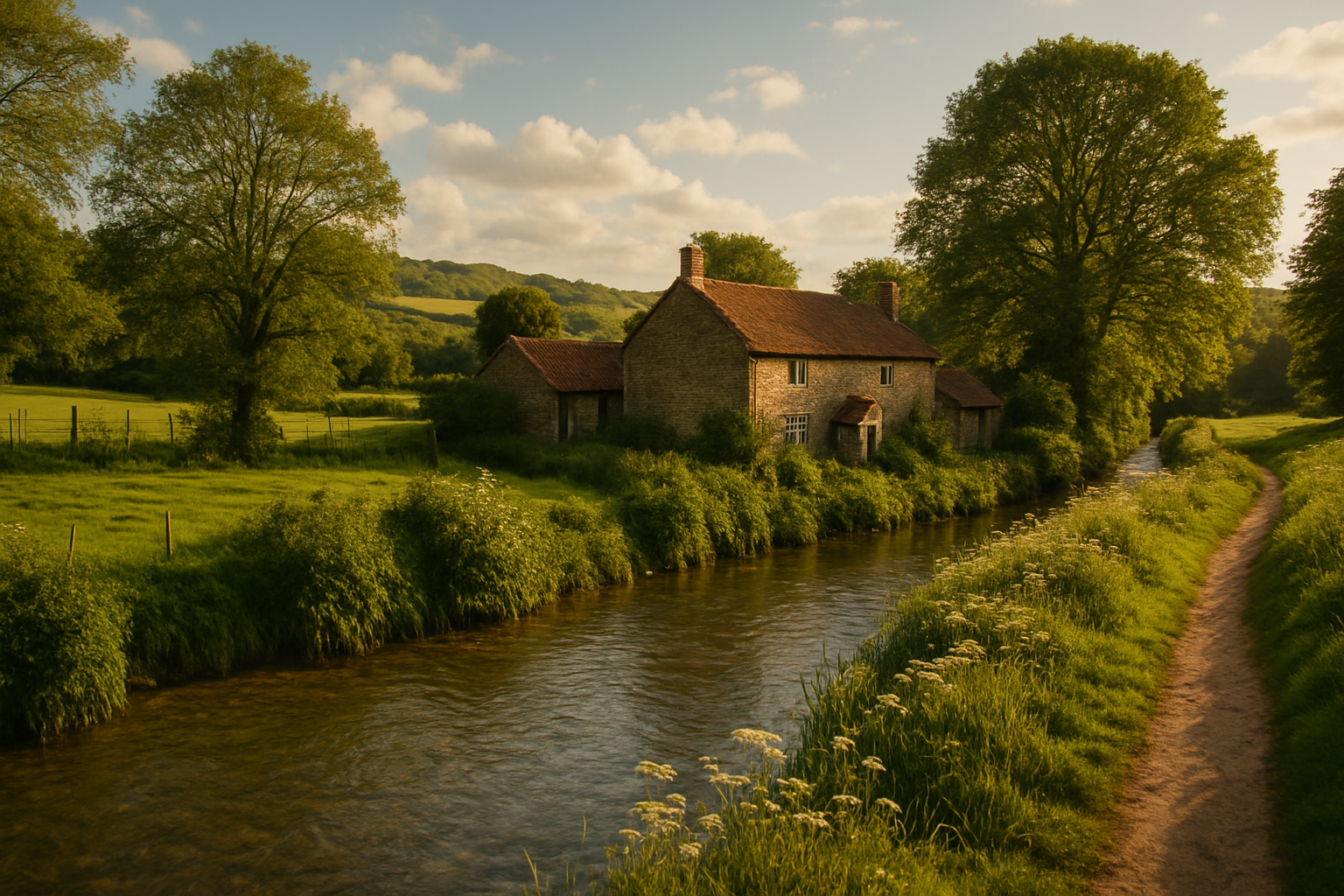
Whitford is a small village in the parish of Shute in East Devon, set on the western bank of the River Axe some three and a half miles south-west of Axminster. With a population of barely two hundred, it is a place of thatched cottages, patchwork farmland, and quiet lanes within the East Devon Area of Outstanding Natural Beauty. From this unassuming setting, Artair Steffen carried a tradesman's instincts to a very different landscape.
Setting and Geography
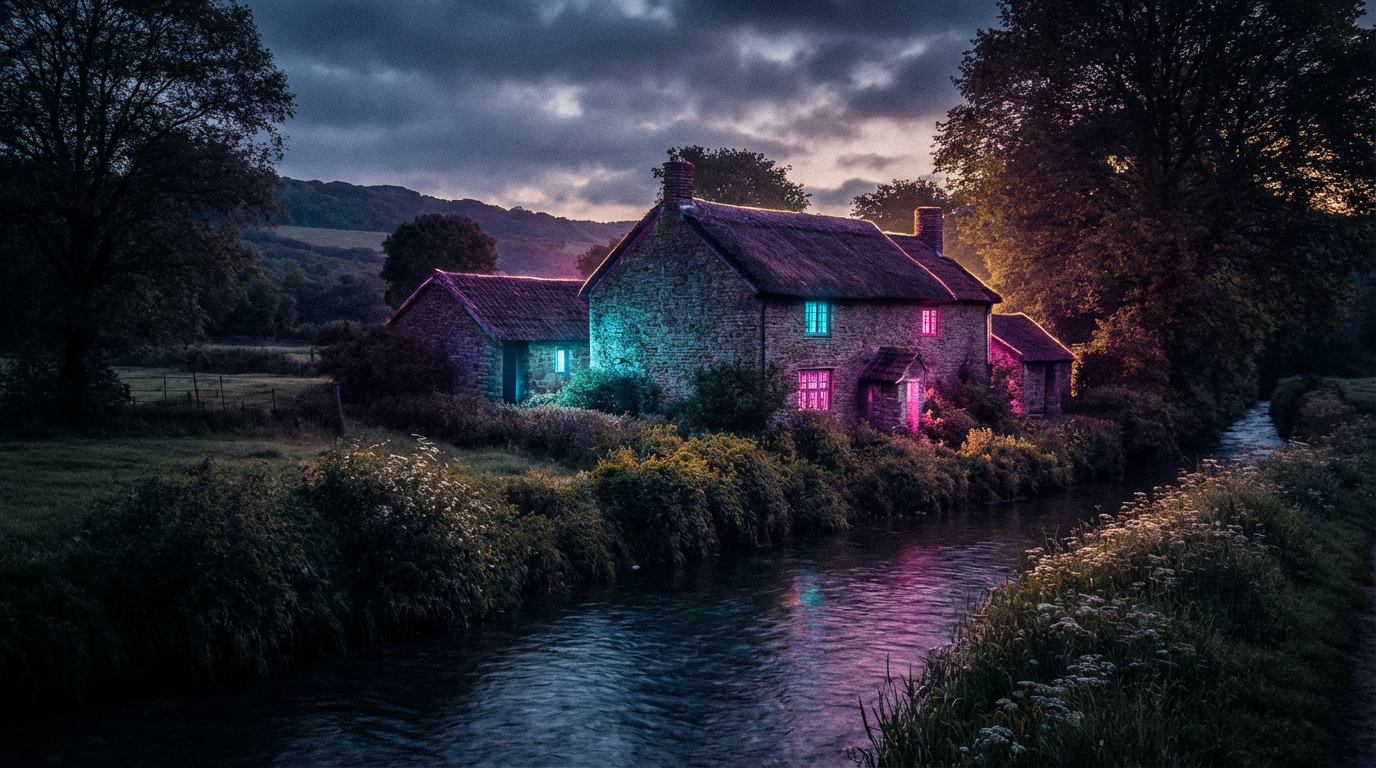
Whitford occupies a gentle stretch of the Axe valley in East Devon, the village strung along the western bank of the River Axe where a small bridge with a weir beneath it carries a lane eastward to join the A358 at Musbury. The landscape is pastoral and unhurried — low hills, mixed farmland, hedgerows thick with hazel and blackthorn, and the river winding south through marshland toward the sea at Axmouth. The Jurassic Coast lies barely four miles to the south at Seaton, and the market town of Axminster — the nearest settlement of any real size — sits three and a half miles to the north-east. The West of England Main Line passes through a cutting near the village, though it does not stop here. Whitford falls within the East Devon Area of Outstanding Natural Beauty, a designation that reflects both the quality of the landscape and the absence of any pressure to develop it.
Parish and Early History
Whitford has historically formed part of the parish of Shute, a rural parish on the River Axe whose manor passed through a succession of notable families — the Shutes, the Bonvilles, the Peters, and the Poles — before settling with the De la Pole baronets. The name Whitford suggests a white or clear ford, likely a crossing point on the Axe or one of its tributaries, and the settlement's origins are those of a farming hamlet dependent on the river and the surrounding fields. The 1894 Comprehensive Gazetteer of England and Wales recorded Whitford as "a village in Shute parish, Devonshire, 3½ miles SW of Axminster," noting little more than a post office and a Bible Christian chapel.
The present church, St Mary at the Cross, was built in 1908 as a daughter church — or mission church — to St Michael's in Shute. A modest stone building seating thirty-six, it serves today as part of the Five Alive Mission Community, a grouping of five parish churches spanning Dalwood, Kilmington, Shute, Yarcombe, and Stockland. Special services are held for festivals, but the days of a resident clergyman are long past. Like much of rural East Devon, Whitford's spiritual life has contracted to a handful of faithful attendees and the rhythms of the church calendar.
Agricultural Life and Modest Industry
Whitford's economy has always been agricultural. The Axe valley's heavy clay soils support mixed farming — cattle grazing, arable crops, and the orchards that once produced cider on every Devon farmstead. Through the nineteenth and early twentieth centuries, the village sustained itself on this basis, supplemented by the kind of small-scale trades that every rural community required: a blacksmith, a wheelwright, the seasonal labour of hedging and ditching.
In the decades following the Second World War, a small engineering workshop was established on the edge of the village under the name North Axe Precision Engineering. Operating from a converted agricultural building, it specialised in small-batch machining for local farm equipment and, later, component work for regional subcontractors in the rail and automotive trades. By the standards of a hamlet, it was a significant employer — at its peak in the 1980s, perhaps a dozen men worked there, with others in the village supporting the operation through haulage and supplies. Among those employees was Iain Steffen, a machinist of quiet temperament and considerable skill with lathe work, whose wife Margaret managed the village's public house, The Lamb and Forge, which served as the settlement's unofficial gathering place and social hub.
By the 2010s, the workshop's relevance had diminished. Outsourcing, automation, and the broader contraction of small-batch manufacturing in rural areas reduced it to a skeleton operation, and its partial closure removed one of the few sources of non-agricultural employment in the village. The loss was felt keenly in a community where alternative work meant a car journey to Axminster or beyond.
Village Life
Whitford has never had its own secondary school; children have traditionally attended institutions in Seaton or Axminster, a bus ride along narrow lanes. Primary education has been provided by a small village school, its Victorian-era building long since supplemented by modular classrooms. Public transport remains limited — a bus service connects to Axminster, but the village's daily commerce depends on the car. A corner shop and the pub constitute the commercial heart of the settlement, such as it is. Broadband arrived later than in surrounding areas, and mobile coverage remains patchy — facts that would surprise no one familiar with the infrastructure challenges of deep rural Devon.
The village hall, maintained by its trustees with the modest budgets and determined volunteerism characteristic of such places, hosts the events that bind the community together: produce shows, quiz nights, seasonal fairs, and the occasional fundraiser. The population — estimated at a little over two hundred — has remained stable, though its age profile has shifted as younger residents leave for employment elsewhere and retirees settle into the thatched cottages and converted farm buildings that estate agents describe, with varying accuracy, as "characterful."
Artair Steffen
Among the few residents to carry Whitford's name beyond Devon, Artair Steffen was born on 14 March 1993, the son of Iain Steffen, the machinist at North Axe Precision Engineering, and Margaret Wallis, who ran The Lamb and Forge. His childhood was typical of Whitford's working families: practical education with an emphasis on trades, workshop afternoons with his father, cycling along the lanes, and fishing in the tributaries of the Axe. He attended technical college rather than university, acquiring skills in metalwork and track-laying that would find unexpected application far from the Axe valley.
In 2019, Artair left Whitford for Bixbus, where he played a central role in the construction of the Bixbus to Brierly Railroad — a feat that married his technical training to a scale of ambition that Whitford's modest workshop could never have offered. He married Calla Evans, a local teacher, in 2020, and together they had two children, Lachlan and Isla. His story is quietly noted at The Lamb and Forge, where older patrons recall the boy with a rucksack of tools and a facility for precision that his father would have recognised at once.
The Village Today
Whitford remains what it has always been: a place too small for a post office, too quiet for a through road, and too stubbornly itself to pretend otherwise. The thatched cottages along the lane still face the river. The bridge still carries the occasional tractor. St Mary at the Cross still opens for festivals. The landscape — the patchwork fields, the hedgerows, the Axe moving slowly south toward the coast — is unchanged in any way that would trouble a returning visitor of fifty years ago. Whether this constitutes resilience or stagnation depends entirely on who is asked, and Whitford has never been a place that invites the question.







