4310.284 · October 11, 1990 AD
Wheels Off the Edge
Amid the sterile corridors of the Adelaide Children’s Hospital, Luke and Gloria escape into reckless play that blurs danger with delight. But when laughter collides with collapse, the fragile boundary between childhood freedom and harsh reality is shaken.
“Sometimes the only way to forget the pain is to race so fast you feel like you might fly—even if you know the crash is coming.”
The wheels were screaming.
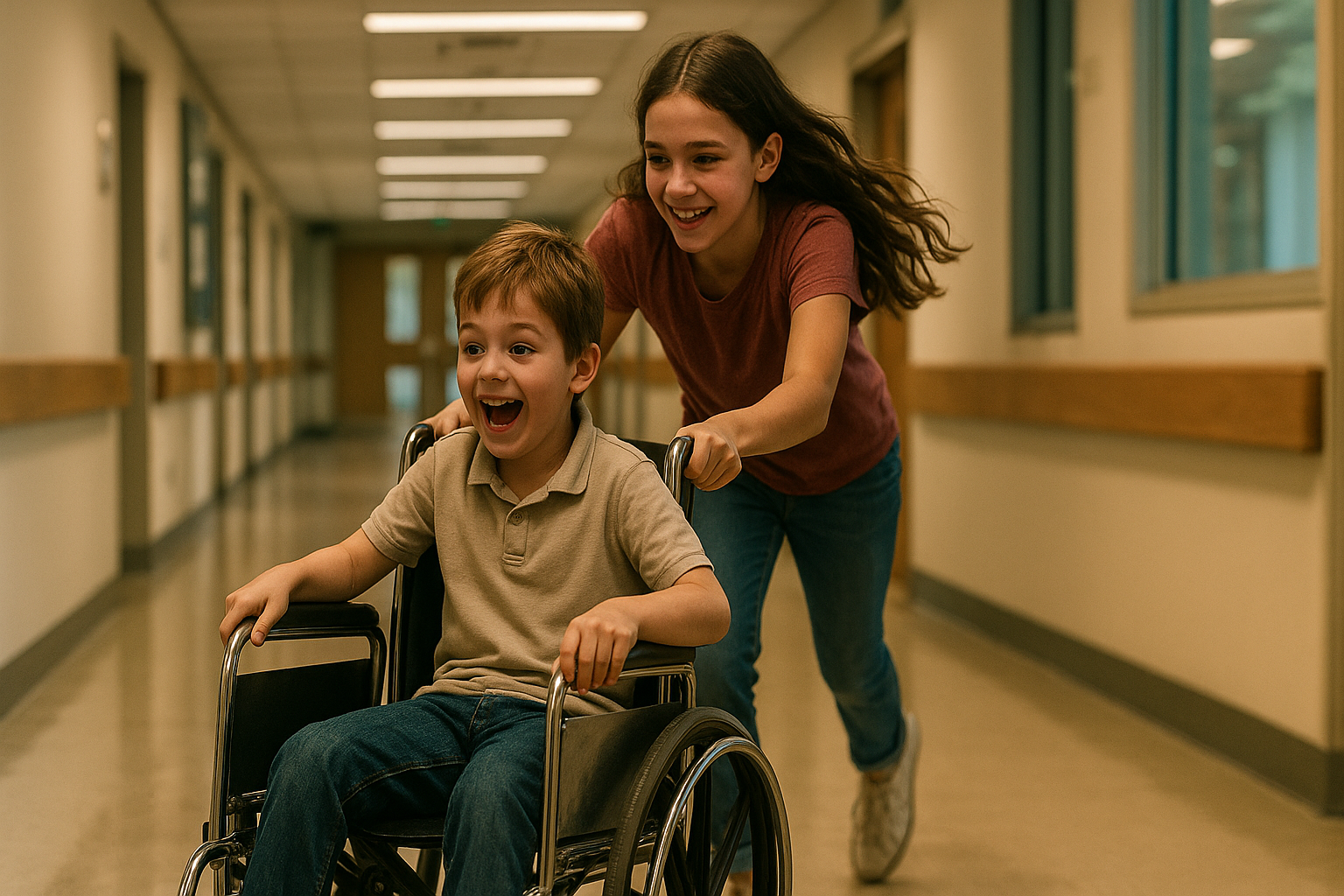
Not screaming like people screamed—not like the sounds that came from behind closed doors sometimes, or the way Mum's voice went high and tight when she was pretending everything was fine. This was a different kind of screaming. Metal on tile. Rubber burning against the floor. The whole wheelchair shaking and rattling like it might fly apart at any second.
I gripped the armrests so hard my fingers hurt.
"Gloria, slow down!" The words ripped out of me, half-laughing, half-terrified. "We're going to crash!"
But she didn't slow down. She never slowed down. I could hear her feet slapping against the floor behind me—those horrible beige hospital slippers we all had to wear, the ones that smelled like plastic and made your feet sweat. Slap-slap-slap-slap, faster and faster, and the wheelchair lurched forward like a living thing trying to escape.
The corridor blurred past. White walls. Green notice boards. The hand hygiene poster with the cartoon germs that always made Gloria pretend to gag. The drawings taped up by some volunteer—wobbly houses and stick-figure families and suns with too many rays, all the things kids drew when adults asked them to draw something happy.
I wasn't happy. I was terrified.
I was so happy.
The air rushed past my ears like water, like the sound inside a seashell but louder, wilder. My hospital gown flapped against my legs and the cold hit my skin in gusts and I could feel my heart slamming against my ribs like it wanted to get out, like it wanted to run even faster than Gloria was pushing us.
This was the best feeling in the world.
The fluorescent lights flickered overhead—they always flickered in this corridor, the one near the supply cupboard where we weren't supposed to play but always did—and for a second everything strobed like a disco. Light-dark-light-dark. Gloria was giggling behind me, that high sound she made when she was really happy, when she forgot about the tubes and the pills and the way her joints swelled up sometimes so bad she couldn't even hold a pencil.
I loved that sound. I loved it more than anything.
"Hold on, Luke!" she shouted, and her voice was breathless and bright and alive. "Here comes your favourite corner!"
My favourite corner. She knew it was my favourite corner because she'd made it my favourite corner. The first time we did this—weeks ago, maybe months, time got funny in here—she'd taken the turn so fast I'd thought we were going to tip right over. My stomach had dropped like on a swing when you went too high, and I'd screamed, and she'd laughed so hard she'd had to stop and catch her breath, bent over with her hands on her skinny knees.
Now she did it every time. For me. Because she knew I loved it.
I could picture her behind me even though I couldn't see her—her long golden-brown hair streaming out like a flag, whipping across her face when the air caught it. She was twelve, which meant she was basically a grown-up compared to me. More than twice my age. But she never treated me like a little kid. Well, except when she wanted to boss me around, which was a lot. But even that was okay. Even that was good.
"Brace yourself!" she yelled, and I could hear the grin in her voice.
The corner came at us fast. The wheelchair's small front wheels weren't made for this—they were made for slow, careful rolling, for nurses pushing sick kids to X-ray or the toilet or the sad little courtyard where you could sit outside if you were well enough. They weren't made for racing. They definitely weren't made for Gloria.
She yanked the handles and the whole chair tilted. For one perfect, terrifying second, I was sure we were going to flip. The left wheels lifted off the ground and I grabbed the armrests so hard my knuckles went white and my stomach swooped up into my throat and—
We made it.
The wheels slammed back down and we shot around the corner and Gloria let out a whoop that echoed off the walls like a victory cry. I was laughing too, the sound punching out of me in gasps, my whole body shaking with it.
The Adelaide Children's Hospital had become my second home over the past year. No—more than that. It had become my first home, the place I actually lived, with our flat in Adelaide being the place I sometimes visited when the doctors said I was well enough. I knew every corridor, every nurses' station, every supply cupboard. I knew which vending machine sometimes gave you two chocolate bars if you pressed the button just right. I knew which toilet had the broken lock that you had to hold shut with your foot. I knew which nurses would let you stay up past lights-out and which ones would tell you off for running in the halls.
Not that Gloria and I ran, exactly. She couldn't run properly anymore—her joints were too sore, too swollen, too wrong. The sickness inside her, the one she'd told me about once in that matter-of-fact voice she used when she didn't want to cry, had been eating at her for five years now. Since she was seven. Since before I could even remember being alive.
"Five years and counting," she'd said, like it was something to be proud of. And maybe it was. Maybe surviving that long in here was an achievement. Every day was a battle against the thing inside you that was trying to win.
I didn't really understand what was wrong with her. The doctors used long words—lupus, autoimmune, systemic—that sounded like spells from a fairy tale, the bad kind that cursed princesses to sleep forever. All I knew was that Gloria hurt a lot, and she was tired a lot, and sometimes her face got puffy and red from the medicines they gave her, and sometimes she had to lie in bed for days and days and couldn't even sit up to play Uno.
But when she was good—when she was Gloria—she was the brightest thing in the whole hospital. Brighter than the fluorescent lights. Brighter than the sun through the window in the morning. She made everything better just by being there.
We hurtled down the long stretch of corridor past the nurses' station. I caught a glimpse of Nurse Weatherby looking up from her paperwork, her mouth opening to say something—probably to tell us off—but we were past her before the words came out. Gloria's slippers slapped even faster against the tiles, her breath coming in short, sharp gasps.
She was pushing herself too hard. I knew she was. She'd been in bed most of yesterday, her joints so swollen she'd cried when she thought no one was looking. But that was Gloria. She didn't let the sickness win. She didn't let anything win.
"Faster!" I shouted, even though part of me was scared. The scared part was getting smaller, swallowed up by the wild, rushing joy of it. "Faster, Gloria!"
She laughed—that high, bright sound—and somehow found another gear. The wheelchair rattled and shook and the wheels screamed their metal-on-tile scream and the world became a blur of white and green and flickering fluorescent light.
This was what we did. This was who we were. In a place where everything was about being sick, about being careful, about lying still and letting the doctors poke you and the nurses measure you and the machines beep their endless beeping—we had found a way to be alive. Really alive. The kind of alive that made your heart pound and your stomach flip and your face hurt from smiling.
The paediatric ward on the third floor was our kingdom. Gloria called herself the queen and me her loyal knight, and sometimes we spent whole afternoons making up stories about our royal adventures. The supply cupboard was our castle. The corridor was our racing track. The sad little courtyard was our enchanted garden, even though it was really just some scraggly bushes and a bench that birds had pooped on.
Other kids came and went. Some of them got better and went home, and we'd wave goodbye and feel happy for them and also a little bit jealous. Some of them got worse and went somewhere else—somewhere the adults didn't talk about, somewhere that made the nurses go quiet and the doctors look at the floor. We didn't talk about that either. It was easier not to.
But Gloria stayed. Month after month. She was the permanent resident, the one who knew all the secrets, the one who had turned this place of sickness and sadness into something that was ours.
I could hear Gloria's breathing getting ragged behind me. Too fast. Too harsh. The sound of someone pushing past what their body wanted to give.
"You okay?" I twisted in the wheelchair, trying to look back at her.
"Fine!" she gasped. "Don't—don't you dare tell me to stop, Luke Smith!"
I wasn't going to tell her to stop. I would never tell her to stop. Because I understood, even at six years old, that this was important. This wasn't just playing. This was Gloria proving to herself—to the sickness, to the doctors, to everyone—that she was still her. That the thing inside her hadn't won yet.
So I held on tighter and faced forward and let her push us as fast as she could go.
The corridor stretched out ahead of us, long and white and empty. The lights buzzed overhead, that constant low hum that became invisible when you'd lived here long enough. Someone had mopped recently—I could smell the sharp chemical tang of disinfectant, the smell that meant hospital in a way nothing else did. It was the smell of my life. The smell of being sick, of waiting, of hoping for something I couldn't quite name.
But right now, with the wind in my face and Gloria's laughter behind me and the whole world blurring into streaks of colour—right now, that smell didn't matter. Nothing mattered except this moment, this feeling, this wild and reckless and completely forbidden joy.
"Coming up on the big one!" Gloria shouted. "The corner by the lift!"
My stomach clenched. The corner by the lift was the sharpest turn in the whole ward. It was the one that always made the wheelchair groan and tilt and threaten to spill me onto the cold tile floor. It was the best one.
"Do it!" I yelled back.
Gloria's feet pounded harder. The wheelchair picked up speed. The corner rushed toward us, that sharp right angle where the corridor met the lift bay, and I could see the dented wall where someone—probably us—had crashed before. The scuff marks on the tiles. The poster about fire safety that was always peeling at one corner.
"Here we go!"
She yanked the handles. The wheelchair tilted—further than usual, further than safe. I felt the left wheels leave the ground and for a moment I was flying, suspended, the world rotating around me in slow motion. Gloria's gasp. The squeal of rubber. The cold air rushing past my face.
And then—
The sound.
It was a crack. Sharp and metallic, like something breaking that wasn't supposed to break. Not a big sound, but wrong—the kind of wrong that made your stomach drop even before you understood what it meant.
The wheelchair lurched. Dropped. The whole back corner collapsed where the wheel had been, and suddenly we weren't flying anymore—we were falling, tipping, the world spinning the wrong way.
I had time to think oh no and then the floor came up to meet me.
The impact knocked everything out. Air, thought, feeling—all of it punched away in a single instant of bang that rattled through my whole body. My shoulder hit first, then my hip, then my head bounced off the tiles with a sound like a coconut falling. Stars exploded behind my eyes. The ceiling swam above me, those familiar tiles with their tiny holes, but these were different tiles, wrong tiles, tiles I was seeing from the floor instead of from my bed.
Somewhere nearby, I heard Gloria yelp. The soft thump of knees hitting the ground. A clatter of metal—the wheelchair, I realised dimly, falling onto its side.
For a long moment, neither of us moved.
The fluorescent lights buzzed overhead. Somewhere down the corridor, a monitor beeped its steady rhythm. The air smelled like disinfectant and floor wax and something else, something metallic that I realised was the inside of my mouth, where I'd bitten my tongue.
I lay there, staring at the ceiling, trying to remember how to breathe.
Pain arrived slowly, in pieces. First my shoulder, which felt like someone had punched it very hard. Then my hip, throbbing in a deep, dull way. Then my head, which had started to ache where it had bounced off the floor. I could feel the cold of the tiles seeping through my hospital gown, could feel the grit of dust against my cheek.
I turned my head—slowly, carefully—and found Gloria.
She was on her knees a few feet away, her palms pressed flat against the tiles. Her golden-brown hair had fallen over her face, hanging in tangled curtains. Her shoulders were shaking.
For one terrible second, I thought she was crying.
Then I heard it. The snort. The wheeze. The high-pitched squeak that escaped through her clenched lips.
She was laughing.
She lifted her head and I saw her face—red and sweaty, her eyes scrunched shut, her mouth twisted into a shape that couldn't decide if it was a grin or a grimace. Tears were leaking from the corners of her eyes, but they were the good kind of tears. The laughing kind.
"Did you—" she gasped. "Did you see—the wheel—"
I didn't see it. I couldn't see anything except Gloria, shaking with laughter on the floor of the paediatric ward, her hospital gown bunched up around her bruised knees.
And then, somehow, I was laughing too.
It hurt. Every breath sent a jolt through my bruised shoulder, my aching ribs, my throbbing head. But I couldn't stop. The laughter came pouring out of me like something that had been locked up too long, great gasping waves of it that made my whole body shake against the cold floor.
We must have looked ridiculous. Two sick kids sprawled in the corridor, one in a hospital gown, one in pyjamas covered with faded cartoon elephants, laughing like we'd just heard the funniest joke in the world. The wheelchair lay on its side nearby, its back left wheel completely snapped off, the metal frame bent at an angle that looked almost painful.
"We broke it," Gloria wheezed. "We actually—we actually broke it."
"The wheel came off!" I couldn't believe it. We'd bent things before, scraped things, dented things. But we'd never actually broken something. Not completely. Not like this.
"Went flying." Gloria mimed the trajectory with one hand, her fingers spinning through the air. "Did you see? Flew right off and—and—" She collapsed back into giggles, her hand pressed against her mouth.
I dragged myself up onto one elbow, wincing at the protest from my shoulder, and looked around. The corridor was empty—miraculously, impossibly empty. No nurses rushing toward us with stern faces. No doctors with clipboards and frowns. No orderlies with mops giving us the look that said I know what you did.
Just us. Just the broken wheelchair. Just the wheel, which had rolled a few metres away and come to rest against the wall, leaning against a mop bucket like it was tired.
"We're in so much trouble," I said, but I was grinning so hard my face hurt.
"So much trouble." Gloria was grinning too, her face flushed, her eyes bright. "This isn't just lose-television-privileges trouble. This is—this is incident report trouble. Meeting-with-the-ward-administrator trouble."
"They're going to kill us."
"Completely murder us."
We looked at each other. Gloria's hair was a mess, sticking up at odd angles, strands of it caught in the corner of her mouth. I could feel a lump rising on the side of my head where it had bounced off the floor. We were both going to have bruises. Gloria collected them like other girls collected stickers—she'd shown me once, pulled up her sleeve to display the purple-yellow map of marks that dotted her thin arms. "Battle scars," she'd called them. "Proof I'm still fighting."
Now we had matching battle scars. Proof of our greatest adventure yet.
"Worth it," Gloria said.
I nodded. "Completely worth it."
And there, lying on the cold tile floor of the Adelaide Women's and Children's Hospital, surrounded by the sharp smell of disinfectant and the distant beeping of monitors and the evidence of our spectacular crime—there, in that moment, I was happier than I'd ever been.
Gloria was still giggling, that high bright sound that I loved more than anything in the world.
All I knew was that we were alive, and we were together, and for just a few minutes, we had flown.







