
4292.133 · May 12, 1972 AD
Violet Dallow
Violet Dallow (1972–1988) was a spirited, adventurous, and fiercely independent young woman from Broken Hill, New South Wales, whose curiosity and love for mystery defined her short life. The eldest daughter of Robert and Evelyn Dallow, she excelled in history, literature, and creative writing, drawn to unsolved disappearances and forgotten stories. She shared a close bond with her friends Mandy, Michelle, and Rebecca and secretly dated Ethan Mitchell, a mysterious "ghost whisperer." Her fascination with a historical missing persons case seemed to foreshadow her own tragic fate when, on 30 September 1988, during a Girl Guides camping trip in Silverton, she was abducted and later found murdered, her case linked to the notorious Silverton Strangler. Her death devastated her family, leading her sister Jasmine to establish the Violet Fund in her memory, ensuring her name would be remembered in the fight for justice and missing persons investigations.
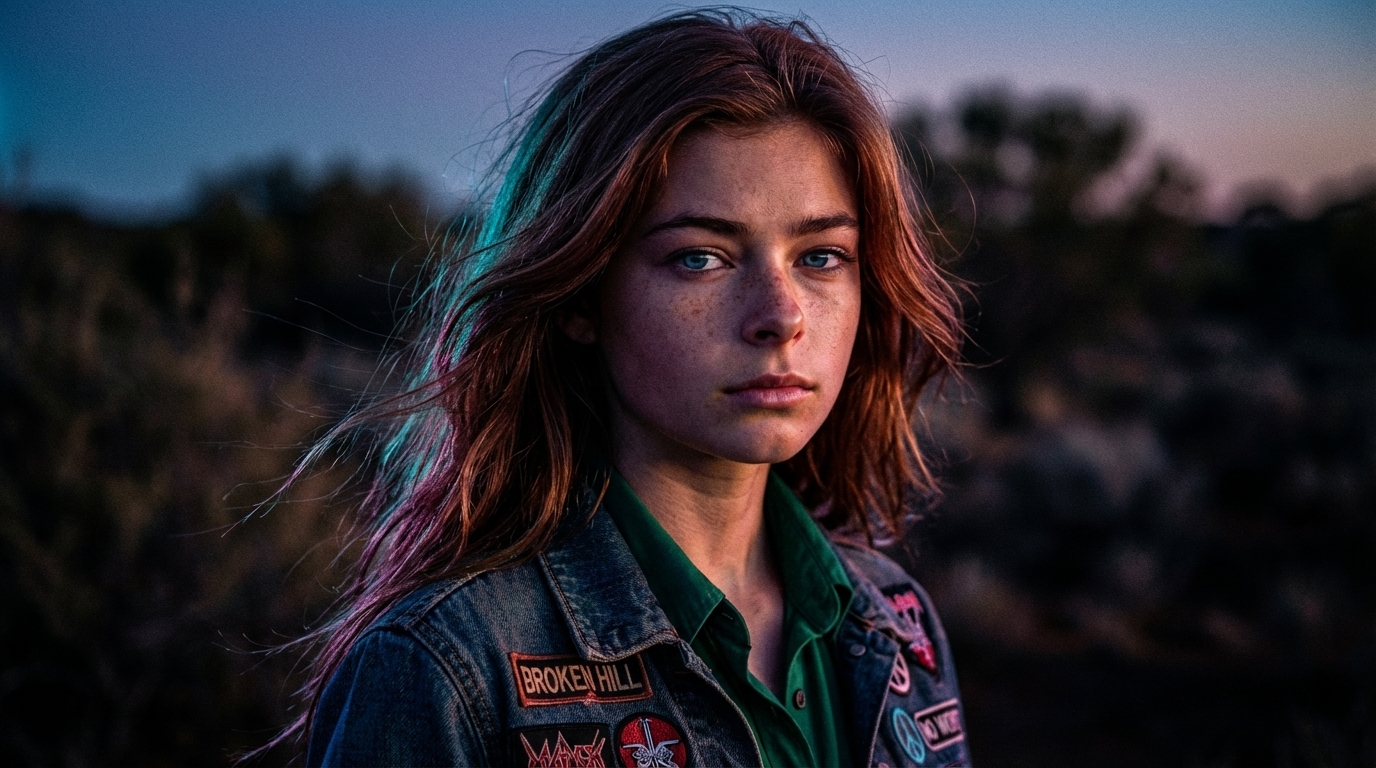
Early Life and Family Background
Violet Dallow was born on 12 May 1972 at Broken Hill District Hospital in New South Wales, the first child of Robert Thomas Dallow and Evelyn Margaret Dallow (née Ashcroft). Her arrival brought immense joy to the young couple, who had married four years earlier in 1968. The Dallow family home, a modest weatherboard house on the outskirts of Broken Hill, became the centre of a close-knit family life characterised by hard work, resilience, and deep affection.
Robert Dallow, a dedicated and respected miner with the Broken Hill Proprietary Company, embodied the stoic work ethic of the Australian mining community. Despite the long hours and harsh conditions underground, he was a devoted father who treasured his time with his daughters. Evelyn, a talented seamstress and active community member, brought warmth and creativity to the household, her sewing room filled with fabrics, patterns, and the constant hum of her machine creating beautiful garments for local families.
Growing up in the harsh yet breathtaking landscape of the Outback, Violet developed an early and profound connection to the red earth, endless skies, and ancient terrain that surrounded Broken Hill. From a young age, she displayed a restless energy and insatiable curiosity about the world. Whilst other children might have been content with dolls or board games, Violet preferred climbing the gnarled eucalyptus trees that dotted the landscape, racing her bicycle down dusty roads, and exploring abandoned mining sites with a fearlessness that both delighted and concerned her parents.
Two years after Violet's birth, on 27 August 1974, her sister Jasmine Anne Dallow was born. Whilst the sisters shared a deep bond, their personalities could not have been more different. Jasmine was quieter, more studious, and methodical—preferring books to adventures, order to chaos. Violet, in contrast, was wild, impulsive, and driven by an almost primal need to understand the mysteries that lurked beneath the surface of everyday life. Despite their differences, the two girls were fiercely loyal to one another, and Violet took her role as elder sister seriously, alternately protecting and teasing Jasmine in equal measure.
The Dallow household was filled with the rhythms of working-class life: the early morning departure of Robert to the mines, the steady clack of Evelyn's sewing machine, the smell of home-cooked meals, and the comforting rituals of family dinners where stories were shared and laughter echoed through the modest rooms. It was a childhood rooted in simplicity, hard work, and the unspoken understanding that family came above all else.
Childhood Adventures and Early Personality
From her earliest years, Violet demonstrated a personality that defied conventional expectations for young girls in rural 1970s Australia. Whilst Evelyn attempted to interest her in sewing, cooking, or other traditionally feminine pursuits, Violet's attention invariably wandered to more adventurous endeavours. She would return home with scraped knees, dirt-stained clothes, and wild tales of her explorations—much to her mother's exasperation and her father's quiet amusement.
Robert recognised something of himself in Violet's fierce independence and love of the land. On his days off, he would take her on long walks through the Outback, teaching her about the geological formations, the history of the mining industry, and the resilience required to survive in such an unforgiving environment. These expeditions became sacred rituals for father and daughter, moments where Violet's endless questions found patient answers in Robert's measured responses.
Violet possessed a vivid imagination that transformed the ordinary into the extraordinary. An abandoned mineshaft became the entrance to a hidden world; a weathered headstone in the local cemetery sparked elaborate fantasies about the life of the person buried beneath; a gnarled tree became a sentinel guarding ancient secrets. She had an innate gift for storytelling, often spinning elaborate tales for Jasmine at bedtime—stories populated with ghosts, mysteries, and adventures that always ended with the heroine (invariably modelled on Violet herself) solving some impossible puzzle or escaping from dire peril.
Her relationship with Jasmine was complex and deeply affectionate. Violet delighted in shocking her younger sister with tales of ghosts and monsters, yet she was fiercely protective when anyone else dared to tease or intimidate Jasmine. The two developed their own private language of gestures and expressions, a silent communication that spoke of the deep understanding between siblings who, despite their differences, knew each other's hearts completely.
Education and Academic Life
Violet began her formal education at the local primary school, where her sharp intelligence was immediately apparent to her teachers. She excelled in subjects that captured her imagination—particularly history, literature, and creative writing—but showed less enthusiasm for mathematics or sciences that required rote memorisation without context or narrative.
In 1984, at the age of twelve, Violet transitioned to Broken Hill High School, where her academic trajectory became more defined. Her teachers quickly recognised her as a gifted but challenging student—capable of producing brilliant work when engaged, but prone to questioning authority, challenging accepted narratives, and occasionally skipping classes that failed to hold her interest.
History became Violet's particular passion, especially topics involving unsolved mysteries, forgotten stories, and the lives of ordinary people whose experiences had been lost to time. She devoured books about historical disappearances, cold cases, and local legends with an intensity that bordered on obsession. Her essays were remarkable for their depth of research and imaginative reconstruction of past events, though teachers occasionally noted that she had a tendency to blur the line between documented fact and speculative interpretation.
Literature provided another outlet for Violet's intellectual curiosity. She read voraciously and eclectically—classic novels, Gothic horror, true crime accounts, Aboriginal dreamtime stories, and anything else that promised mystery, atmosphere, or insight into the human condition. Her creative writing assignments were vivid, atmospheric, and often unsettling, populated by characters who faced impossible choices and settings that seemed to pulse with hidden meanings.
However, Violet's relationship with formal education was complicated by her rebellious streak. She chafed against what she perceived as arbitrary rules and pointless bureaucracy. Detentions for uniform violations, arguments with teachers who dismissed her questions, and occasional truancy when the lure of exploring an abandoned building proved stronger than the prospect of attending a tedious lesson—these infractions earned her a reputation as a troublemaker, though most of her teachers recognised that her defiance stemmed from intellectual frustration rather than malice.
Friendships and Social Connections
Throughout her teenage years, Violet cultivated a close circle of friends who shared her appetite for adventure and her disdain for conventional teenage pursuits. This tight-knit group became her chosen family beyond the Dallow household—co-conspirators in exploration, confidantes for secrets, and companions in the ongoing quest to find excitement in the confines of small-town life.
Mandy Glasson emerged as Violet's closest friend and partner in adventure. Bold, outspoken, and similarly dismissive of authority, Mandy matched Violet's fearlessness with her own brand of reckless curiosity. Together, they explored abandoned mine shafts, investigated supposedly haunted buildings, and pushed boundaries in ways that alternately thrilled and terrified their more cautious companions. Their friendship was built on mutual respect, shared secrets, and an unspoken understanding that they were kindred spirits navigating a world that seemed determined to constrain them.
Michelle Richards provided a necessary counterbalance to the more reckless impulses of Violet and Mandy. Thoughtful, cautious, and possessed of a quiet strength, Michelle served as the voice of reason in the group—though she was rarely able to actually prevent her friends from pursuing their more dangerous schemes. Michelle's parents' imminent divorce had left her emotionally vulnerable, and Violet became one of the few people in whom Michelle could confide her deepest fears and sorrows. In return, Michelle became the keeper of Violet's most closely guarded secret: her clandestine relationship with Ethan Mitchell.
Rebecca Monk, the quietest member of the quartet, brought a different energy to the group. Bookish, observant, and often content to watch rather than actively participate, Rebecca nonetheless shared the group's fascination with mysteries and the unknown. Her cautious nature and protective instincts made her worry constantly about Violet's safety, a concern that would prove tragically prescient. Rebecca's future aspirations towards medicine reflected her deep-seated desire to heal and protect—instincts that would be forever marked by her inability to save her dearest friend.
The four girls formed a constellation of complementary personalities: Violet's fierce curiosity and leadership, Mandy's bold recklessness, Michelle's emotional depth and loyalty, and Rebecca's thoughtful observation. Together, they navigated the complexities of adolescence in a town where entertainment was scarce and the landscape itself seemed to whisper of secrets and hidden dangers.
The Secret Romance with Ethan Mitchell
In the winter of 1988, sixteen-year-old Violet embarked on what would become the most significant and controversial relationship of her short life. Ethan Mitchell, a twenty-year-old man with a reputation as Broken Hill's resident "ghost whisperer," entered Violet's orbit at precisely the moment when her fascination with the supernatural and mysterious had reached its peak.
Ethan was an enigmatic figure in the community—neither fully accepted nor entirely ostracised, he occupied a liminal space between respectability and eccentricity. Claiming the ability to communicate with spirits, he spent his time frequenting cemeteries, investigating allegedly haunted locations, and collecting local folklore about deaths, disappearances, and supernatural occurrences. To most adults in Broken Hill, he was a harmless oddity, perhaps slightly disturbed but essentially benign. To Violet, he was fascinating.
Their relationship began with chance encounters at the local cemetery, where Violet had gone to research the grave of a historical figure for a school project. Ethan, conducting one of his supernatural investigations, struck up a conversation about the deceased. What began as intellectual discourse about local history and folklore gradually evolved into something more intimate as they discovered a shared passion for the mysterious, the unsolved, and the liminal spaces between the living and the dead.
Violet was drawn to Ethan's apparent knowledge of Broken Hill's hidden histories, his willingness to take her seriously as an intellectual equal, and the thrilling sense of transgression that came from their age difference. For Ethan's part, he seemed genuinely captivated by Violet's fierce intelligence, her fearlessness, and her authentic curiosity about the supernatural rather than mere sensationalism.
They met in secret—late-night rendezvous in the cemetery, afternoon explorations of abandoned buildings, long conversations about the nature of death, memory, and the persistence of the past into the present. Ethan shared with Violet his collection of local ghost stories, his theories about why certain locations seemed to retain traces of traumatic events, and his interpretation of unexplained phenomena. Violet, in turn, brought her historical research skills to bear on his investigations, helping him contextualise supernatural claims within documented history.
The relationship remained hidden from everyone except Michelle, who worried about both the age gap and Ethan's potentially unhealthy influence on her friend's already morbid fascinations. Michelle's concerns proved prescient when, in the final week of Violet's life, Ethan issued an urgent warning for her to stay away from Silverton and to abandon her investigation into historical disappearances. The cryptic nature of his warning and his refusal to elaborate would later make him a person of interest in the investigation into Violet's death, though he was never formally charged.
Obsession with Emily Sullivan and Historical Mysteries
During her final year of life, Violet became increasingly consumed by the unsolved disappearance of Emily Sullivan, a young woman who had vanished from Silverton in the late 1800s. What began as casual research for a school history project evolved into something approaching obsession as Violet uncovered disturbing patterns and eerie parallels between Emily's case and other disappearances in the region.
Emily Sullivan's story had all the elements that captivated Violet's imagination: a spirited young woman ahead of her time, unexplained circumstances, conflicting witness accounts, cryptic letters suggesting foreknowledge of her fate, and persistent local legends about a "watcher in the night" who had allegedly been seen in the vicinity before her disappearance. The case had never been solved, and over the decades, it had faded from public consciousness into the realm of historical footnote and campfire tale.
Violet approached the mystery with the combined tools of academic rigour and imaginative reconstruction. She spent hours in the Broken Hill library, poring over old newspapers, census records, and archived correspondence. She interviewed elderly residents who might have heard stories passed down from grandparents who had lived during Emily's era. She visited Silverton repeatedly, photographing locations mentioned in historical accounts and attempting to trace Emily's final known movements.
What troubled Violet—and increasingly worried her friends—was the pattern she believed she had uncovered. Emily Sullivan's disappearance seemed to be part of a larger phenomenon: young women vanishing from the Silverton area under similar circumstances across different historical periods. Whilst many would dismiss such patterns as coincidence or the natural human tendency to find connections where none existed, Violet became convinced that something deeper and more sinister was at work.
Her theories grew more elaborate and, to the outside observer, perhaps less grounded in evidence. She speculated about everything from a multigenerational killer operating in the area to supernatural forces tied to the land itself. Ethan Mitchell encouraged these investigations, sharing folklore about cursed locations and malevolent spirits, though whether he genuinely believed these explanations or was simply indulging Violet's fascination remains unclear.
In the final weeks of her life, Violet's research took on an urgent, almost feverish quality. She filled notebooks with observations, timelines, and speculative connections. She spoke of feeling as though she were on the verge of a breakthrough, of finally understanding what had happened to Emily Sullivan and, by extension, to all the other young women who had vanished from the Outback over the decades. Friends would later recall how distracted and preoccupied she had become, often losing the thread of conversations as her mind returned to the mystery that had come to dominate her thoughts.
The final, terrible irony of Violet's life is that her fascination with historical disappearances seemed to foreshadow—or perhaps in some unknowable way, precipitate—her own tragic fate. Whether she inadvertently drew the attention of a dangerous individual through her investigations, or whether her death was simply the random act of a predator who happened to cross her path, remains one of the unanswered questions that continue to haunt those who knew and loved her.
The Girl Guides Camp and Final Hours
On the afternoon of 30 September 1988, Violet departed Broken Hill with her Girl Guides troop for what should have been a routine camping trip to Penrose Park in Silverton. Despite her rebellious nature, Violet had maintained her involvement with the Girl Guides—partly at her mother's insistence, partly because it provided legitimate opportunities to explore the Outback, and partly because her closest friends were also members.
The mood of the trip was festive. Violet, Mandy, Michelle, and Rebecca were together, freed temporarily from parental supervision and the constraints of school. Violet had packed not only her camping gear but also her notebooks on Emily Sullivan, hoping to use the proximity to Silverton to conduct further research. She seemed to her friends to be in high spirits, though Michelle would later recall a certain restlessness, a quality of heightened awareness that suggested Violet's mind was not fully present in the moment.
As evening fell and the group gathered around the campfire, an unexpected encounter occurred that would cast a long shadow over subsequent events. Gordon Richards, Michelle's older brother, appeared at the camp along with his unsettling friend Liam. The two young men proceeded to regale the girls with gruesome stories of a murdered backpacker, tales told with disturbing relish and graphic detail that left the audience genuinely shaken.
Violet's response to these stories was complex. She was simultaneously drawn to the narrative's dark appeal and disturbed by the barely concealed cruelty in how Gordon and Liam seemed to take pleasure in frightening their audience. When Gordon later staged a cruel prank involving a theatrical "attack" on the group, Violet was one of the few who immediately recognised it as such, her anger at the violation of trust momentarily overriding her fear.
When nature called, Mandy and Violet made the fateful decision to walk to the dilapidated toilet block situated some distance from the main camping area. The facility, a decrepit structure scarred by time and neglect, stood isolated against the darkness of the surrounding landscape. The two girls approached it together, but only Mandy entered whilst Violet remained outside, standing sentinel in the oppressive darkness.
What happened in the next moments would forever divide Violet's life into the before and after, the possible and the actual, the living and the dead. As Mandy attended to her needs inside the toilet block, Violet stood alone in the darkness outside. According to Mandy's later testimony—given through tears and trauma—she heard no scream, no sound of struggle, nothing that would have alerted her to the catastrophe unfolding mere metres away.
When Mandy emerged from the toilet block, Violet was gone. No signs of struggle, no indication of which direction she might have gone, nothing but the empty darkness and the terrible absence where her friend had stood moments before. The immediate search revealed nothing. Violet Dallow had simply vanished, as though the Outback itself had swallowed her whole.
The Search, Discovery, and Aftermath
The disappearance of Violet Dallow triggered one of the most extensive search operations in Broken Hill's history. Within hours of her vanishing being reported, police, emergency services, and volunteers mobilised to comb the rugged terrain surrounding Silverton. Robert Dallow abandoned his shift at the mine to join the search, his face a mask of stoic determination that barely concealed the terror beneath. Evelyn, forbidden from joining the physical search due to her fragile emotional state, waited at home with Jasmine, both women suspended in an agonising limbo between hope and despair.
The search continued for weeks, expanding in concentric circles from the campsite, employing tracker dogs, local volunteers with intimate knowledge of the terrain, and increasingly sophisticated police resources. Every abandoned building, every mine shaft, every depression in the red earth was investigated. The community rallied with characteristic Australian solidarity—miners gave up their days off, shopkeepers closed their stores to join search parties, and local media kept Violet's image constantly in the public eye.
But the Outback is vast, unforgiving, and skilled at keeping its secrets. Despite the intensity of the search efforts, Violet remained missing for weeks that stretched into an eternity for the Dallow family. The initial hope that she might have simply become lost or injured gradually gave way to darker speculation. Rumours circulated: had she run away? Had she been abducted? Was she alive somewhere, or had the cruel landscape claimed another victim?
The terrible answer came in late October when Violet's body was discovered in a remote location, partially concealed by the natural formations of the terrain. The discovery brought an end to the uncertainty but opened a new chapter of horror and grief. Violet had been strangled—a deliberate act of violence that transformed her disappearance from potential accident or misadventure into unambiguous murder.
The forensic investigation revealed little beyond the cause of death. Time, weather, and the attentions of scavengers had degraded much of the potential evidence. What was clear was that Violet had been killed shortly after her abduction, sparing her any extended captivity or suffering—a small mercy in an otherwise merciless situation. Her clothing was found nearby.
The investigation into Violet's murder quickly focused on the notorious Silverton Strangler, a serial killer believed responsible for several murders of young women in the region. The modus operandi matched: young women taken in isolated areas, strangled, and left in remote locations where discovery would be delayed. Yet despite this apparent connection, despite extensive police investigations and multiple persons of interest, no arrest was ever made. The Silverton Strangler remained at large, and Violet's murder joined the list of unsolved crimes that haunted the Outback.
The failure to achieve justice compounded the family's grief. Robert Dallow, a man whose life had been defined by concrete problems with practical solutions, found himself confronting a situation that defied resolution. He became quieter, more withdrawn, the light behind his eyes dimmed by a loss that all his strength and dedication could not prevent or remedy. Evelyn, devastated beyond words, poured her grief into marathon sewing sessions, creating garment after garment as though the rhythm of the needle and thread might somehow stitch closed the wound in her heart.
For Jasmine, then only fourteen years old, the loss of her sister was compounded by her parents' understandable but overwhelming grief. Recognising that their younger daughter needed a fresh start away from the constant reminders of tragedy, Robert and Evelyn made the painful decision to send Jasmine to boarding school in Adelaide. The intention was merciful—to give Jasmine a chance at a childhood not entirely defined by trauma—but the separation added another layer of fracture to a family already shattered by loss.
Legacy and Remembrance
The immediate aftermath of Violet's death saw an outpouring of community support that reflected both the tragedy of her loss and the love with which she had been regarded. The funeral service at St. Matthew's Church was attended by hundreds—school friends, teachers, her father's colleagues from the mines, her mother's clients and fellow community volunteers, and countless others whose lives Violet had touched in her brief sixteen years.
Yet the most enduring legacy of Violet's life came not from these immediate expressions of grief but from the long-term commitment of her younger sister to ensure that Violet's name would not simply become another sad footnote in the region's history. Years after the tragedy, Jasmine Collins (née Dallow) established the Violet Fund, a charitable organisation dedicated to supporting missing persons investigations and providing assistance to families of victims.
The Violet Fund operates on the principle that every missing person deserves the same intensive search and investigation that Violet received, regardless of the victim's background, circumstances, or the resources of their family. It provides financial assistance for private investigators, funds reward programmes for information, supports families through the traumatic process of navigating law enforcement bureaucracies, and advocates for improved protocols in missing persons cases.
Jasmine's dedication to this cause is intensely personal. She has stated in interviews that whilst she cannot bring her sister back, she can honour Violet's memory by ensuring that other families receive every possible resource in their own searches for missing loved ones. The Violet Fund has assisted in dozens of cases over the years, bringing closure to some families and renewed hope to others. It stands as a testament to how tragedy, whilst it can never be undone, can sometimes be transformed into a force for good.
The Dallow Residence remains in the family, now occupied by the retired Robert Dallow, who maintains the modest house as a repository of memories. Violet's bedroom remains largely unchanged—a shrine not to death but to the vibrant, complex, maddening, and wonderful young woman who once filled those walls with her energy. Her books line the shelves, her journals (those the police released back to the family) rest in a drawer, and the locket Robert had given her occupies a place of honour on a small table by the window.
In Broken Hill, Violet's story has become part of the community's collective memory, invoked whenever discussions turn to the safety of young people, the unsolved mysteries that haunt the region, or the enduring pain of crimes without resolution. Old-timers still speak of her in hushed tones—"You remember the Dallow girl?"—and whilst time has softened some of the immediate pain, the fundamental tragedy remains undiminished.







