Victoria Evelyn Blackwood
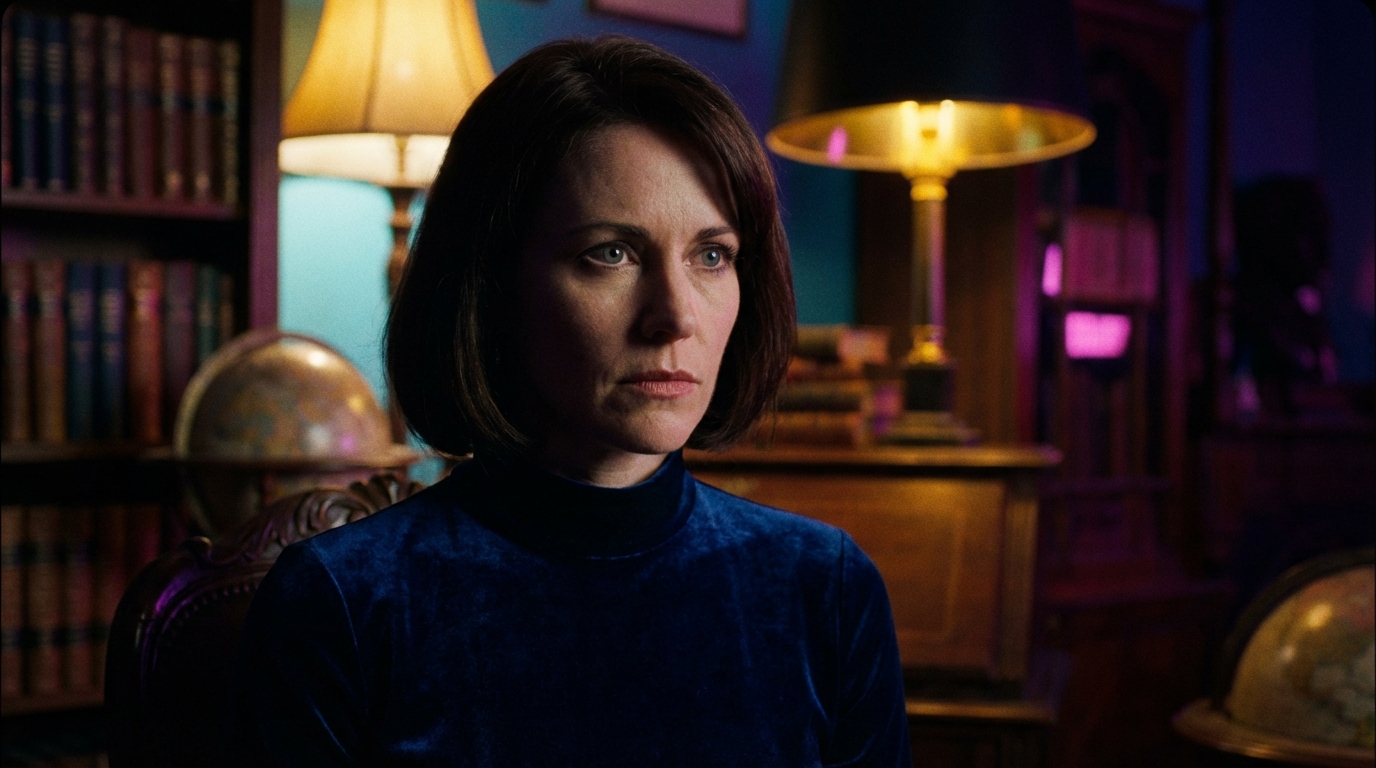
Victoria Evelyn Blackwood, born on 4 March 1943 in Melbourne, was the daughter of Dr Alastair Prometheus Blackwood and Margaret Helen Stevenson, and the younger sister of Maxwell Alastair Blackwood. Raised in a household whose private dimensions she was not invited to comprehend, she left Melbourne after her brother's unexplained death in 1974 and built a career in education advocacy in Tasmania — the island from which the Blackwood dynasty had originated and to which she returned, deliberately, alone.
Early Life
Victoria Evelyn Blackwood was born on 4 March 1943 in Melbourne, the second child and only daughter of Dr Alastair Prometheus Blackwood, founder of the Obsidian Healthcare Group, and Margaret Helen Blackwood, née Stevenson, whose social acuity and sustained discretion maintained the domestic architecture within which Alastair's career operated. Victoria arrived three years after her brother Maxwell, into a household whose rhythms were determined by her father's research schedule and whose emotional climate was managed by her mother with the composed competence that the Stevenson upbringing had provided and that the Blackwood marriage required.
She grew up in the family's Melbourne residence — a substantial property whose grounds accommodated both the conventional features of an affluent household and the restricted-access facilities whose purposes Victoria was not encouraged to enquire about. The household contained locked rooms, laboratories that staff were instructed not to enter, and a greenhouse whose botanical contents her father cultivated with an attention he did not extend to his domestic relationships. Victoria absorbed the household's geography of permission and restriction early, learning which doors could be opened and which could not, which questions could be asked and which would be met with the particular silence that constituted, in the Blackwood household, the most emphatic form of answer.
The Shape of Neglect
Alastair's attention was distributed according to institutional criteria that domestic affection could not satisfy. Maxwell, as the elder child and the son, received the concentrated focus of a father who regarded his children as instruments of succession — assessed, directed, and prepared for roles within the organisational architecture he was constructing. Victoria received less. The disparity was not hostile; Alastair did not mistreat his daughter. He simply did not regard her as consequential to the project that consumed his professional life, and the inattention — experienced by Victoria as a constant, low-grade awareness that she existed in her father's peripheral vision rather than his direct gaze — shaped her childhood in ways that absence, paradoxically, made more formative than presence might have been.
Margaret compensated. The relationship between mother and daughter became the household's most emotionally sustaining connection — Margaret's warmth, her piano music in the evenings, her practical management of Victoria's education and social development providing the stability that Alastair's intermittent presence and Maxwell's absorption into the paternal programme could not. Victoria grew up closer to her mother than to anyone else in the family, the bond strengthened by their shared position as the household members whose access to its inner operations was limited and whose importance within its hierarchy was determined by criteria they did not control.
She attended the Presbyterian Ladies' College in Melbourne, as her mother had before her, and performed adequately without distinction — a student whose capabilities her teachers assessed as solid and whose apparent lack of ambition they attributed to temperament rather than to the particular form of disillusionment that develops in a child who has observed, from close quarters, what ambition looks like when it operates without restraint. Victoria was not unambitious. She was cautious about ambition, having grown up in its most extreme domestic expression, and the caution expressed itself as a preference for quieter forms of achievement whose value did not depend upon institutional recognition or paternal approval.
Maxwell
Victoria's relationship with her brother was complicated by the asymmetry of their positions within the household. Maxwell was the heir — groomed, directed, absorbed into Obsidian's institutional trajectory from an age when other children were playing cricket and reading adventure novels. Victoria was the sibling who watched the grooming from outside its parameters, close enough to observe its effects without being subject to them. She loved Maxwell with the particular loyalty of a younger sister who understood that her brother's life was being shaped by forces neither of them controlled, and the loyalty included a component of anxiety whose source she could not have articulated as a child but that she later recognised as the intuition that the forces shaping Maxwell's trajectory were not entirely benign.
Maxwell married Evelyn Rose Harris in 1965 and had a daughter, Evelyn Rose Blackwood, in 1967. He assumed the Obsidian Chief Executive role in 1971. Victoria observed her brother's assumption of the position their father had prepared him for with a mixture of pride and foreboding whose proportions shifted, over the three years that followed, increasingly toward the latter. Maxwell changed during his tenure — the warmth that had characterised his personality compressing under pressures whose nature he did not discuss with Victoria and whose institutional origins she was not positioned to investigate. Their conversations became shorter, more guarded, the ease of childhood replaced by the particular caution of a man who had learned that information was currency and that its distribution required management even within family relationships.
Maxwell Alastair Blackwood died on 3 May 1974 in Sydney, at the age of thirty-three. The death was sudden. The circumstances were unexplained. The official record provided a cause that satisfied administrative requirements without addressing the questions that Victoria and, she believed, Margaret both carried — questions about what Maxwell had been involved in during the final months of his life, about the nature of the work that Obsidian's restricted operations encompassed, and about the relationship between her brother's death and the research that her father had been conducting with an intensity that Maxwell's assumption of the Chief Executive role had been supposed to relieve but that his death appeared, instead, to have accelerated.
Victoria was thirty-one years old. The grief was compounded by its opacity — she mourned a brother she had loved whilst understanding that the circumstances of his death had been shaped by dimensions of his life and their father's that she had not been permitted to access. The combination of loss and enforced ignorance produced in Victoria a response that would define the remainder of her life: she withdrew from the Blackwood household's institutional orbit and did not return.
Tasmania
Victoria left Melbourne in 1975 and relocated to Hobart — a choice whose geographical significance was not lost on her. The Blackwood family had originated in Tasmania, the legal dynasty stretching from Erasmus Percival's arrival in colonial Sydney through to the Hobart firm that Thomas Erasmus had founded and that four generations had sustained. Victoria returned to the island not as a member of the dynasty's institutional continuation but as a woman who had chosen to build a life at the maximum available distance from the organisation that the dynasty's most recent and most troubling member had created. Hobart was far from Melbourne, far from Obsidian's operational centre, and connected to the family's earlier history — the history before Alastair, before the research, before the locked rooms and the unexplained death and the questions that no one was permitted to ask.
She enrolled at the University of Tasmania as a mature student, completing a Bachelor of Education in 1979 and a Master of Education in 1983. The academic work provided both professional qualification and intellectual framework — a structured means of understanding the processes by which institutions shaped the people within them, a subject whose personal resonance Victoria did not need to explain to anyone familiar with her biography. She taught at secondary schools in Hobart during the 1980s, her classroom practice characterised by an attention to students whose circumstances placed them outside institutional favour — the quiet ones, the overlooked ones, the children whose capabilities were not matched by the attention their environments provided. The attentiveness was professional and personal simultaneously, Victoria recognising in her students the particular form of disadvantage she had experienced within her own household: the disadvantage of being present without being seen.
Advocacy
Victoria's transition from classroom teaching to education advocacy occurred gradually during the late 1980s and 1990s, her involvement with organisations promoting equitable access to education and women's participation in institutional governance reflecting convictions whose origins lay in the specific circumstances of her upbringing and whose expression she directed toward systemic reform rather than personal grievance. She served on advisory boards for the Tasmanian Department of Education, contributed to policy reviews on educational equity, and advocated for programmes that extended educational access to rural and disadvantaged communities across the island.
The work was not prominent. Victoria did not seek public visibility, did not cultivate media attention, and did not build the kind of institutional profile that her father's career had demonstrated and that her brother's truncated tenure had exemplified. She worked within systems rather than upon them, her influence expressed through the committees, the submissions, the quiet conversations with policymakers whose decisions affected children who would never know that the woman advocating on their behalf had grown up in a household whose restricted-access laboratories and unexplained absences had taught her, more thoroughly than any pedagogical theory, what it meant to be excluded from the processes that determined one's circumstances.
The Deaths
Alastair Prometheus Blackwood died on 30 September 1985 at his Daylesford estate. Victoria was forty-two years old, resident in Hobart, and had not visited her father in over a year. The funeral was closed to the public — a decision made by the Obsidian Historical Trust, the entity to which Alastair's estate passed and whose governance provisions Victoria had no role in establishing and no authority to contest. She attended the funeral without speaking publicly, her presence constituting the minimum that filial obligation required and the maximum that her feelings toward her father's career and its consequences permitted.
She did not grieve Alastair in the way she had grieved Maxwell. The distinction was not the absence of feeling but the difference in its composition — Maxwell's death had produced sorrow complicated by enforced ignorance, whilst Alastair's produced a quieter, more ambivalent response in which relief, loss, anger, and the particular exhaustion of a woman who had spent four decades managing her relationship to a man she had never been permitted to understand combined into something that conventional grief could not encompass.
Margaret Helen Blackwood died on 14 February 1993, in Melbourne, at seventy-nine. Victoria had maintained closer contact with her mother during the widowhood years — visits to the Toorak house, telephone conversations whose content was domestic and whose emotional register communicated what the content did not. Margaret's death removed from Victoria's life the person who had provided its earliest and most sustaining emotional connection, and the loss was experienced with the uncomplicated grief that her father's death had not permitted — the sorrow of losing someone who had been genuinely present, genuinely kind, and genuinely limited in her capacity to protect her children from the household's darker dimensions.
The Life Outside
Victoria Evelyn Blackwood never married. The decision was not ideological; she did not construct a philosophical position from her singleness. She simply found, across the decades of her adult life, that the forms of intimacy she valued — friendship, professional connection, the relationships she built with colleagues and students and the communities she served — provided what she needed without requiring the particular vulnerability that marriage demanded and that her childhood had taught her to regard with a wariness she acknowledged without apologising for. She lived in a cottage in Battery Point, Hobart, surrounded by books and within walking distance of the waterfront, and the life she constructed there — small, deliberate, connected to its community, and entirely free from the institutional machinery that had defined and consumed the family she had been born into — constituted, in its modest way, the most radical departure any Blackwood had made from the dynasty's accumulated patterns.
She maintained a careful distance from Obsidian Healthcare Group throughout her adult life. She was aware, through fragments of information that reached her despite her deliberate disengagement, that the organisation her father had founded continued to expand, that its operations retained the opacity that had characterised them under Alastair's leadership, and that her nephew Alexander's eventual consultancy and her great-nephew Sebastian's eventual assumption of the Chief Executive role extended the family's connection to an institution whose nature she had spent decades avoiding. She did not comment publicly on Obsidian. She did not contribute to the speculation that surrounded her father's death, her brother's death, or the organisation's activities. Her silence on these subjects resembled her mother's — not because the motivations were identical, but because both women had concluded, through different routes and for different reasons, that the questions the Blackwood family's history generated were not questions that speaking aloud could resolve.
Victoria Evelyn Blackwood was the Blackwood who left. In a dynasty defined by institution-building — the law firm, the healthcare empire, the research programmes whose boundaries exceeded what public accountability could map — she chose a life whose institutional footprint was small, whose ambitions were local, and whose value was measured in the students she taught, the policies she influenced, and the communities she served without requiring them to understand the family history that had produced her conviction that power exercised without transparency was power that could not be trusted. She carried the Blackwood name without carrying its institutional weight, and the distinction — between inheritance and identity, between what one was born into and what one chose to become — was the most important thing about her.







