Victoria Blackwood (née Hawthorne)
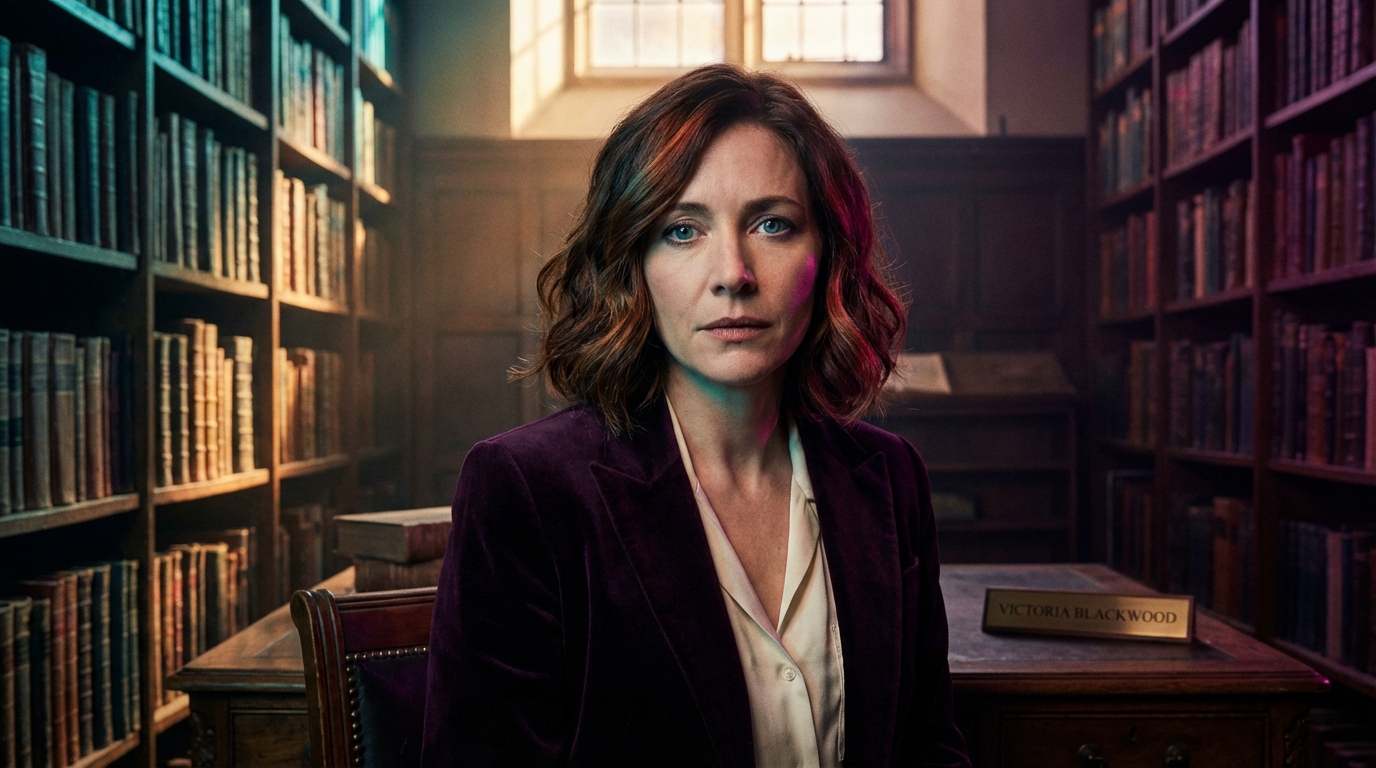
Victoria Blackwood, née Hawthorne (born 1947), was a historian of colonial medicine whose academic career spanned five decades and three continents. Briefly married to the cardiologist Alexander Blackwood from 1975 to 1979, she was the biological mother of Sebastian Charles Blackwood, whose upbringing she shared across a divorce whose civility disguised its cost. She published eleven books, outlived her marriage by decades, and never entirely resolved the questions it raised.
Early Life and Family
Victoria Anne Hawthorne was born on 11 June 1947 in Adelaide, South Australia, the second of three children born to Professor Gerald Hawthorne, a lecturer in modern history at the University of Adelaide, and Ruth Hawthorne, née Sinclair, a secondary school teacher whose own academic ambitions had been curtailed by marriage and motherhood in an era that considered the two incompatible with professional life. The Hawthorne household occupied a bungalow in Unley, within cycling distance of the university campus, and the rhythms of Victoria's childhood were set by the academic calendar — her father's lecture preparation, the visiting scholars who appeared at the dinner table during conference season, and the particular atmosphere of a home in which books occupied more space than furniture and intellectual argument was considered a form of recreation.
Victoria's elder brother, Gerald David, born in 1944, followed their father into academia and eventually held a chair in political science at the Australian National University. Her younger sister, Catherine Ruth, born in 1950, became a secondary school teacher — inheriting, whether by choice or by the gravitational pull of family precedent, their mother's profession alongside the constraints that accompanied it. Victoria occupied the middle position in the sibling order and, by temperament and circumstance, the middle ground between her brother's straightforward replication of their father's career path and her sister's more modest professional trajectory. She was the one who would go further than Gerald without the advantage of being male, and further than Catherine without the protection of having aimed lower.
Ruth Hawthorne's influence on Victoria was complex and formative. Ruth had completed a master's degree in English literature before her marriage — a qualification whose existence she mentioned rarely and whose abandonment she discussed never. Victoria grew up aware, through the particular sensitivity of a child who reads emotional atmospheres more accurately than the adults creating them, that her mother's contentment with domestic life was genuine in its upper registers and constructed in its depths. The awareness did not produce rebellion — Victoria was too analytical for rebellion, which she regarded as an emotional response to conditions that required strategic ones — but it produced a determination, present from adolescence and hardening through her university years, that her own intellectual life would not be subordinated to the domestic arrangements that marriage might impose.
Education
Victoria attended Unley High School, where she demonstrated the academic capabilities that her household's intellectual culture had cultivated and that the South Australian state school system, at its best, was equipped to develop. She excelled in history and English, showed facility for languages that the curriculum's limited offerings could not fully engage, and developed a capacity for sustained research — the patient accumulation and assessment of evidence in pursuit of arguments that the evidence supported — that her teachers identified as unusual in its maturity and that would prove the foundation of her scholarly career.
In 1965, she enrolled at the University of Adelaide to read history, following the path her father's career had illuminated without submitting to his specific direction. Her undergraduate years coincided with the cultural transformations of the late 1960s, and Victoria engaged with the era's political and intellectual currents — feminism, anti-war activism, the questioning of institutional authority — with the analytical seriousness that would characterise her approach to everything. She was not a marcher or a placard-bearer; she was a reader and a thinker who absorbed the era's arguments, assessed their evidentiary foundations, and incorporated what survived her scrutiny into an intellectual framework that became, over time, distinctively her own.
Her honours thesis on medical practice in colonial South Australia attracted attention for its methodological rigour and its unusual subject matter — the intersection of medical history with colonial social history being, in the late 1960s, a field whose potential was recognised by few and pursued by fewer. She graduated with First Class Honours in 1969 and commenced doctoral research at the University of Melbourne, where the history department's stronger resources and broader intellectual networks provided the environment her specialisation required. Her PhD, completed in 1974, examined the transfer of British medical knowledge to the Australian colonies during the nineteenth century — a subject whose scope would expand across her career into a body of work that positioned her among the most respected historians of colonial medicine in the English-speaking world.
Alexander
Victoria met Alexander Blackwood in 1974 at a Brisbane medical fundraiser where she was presenting research on colonial medical practices and he was present in his capacity as a rising figure in Queensland's cardiology establishment. The attraction was intellectual before it was personal — they recognised in each other a quality of sustained, focused engagement with their respective disciplines that most of their contemporaries did not share. The conversations that followed the fundraiser extended across weeks and then months, conducted through the long-distance telephone calls and occasional weekend visits that geographical separation required, their content shifting from professional exchange to something whose personal dimensions neither party fully examined before committing to them.
They married on 15 December 1975 at St John's Cathedral, Brisbane. Victoria was twenty-eight, Alexander thirty-three. The union brought together two forms of professional brilliance that complemented each other intellectually and competed with each other practically. Victoria's historical research required archival work in London, Boston, and the scattered repositories where colonial medical records had been deposited across two centuries. Alexander's surgical career demanded continuous presence in Brisbane, where his patients and his professional reputation could not be maintained at a distance. The incompatibility was structural rather than personal — neither partner's professional requirements could be modified to accommodate the other's without a sacrifice that the person making it would experience as mutilation rather than compromise. They discussed the problem with the analytical rigour they brought to everything, identified no solution that did not involve one of them abandoning what they considered essential, and proceeded as though the absence of a solution constituted permission to continue without one.
The marriage functioned, for its first two years, on the basis of sustained absence punctuated by intense reunion — a rhythm that academic and medical careers could accommodate without either partner acknowledging that accommodation was not the same thing as sustainability. Victoria spent months at a time in archives whilst Alexander operated and published and built the reputation whose demands left diminishing space for a wife who was not there. The arrangement was not hostile; it was simply insufficient, the emotional infrastructure of a marriage requiring a minimum of shared presence that their competing schedules could not provide.
Sebastian
Sebastian Charles Blackwood was born on 15 April 1978 in Melbourne, where Victoria was completing a research fellowship at the University of Melbourne. The geographical circumstances of his birth — his mother in Melbourne, his father in Brisbane — encapsulated the marriage's central difficulty with a concreteness that abstract discussions about professional commitment had not achieved. Alexander flew to Melbourne for the delivery and returned to Brisbane within days. Victoria remained in Melbourne with the infant, the research fellowship requiring completion and the domestic support that a Brisbane household might have provided being fifteen hundred kilometres away.
The arrangement was practical and unsustainable and both partners knew it. The divorce was initiated within months of Sebastian's birth and finalised in December 1979, conducted with a civility that reflected both partners' preference for rational process over emotional confrontation and that concealed, beneath its orderly surface, grief that neither person's temperament equipped them to express. Victoria retained primary custody initially, a decision that was legally conventional and practically complicated — her research commitments requiring the same travel that had contributed to the marriage's failure, the presence of an infant adding to the logistical challenge without reducing the professional ambition that generated it.
The custody arrangement shifted within the first year. Alexander, whose emotional response to the divorce expressed itself characteristically through increased professional dedication and a simultaneous desire to maintain connection with his son, sought and obtained expanded access. By the time Alice Thompson entered Alexander's life in early 1980, Sebastian was spending increasing periods in Brisbane, and the transition toward Alexander's household as the boy's primary base was already underway. Victoria consented to the shift — not without pain, not without the particular anguish of a mother who understood that the life she had chosen and the motherhood she valued required more simultaneous presence than she could provide — and the co-parenting arrangement that followed was managed with the civilised competence that both former partners brought to the management of difficult situations and the emotional avoidance that both brought to everything else.
The Academic Career
The divorce liberated Victoria's professional life from the constraints that the marriage had imposed without resolving the personal costs that the liberation entailed. She accepted a lectureship at the University of Melbourne in 1980, establishing the institutional base from which she would build a career that spanned the next four decades. Her research on the history of colonial medicine expanded in scope and ambition, encompassing the transfer of medical knowledge between Britain and its southern colonies, the institutional development of hospitals and medical education in colonial Australia, and the social history of disease, public health, and medical practice across the nineteenth and early twentieth centuries.
She published prolifically — monographs, edited collections, journal articles whose frequency and quality established her reputation within the international community of medical historians. Her work was characterised by the methodological rigour that her doctoral training had instilled and by a capacity for archival research whose exhaustiveness colleagues found both impressive and faintly intimidating. She spent extended periods at the Wellcome Library in London, the Countway Library at Harvard, and the scattered colonial archives whose material she assembled into arguments of formidable precision. The research trips that had destroyed her marriage became, after the marriage ended, the unencumbered professional activity they had always wanted to be — the removal of the competing obligation revealing, with uncomfortable clarity, that the obstacle to Victoria's complete professional fulfilment had been the relationship she had formed with the one person whose intellectual intensity matched her own.
She rose through the academic ranks at Melbourne — senior lecturer, associate professor, full professor — with the steady progression that sustained publication and institutional service produced. She supervised doctoral students whose own careers in medical history constituted an extension of her intellectual influence. She delivered keynote addresses at international conferences, served on editorial boards, and received the awards and fellowships that academic disciplines bestow upon their most productive members. The career was, by any external measure, a success, and Victoria experienced it as such — the work was genuine, the recognition was earned, and the intellectual satisfaction that research provided was real rather than compensatory.
The Relationship with Sebastian
Victoria's relationship with her son was the dimension of her life that her professional competence could not adequately manage and that her analytical temperament could not satisfactorily resolve. She loved Sebastian — the assertion requires no qualification, though its expression took forms that a child raised primarily by other people might not always have recognised as love. She visited regularly during his Brisbane childhood, maintained telephone contact with a consistency that Alexander and later Alice ensured was reciprocated, and provided during Sebastian's adolescence and adulthood a perspective on the Blackwood family that his immersion within it could not have generated — the outsider's view, the historian's contextualisation, the particular clarity of a woman who had been close enough to the dynasty to understand its patterns and distant enough to see their costs.
Sebastian's acceptance of Alice as "Mum" was a wound whose rational justification Victoria acknowledged and whose emotional consequences she bore in private. She did not contest the arrangement — Alice's devotion to Sebastian was genuine, her competence as a parent was evident, and the stability that the Blackwood-Thompson household provided exceeded what Victoria's itinerant academic life could match. The recognition that another woman was raising her son more effectively than she could have done was processed with the intellectual honesty that Victoria brought to unwelcome evidence in every other context and with the emotional difficulty that intellectual honesty, in this context, could not alleviate.
Their relationship deepened as Sebastian matured — the adult son capable of understanding what the child could not: that his mother's absence had been the consequence of choices whose complexity a young boy could not assess and that the woman who had made those choices carried their cost more visibly than she had carried their benefits. Sebastian's visits to Melbourne during his university years, and later his professional trips that included time with Victoria, created a connection whose quality improved as its frequency decreased — the conversations becoming more substantive, the understanding more reciprocal, the mutual recognition that they shared a form of intelligence whose analytical precision and emotional limitation were equally inherited.
Later Career
Victoria retired from the University of Melbourne in 2017 at the age of seventy, her departure marked by the emeritus appointment and the conference in her honour that academic custom prescribed. She did not experience retirement as the diminishment that many academics feared, partly because her intellectual curiosity had not diminished and partly because the institutional obligations of a professorship — the committee meetings, the administrative burden, the student interactions whose quality had become increasingly variable — had been consuming time that she preferred to spend on research. She continued to publish, to attend conferences selectively, and to maintain the archival habits that had sustained her career for five decades.
She settled in a terrace house in Carlton, Melbourne, whose rooms accommodated the library that had accompanied her through every residential transition since her doctoral years. She visited Sebastian when his schedule and hers coincided, and followed Sienna's career with the interest of a woman who recognised in her former husband's daughter qualities — directness, analytical rigour, the willingness to act on evidence regardless of its personal cost — that she valued without claiming credit for them. Her awareness of the Obsidian Healthcare Group and its complexities, filtered through Sebastian's position within it, provided her historian's understanding of institutional power with a contemporary case study whose personal dimensions she was not always able to separate from the analytical ones.
Alice's death in March 2023 affected Victoria in ways she had not anticipated and that her long-standing habit of emotional self-containment made difficult to process. She had respected Alice without being close to her — the two women occupying positions in Alexander's life whose sequential nature precluded the friendship that their shared qualities might otherwise have produced. Alice's death removed from the family the person who had provided the emotional coherence that Victoria's departure had disrupted and that Alexander's temperament could not generate independently, and the recognition that the family structure she had chosen to leave was now diminished by the death of the woman who had chosen to sustain it produced in Victoria a grief whose composition included sorrow, respect, and the particular anguish of regret that arrived too late to be useful.
The Shape of a Life
Victoria Hawthorne — she resumed her maiden name after the divorce and used it professionally throughout her career, retaining "Blackwood" only in the legal documents that Sebastian's parentage required — published eleven books, supervised twenty-three doctoral students, and contributed to the understanding of colonial Australian medicine in ways that her discipline acknowledged and the general public did not. She married once, briefly, a man whose intellectual intensity matched her own and whose emotional limitations mirrored hers with a precision that made the marriage both compelling and impossible. She had one child, raised primarily by another woman, whose career in healthcare administration connected him to a family legacy whose historical dimensions Victoria understood better than anyone else living — the historian's perspective on a dynasty she joined, departed, and never entirely ceased to observe.
She did not regret the choices she made. The statement required the qualification that not regretting and not grieving were different conditions, and that Victoria spent nearly fifty years managing the distinction between them with the same analytical precision she brought to archival research. She chose her career over her marriage because the career was what she could not do without, and the marriage — for all its intellectual richness — was what she could survive without, and the hierarchy of needs that this assessment revealed was not something she chose but something she discovered about herself during the years when the choice could no longer be deferred. Whether the discovery constituted self-knowledge or self-justification was a question that Victoria, with the historian's respect for the limits of available evidence, declined to answer definitively. She lived with the question instead, as she lived with everything else — thoughtfully, independently, and with a solitude whose voluntary character did not make it, on every evening and in every room of the Carlton terrace, entirely sufficient.







