
Victoria Anne Ashford
Victoria Anne Ashford, born 22 April 1796 in Portsmouth, England, became the sharp-witted chronicler and steadfast companion to colonial Tasmania's most enigmatic figures. A naval officer's daughter who followed her friend Madelyn Jeffries to Van Diemen's Land in 1819, she wielded her pen under the pseudonym "V.A. Spectator" to skewer colonial hypocrisies whilst providing unwavering support through scandal and triumph. Her independent spirit, keen social observation, and resilient navigation of personal disappointments established her as a unique voice in colonial society. She died 18 December 1864, aged sixty-eight.
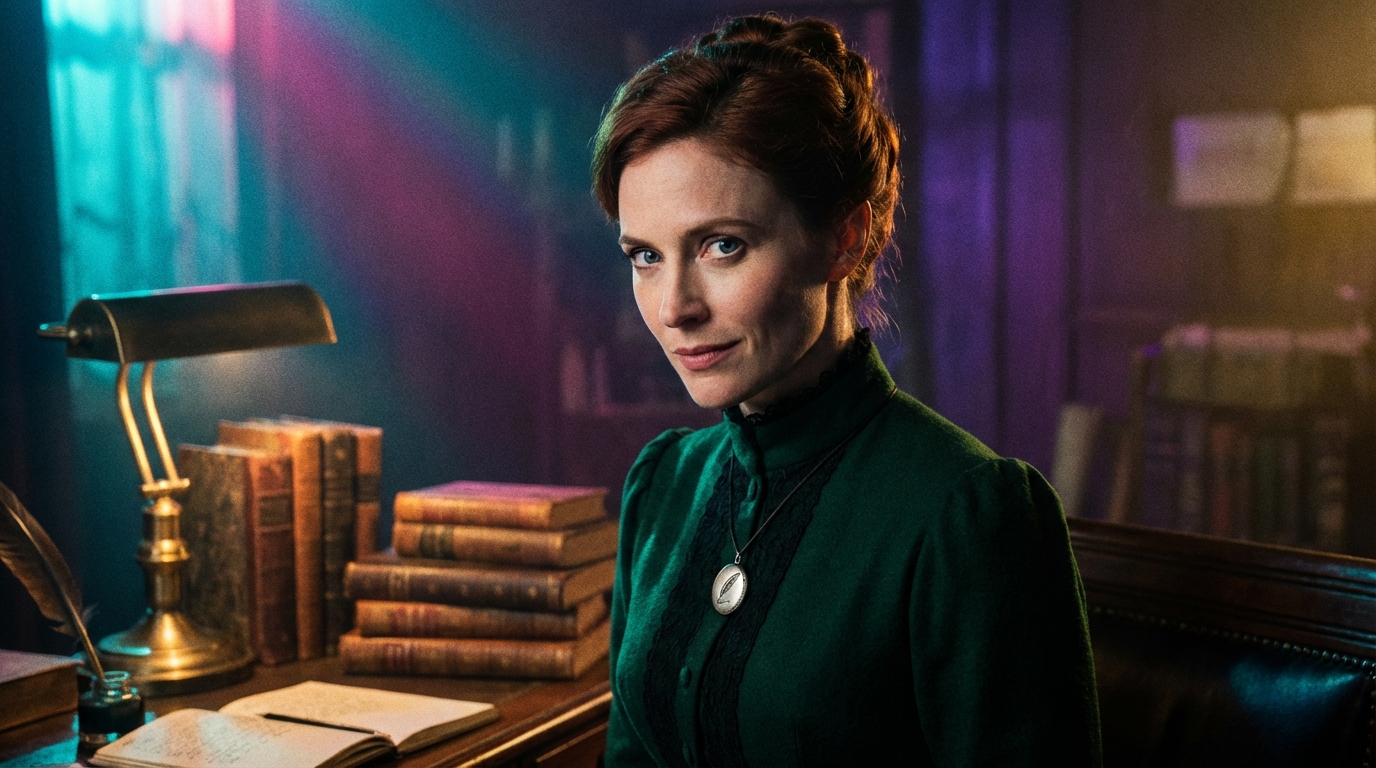
Portsmouth Harbour Child
The naval port of Portsmouth in the late eighteenth century bred a particular kind of resilience in its daughters. Victoria Anne Ashford was born on the 22nd of April 1796, the youngest of four children born to George Ashford, a naval officer whose career kept him at sea more often than not, and Lydia Carter Ashford, a seamstress whose capable hands supported the family through her husband's frequent absences. The Ashford household occupied modest rooms above a chandler's shop near the harbour, where the smell of tar and salt water permeated everything, and the distant cries of sailors loading cargo provided constant background music to daily life.
George Ashford's naval service meant that Victoria grew up in a household dominated by female resourcefulness. Her mother managed their limited finances with pragmatic efficiency, taking in extra sewing work when the naval pay proved insufficient, teaching her daughters the value of self-reliance long before such lessons became necessary. Lydia had no patience for delicate sensibilities or impractical romanticism—the navy would not wait for sentiment, and neither would she. Her children learned early that survival required clear thinking and practical action.
Victoria, as the youngest, enjoyed certain freedoms her elder siblings had not. By the time she arrived, Lydia had perfected her household economy and could spare attention for her daughter's education. The local governess, Miss Eleanor Patterson, recognised Victoria's quick intelligence and encouraged her voracious reading. Where other girls of her station focused primarily on needlework and domestic arts, Victoria devoured books—novels, philosophy, history, anything she could borrow from Miss Patterson's surprisingly extensive library.
Her father's returns from sea provided brief windows into a wider world. George would arrive home weathered and weary, smelling of tar and salt, carrying stories of distant ports and naval engagements. Young Victoria sat riveted as he described Mediterranean harbours, Atlantic storms, and the rigid discipline that governed life aboard His Majesty's ships. These tales planted seeds of wanderlust, suggesting that the world extended far beyond Portsmouth's familiar streets and that women needn't accept narrow confines simply because society expected it.
The Ashford family's social position existed in that precarious middle ground between respectable poverty and comfortable prosperity. They were neither so poor as to be shameful nor wealthy enough to feel secure. This ambiguity shaped Victoria's character, teaching her to navigate social situations with careful attention to nuance. She learned to present herself creditably amongst families of higher station whilst never forgetting the pragmatic realities that her mother's constant sewing reminded her of—gentility required maintenance, and maintenance required work.
Friendship Beyond Station
Victoria's friendship with Madelyn Bally began during her fourteenth year, when the merchant's daughter appeared at Miss Patterson's small school for young ladies. The Ballys occupied a distinctly higher social rung than the Ashfords—Thomas Bally's mercantile success providing comforts that naval pay could never match. Yet Madelyn, perhaps lonely in her prosperity, gravitated towards the sharp-tongued youngest Ashford girl whose observations made her laugh and whose honesty cut through the polite fictions that usually governed young ladies' interactions.
Their friendship flourished despite the difference in their circumstances. Madelyn invited Victoria to Bally family gatherings, introducing her to a world of commercial discussion and social ambition that fascinated Victoria even as she maintained ironic distance from it. Victoria provided Madelyn with candid counsel, warning when flattery grew excessive or when social climbers attempted manipulation. Where Madelyn's natural warmth sometimes blinded her to others' less noble motivations, Victoria's sharper instincts detected pretence and self-interest.
The Bally household welcomed Victoria with genuine warmth, Elizabeth Bally recognising that her daughter's friend possessed intelligence and character that transcended mere social position. Thomas Bally appreciated Victoria's quick wit, occasionally drawing her into conversations about literature and current affairs, treating her as an intellectual equal in ways that surprised and gratified her. These experiences shaped Victoria's understanding that class distinctions, whilst real, need not be absolute—capability and character could earn respect that birth alone might not command.
Victoria's observations of Madelyn's courtship by William Jeffries Sr. in 1818 aroused her protective instincts. She recognised the colonial entrepreneur's considerable charm but sensed shadows behind his confident façade. When she voiced gentle warnings—should not Madelyn learn more about his life in Van Diemen's Land? did he not deflect certain enquiries rather too smoothly?—Madelyn dismissed her concerns with the blithe assurance of a woman in love. Victoria, understanding that friendship sometimes required accepting decisions one questioned, suppressed her misgivings and wished her friend happiness.
The Jeffries wedding on 28 June 1818 brought Victoria both joy for her friend's apparent good fortune and melancholy awareness that this marriage would separate them perhaps permanently. The distance to Van Diemen's Land was not merely geographical but existential—Madelyn was stepping into a life Victoria could scarcely imagine, becoming mistress of colonial estates whilst Victoria remained in Portsmouth's modest circles. Yet even as she watched Madelyn depart aboard the Persephone on 13 July 1818, Victoria suspected that their story together had not truly ended.
The Colonial Gamble
Victoria's own decision to emigrate to Van Diemen's Land emerged from that peculiar mixture of pragmatism and desperation that characterised so many colonial ventures. At twenty-three, she faced the grim realities of an unmarried woman's prospects in Portsmouth. Her modest dowry and uncertain family position made marriage to anyone respectable unlikely. Employment options consisted primarily of governessing or companionship—respectable poverty dressed in better clothes.
The letter from Madelyn in late 1818, describing her new life at Jeffries Manor and suggesting that Victoria might find opportunities in the colony, arrived at a moment when Victoria was particularly conscious of her limited options. A failed understanding with a young naval officer—nothing official, merely an assumption that had dissolved when his family made clear that an Ashford connection would not suit their ambitions—had left her bruised and aware that Portsmouth held little promise of change.
She spent months considering the proposition, weighing Portsmouth's familiar limitations against Tasmania's unknown possibilities. Her mother, now widowed following George's death at sea in 1817, encouraged her decision with characteristic pragmatism. "You're too sharp to be happy as someone's charity case," Lydia observed. "Go. Make something of yourself where fresh starts matter more than ancient names." Her siblings, settled into their own modest lives, offered similar counsel, recognising that Victoria's restless intelligence required scope their familiar world could never provide.
The journey aboard the merchant vessel Providence in the spring of 1819 tested Victoria in ways her Portsmouth upbringing had never required. The tedious months at sea, the close quarters with strangers, the constant awareness of the ocean's indifference to human comfort or dignity—all reinforced her understanding that colonial life would demand resilience of a very practical sort. She arrived in Hobart Town in September 1819, stepping onto colonial shores with one trunk of possessions and considerable uncertainty about the wisdom of her choice.
Finding Colonial Footing
Madelyn's welcoming embrace when Victoria arrived at Jeffries Manor provided reassurance that their friendship had survived the separation and would anchor her in this strange new world. Yet Victoria quickly recognised that she could not simply attach herself to Madelyn's household as a dependent companion. Colonial society already whispered about the mysterious source of Jeffries wealth; becoming a charity case would benefit neither woman. Victoria needed to establish her own position, her own identity separate from the Jeffries connection, even whilst maintaining the friendship that had brought her across the world.
Her solution came through employment with the Thornton family, prosperous settlers who required a governess for their four daughters. Mrs Margaret Thornton, herself educated beyond the usual colonial standard, interviewed Victoria with questions that tested not merely her accomplishments but her intelligence and character. Victoria's honest responses—she could teach literature and history competently, mathematics adequately, but claimed no expertise in music beyond basic proficiency—impressed Margaret more than false assurances would have. The position offered modest salary but decent accommodation and entry into Hobart society's respectable circles.
The Thornton household provided Victoria with her first sustained exposure to colonial society's peculiar dynamics. Margaret and her husband Robert moved amongst the colonial elite, their dinner table hosting government officials, successful merchants, and ambitious newcomers. Victoria, occupying that ambiguous position between servant and family member that governesses inhabited, observed these interactions with the sharp attention that would later inform her writings. She noted the tensions between free settlers and emancipated convicts, the careful hierarchies that attempted to import English class structures into the colonial context, the hypocrisies that flourished where appearances mattered more than substance.
Her relationship with the Thornton daughters revealed her gift for education that transcended mere instruction. She taught them literature not as dry recitation but as windows into human nature, encouraged their questions rather than demanding rote acceptance, and treated their developing minds with respect that conventional pedagogy rarely afforded young girls. Margaret Thornton, observing Victoria's methods, remarked that her daughters were learning to think rather than merely to perform—praise that meant more to Victoria than increased salary could have.
Throughout this period, Victoria maintained close contact with Madelyn, visiting Jeffries Manor regularly and providing her friend with the candid companionship that Madelyn's elevated position increasingly denied her. Where colonial society treated the mistress of Jeffries Manor with careful deference, Victoria spoke to Madelyn with the honest directness of old friendship. This role—trusted confidante to one of colonial Tasmania's wealthiest women—gave Victoria social standing that governessing alone never would have provided, whilst her independent employment ensured she remained Madelyn's equal rather than her dependent.
The Crisis and Its Aftermath
The news of William Jeffries Sr.'s disappearance on 10 August 1821 reached Victoria through a frantic message from Madelyn: "Come immediately. William is gone." Victoria arrived at Jeffries Manor to find her friend struggling to maintain composure whilst the household erupted in controlled chaos. Constable Broadmoor's methodical questions, servants' frightened whispers, and the palpable sense that something terrible and inexplicable had occurred—all created an atmosphere of barely contained panic.
Victoria stepped into the role she would occupy throughout the crisis: Madelyn's anchor in the storm. She managed household details that Madelyn could not focus on, dealt with the influx of curious callers with firm politeness, and provided the emotional support that prevented her friend from collapsing under the combined weight of grief, fear, and suspicion. When Constable Broadmoor interviewed Madelyn, Victoria sat beside her, offering silent support and occasionally interjecting to clarify questions that seemed designed more to confuse than illuminate.
The weeks following William's disappearance revealed colonial society's less admirable qualities. The whispered speculation, the avid consumption of scandal, the barely concealed satisfaction some felt at the Jeffries family's misfortune—all disgusted Victoria even as she understood the human impulses driving such behaviour. She found herself assessing those who called at Jeffries Manor, noting who offered genuine sympathy versus who arrived primarily to gather gossip. These observations would later inform the satirical essays that made "V.A. Spectator" both admired and feared.
Her own position became precarious as the scandal deepened. Association with the Jeffries family carried social risk, and Mrs Thornton gently suggested that perhaps Victoria might limit her visits to the manor "just until matters settle." Victoria understood the implicit warning: continued close friendship with the suspected widow might cost her respectable employment. She weighed this concern against loyalty to Madelyn and chose loyalty without particular difficulty. If necessary, she could find other employment, but abandoning Madelyn during her greatest crisis was unconscionable.
Investigator Lockhart's interrogation of Madelyn on 16 August 1821, which Victoria attended at her friend's request, demonstrated the investigation's intensity and the suspicion surrounding the Jeffries family. Victoria watched Lockhart's methodical dissection of Madelyn's statements, his attempts to find inconsistencies or admissions of foreknowledge, his barely concealed belief that Madelyn must know more than she revealed. Victoria's presence provided Madelyn strength to maintain composure, yet Victoria herself felt the investigation's weight—the sense that everyone connected to the Jeffries family had become suspect by association.
The Chronicler Emerges
Through the crisis, Victoria discovered her true vocation. Observing the investigation, noting colonial society's reactions, analysing the gap between public sympathy and private speculation—all crystallised into an understanding that these events contained lessons about human nature and social dynamics that deserved documentation. She began writing, initially for her own clarification, attempting to make sense of the chaos through careful observation and analysis.
Her first essay, published pseudonymously in The Hobart Town Gazette in November 1821 under the signature "V.A. Spectator," ostensibly discussed the general problem of gossip in colonial society. Yet anyone familiar with recent events recognised the specific inspiration. Victoria's prose combined wit with insight, skewering those who consumed scandal whilst professing sympathy, noting how tragedy became entertainment for those safely distant from its actual consequences. The essay attracted attention precisely because it said publicly what many thought privately: that colonial society's response to the Jeffries disappearance revealed more about the community than about the missing man.
Subsequent essays established "V.A. Spectator" as a voice worth attending to. Victoria wrote about the contradictions between professed Christian charity and actual social cruelty, about the absurdities of attempting to maintain rigid English class structures in a colony where yesterday's convict might become tomorrow's employer, about the particular challenges women faced in a society that valued them primarily for their marital status and reproductive capacity. Her observations struck nerves precisely because they combined accuracy with irreverent humour that made harsh truths palatable.
The pseudonym provided necessary protection. A governess openly publishing satirical social commentary would likely find employment scarce, yet "V.A. Spectator" could write with freedom that Victoria Ashford could not afford. The mystery of the author's identity became its own source of social speculation—various theories circulated about who possessed such insight into Hobart society's foibles. That the incisive observer might be a woman of modest station occurred to few; most assumed "V.A. Spectator" must be an educated gentleman with insider access to elite circles.
Victoria's writing provided income that supplemented her governess salary, allowing her greater financial independence. The Gazette paid modestly for essays, but other colonial publications soon sought her contributions. By 1823, "V.A. Spectator" had become sufficiently established that Victoria could command reasonable fees for her work. This financial security, whilst still modest, gave her options she had never previously possessed—the freedom to leave unsatisfactory employment, the capacity to refuse positions that would compromise her writing time, the dignity of supporting herself through her intellect rather than merely her accomplishments.
Personal Disappointments
Amidst her professional development and her support of Madelyn through crisis, Victoria's personal life unfolded with less satisfaction. In 1823, she accepted the proposal of Richard Foster, a merchant who seemed to offer the stability and companionship she had resigned herself to never finding. Richard appreciated her intelligence, claimed to value her independence, and presented himself as a man who could love a woman of wit rather than merely a decorative wife.
The engagement lasted eight months before Richard announced his return to England to manage unexpected family business concerns. His assurances that Victoria would join him once matters were settled gradually revealed themselves as polite fiction. Letters from Portsmouth grew less frequent, their tone more distant, until finally he wrote with awkward honesty that his family's expectations and his own reconsideration suggested that perhaps they were not as well-suited as he had initially believed. The colonial experiment, it seemed, had not transformed him as thoroughly as Victoria had hoped.
The broken engagement stung less for lost love—Victoria had never quite convinced herself that Richard truly understood or valued her—than for the confirmation it provided of her fundamental unsuitability for conventional domestic happiness. She was too sharp, too independent, too unwilling to perform the deference that marriage typically required from women. At twenty-seven, she accepted with clearer eyes that she would likely never marry, that her future lay in the independence she had already begun constructing through her writing and her teaching.
This acceptance, whilst melancholy, also brought liberation. She need not waste energy on futile hopes of transformation into someone more conventionally acceptable. Instead, she could invest herself fully in the work and relationships that actually sustained her. Her friendship with Madelyn deepened as both women navigated disappointment—Madelyn's from her husband's disappearance and colonial society's suspicion, Victoria's from romantic failure and the recognition of permanent spinsterhood. They understood each other's resilience born from necessity rather than choice.
The decades following her broken engagement brought other disappointments—positions lost when families moved or reduced household expenses, publication opportunities that promised more than they delivered, the constant low-level awareness that her financial security remained perpetually precarious. Yet these challenges also honed her resourcefulness. She learned to negotiate better terms, to maintain multiple income streams, to save against inevitable downturns. By her mid-thirties, Victoria had constructed a modest but genuine independence that required no man's approval or support.
The Established Observer
Through the 1830s and into the 1840s, Victoria's dual roles—governess to respectable families and satirical essayist under pseudonym—established her as a fixed presence in Hobart society. The Thornton family eventually moved to Sydney in 1832, and Victoria secured positions with other families, her reputation for competent instruction and good character ensuring steady employment despite occasional employers' discovery that their governess was rather more educated and independently minded than they had anticipated.
Her essays continued appearing regularly in colonial publications, "V.A. Spectator" becoming an institution that readers eagerly anticipated. She wrote about the transformation of Van Diemen's Land from penal colony to prosperous settlement, noting ironies and contradictions that official accounts preferred to ignore. She skewered ambitious social climbers, punctured pompous authorities, and occasionally praised genuine accomplishment or authentic character—her pen proving equally capable of commendation as criticism, though criticism came more naturally to her temperament.
The secret of her authorship remained remarkably well-kept, though Madelyn knew from the beginning and a few other trusted friends eventually discovered the truth. Victoria's discretion in separating her governess identity from her writing persona helped preserve the mystery. She never referenced her essays in polite conversation, never betrayed knowledge that "V.A. Spectator" possessed, maintaining careful boundaries that protected both her employment and her writing's effectiveness.
Her presence at Jeffries Manor became increasingly frequent as Madelyn transitioned from business management to philanthropic focus. Victoria served as surrogate aunt to William Jeffries Jr., providing him with intellectual stimulation that complemented his formal education. She encouraged his reading, discussed ideas with him as an equal despite the decades separating them, and offered perspective on his mother's remarkable accomplishments that helped him appreciate what Madelyn had achieved whilst bearing the burden of his father's mysterious disappearance.
Her observations of William Jr.'s development informed several of her most insightful essays about education and the shaping of character. She wrote about the challenges of raising children under public scrutiny, about how scandal's shadow could motivate either collapse or exceptional achievement, about the particular pressures facing those who inherited wealth and position without having earned them themselves. Those who knew the Jeffries family recognised the inspiration whilst appreciating that "V.A. Spectator" wrote with sympathy rather than exploitation.
The Literary Legacy
By the 1850s, Victoria had established herself sufficiently that teaching became optional rather than necessary. Her writing income, combined with careful savings accumulated over decades, provided modest security. She continued accepting select governessing positions, but increasingly as a choice rather than compulsion—families who appreciated her methods and treated her with respect deserved her service, whilst those who merely wanted a decorative instructor for their daughters could seek elsewhere.
Her essays evolved from sharp social satire into more reflective observations about colonial life's transformation. She wrote about memory and change, about how the rough settlement she had arrived in forty years earlier had become something approaching civilised society. Yet she maintained her critical edge, noting that prosperity and sophistication had not eliminated the human flaws she had always dissected—greed, hypocrisy, social cruelty—merely dressed them in better clothes and more sophisticated justifications.
The question of collecting her essays into book form arose periodically. Publishers in Hobart and Melbourne expressed interest in a "V.A. Spectator" anthology, suggesting that forty years of colonial social commentary would attract significant readership. Victoria resisted these proposals, partly from habitual privacy, partly from uncertainty whether the essays would retain their impact outside their original contexts. Individual pieces written for specific moments might seem dated when compiled years later, whilst the anonymity that had protected her might prove impossible to maintain once her name appeared on a title page.
Yet she also recognised that her work documented colonial Tasmania's development in ways that official histories never would. The social dynamics, the daily hypocrisies, the small victories and petty cruelties that shaped actual lived experience—these appeared in "V.A. Spectator's" essays but not in governors' reports or business ledgers. Her writing preserved perspectives that would otherwise vanish, voices that historians typically ignored, truths that respectable society preferred not acknowledging.
In 1860, she finally agreed to compile selected essays for publication, choosing pieces that she believed retained relevance beyond their immediate occasions. The resulting volume, "Observations from the Colonies: Selected Essays by V.A. Spectator," appeared in 1862 with an anonymous preface explaining that the author's identity would remain undisclosed. The book attracted modest attention, praised by some for its insight whilst criticised by others as excessively cynical about colonial progress. Victoria, reading reviews in her modest rooms, felt satisfaction at having preserved something permanent from decades of observation.
The Final Years
Victoria's health began declining noticeably in early 1864. The cough that had troubled her through the previous winter persisted into spring, and the chronic fatigue that she had initially dismissed as mere aging revealed itself as something more serious. Her physician, examining her with concerned attention, delivered the diagnosis she had already suspected: consumption, well advanced, offering little hope of recovery.
She received the news with characteristic pragmatism, making arrangements with calm efficiency. Her savings, modest but carefully husbanded, she divided between a small bequest to Madelyn—not from need, for Madelyn required no financial assistance, but as token of gratitude for decades of friendship—and donations to The Haven Home for Children and other charitable institutions. Her papers, including the manuscripts for unpublished essays and her extensive correspondence, she entrusted to Madelyn's care with instructions that they be preserved but not published during her lifetime.
The final months brought pain she endured with as much dignity as circumstances allowed. Madelyn visited frequently, sitting beside Victoria's bed and reminiscing about Portsmouth days that seemed impossibly distant yet remained vivid in memory. They laughed about youthful innocence, acknowledged mistakes and disappointments, and agreed that their lives, whilst not following conventional patterns, had possessed genuine meaning and accomplishment.
William Jeffries Jr., now a prosperous gentleman in his mid-forties, also visited, bringing his own gratitude for Victoria's influence on his development. She had taught him to think critically, to value substance over appearance, to recognise that intelligence and character transcended social position. These lessons had served him well, and he wanted her to know that her impact extended beyond her essays—she had shaped at least one life in ways that would echo through subsequent generations.
On the 18th of December 1864, Victoria Anne Ashford died peacefully in her sleep, aged sixty-eight. Madelyn, who had sat beside her through the final night, was present when Victoria's breathing simply stopped, her long struggle finally concluded. The funeral, held two days later, drew attendance from across Hobart society—families she had taught, readers who had appreciated "V.A. Spectator's" insights, and those who had known her personally and valued her friendship.
The obituaries published in colonial newspapers varied in their assessment. Some praised her as a dedicated educator who had shaped young minds throughout decades of service. Others, revealing the poorly kept secret of her authorship, celebrated "V.A. Spectator" as one of colonial Tasmania's keenest observers, whose essays had chronicled the settlement's transformation with wit and wisdom. A few noted disapprovingly that she had never married, had lived independently in ways that some found unsuitable for a respectable woman, had written with sharpness that occasionally crossed into impropriety. Victoria, had she been able to read these varied assessments, would likely have appreciated the contradictions—evidence that she had remained herself, refusing easy categorisation, to the very end.
She was buried in Hobart's St David's Cemetery, her headstone bearing simple inscription: "Victoria Anne Ashford, 1796-1864, Observer and Friend." Madelyn, standing at the graveside, reflected that those two words—observer and friend—captured what had mattered most to Victoria. She had watched colonial society with unsparing clarity, recording its flaws and occasional virtues, yet she had also provided loyal friendship when friendship proved most necessary. The combination represented Victorian life's essential achievement: maintaining critical intelligence whilst never abandoning human connection, seeing clearly whilst loving deeply nonetheless.







