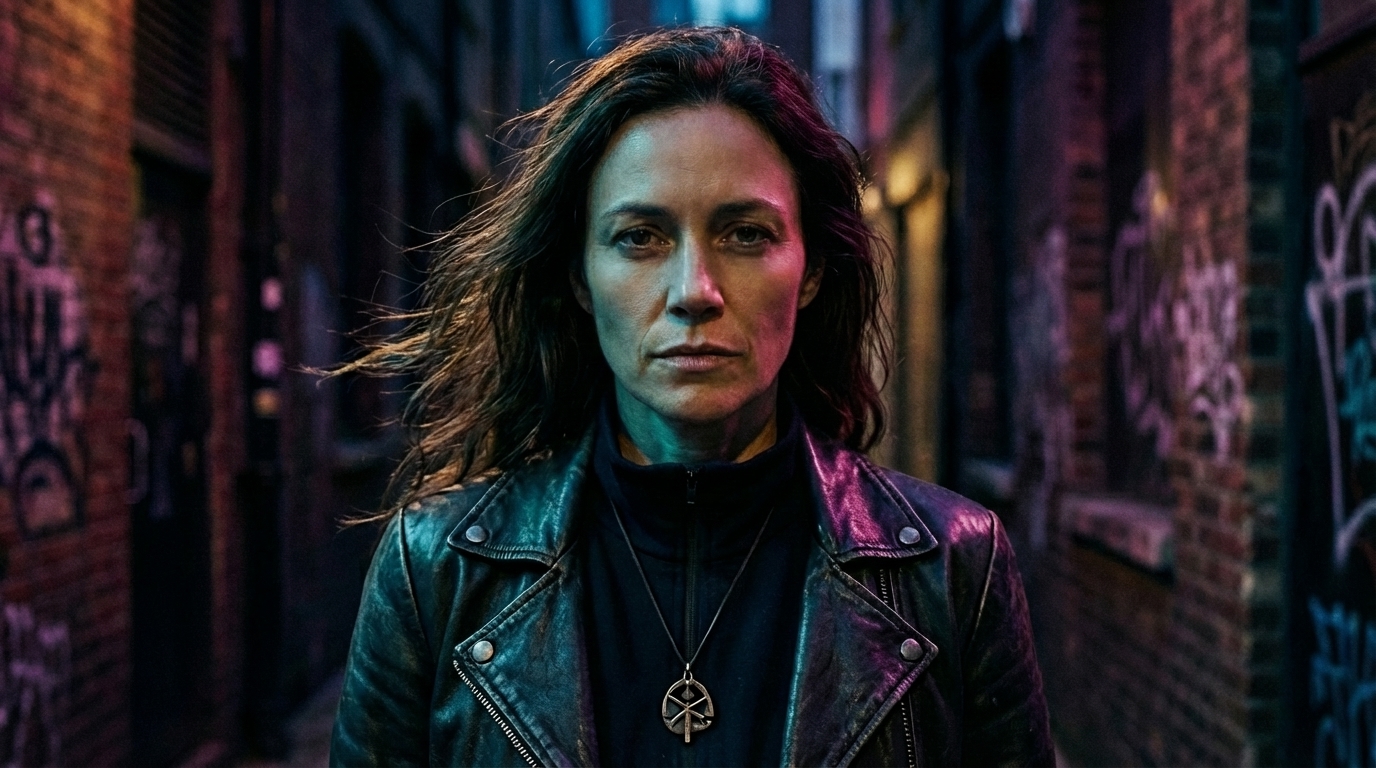
Verity Elizabeth Sloane
Verity Elizabeth Sloane (born 22 February 1990) is a forensic accountant and Guardian of Saint Phillis. Born in Hobart to a family marked by early loss, Verity developed a sharp intelligence and pragmatic exterior that concealed periods of intense introspection. Her career analysing financial discrepancies for the Tasmanian Government brought her into Nathan Cowdrey's orbit, and their professional rapport became the foundation for her recruitment into the Guardians. The London incident of 2019—watching Amber Styles die, freezing for a crucial second before fleeing through her Portal Key—shattered something in Verity that pragmatism couldn't repair. In the years since, she has become a ghost in the information grid, her whereabouts and activities known only to those who need to know.
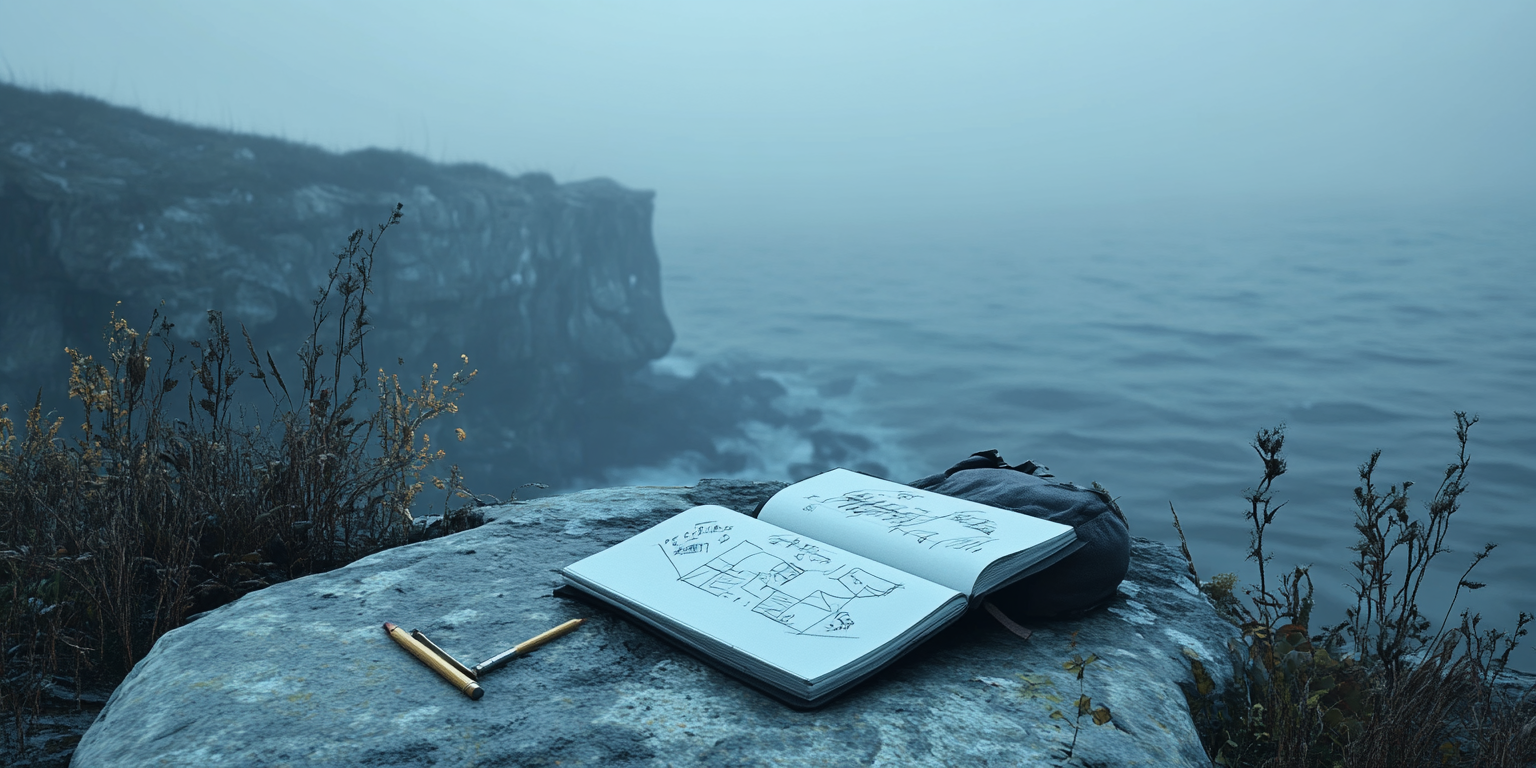
Early Life in Hobart
Verity Elizabeth Sloane was born on 22 February 1990 at the Royal Hobart Hospital, the third child of Colin Andrew Sloane, a marine engineer who maintained vessels at the port, and Judith Anne Sloane (née Brennan), a radiographer at the hospital where Verity was born. The family lived in a weatherboard cottage in South Hobart, on a steep street where the houses clung to the hillside and the views stretched across the Derwent to the eastern shore.
Her older siblings had arrived in quick succession: Thomas in 1985 and Eleanor in 1987. By the time Verity came along, the household had established its rhythms—Colin's irregular hours dictated by shipping schedules, Judith's shift work at the hospital, the children learning early to entertain themselves and look after each other. Thomas, the oldest, took his responsibilities seriously; Eleanor, the middle child, carved out space through dramatic flair and social charm. Verity, the youngest, watched and listened and noticed things the others missed.
She was an observant child in ways that occasionally unsettled adults. At four, she asked her grandmother why she kept touching the spot where her wedding ring used to be, though no one had mentioned the recent divorce. At six, she told her father that the new deckhand at work was lying about something, based on nothing more than how he'd stood during a family visit to the port. Colin had laughed it off; three weeks later, the deckhand was dismissed for falsifying his qualifications.
The family called it "Verity's knack"—her ability to read situations, to spot inconsistencies, to see what people were trying to hide. It was treated as endearing, a quirk that would serve her well someday. No one understood yet that it was also a defence mechanism, a child's way of trying to predict when the next bad thing would happen by watching for the signs she'd missed before.
The Year Everything Changed
In September 1997, Eleanor Sloane was diagnosed with acute lymphoblastic leukaemia. She was ten years old. Verity was seven.
The next eighteen months reorganised the Sloane household around hospital visits, treatment schedules, and the particular geography of hope and dread that families of sick children learn to navigate. Colin took on extra work to cover expenses not covered by Medicare; Judith reduced her hours to be present for Eleanor's chemotherapy sessions; Thomas, at twelve, became a surrogate parent to Verity in ways no child should have to manage.
Verity's memories of this period are fragmentary but vivid. The smell of hospital disinfectant that clung to her mother's clothes. The way Eleanor's hair fell out in clumps, then grew back different—darker, curlier—after the first round of treatment. The whispered conversations that stopped when she entered rooms, as if seven-year-olds couldn't understand words like "remission" and "prognosis" and "prepare ourselves."
What Verity understood, with the clarity that would later define her professional life, was that adults lied. Not maliciously—they lied to protect, to hope, to maintain the fiction that everything would be fine. Her mother said Eleanor was getting better when the dark circles under her eyes said otherwise. Her father said there was nothing to worry about while his hands shook over the household accounts. The doctors spoke in careful probabilities that meant nothing and everything simultaneously.
Verity stopped asking questions. She started watching instead, cataloguing the gap between what people said and what their bodies revealed, between the official story and the evidence she could see with her own eyes. It was the beginning of a lifelong habit: trust what you can verify, and understand that the surface of things rarely tells the whole truth.
Eleanor responded to treatment. By early 1999, she was declared in remission—a word Verity later learned meant "not cured, but not dying right now." The Sloane family exhaled, cautiously at first, then with increasing confidence as months became years without relapse. Eleanor returned to school, made friends, developed the dramatic personality that would lead her to study theatre at university. The crisis receded into family history, mentioned occasionally but no longer the organising principle of daily life.
But Verity had changed in ways that weren't immediately visible. She had learned that catastrophe could arrive without warning, that the people meant to protect you couldn't always do so, that survival sometimes meant watching carefully and saying nothing. The observant child became a guarded one—outwardly open, socially capable, but with depths she kept hidden even from those closest to her.
Adolescence and Education
Verity attended South Hobart Primary School and then Hobart College, where she excelled academically without drawing excessive attention. Her teachers noted her intelligence, her reliability, her tendency to submit work that was technically flawless but emotionally restrained. She had friends—she was too socially adept not to—but the friendships rarely deepened beyond a certain point. There was always a part of Verity that remained in reserve, watching from behind her own eyes.
Her "knack" evolved into something more sophisticated during these years. She developed an almost unconscious ability to track inconsistencies—in stories people told, in financial arrangements she overheard, in the small hypocrisies that accumulate in any community. When a school fundraiser's numbers didn't add up, fifteen-year-old Verity was the one who noticed, though she reported it through a teacher rather than confronting anyone directly. When her father mentioned that something felt "off" about a contractor bidding for port work, Verity asked to see the paperwork and identified the discrepancies within an hour.
Colin Sloane began calling her "my little auditor," half-joking but half-serious. It planted a seed.
Mathematics came naturally, as did the logical structures underlying accounting and finance. Verity enrolled at the University of Tasmania in 2008 to study a Bachelor of Commerce, majoring in accounting with a minor in information systems. The degree suited her temperament: rigorous, rule-governed, concerned with verification and evidence. She graduated in 2011 with first-class honours, her dissertation examining anomaly detection methodologies in financial datasets—essentially, a systematic study of how to spot when numbers were lying.
Career and the Path to Government
Verity's early career followed a conventional trajectory for a high-achieving accounting graduate. She completed her CPA certification while working at a mid-tier firm in Hobart, spending three years auditing local businesses, non-profits, and the occasional government contract. The work was competent but unsatisfying—she was good at finding discrepancies, but the stakes felt trivial. Expense report irregularities and inventory shrinkage didn't engage the part of her that had learned to watch for signs of genuine danger.
In 2014, a position opened in the Tasmanian Government's financial oversight division. The role was technically a step sideways rather than up, but it offered something the private sector couldn't: access to systems where the stakes were higher, where discrepancies might indicate genuine wrongdoing rather than mere sloppiness. Verity applied and was accepted, beginning what would become a four-year tenure that would change the course of her life.
The work suited her. Forensic accounting in a government context meant examining procurement processes, analysing contractor relationships, identifying patterns that suggested corruption or mismanagement. Verity developed a reputation for thoroughness and discretion—she found problems, documented them meticulously, and let others decide what to do with her findings. Her reports were models of precision, laying out evidence without editorialising, allowing the facts to speak for themselves.
It was in this role that she encountered Nathan Cowdrey.
Nathan
They met in 2015 during a cross-departmental project examining service delivery systems. Nathan was a senior business analyst; Verity was auditing the financial controls surrounding a major IT upgrade. Their working relationship developed through shared meetings, collaborative documents, and the particular intimacy of people who spend long hours together solving problems that no one else in the building fully understands.
Nathan noticed things. Not the way Verity did—he didn't track inconsistencies or watch for deception—but he paid attention to people in ways that most colleagues didn't. He remembered that she took her coffee with milk but no sugar. He noticed when she was having a difficult day and gave her space without making it awkward. He asked questions about her work that suggested genuine interest rather than mere politeness.
For Verity, who had spent her adult life maintaining careful boundaries, Nathan's attentiveness was both appealing and slightly unnerving. He seemed to see her more clearly than she was comfortable being seen, yet he never pushed past the limits she established. Their friendship deepened gradually, built on professional respect and the particular bond of two people who found themselves slightly out of step with the world around them.
By 2017, they were working together on the Inteq OneGov upgrade—a sprawling government IT project that consumed most of their professional attention. The project was plagued by the usual complications: scope creep, vendor conflicts, stakeholder disagreements, the slow grind of bureaucratic process. Nathan and Verity became something like co-conspirators, united by shared frustration and the dark humour that develops between colleagues navigating institutional dysfunction.
Verity's forensic eye caught things about the project that troubled her—procurement decisions that didn't quite add up, contractor relationships that seemed too cosy, the particular pattern of problems that suggested something beyond mere incompetence. She documented her concerns carefully, uncertain whether she was seeing genuine issues or simply applying her habitual suspicion to ordinary government messiness. She mentioned some of these concerns to Nathan, who listened seriously but couldn't offer explanations.
What Verity didn't know—couldn't have known—was that Nathan's world was about to crack open in ways that would make procurement irregularities seem laughably insignificant.
January 2018
The change in Nathan was subtle at first. Verity noticed it the way she noticed everything: the slight distraction in his eyes, the moment of hesitation before answering routine questions, the sense that part of his attention was elsewhere even when he was physically present. When he requested personal leave in mid-January, citing vague "family matters," she accepted the explanation without challenge—but she noted the microsecond of guilt that crossed his face as he said it.
It was the first time Nathan had ever lied to her.
The realisation sat uncomfortably in Verity's chest for days afterward. Not anger, exactly—she had no claim on Nathan's private life, and people were entitled to their secrets. But the discrepancy between the Nathan she knew and the Nathan who would look her in the eye and say something untrue represented a crack in her mental model of him, a sign that something significant had shifted.
When Nathan returned, he was different in ways that were difficult to articulate. More present in some moments, more distant in others. He watched people with new intensity, as if seeing them for the first time—or seeing through them to something underneath. And when he asked Verity to meet him for coffee outside the office, his expression carrying a weight she'd never seen before, she understood that whatever he was about to tell her would change things permanently.
The conversation that followed—the Portal Key, Clivilius, the Guardians, the impossible facts that Nathan laid out with the careful precision of someone who knew how insane it all sounded—should have triggered every sceptical instinct Verity possessed. She should have concluded that her friend had suffered some kind of breakdown, that the stress of the OneGov project had cracked something fundamental in his mind.
Instead, she found herself believing him. Not because the evidence was compelling—he had nothing but words and a strange object that could have been anything—but because she knew Nathan, had spent years calibrating her understanding of who he was and how he operated. The Nathan sitting across from her wasn't delusional. He was scared, and exhilarated, and asking for her help with something that mattered more than anything had ever mattered.
Verity said yes.
Guardian
The activation of her Portal Key, the first crossing into Clivilius, the visceral shock of standing in a world that shouldn't exist—these experiences are documented elsewhere. What matters for understanding Verity is how quickly she adapted, how the pragmatism that had defined her professional life translated into practical problem-solving in circumstances that defied all practical understanding.
Saint Phillis needed infrastructure. It needed systems for shelter, water, communication, resource allocation. It needed someone who could look at impossible problems and break them into manageable steps, who could identify what was actually required versus what people thought they wanted, who could track progress and flag risks and keep the whole enterprise from collapsing under the weight of its own ambition.
Verity became that person. Her forensic accountant's mind—trained to find patterns, verify claims, spot discrepancies—proved unexpectedly valuable in a world where the rules were still being discovered. She designed systems, documented processes, challenged assumptions, and occasionally told Nathan that his visionary ideas were logistically impossible in terms that left no room for argument.
Their dynamic evolved. Where they had been colleagues united by shared frustration, they became something more like partners—Verity's pragmatism grounding Nathan's idealism, his conviction inspiring her to attempt things she would never have considered possible. It wasn't romantic, though observers sometimes wondered. It was something rarer: a working relationship built on genuine mutual respect, where each person made the other more effective than they could be alone.
The addition of Josh Cowdrey, Saul Carter, and Amber Styles completed the Guardian Group. Verity's relationship with each of them developed differently—Josh's methodical competence aligned with her own approach; Saul's financial expertise made him a natural collaborator; Amber's instinctive warmth gradually wore down Verity's habitual reserve. For the first time since Eleanor's illness, Verity found herself part of something that felt like family.
London 2019
The penthouse operation represented everything the Guardians had been working toward. A base of operations. A coordinated plan to expose the Clivilius Corporation. The sense that they were finally moving from survival to action, from reaction to initiative.
Verity managed intelligence. She pinned threads to the corkboard, mapping connections and identifying targets with the methodical precision she'd developed over years of forensic work. The wall of information represented her contribution—patterns made visible, relationships documented, the architecture of conspiracy laid bare for those who knew how to read it.
She was working on the corkboard when Amber stumbled through the door.
The image is burned into Verity's memory with perfect, terrible clarity. Amber's face, usually so animated, gone slack with shock. The blood spreading across her chest, too much blood, the colour wrong somehow under the artificial lights. Her eyes finding each of them in turn—Nathan, Josh, Saul, Verity—before focusing with desperate intensity.
"Run!"
Verity froze.
It was only a second, maybe two. An eternity measured in heartbeats. Her mind, usually so quick to process and respond, simply stopped—overwhelmed by input that didn't fit any pattern she knew how to interpret. This wasn't a discrepancy in a financial report. This wasn't a contractor lying about qualifications. This was a woman she cared about dying in front of her, and every system Verity had built for understanding the world failed simultaneously.
Then her hand was on her Portal Key, and she was activating it without conscious decision, and the penthouse dissolved into rainbow light, and she was somewhere else with tears already streaming down her face.
She never saw Amber alive again. She never said goodbye, or thank you, or any of the things you're supposed to say to someone who sacrifices themselves so you can escape. She just ran, exactly as Amber had commanded—and some part of Verity has never stopped running since.
After
The Guardian Group scattered according to protocol, each member disappearing into separate safety, communication limited to encrypted channels and emergency codes. It was the right decision tactically, the only decision given what had happened. But for Verity, the isolation compounded the trauma in ways she hadn't anticipated.
She had spent her life maintaining careful distance from others, protecting herself through observation and reserve. Now that distance became absolute, and she discovered it wasn't protection at all—it was just loneliness with a different name.
The weeks immediately following London are a blur in Verity's memory. She moved between safe locations, maintained minimal contact with the other Guardians, and tried to process what had happened through the analytical frameworks that had always served her before. It didn't work. Amber's death wasn't a problem to be solved or a discrepancy to be documented. It was a wound that wouldn't close, a gap in the world where someone should have been.
Eventually, Verity stopped trying to process and started trying to function. She had skills—forensic analysis, pattern recognition, the ability to find what others wanted hidden. In a world where the Guardian organisation had fractured into isolated cells, where trust was scarce and information was power, those skills had value.
She became, as Nathan would later describe it, a ghost in the information grid.
Present Day
The specifics of Verity's current activities remain largely undocumented, known only to those with direct need to know. She maintains encrypted contact with the surviving Guardians of Saint Phillis—Nathan, Josh, Saul—but the relationships have changed. The family they'd built has become something more like a network: functional, professional, connected by shared history and mutual obligation rather than daily presence.
What can be said is that Verity Elizabeth Sloane is thirty-five years old, and she has not stopped watching. The child who learned to read the gap between what people said and what they meant has become an adult who operates in the spaces between official stories, tracking patterns that others miss, documenting truths that powerful people would prefer remained hidden.
The pragmatism that once balanced Nathan's idealism now serves different purposes. The sharp intelligence that made her invaluable to the Tasmanian Government's financial oversight division now applies itself to questions with higher stakes and less clear answers. The guarded reserve that protected her through childhood trauma and professional challenges has hardened into something closer to operational security.
Somewhere beneath all of it—beneath the competence and the caution and the carefully maintained distance—Verity still carries the image of Amber stumbling through that door. The second she froze. The tears she couldn't stop as rainbow light carried her away from everything that mattered.
She has never forgiven herself for that frozen second. She suspects she never will.
But she has learned to keep moving anyway, to do the work that needs doing, to maintain the connections that matter even when maintaining them hurts. The youngest Sloane sibling—the one who watched and noticed and kept her own counsel—has become exactly what her circumstances required: a ghost with a purpose, invisible until she chooses not to be, finding the hidden truths that shape the visible world.
Her father's old joke echoes differently now. She didn't become an auditor. She became something harder to name—but the work, in its essentials, remains the same.
Find the discrepancy. Document the evidence. Let the facts speak for themselves.
And never, ever stop watching.







