Václav Vojtěch Novak
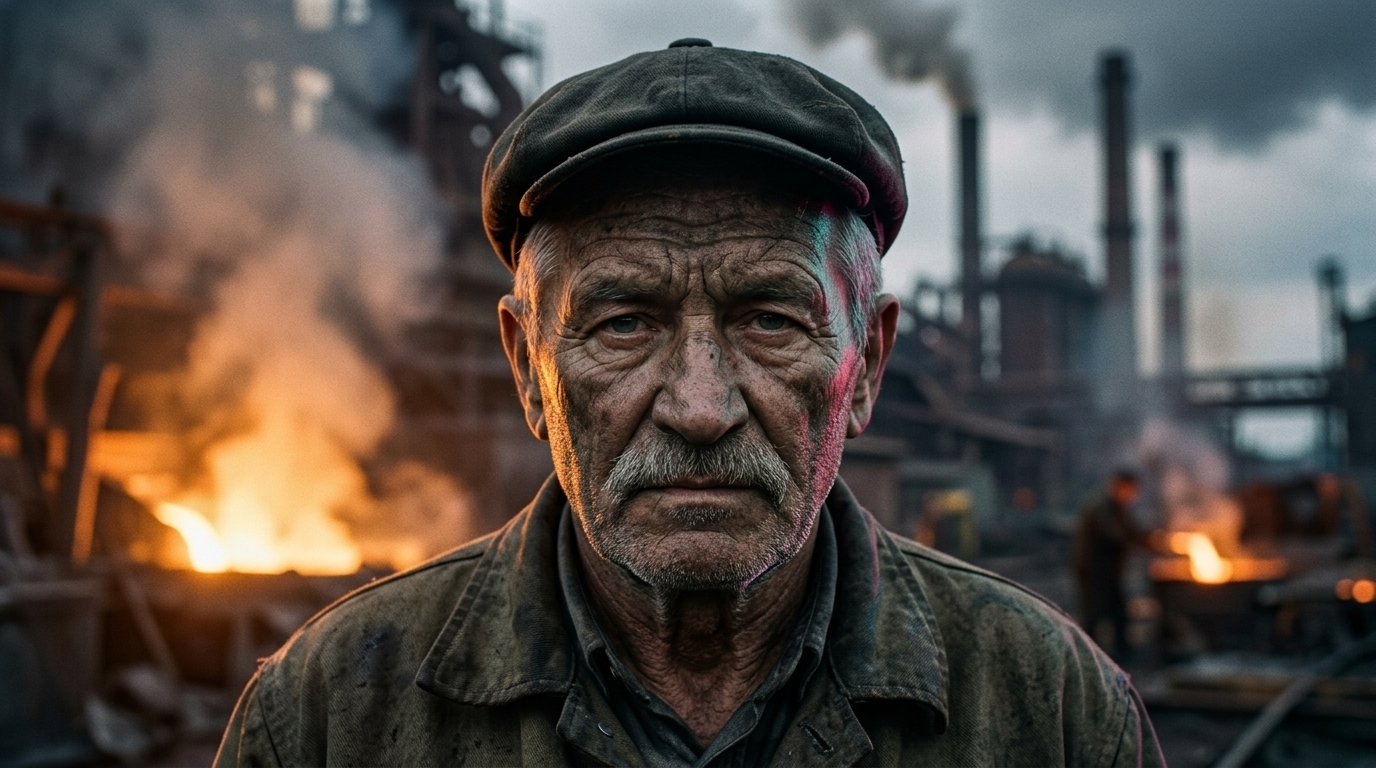
Václav Novak, born in Ostrava in 1921 on the feast of Saint Wenceslas, was the patriarch of the Novak family and a Vítkovice ironworks foundryman for forty-six years. A hard, mute man shaped by the German occupation and a lifetime under communism, he loved his wife Marie and his sons—Mikhail the surgeon and Pavel the fitter—through provision and never through speech. Both emigrated and left him; widowed and alone, he died in Ostrava in 1994, the unspoken source of his family's long silence.
Born on the Saint's Day
Václav Vojtěch Novak was born on the 28th of September 1921 in Ostrava, on the feast of Saint Wenceslas, patron and martyr of the Bohemian lands, and he was named for him—Václav, with Vojtěch set behind it for Saint Adalbert, a second patron of the nation. It was the kind of name a working family gave a son in the proud young Czechoslovak republic that had existed for barely three years: a small declaration of who they were, which was Czech, Catholic, and certain that the new state would make a place for men like them.
Half a lifetime later the regime that followed would prefer such names forgotten, and Václav would let it think they were, while keeping the older meanings quietly where they had always sat.
He was the elder son of Antonín Novak, a moulder on the casting floor of the Vítkovice ironworks, and his wife Růžena (née Pospíšilová), and he came into a world already organised entirely around the works. The blast furnaces and the casting halls, the shift whistle that governed the day, the perpetual orange glow on the underside of the clouds that the children of Ostrava took for the ordinary colour of a night sky—this was the whole horizon of his boyhood, and it was understood without discussion that he would give himself to it as his father and grandfather had before him.
Antonín Novak was a hard, exact, sparing man who had buried his own softness somewhere in his youth and never gone back for it, and from him Václav learned the only model of fatherhood he would ever possess: provide, endure, demand competence, and say nothing that could as easily be left unsaid. There was a younger brother, Jan, three years his junior and quicker to laugh, and a mother who kept a clean and devout house and took the boys to Mass while the First Republic still made Mass an ordinary thing to attend.
It was not a warm childhood, but it was a solid one, and Václav, who had never been promised warmth, did not miss it. He left school at fourteen and walked through the gate of the Vítkovice works in 1936, a boy of fifteen on the casting floor beside his father, and in one corner of those works or another he would remain for the next forty-six years.
Family Tree
Iron for the Occupier
He was seventeen when the German army marched into the rest of the country in March 1939 and the Czechoslovakia he had been named for ceased, overnight, to exist. The Vítkovice works—far too valuable to leave idle—were folded into the machinery of the German war economy, and Václav, like every able man on the casting floor, found himself making iron for an occupier under the eye of overseers who could send a man east for forced labour, or worse, on little more than a whim.
He learned, in those six years, the lesson that would govern the rest of his life: that a working man under a regime he had not chosen survived by being useful, reliable, and invisible, and by keeping whatever he truly thought behind his teeth. It was a lesson he would have cause to practise twice over before he was done.
The war took Jan. The younger brother was swept up in the forced-labour drafts that emptied the Protectorate of its young men, sent into Germany in 1943 to tend the factories there, and he did not come home; the family understood only afterwards, and never in full, that he had died beneath an Allied raid on the very sort of plant his brother was tending in Ostrava. Václav did not speak of it. He folded the loss away beside the others, in the place his father had taught him to keep such things, and there it stayed, unmentioned, for the next fifty years.
In the late summer of 1944 the American bombers came for the Ostrava industrial belt, and he worked on through the raids and the rubble because the alternative was not permitted; and in the spring of 1945 the Red Army fought its way into the city, and the war was at last over. He was twenty-three. He had spent the whole of his young manhood making iron for men he despised and burying the people he loved, and the experience finished the work his father had begun. It made him a man of granite silences, for whom feeling was a private weather that was never, under any circumstances, to be reported aloud.
Marie
Amid all of it, in the grey last winter of the occupation, he had married. Marie Kratochvílová was a miner's daughter from a neighbouring street, the child of Josef Kratochvíl, a quiet and capable and devout young woman who had known the Novak boys the whole of her life. The wedding was a small wartime affair with little to eat and less to celebrate beyond the bare fact of itself. It was not, on his side, a marriage of declared passion—Václav declared nothing—but it was a true one, and it held for forty-seven years, and in his fashion he was steadfast to her every single day of it.
What softness the home possessed was hers. Marie kept the faith alive through the years when faith was unfashionable and quietly unwise—the discreet Mass, the saint's medal in the drawer, the children taught their prayers in a whisper—and she kept, too, the threads of family and neighbourhood that her husband had neither the words nor the inclination to maintain. She took in mending to stretch his wage, raised the boys, and bore without complaint a man who loved her in deeds and never once in speech, having decided early, as her mother and grandmother had decided before her, that this was simply how the men of that country were made.
Their first son, Mikhail, was born in the autumn of 1945, in the first hopeful months of the recovered peace; their second, Pavel, came four years later, in 1949, by which time a new regime had seized the country and the brief democratic interval between the Germans and the Communists had closed for good. The two boys would grow into the great quiet drama of Václav's life, and into its central sorrow—which was not that either ever failed him, for neither did, but that he could never once find the words to tell either one what he felt.
The Foundry and the Party
When the Communists took the country in February 1948, the change was at once enormous and, for a man on the casting floor, oddly slight. The flags changed and the speeches changed and the works acquired a thick new layer of committees and slogans, and a foundryman was now, officially, a hero of socialist labour, the very backbone of the workers' state. The propaganda lionised him; the reality left him much as it had found him, in hot, hard, dangerous work for a wage that bought enough and rarely a great deal more.
Václav listened to none of the speeches and believed none of the slogans. He carried, when it became prudent to carry one, a Party card he regarded with the same flat practicality as a works pass—a thing a sensible man held because holding it cost less than not holding it did.
He marched under the red banners on May Day and slipped into the back of a church at Christmas and Easter, and he saw no contradiction worth examining in the two: the parade was for the regime and the Mass was for himself, and a man kept the ledgers separate and his own counsel in both. He never thought of it as cowardice. It was the particular, unheroic competence of survival that his whole generation had learned twice over, once under the Germans and once under the Russians, and he had it down to the marrow.
The works themselves remained, through every change of flag, exactly as dangerous as they had always been. He saw men maimed by molten iron and crushed beneath falling castings; he helped to carry out, more than once, what the casting floor had left of a workmate; and he bore on his own forearms and across one shoulder the smooth pale burn-scars that every foundry man wore like a trade qualification.
He was good at the work—an exact and unhurried moulder, and in later years a maintenance hand who could find the fault in any machine the foundry owned—and across forty-six years he earned the one form of regard he valued, which was the unsentimental respect of men who knew the job and could see that he knew it too.
Two Sons, Two Directions
His two boys could not have been less alike, and the difference declared itself early. Mikhail, the elder, was clever in the way the schools rewarded—a reader, a questioner, a boy plainly destined for something the casting floor could not contain—and he won his way, by examination and sheer ability, to the medical faculty in Prague and a surgeon's training and a life his father could scarcely picture.
Pavel, the younger, was clever in his hands instead, happiest taking a thing to pieces to see how it worked, and he walked, as expected, through the same gate his father had walked through and became a fitter at the Vítkovice works.
With Pavel there was an ease, a wordless mutual understanding between men who shared a world; the two of them could stand at a bench together for an hour, exchange twenty words, and both go home content. With Mikhail it was harder. Václav was fiercely, helplessly proud of the son who had become a surgeon—he let it slip to the men at the works more often than he knew, my son the doctor, in Prague—and yet when Mikhail came home, polished and articulate and faintly foreign now in his own father's kitchen, the two of them could find almost nothing to say to one another, and the silence between them was not the comfortable kind he kept with Pavel but a chasm neither knew how to cross.
He loved them both, in the deep, inarticulate, undemonstrated way that was the only way he had. He simply could not say so—not to the surgeon and not to the fitter, not once in their boyhoods nor once in their manhoods. The words had been bred out of the Novak men a generation or more above him, and he passed the lack down to his sons as faithfully as he had received it, so that the silence travelled on through the family like an heirloom none of them had asked to inherit.
Left Behind
In the end they both went to the far side of the world. Mikhail emigrated first, in 1985, leaving Prague for a surgeon's post in Melbourne and a future the old country could not offer him. Of the wife and the daughter of his Melbourne life Václav knew little and saw less; they belonged to a household as remote to him as the moon, a second grandchild he would never lay eyes on.
Two years later Pavel followed south—widowed by then, with a boy of his own to raise—to a city called Adelaide that Václav could not have found on any map. Pavel's leaving, in 1987, was the harder of the two, because Pavel had been the near one, the son who shared his world. Václav stood at the door of the flat near the works and shook his son's hand and said almost nothing, because almost nothing was what he had; and he watched Pavel go down the stairs with his motherless grandson—the boy Stefan, who carried Václav's own name—and out of the country, and he understood, with a clarity he did not voice, that he would not see either of them again. He was right.
The old couple kept on in the flat near the works, two people in their sixties and then their seventies with their sons on the underside of the planet; and around them, astonishingly, the whole edifice of the world Václav had survived began to come down.
In November 1989 the regime he had outlasted simply dissolved, almost without a shot fired—the red banners came down, the slogans stopped, the Party card in his drawer turned overnight into a scrap of worthless history. He watched it with the flat, unsurprised eyes of a man who had seen regimes arrive and depart and had never believed in a single one of them, and he said, to Marie and to the television both, almost nothing at all.
Marie died in the winter of 1991, of a failure of the heart, in the second year of the new freedom and very near the last of the old country—for within two years Czechoslovakia would divide in two, and Václav would find himself, without having moved an inch, a citizen of a Czech Republic he had never asked to join.
Her death took from him the one person who had supplied the words and the warmth and the faith for the both of them, and it left the hard old man alone in the flat with the silence he had spent a lifetime perfecting, and nothing now with which to fill it.
The Last of the Novaks of Ostrava
The foundry had got into his lungs, as it got into the lungs of every man who gave it forty years—the fine iron dust and the smoke of the casting floor settling down across the decades into a hardness no air could fully reach. In his last years his breath came shorter and shorter, the climb to the flat grew longer, and the granite old man was reduced by degrees to merely an old one, sitting at the window above the street he had walked to the works along for more than half a century, alone with his cigarettes and his silence.
Václav Novak died in Ostrava in the autumn of 1994, a few days past his seventy-third birthday and his name-day both, his lungs at the last giving out. Neither of his sons stood at the graveside. Pavel, half a world away in Adelaide and living close to the bone, could not raise the fare and grieved at a distance he had no way to close; Mikhail, who could easily have come, sent a handsome wreath from Melbourne and his regrets, and did not come.
So the patriarch of the Novaks of Ostrava was put into the ground by the people who were left to do it: a handful of old workmates from the casting floor, grey and burn-scarred like himself; a few neighbours; the priest he had held at arm's length the whole of his life and gone, all the same, to see at Christmas.
There was no eulogy worth the name, because no one present had ever been told enough of the inner man to give one. He had spent seventy-three years making himself understood through competence and provision and never through speech, and he was mourned, in the end, exactly as he had lived—plainly, briefly, and by men who respected him without ever having known him.
What outlived him, besides the iron he had cast into the bones of a hundred forgotten machines, was his name. A continent away, in a fibro house in the Australian suburbs, a boy was growing up who carried it as a middle name—Stefan Václav, the grandson he had watched go down the stairs in 1987—a small, half-understood inheritance of a nation and a faith and a hard, unspeaking line of men, carried on into a future that Václav could not have imagined and did not live to see.







