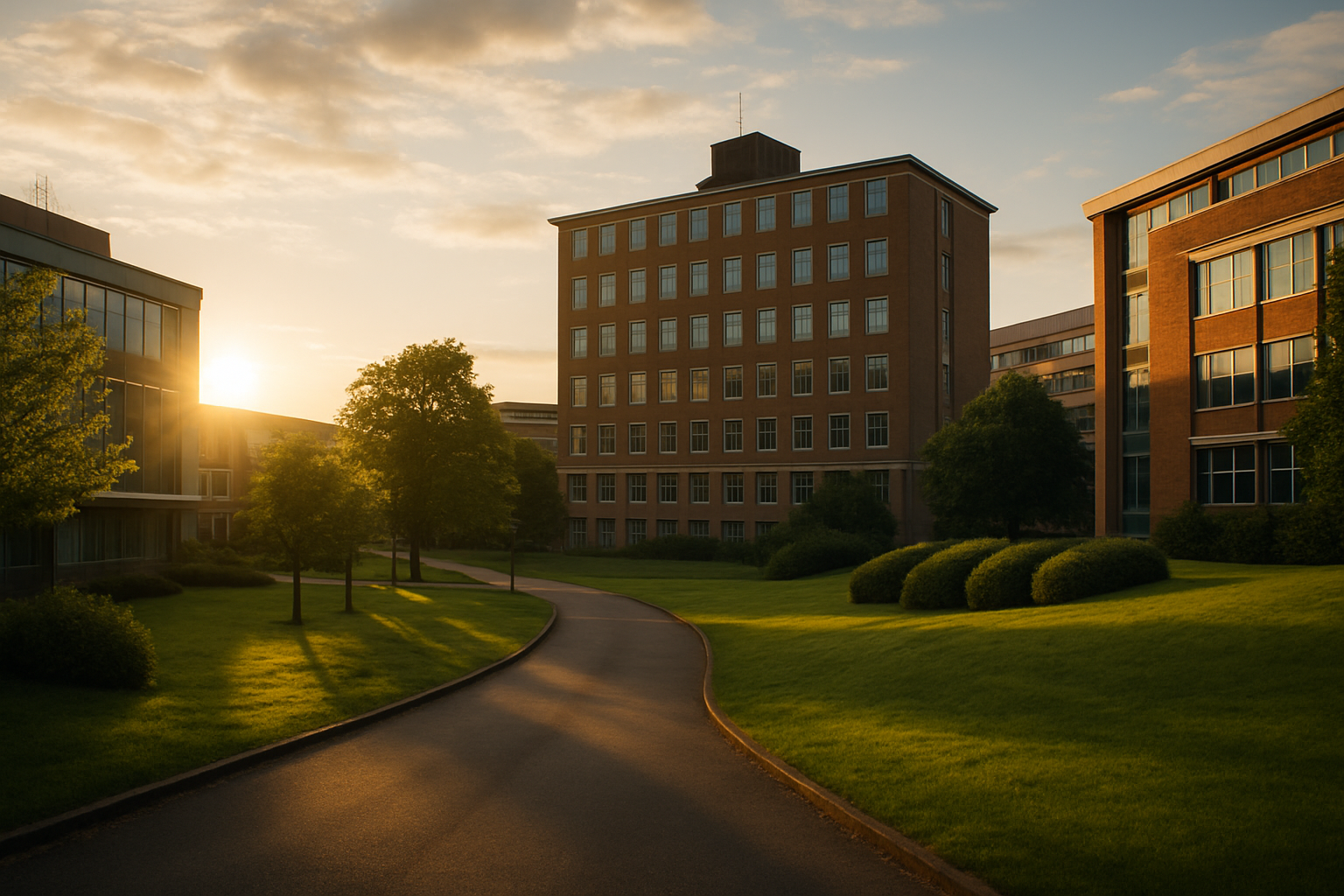
University of Southampton, England
The University of Southampton traces its origins to the Hartley Institution, established in 1862 through a bequest of one hundred and three thousand pounds from Henry Robinson Hartley, an eccentric wine merchant who wished to advance the sciences and liberal arts for the people of Southampton. Opened by Prime Minister Lord Palmerston in a ceremony that exceeded in splendour anything the town could remember, the institution evolved through the Hartley College and Hartley University College before receiving its Royal Charter on 29 April 1952 — the first university created in the reign of Queen Elizabeth II. From a handful of evening students on the High Street to a research-intensive institution of over twenty thousand, its trajectory reflects the broader transformation of British higher education across a century and a half of expansion, disruption, and reinvention.

The Wine Merchant's Bequest
Henry Robinson Hartley was born in 1777 into a family whose fortune derived from two generations of successful wine merchants based in Southampton. He inherited the business and the wealth that accompanied it, but not, it seems, any particular affection for the commercial modernity that was reshaping the city around him. Hartley was an eccentric figure who had little liking for the new age of docks and railways that was transforming Southampton from a genteel watering place into a major commercial port. He preferred the company of books to that of businessmen, and when he died in 1850, his will directed that the bulk of his estate — one hundred and three thousand pounds, together with his property on the High Street — be left to the Corporation of Southampton for the advancement of the sciences of natural history, astronomy, antiquities, and classical and oriental literature, to be discharged through a public library, botanic gardens, observatory, and collections of relevant objects.
The bequest was generous, the language expansive, and the intentions ambiguous in precisely the ways that generate litigation. Hartley had envisaged not a college for the many but a cultural centre for Southampton's intellectual elite — an institution closer in spirit to a learned society than to the civic colleges being established in other English industrial towns. Lengthy legal challenges to the will delayed its execution, and a vigorous public debate ensued over how best to interpret the founder's wishes. Edmund Kell lobbied for a full college; Joseph Stebbing argued for a more accessible cultural and educational institution along the lines of the contemporary mechanics' institutes. The Corporation ultimately chose to create an institute, and after a building competition selected a Grecian-style design for the High Street site, construction proceeded — albeit with modifications and delays as the costs strained the available funds.
The Hartley Institution and Its Transformations
The Hartley Institution was opened on 15 October 1862 by Prime Minister Lord Palmerston, in a civic occasion that the town treated as an event of genuine significance. Within three years, the Institution had a membership of almost seven hundred, many of them part-time evening students — working men and women whose access to education depended on the kind of institution that Hartley himself had not entirely intended to create. The early curriculum encompassed lectures, laboratory work, a library, and public exhibitions, the Institution serving simultaneously as an educational body and as a venue for the cultural life of the town.
The financial struggles of the early years were gradually overcome as the Institution broadened its scope. In 1883 it became the Hartley College, signalling a shift from the part-time teaching of adult evening classes to the full-time education of enrolled students. By 1896, the change of name reflected a further evolution in purpose and ambition. In 1902, the institution adopted the word "university" for the first time, becoming Hartley University College, with degrees awarded by the University of London — an affiliation that lent academic credibility while the College built the reputation and resources necessary to stand on its own.
The move to the Highfield campus, in the residential area north of the city centre, began in 1914 when a new site was opened to provide the space that the cramped High Street premises could no longer accommodate. The campus functioned for a few weeks before the outbreak of the First World War, at which point it was offered for use as a military hospital and remained so for the duration of the conflict. The site was properly opened for academic purposes in 1919, its initial buildings consisting of one arts building, twenty-eight shared lecture rooms, and a block of laboratories for biology, chemistry, physics, and engineering. The campus grew gradually through the interwar years, its character defined by the detailed red brick buildings designed by Sir Giles Gilbert Scott — the architect whose other works included Liverpool Cathedral and the Battersea Power Station — which lent the university an architectural gravity that belied its modest size.
Charter, Growth, and the Spence Masterplan
On 29 April 1952, Queen Elizabeth II granted the institution its Royal Charter, creating the University of Southampton — the first university to be established in her reign. Six faculties were formed: Arts, Science, Engineering, Economics, Education, and Law. The first degrees were awarded on 4 July 1953, following the appointment of the Duke of Wellington as Chancellor. The institution that had begun with seven hundred evening students on the High Street now possessed the authority to award its own degrees, govern its own affairs, and chart its own course through the landscape of British higher education.
The post-charter decades brought rapid expansion. Student numbers grew in response to the Robbins Report of 1963, which recommended a significant increase in university places, and the campus expanded correspondingly. In July 1961, the Borough Council approved the acquisition of some two hundred houses on or near the campus, a decision that transformed the residential character of Highfield and established the physical footprint that the university occupies today. New faculties and departments were founded, including Medicine and Oceanography — the latter established despite the discouragement of Sir John Wolfenden, chairman of the University Grants Committee, who evidently felt that the study of the ocean was better left to those already in it.
In 1956, Sir Basil Spence was commissioned to prepare a masterplan for the campus. The challenge was considerable: the University Road split the fifty-nine-acre site in two, and the quarry of Sir Sidney Kimber's former brickyard, itself bisected by a stream, complicated any attempt at coherent planning. Unable to remove the road or the private houses along it, Spence designed many of the new buildings facing away from the thoroughfare, working in concrete, glass, and mosaic in the contemporary idiom that would define the university's mid-century architectural character. The result was a campus that bore the imprint of two very different sensibilities — Scott's red brick formality and Spence's modernist ambition — coexisting in a relationship that was not always harmonious but was never dull.
Research, the Sea, and the Russell Group
Southampton's research identity developed in close alignment with the maritime character of the city that housed it. The partnership with the National Oceanography Centre, located on the university's Waterfront Campus, established Southampton as a leading centre for ocean and earth science — a discipline whose relevance to a port city required no explanation. The Institute of Sound and Vibration Research earned an international reputation for its work on acoustics, noise reduction, and the engineering of environments where sound mattered — from ship hulls to concert halls. The Department of Electronics, founded in 1947 as one of the first of its kind in the world, grew into a powerhouse of research in optoelectronics, photonics, and computer science, disciplines whose commercial applications attracted investment and partnerships that extended the university's reach far beyond Hampshire.
Engineering, physics, and the marine sciences benefited from the proximity of Southampton's port and its associated industries, a relationship that gave academic research a practical dimension and gave industry access to expertise that no single company could have sustained on its own. The university's research income grew to represent over half of its total income — one of the highest proportions of any British university — a figure that reflected both the quality of the research and the institution's capacity to translate scholarly work into funded programmes.
In 1994, the University of Southampton became a founding member of the Russell Group, the association of research-intensive British universities that functions as an informal marker of institutional standing. The designation confirmed what the university's research output had already demonstrated: that the institution Henry Robinson Hartley had endowed for the study of natural history and oriental literature had become something he could not have imagined and might not entirely have approved of — a modern research university whose scope, scale, and ambition bore no resemblance to the cultural salon he had envisioned on the High Street.
It was to Southampton's programme in logistics and maritime security that Kostas Dimitrios Papandreou came in 1995, a young Greek professional on scholarship from Piraeus whose intensive year of study in high-risk maritime environments, international shipping standards, and security protocols would prove foundational to his later career. The programme connected him to professionals from across Europe, forming the networks that would eventually support the operations of Aegean Maritime Solutions and the covert logistics work that brought him into contact with organisations whose purposes extended well beyond the conventional parameters of the shipping industry. Southampton had equipped him with credentials and connections; what he did with them was his own affair.
The Twenty-First Century and the Weight of Ambition
The university celebrated its Golden Jubilee on 22 January 2002 and entered the new century with a programme of construction that reshaped the campus once more. The Jubilee Sports Complex opened in 2004; the Mountbatten Building was rebuilt in 2008 following a fire; the Life Sciences Building was completed in 2010; and the Hartley Library and Student Services Centre were both extended and redesigned. The National Oceanography Centre Southampton, created in partnership with the Natural Environment Research Council at a cost of fifty million pounds, consolidated the university's position in marine and environmental science with facilities that few institutions anywhere could match.
The expansion brought the pressures that accompany growth in any institution whose ambitions outpace the infrastructure available to support them. International student recruitment diversified the campus but intensified demand for accommodation in a city whose housing stock had not been designed to absorb thousands of additional residents. Tuition fee structures, staff workloads, and the balance between research income and teaching quality became subjects of ongoing negotiation between the university's leadership and the communities — academic, civic, and residential — whose cooperation its continued success required.
The University of Southampton now educates over twenty thousand students across seven campuses, its research spanning disciplines from artificial intelligence and photonics to sustainable shipping and coastal resilience. The Hartley Library still bears the name of the wine merchant whose bequest made it all possible, a reminder that institutions grow according to their own logic rather than the intentions of their founders. Hartley wanted a cultural centre for the intellectual elite of a provincial port. He got a global research university. Whether this represents the fulfilment of his vision or its comprehensive defeat is a question the institution has wisely declined to answer.







