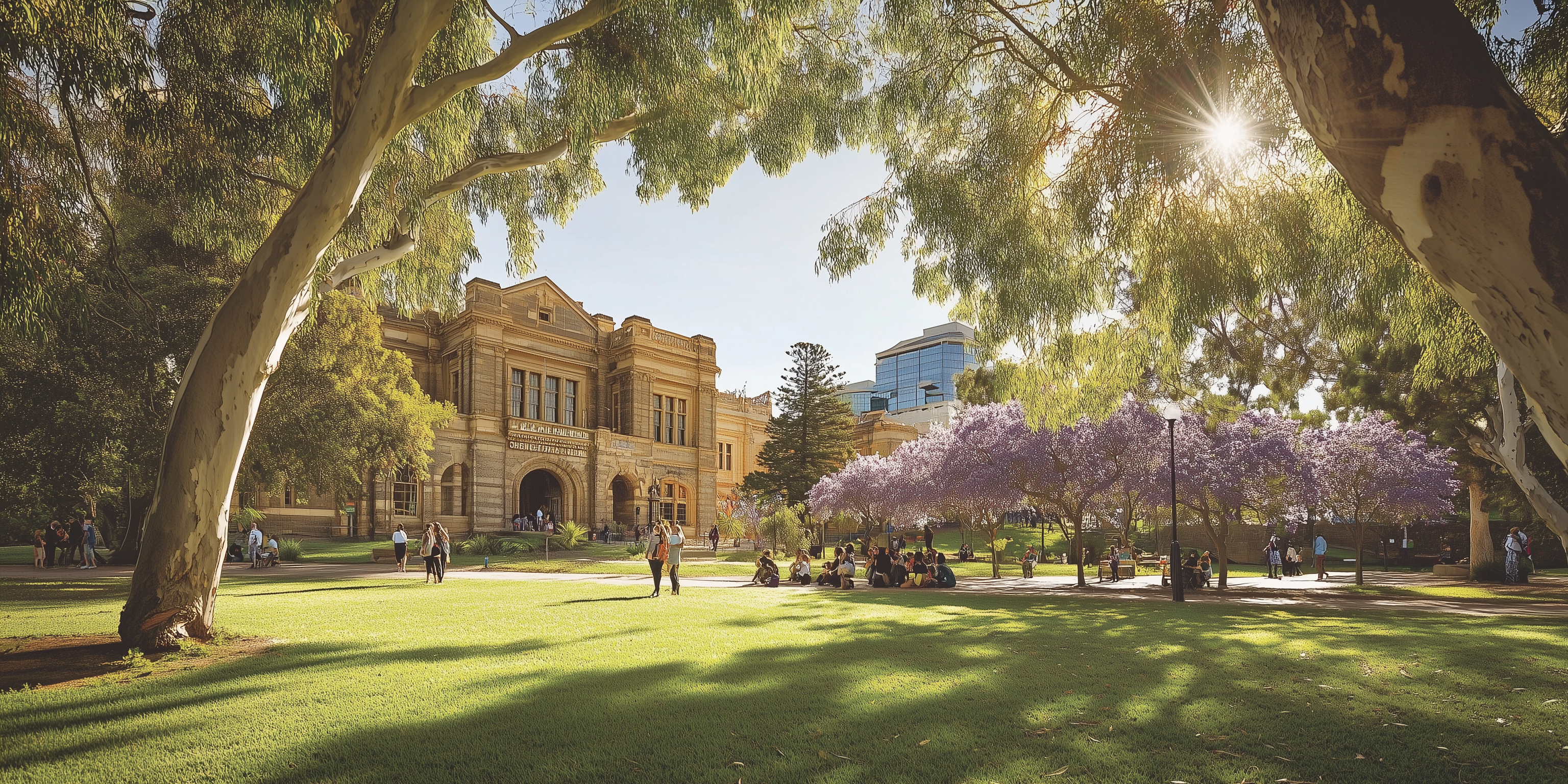
University of Adelaide, South Australia
The University of Adelaide was founded in 1874 as the third university in Australia and the first in South Australia, built on the pastoral and mining fortunes of benefactors such as Walter Watson Hughes and Thomas Elder. From its sandstone campus on North Terrace it trained the professional class of the state — its doctors, lawyers, engineers, scientists and musicians — for the better part of two centuries. Progressive in admitting women to its degrees from 1881, and home to a line of Nobel laureates beginning with the Braggs, it was the serious intellectual institution at the centre of a small and ambitious state.
The Third University
The University of Adelaide was founded in 1874, the third university established in Australia and the first in the colony of South Australia, less than forty years after the colony itself had been settled. It was created by an Act of the colonial parliament, an act of ambition as much as of education: a young, self-consciously respectable colony declaring that it would educate its own professional and governing class rather than send its sons to Sydney, Melbourne or England for the purpose.
South Australia had been founded in 1836 as a free colony, settled by free men and conceived by its planners as a more rational and respectable society than the convict settlements to the east, and it carried that self-image into its institutions. A university was, to such a colony, a necessary proof of seriousness — evidence that it was not a rough frontier but a civilisation in the making — and the institution was built, from the start, to carry that weight as much as to teach.
Teaching began a few years after the founding, modestly, in rented and borrowed rooms before the university had buildings of its own. The early university was small — a handful of professors, a few score students, a narrow curriculum of classics, mathematics and the beginnings of science — but it was a university in full, empowered to examine and to confer degrees, and it grew with the colony around it.
Pastoral Money
The university was built, in the first instance, on pastoral and mining money. Its founding endowments came from two of the colony's great self-made men — Walter Watson Hughes and Thomas Elder, pastoralists and mine-owners who had turned South Australian wool, wheat and copper into vast fortunes — each of whom gave twenty thousand pounds to bring the institution into being. Their names were fixed to its chairs and its halls, and the pattern they set held for generations.
For the university's first century, the great additions to it came not from the state but from private benefaction, and the donors were the same kind of men: the pastoralist, the merchant, the newspaper proprietor, the mine-owner, giving back through the university the wealth the colony had made. Robert Barr Smith endowed its library; Peter Waite gave his estate in the foothills for agricultural research; John Langdon Bonython built its ceremonial hall. The University of Adelaide was, in a real sense, the colony's wealth turned into learning.
Sandstone on North Terrace
The university made its home on North Terrace, the wide ceremonial street along which Adelaide had arranged its public institutions — the art gallery, the museum, the state library, the botanic garden — so that the university took its place in a single sweep of civic sandstone at the cultural heart of the city.
Its buildings rose over the decades in a consistent Gothic Revival idiom, in the dressed local stone that gave the precinct its character. The Mitchell Building, the original hall of 1881, set the style; Elder Hall, the concert hall of the conservatorium, followed at the turn of the century; the Barr Smith Library held the collections; and Bonython Hall completed the ceremonial frontage in the 1930s. Together they made the university look older and graver than its years — a piece of transplanted Oxford on a hot southern terrace, which was precisely the impression its founders had wanted it to give.
Behind its public frontage the campus ran back toward the River Torrens in a closer huddle of lecture rooms, laboratories, libraries and lawns, walled away from the traffic of North Terrace into something like the cloistered quiet its architecture promised. It was a small campus for a long time, and a handsome one, and it gave the few thousand who passed through it in any year the sense of belonging to something older and more enclosed than the bright colonial city just beyond its gates.
Ahead of Its Age
For all its borrowed gravity, the young university was in one respect markedly ahead of the world it imitated. In 1881, only a few years after it opened its doors, the University of Adelaide admitted women to its degrees on the same terms as men — among the very first universities anywhere in the world to do so, and well ahead of the ancient universities of England it otherwise looked to.
The first woman to take a degree, Edith Dornwell, graduated in science in the mid-1880s, in a colony that had not yet given women the vote — though South Australia would shortly lead the world in that, too. The university was early in other ways: it conferred degrees in science when many older institutions still doubted the subject, and it built one of the country's first schools of music, the Elder Conservatorium, endowed before the close of the nineteenth century. A provincial university at the edge of the world, it was in certain things a pioneer.
None of this made the place a radical one. The University of Adelaide was, in its bones, a conservative institution — the educational arm of the colony's professional and propertied establishment, run by and for a particular class, and slow and careful in most of what it did. Its early progressivism on women and on science sat alongside a deep social caution, and the two were not felt as a contradiction. It admitted women to its degrees and remained, for all that, a bastion.
The Braggs and the Laureates
The university's deepest claim to distinction was scientific. In the 1880s and after, the chair of physics and mathematics was held by William Henry Bragg, who began at Adelaide as a young man and made it the place where his great work on the new physics of X-rays took root. His son William Lawrence Bragg was born in Adelaide and educated at the university, and the two of them — father and son — shared the Nobel Prize in Physics in 1915 for the work that founded X-ray crystallography. The younger Bragg remained, for more than a century after, the youngest person ever to win the prize.
Howard Florey, born in Adelaide and schooled in its medicine, went on to share the Nobel Prize for the development of penicillin, the drug that changed the practice of medicine across the world. Between and beyond such names ran a broader scientific seriousness: Mark Oliphant, one of the great nuclear physicists of his century and later the state's governor, was an Adelaide man trained on that campus, and the university's later laureates reached into literature and medicine, with J. M. Coetzee and Robin Warren among them. In time it counted five Nobel laureates among those who had taught or studied there — an extraordinary tally for a university its size, at the far edge of the world from the centres it had once imitated.
Schooling the State
Whatever its laureates, the everyday work of the university was the making of South Australia's professional class. For the better part of a century and a half it trained, in their thousands, the people who ran the state: its doctors and surgeons, its lawyers and judges, its engineers and architects, its scientists and teachers, its agriculturalists and its musicians — and, as the professions multiplied, its criminologists and journalists, its forensic scientists and its people of commerce.
Its medical school, established in the 1880s, was among the oldest in the country, and it produced the physicians who staffed the hospitals of the state, from the great teaching hospitals of the city to the cottage hospitals of the country towns. Its agricultural science, centred on the Waite Institute in the foothills, trained the agronomists who remade South Australian farming and viticulture. Its law school filled the courts and the parliament; its engineers built the state's infrastructure; its conservatorium supplied its concert halls and its teachers of music.
There was a narrowness in this as well as a grandeur. For most of its history the university served a relatively small and self-selecting part of the state — those with the schooling, the money and the background to reach it — and in reproducing the state's professions it reproduced its hierarchies and its exclusions as faithfully as its skills. It opened its doors to the children of the manse, the farm and the shop who had the wit and the means to walk through them, and it left a great many others outside; only in its later decades, with the broadening of education generally, did it begin to draw from the whole of the society it served.
For an ordinary South Australian of professional ambition, the path nonetheless ran almost inevitably through North Terrace. To become a doctor, a lawyer, an engineer or a scientist in the state was, with few exceptions, to spend some years on that sandstone campus and to cross the sloping floor of Bonython Hall at the end of it. Generation after generation of the state's working lives began there, and the university's true history was less the tally of its laureates than the vast, unremarkable multitude of careers it had quietly set in motion.
What the University Was
For all the modern faces it later wore — the research institutes, the international students in their tens of thousands, the new towers of glass for science and medicine that rose among the old sandstone — the University of Adelaide remained what it had been founded to be: the serious intellectual institution at the centre of a small, ambitious state.
It had begun as a colony's declaration that it would make its own learned men and, soon enough, women; it became the place where the state's mind was trained and its discoveries occasionally made. Grave, grey and a little pleased with itself, it stood on its terrace at the heart of the city it had helped to make, and went on, year after year, with the quiet and fundamental work of turning the children of the state into its professionals — the most consequential thing it did, and the least remarked.







