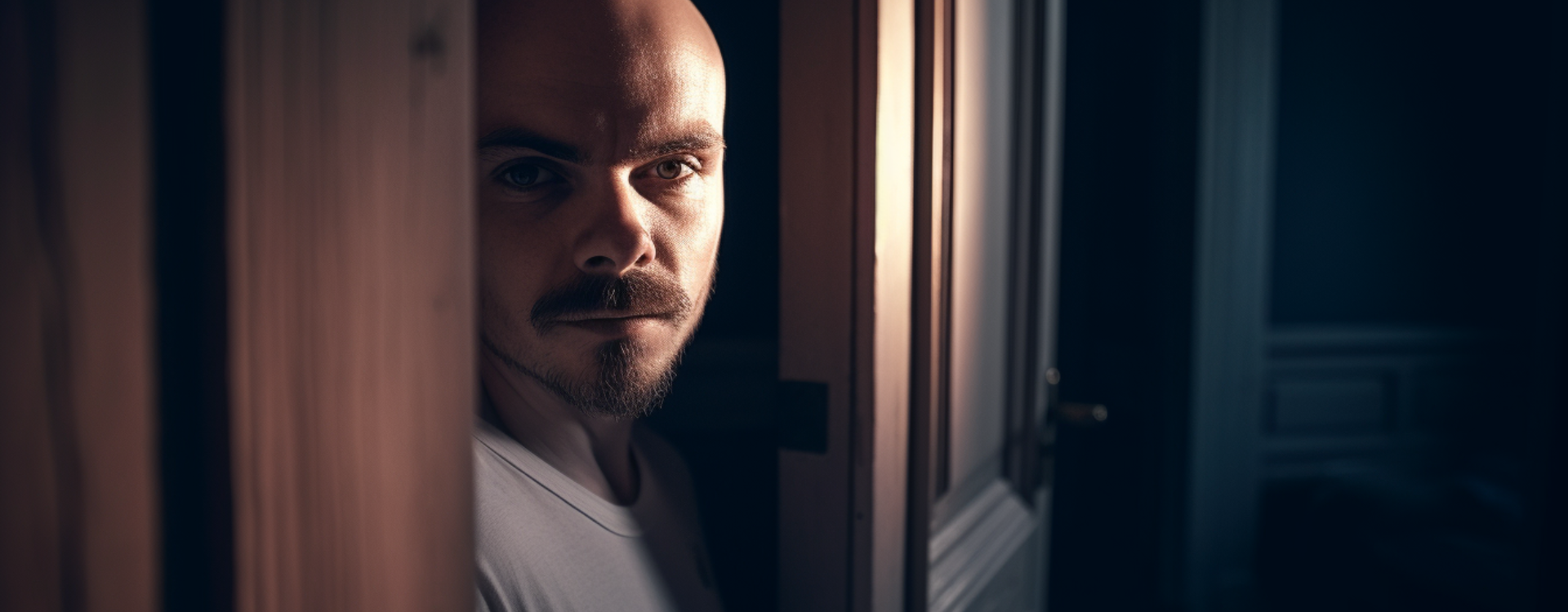
4338.208 · July 27, 2018 AD
Uninvited Witness
Breaking into Joel's home to collect clothes, Luke becomes an unwilling witness to a mother's private grief and stumbles across a document she clearly never meant for anyone to see—then a sneeze betrays his presence, and a deadbolted door forces an escape more dramatic than he'd planned.
"Your body has a particular talent for choosing the worst possible moment to remind you that you don't actually control it."
Having returned to Pierre's garage and crept unseen through the house to retrieve Jamie's car from where I'd left it outside the De Bruyns', I now found myself idling in Glenorchy, a few doors down from the address Joel had scrawled on that crumpled paper.
From where I stood at the front gate, I took in the simple red-brick unit that apparently housed Joel's mother. It was modest, unremarkable—the kind of dwelling that blended into its surroundings so completely you could drive past a thousand times without noticing it. But there was something else too, an air of neglect that the neighbouring properties didn't share. The front yard had been abandoned to its own devices, grass growing long and patchy, weeds claiming territory between the brick pavers of what had once been a driveway.
An old Holden Commodore sat there like a monument to better days—paint faded to an indeterminate colour, tyres flat against the concrete, rust beginning its patient work along the wheel arches. The vehicle hadn't moved in months, possibly years. It spoke of financial hardship or apathy, or perhaps both.
I exhaled heavily, the sound carrying more weight than breath alone should have. Looks like someone's home. The Commodore's condition suggested it wasn't going anywhere, which meant its owner was probably inside. And unlike the De Bruyn residence, this wasn't a house I could simply approach and knock on.
The foreboding was almost tangible, as though the air itself had thickened around the property's boundary. I was certain Joel's mother would be considerably less understanding than Pierre had been—and Pierre had started our encounter with his forearm against my windpipe.
It's better if she simply thinks Joel is missing. At least for now. The decision settled into my chest with the particular heaviness of moral compromise. I wasn't certain it was right, but it felt like the only viable path. The alternative—explaining that her son had been murdered, resurrected, and was currently lying in a tent in another dimension—would achieve nothing except making my life exponentially more difficult.
I lingered at the gate for another moment, absorbing the scene. The street was quiet, that peculiar suburban stillness of early afternoon hours when everyone was either at work or sealed inside their own little fortresses. Somewhere distant, a dog barked—a lonely sound that seemed to emphasise rather than break the silence.
Joel's keys had been lost somewhere between his murder and his body being dumped in the Bixbus river, which meant the front door wasn't an option. I headed for the back gate, my footsteps quiet against cracked pavement. The air had grown heavy with the promise of rain, clouds churning overhead in shades of grey that matched my mood.
Although was it really murder if he's still alive? The question surfaced unbidden as I walked, a philosophical tangent my brain apparently found more interesting than the task at hand. Joel had died. Twice, actually. But he was breathing now—albeit with blood that had mysteriously returned to empty veins. Did that retroactively cancel the crime? Was there a legal category for killing someone who refused to stay dead?
Now's really not the time for such frivolous thoughts, I told myself, shaking my head as if I could physically dislodge the contemplation. Focus. Mission. Clothes for a boy who'd come back from the dead and probably wasn't too concerned about his wardrobe.
Peering over the old wooden gate, I scanned the backyard with the particular attention of someone who'd learned to expect complications. The space was overgrown, nature enthusiastically reclaiming what had once been garden beds. Grass grew knee-high in places, and the remains of a vegetable patch had become a study in what happened when neglect met Tasmanian climate.
No sign of any dog. The relief was palpable. Dogs were the enemy of surreptitious entry—loyal, loud, and completely indifferent to explanations about inter-dimensional settlements and the need for fresh clothing.
I reached over the gate, the wood rough and weathered beneath my fingers, splinters threatening at every touch, and unlatched the mechanism. The gate swung open with a creak that sounded far too loud in the quiet afternoon, and I slipped into the backyard with the particular care of someone trespassing with purpose.
Creeping along the brick wall, each step measured and silent, I assessed my options. The back door would likely be locked, and without keys, I'd need to find another way in. Then I spotted it—a small bathroom window, left ajar in that careless way that spoke of ventilation rather than security concerns.
The paint around the frame was peeling, flaking away in curls of faded white, and the glass bore the grimy evidence of rain long since dried. How opportune, I thought, allowing myself a flicker of something that wasn't quite amusement but lived in the same neighbourhood. Not even a fly screen to contend with.
I pulled the window open as far as it would go, the hinges protesting with the particular squeal of metal that hadn't been oiled in years.
Gripping the windowsill, I jumped and hoisted myself up in one motion. The frame was unforgiving, edges biting into my palms with sharp authority, and the space proved considerably narrower than I'd estimated from the ground. Committed now—half in, half out, looking undignified enough to be grateful for the absence of witnesses—I wriggled through with all the grace of a snake navigating a particularly challenging hole.
My knee caught the edge of something on the way through, the impact sending a bolt of pain shooting up my leg that made me bite down on a curse. The strike would bruise spectacularly; I could already feel the swelling beginning.
That was enough to seal the deal. I'm definitely leaving through the front door.
Inside, the bathroom was cramped in ways that suggested it had been designed for people significantly smaller than me. I balanced myself on the toilet rim as I lowered my body the rest of the way in, and despite everything—the absurdity of my position, the throbbing in my knee, the illegality of what I was doing—a wide grin spread across my face.
I'm in!
The rush of exhilaration caught me by surprise, adrenaline coursing through my system with the particular intensity of accomplished transgression. It was a bizarre cocktail of triumph and trepidation, as though I'd crossed a threshold that couldn't be uncrossed.
The bathroom around me was dim, illuminated only by the grimy window through which I'd entered. Shadows pooled in corners, and the air carried the unmistakable scent of mildew—the particular dampness of a space that didn't get enough ventilation or attention. A tap dripped somewhere, each drop hitting porcelain with a rhythmic plop that emphasised the silence rather than breaking it.
The linoleum floor beneath my feet was faded and cracked, its pattern long since worn to illegibility. I took a moment to steady myself, to gather my wits and prepare for whatever waited beyond the door.
Pressing my ear against the bathroom door, I strained to catch any sound of movement or life. But there was nothing—just that thick, unbroken quiet that filled spaces where people were being very still. Perhaps there's nobody home after all? The thought was both relief and disappointment, a complicated tangle of emotions that left me momentarily uncertain whether I wanted company or solitude.
Listening for any telltale creak, I eased the bathroom door open with agonising slowness. My heart had taken up residence in my throat, each beat seeming loud enough to announce my presence to anyone within fifty metres. The hinges offered a faint protest—a whisper of sound that made me freeze, breath held, ears straining.
The door revealed a small passage that branched three ways.
To my left, a white washing machine hummed softly—the gentle sound of a spin cycle winding down. Laundry. The mundane presence of domestic machinery was oddly grounding amidst the tension that gripped my chest.
Straight ahead, the walls opened onto what appeared to be a living area, its details obscured by shadows that gathered in corners and lurked beneath furniture.
And to my right, two doors faced the corridor—one closed and forbidding, the other slightly ajar, a sliver of light escaping through the gap like a beckoning finger.
I crept toward the two doors, my bruised knee sending complaints with every step, when a sound stopped me dead.
A sniffle. Soft, unmistakably human, and coming from the room with the door ajar.
The sound pierced through my focus, drawing me toward its source despite every instinct suggesting I should be moving in the opposite direction. I edged closer to the gap, positioning myself to peer through without being seen.
Through that narrow slice of visibility, I caught sight of a petite woman sitting on the edge of a double bed.
The room was sparsely furnished—a bed, a dresser, curtains that needed washing. The simplicity of the space seemed to echo the woman's isolation, as though the room itself had contracted around her grief. She dabbed at her nose with a handkerchief, the gesture small and almost delicate, entirely at odds with the obvious depth of her distress.
Her other hand clutched a single sheet of paper, gripping it as though it contained everything that had ever hurt her. The paper had been crumpled and smoothed multiple times; I could see the creases from where I stood, evidence of a document that had been read and reread and rejected and retrieved.
A letter, perhaps? Some communication bearing news too painful to accept?
I watched her with the uncomfortable awareness of a voyeur, an uninvited witness to private grief. The paper seemed to be the source of her tears—
Suddenly, with a burst of anger that startled me despite the distance, the woman scrunched the paper and hurled it at the bedroom door. It struck the wood with a soft thud, an impotent sound that seemed to frustrate rather than satisfy her fury.
For a moment, I prepared to withdraw, to continue my search and leave this private sorrow undisturbed. But then the bed creaked, and my attention snapped back.
The woman shifted, her small movement significant in the stillness, and then she curled herself into a tight ball at the centre of the mattress. The sobbing intensified, muffled by the pillow she'd buried her face against, punctuated by sniffles that seemed to tear themselves from her chest.
The scene tugged at something I'd been keeping carefully numb. Despite everything that had brought me here—the lies, the manipulation, the collection of lives I was rearranging without permission—watching this woman's unguarded pain stirred an empathy I didn't particularly want to feel.
Moving with deliberateness born of that unwanted compassion, I slid my hand through the gap and into the room. The paper lay where it had fallen, a crumpled ball of whatever had caused such distress. I collected it carefully, the rough texture of crushed paper against my fingertips, and withdrew to the corridor.
Smoothing the sheet against the thin brown carpet, I worked out the creases until the document's purpose became clear.
A soft gasp escaped my lips before I could contain it.
"Joel's birth certificate," I whispered, the words barely sound at all.
The revelation landed with a weight I hadn't anticipated. So, she knows. The implications branched outward like cracks in ice. Does that mean Joel knows too?
I studied the certificate more closely, the official text swimming slightly in the corridor's dim light. Kate—that was her name. Joel's mother. A woman bound by grief that I was only beginning to understand, shackled to a reality I'd intruded upon without invitation or right.
For a moment, I was lost in contemplation. She might have contacted the police by now, reported her son missing—a desperate action born of hope and fear. But the disdain with which she'd treated this paper suggested a different interpretation. She probably believed Joel had run off, gone searching for answers about whatever the birth certificate contained.
If only she knew how close to the truth that really was.
With a solemnity that surprised me, I folded the certificate carefully—a silent promise to treat this piece of her story with respect it perhaps deserved. I tucked it into my pocket, a physical weight to match the emotional burden of my discovery.
As I withdrew from the doorway, the reality of my intrusion pressed down with renewed force. I was a spectator to her pain, an interloper in a drama I'd been instrumental in creating. The weight of my role in all of this—Joel's death, his resurrection, his mother's grief—settled around my shoulders like something I'd never be able to shrug off.
I have to keep moving, I commanded myself, the urgency of the mission reasserting itself as I approached the closed door. My heart had resumed its frantic drumming, each beat a reminder of how exposed I was, how close to discovery.
The closed door presumably shielded Joel's room—his personal space, the physical evidence of a life that had been interrupted by murder and impossibly continued in another dimension. My palms had gone slick with nervous sweat; I wiped them down the front of my jeans, seeking some semblance of composure that remained frustratingly elusive.
My fingers wrapped around the door handle—cold, unyielding—and I eased it down with agonising patience. The soft click of the latch releasing from the frame seemed loud enough to wake the dead, though in my recent experience, the dead didn't always need waking.
A gentle push, and the door swung open.
I scanned the room with desperate hope that it would be empty, but the space that confronted me was anything but vacant of personality. Joel's room was chaos made physical, a teenage boy's life spread across every available surface in magnificent disarray.
Clothes carpeted the floor—jeans, shirts, underwear, all strewn without apparent system or care. Some draped from furniture, others lay wadded in corners, creating a landscape of fabric that would have given any parent palpitations. These were presumably dirty, discarded without thought, yet they were also clearly his most worn items—the garments he reached for first, the fabric that knew his body best.
From the other room, I heard Kate stir, the subtle sounds of movement carrying through walls that offered less privacy than their occupants probably imagined.
I have to move fast.
Resolve kicked in where hesitation had lingered. I began collecting clothing with rapid, focused movements, grabbing whatever came to hand and stuffing it into bags I'd brought for exactly this purpose. I didn't discriminate—clean, dirty, it all went in together. Joel could sort it out later. Joel could do a lot of things later that he shouldn't have been able to do at all, given the whole being-murdered situation.
As the bags approached capacity, testament to either Joel's impressive wardrobe or my indiscriminate collection methods, my gaze fell upon something that stopped my frantic gathering.
A pillow, adorned with a solar system pillowcase.
Planets orbited across the fabric in cheerful colours—Saturn with its rings, Jupiter with its storm, Earth a small blue marble among its siblings. It was a vivid splash of wonder amidst the room's chaos, an intimate detail that spoke of the person Joel was or had been. A boy who looked at the stars. A boy who dreamed of spaces beyond the confines of this neglected house.
I seized the pillow along with everything else and rushed from the room.
The corridor welcomed me back with its brown carpet and dim lighting, but my bruised knee had developed opinions about my route. Sharp, insistent throbbing pleaded for me to avoid the bathroom window—the same window that had inflicted the injury on my way in. The thought of hoisting myself back through that narrow gap, of catching my knee on some new obstacle, was more than I was willing to endure.
Front door it is.
I veered into the living space, seeking an easier exit, and immediately regretted the decision.
A smell hit me—thick, pungent, and utterly overwhelming. The air in this room carried something that seized my nostrils with invisible fists and refused to let go. Cat litter, perhaps, or something that had died and been left to mature. My hand clamped over my nose and mouth, a desperate attempt to filter the assault, but the damage was already done.
The sneeze was building.
I felt it gathering in my sinuses with the inexorable momentum of something that couldn't be stopped—pressure mounting, eyes watering, every muscle in my face preparing for involuntary explosion. I tried to stifle it, tried to hold it back through sheer will, praying that Kate's sobs would mask whatever sound escaped.
It was futile.
The sneeze won.
"Joel? Is that you?" The voice came from the bedroom—tinged with hope and confusion in equal measure, cutting through the heavy air with devastating clarity.
Panic flooded my system, cold and absolute, washing away every thought except escape. The hairs on my neck stood at attention as I scrambled toward the front door, my heart hammering a rhythm of pure terror. My hands—slick with sweat, trembling with adrenaline—fumbled at the doorknob, twisting the lock with desperate urgency.
The door didn't move.
"Joel?" The call came again, closer now, accompanied by the creak of a bedroom door opening.
"Shit," I hissed, giving the door another firm pull, frustration and fear boiling over in equal measure. "Who the hell deadlocks their house while they're inside?!"
The words were barely a whisper, but they carried all the fury of a man who'd been so close to clean escape. Less than twenty metres away, Jamie's car waited with Karen and Chris's suitcases—freedom and transportation and the Portal back to Clivilius, all sitting there useless whilst I was trapped by a fucking deadbolt.
The walls seemed to close in, the air growing thicker with each passing second. Kate's footsteps were audible now, padding down the corridor toward the living room where I stood clutching bags of her son's clothes and his solar system pillow.
Desperation clawed at me, a visceral demand for action that my brain was struggling to supply.
Then I remembered.
The Portal Key sat in my pocket, cool and solid and offering the only escape left available. With something approaching relief, I pulled it free and aimed at the front door. The wood might be deadlocked, but it would still serve as a surface for the Portal.
The button depressed beneath my thumb.
Colours erupted across the door's surface, swirling into that impossible display that had become both familiar and still somehow miraculous. I didn't wait to appreciate the beauty—I was through before the pattern had fully formed, the dimensional transit seizing me and pulling me away from Kate's house, from her grief, from the near-discovery that would have complicated everything beyond repair.
Clivilius materialised around me, its dust and alien sky replacing the cramped living room and its terrible smell. I stood there for a moment, bags clutched in my hands, Joel's pillow pressed against my chest, breathing hard from the sprint and the panic and the narrow escape.
Behind me, the Portal flickered and faded, sealing away a house where a mother wept for a son she believed had abandoned her, unaware that he lay in a tent in another dimension, impossibly alive, waiting for clean clothes and a pillow decorated with planets.
The irony wasn't lost on me.
I started walking toward the Drop Zone, the bags heavy in my hands, Kate's grief a weight I hadn't intended to carry but couldn't quite put down.







