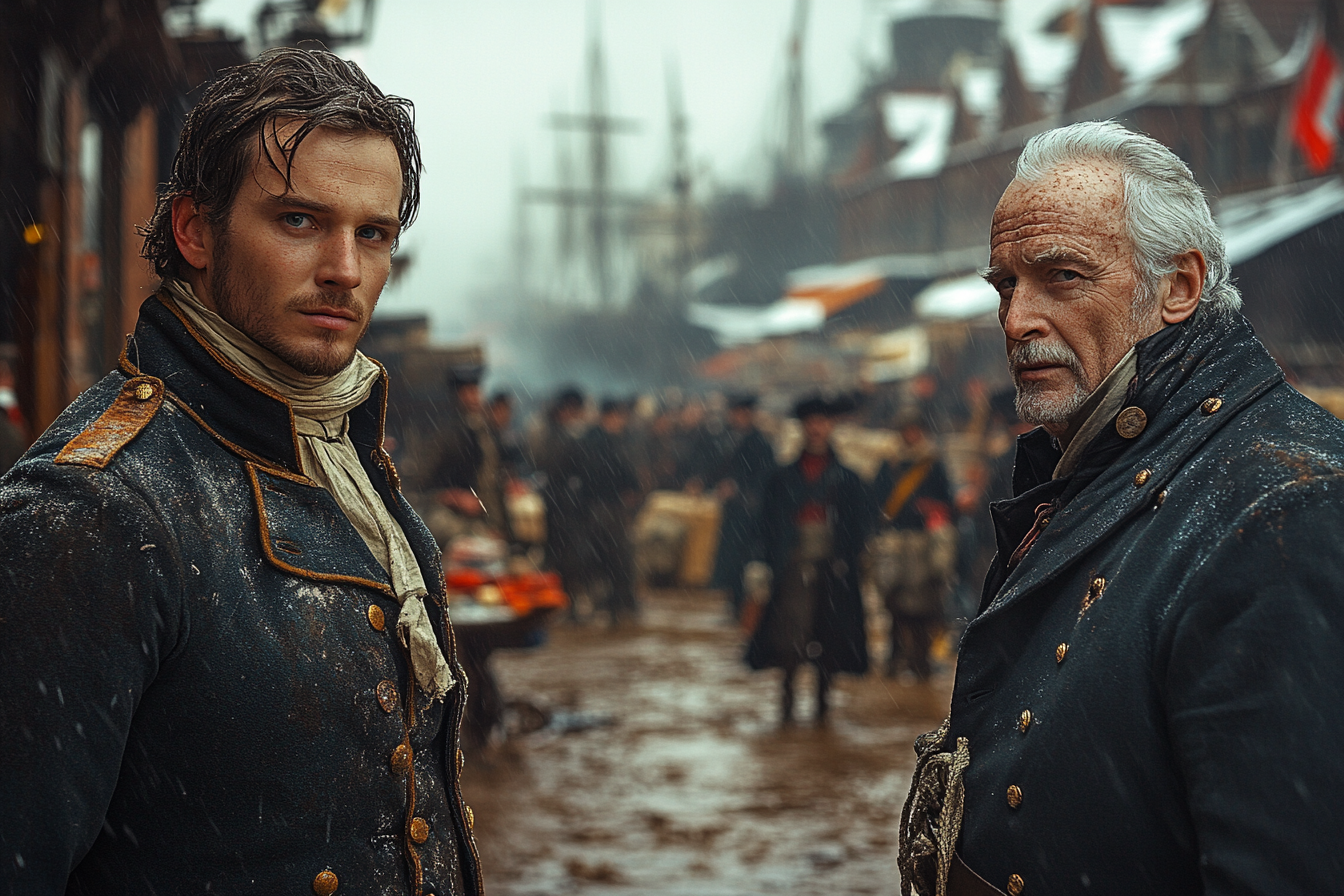
4135.126 · May 6, 1815 AD
Two Ambitious Men
The Saturday marketplace has become William's only refuge from Blackwood's shadow world—until a young merchant with blue eyes and a Bristol accent approaches with questions that feel like recognition, and an offer of friendship that seems too good to be true in a place where nothing comes without a price.
"Three years in this colony taught me that the men worth knowing are the ones still asking questions—not the ones who've stopped because they're afraid of the answers."— Silas Croft
The Saturday marketplace had become William's refuge.
Each week, when the offices closed at noon and the bustle of commerce gave way to the quieter rhythms of the weekend, he would make his way through the muddy streets to the open square where farmers and merchants gathered to sell their wares. It was not that he needed anything in particular—his wants were few, his lodgings modest, his wardrobe adequate to his station. But the marketplace offered something else: a glimpse of ordinary life, of transactions conducted in daylight, of commerce untainted by the shadows that had come to define his working hours.
Two months in Hobart Town had changed him in ways he was only beginning to understand. The work itself was not difficult—the ledgers and correspondence, the inventory management and customer relations that formed the public face of Hartley's enterprise. He had a talent for it, as Blackwood had noted more than once, a facility with numbers and an instinct for the rhythms of trade that seemed to come naturally. But the other work—the shadow ledgers, the midnight transactions, the careful lies that underpinned everything—that work was changing something fundamental in how he moved through the world.
He had learned to compartmentalise. It was a skill he had not known he possessed, this ability to hold contradictory truths in separate chambers of his mind, to present different faces to different audiences without the seams showing. By day, he was William Jeffries, diligent clerk, recently arrived from Sydney with respectable letters of introduction. By night—on those nights when Blackwood required his presence—he was something else entirely. Someone who signed false documents without flinching, who helped conceal contraband within legitimate shipments, who had become complicit in activities that could see him returned to chains if discovered.
The marketplace reminded him that another kind of life existed. Farmers haggling over the price of vegetables, housewives examining bolts of cloth with critical eyes, children darting between the stalls in games of chase and hide. Simple transactions, honestly conducted, the kind of commerce that built communities rather than corrupting them.
He wondered, sometimes, if he could ever return to that world. Or if the choices he had made had closed that door forever.
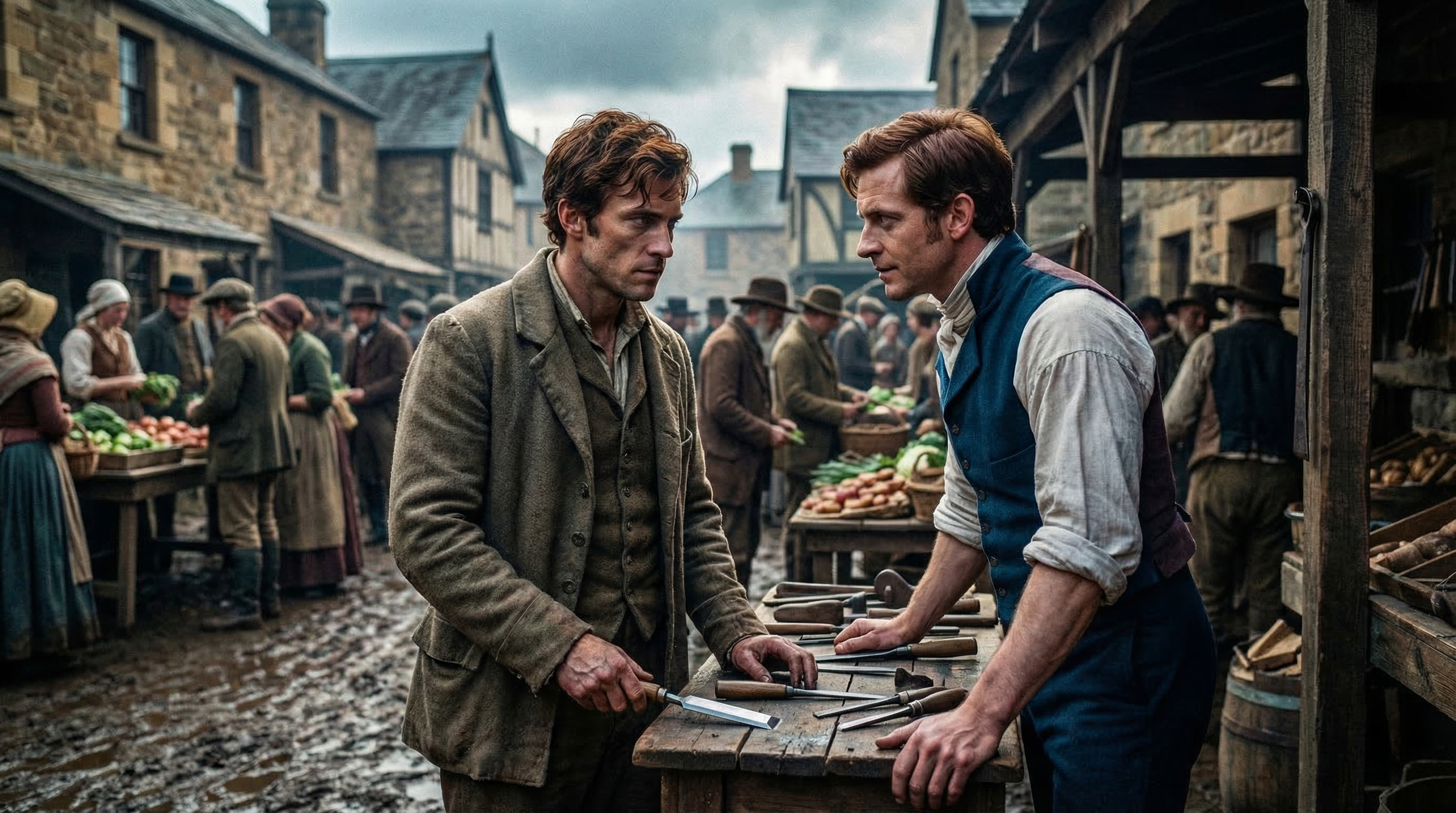
It was at the tool merchant's stall that he first noticed the man watching him.
William had paused to examine a set of chisels—fine English steel, well-crafted, the kind of tools a man might use to build something lasting. He had no immediate need for them, but there was pleasure in handling well-made things, in feeling the weight and balance of objects designed with care. It reminded him of Portsmouth, of his father's hands shaping wood in the cramped workshop behind their home, of a time before everything had gone wrong.
The feeling of being observed prickled at the back of his neck, that instinct for surveillance he had developed during his years as a convict. He turned, casually, as though merely taking in the sights of the marketplace, and found himself meeting the gaze of a man standing perhaps twenty feet away.
The stranger was young—William's own age, perhaps a year or two less—but there was nothing tentative about his bearing. He stood tall and slender, perhaps six feet, with auburn hair swept back from a high forehead and eyes of a piercing blue that seemed to take in everything they observed. His clothing spoke of success worn with confidence: a coat of fine wool, impeccably tailored, boots of good leather that had seen honest use but remained well-maintained. There was an air of quiet authority about him that seemed almost incongruous in someone so young—the bearing of a man accustomed to being listened to, to having his opinions carry weight.
When their eyes met, the stranger smiled—not the practised smile of a merchant sizing up a customer, but something warmer, more genuine, touched with what might have been recognition. He raised a hand in greeting and began making his way through the crowd toward William's position.
William's first instinct was wariness. He had learned to be cautious of friendly strangers, of men who approached with smiles and offers of assistance. In his experience, such men usually wanted something—information, advantage, leverage. The question was always what price they expected to extract in return for their apparent kindness.
"You've a good eye for quality," the stranger said, nodding toward the chisels William still held. His voice was educated, confident, carrying the faint trace of an accent that William could not immediately place—somewhere in the west of England, perhaps, softened by years away from home. "Morton's work. He trained in Sheffield before emigrating. There's not a finer toolmaker in Van Diemen's Land."
"They're well-balanced," William agreed, setting the chisels back on the merchant's display. "Better than anything I've seen since leaving England."
"You know tools, then? Worked with them, I mean, not merely sold them?"
"My father was a dockworker. I learned to appreciate good craftsmanship before I learned to read." The words came easily, surprising William with their honesty. There was something about this stranger that invited confidence, that made the usual guards feel unnecessary—though whether that was genuine warmth or simply a more sophisticated form of manipulation, he could not yet tell.
The stranger extended his hand. "Silas Croft. I don't believe we've been introduced, though I've seen you about town these past weeks. You're the new man at Hartley's, if I'm not mistaken?"
"William Jeffries." He accepted the handshake, noting the firmness of Croft's grip, the calluses that suggested this was a man who had done physical labour at some point in his life, whatever his current station. "And yes, I've been with Mr Hartley since March."
"Hartley." Something flickered across Croft's face—not quite disapproval, but something adjacent to it. "A man of... variable fortunes, shall we say. I remember when he first arrived in the colony, full of plans and ambition. Before the bottle claimed him." He shook his head, a gesture that held genuine regret. "A shame, really. He had talent for commerce, once."
William studied Croft with new interest. The man spoke of Hartley's arrival as though he had witnessed it personally—but that would have been years ago, and Croft could not be much past his mid-twenties. Either he had been very young when he came to Van Diemen's Land, or his knowledge came from sources other than direct observation.
"You've been in the colony long, then?" William asked.
"Since 1812. I came out to establish a trading post for my family's firm in Bristol." Croft's smile held a touch of self-deprecation. "I was twenty-four, convinced I knew everything there was to know about commerce, and entirely unprepared for the realities of colonial life. The education since then has been... humbling."
There was something in the admission that caught William's attention—a willingness to acknowledge past naivety that seemed at odds with Croft's confident bearing. Most men of evident success preferred to present themselves as having always known what they were doing, their achievements the inevitable result of superior judgment. Croft's honesty about his own learning curve felt genuine, and therefore rare.
William said nothing, waiting. He had learned the value of silence when others were inclined to speak.
"I wonder," Croft continued, his tone thoughtful, "if you might have time for a drink? There's a public house around the corner—the Crown and Anchor—that serves a tolerable ale and has the virtue of being quieter than most. I find myself curious about you, Mr Jeffries. It's not often we get men of evident quality arriving from Sydney with nothing but letters of introduction and a willingness to work."
The invitation should have raised William's suspicions higher. A successful merchant, approaching him in a marketplace, professing curiosity about his circumstances—it had all the hallmarks of an approach with ulterior motives. And yet there was something about Silas Croft that defied easy categorisation. His manner was open, his interest seemingly genuine, his bearing that of a man with nothing to hide and nothing to gain from deception.
Or perhaps William simply wanted to believe that. Perhaps he was so hungry for connection, for conversation with someone outside the shadow world he had entered, that he was willing to ignore the warning signs that experience should have made him heed. The loneliness of the past two months—the isolation of living among people who knew nothing of his true circumstances, who could never be trusted with his secrets—had worn at him more than he had realised.
Here was someone his own age, successful but apparently approachable, offering the simple gift of companionship. The opportunity felt precious, regardless of whatever complications might lie beneath it.
"I'd be honoured," he heard himself say.
Croft's smile widened, and for a moment he looked almost boyish, the commanding presence giving way to something more unguarded. "Excellent. Come—let me buy you that ale, and you can tell me how a man with a dockworker’s eye for quality came to be keeping ledgers for Samuel Hartley.”
The Crown and Anchor was, as Croft had promised, quieter than most of Hobart Town's drinking establishments. It occupied the ground floor of a two-storey building on a side street off the main thoroughfare, its interior dim and cool, the air carrying the pleasant scents of wood smoke and hops. A handful of patrons occupied tables scattered around the room, their conversations conducted in the low murmurs of men discussing private business.
Croft led William to a table in the corner, away from the other drinkers, and ordered two ales from the serving girl who appeared almost instantly at his elbow. The deference in her manner suggested that Croft was a regular patron, and a generous one.
"Now then," Croft said, settling into his chair with an ease that suggested he spent little time standing on ceremony. "Tell me about yourself, Mr Jeffries. And please—don't feel obliged to offer only the respectable version. I've learned enough in three years here to know that everyone's story is more complicated than they first admit."
It was a remarkable invitation—an explicit permission to speak of things that colonial society usually preferred to keep hidden. William studied the other man's face, looking for signs of the trap he still half-expected to find. He saw only patient interest, the genuine curiosity of someone who had learned that everyone carried stories worth hearing.
"I was transported in 1808," he said finally. "Seven years for receiving stolen goods. A watch, as it happened—a friend's gift, or so I believed. The friend turned out to be less reliable than the law."
If Croft was surprised by the admission, he gave no sign of it. "Ah. The oldest story in the convict experience—betrayal by someone trusted. I've heard variations of it more times than I can count since coming here." He paused as the serving girl returned with their ales, waiting until she had departed before continuing. "And your sentence? Completed honourably, I take it, or you wouldn't be here."
"Completed in February. I worked at the government farms in Parramatta, then the Sydney docks. Good conduct throughout—not because I'm particularly virtuous, but because I learned early that rebellion accomplishes nothing except the satisfaction of one's gaolers."
"A pragmatic philosophy." Croft raised his tankard in a small salute. "And one that serves men well in this part of the world. The colonies have little patience for idealists, Mr Jeffries. We're built on the labour of practical men—men who understand that survival sometimes requires compromises that would be unthinkable in more civilised circumstances."
There was something in the way Croft spoke the word "compromises" that caught William's attention—a slight emphasis, perhaps, or a flicker of something in those blue eyes that suggested the word carried more weight than its casual delivery implied. But the moment passed before he could examine it, and Croft was speaking again.
"What brought you to Van Diemen's Land? Sydney has opportunities enough for a man of your evident capabilities."
"A merchant there—Reginald Donnelly—thought I might do better here. Fewer established hierarchies, more room for advancement. He gave me letters of introduction to Hartley, spoke of opportunities in the southern colony." William paused, weighing how much to reveal. "The reality has proven... different from the description."
Croft's expression shifted, sympathy and something else mingling in his features. "Donnelly. Yes, I know the name—we've done business, peripherally. A shrewd man, but his information about Hartley was clearly out of date. Samuel was a different person three years ago, before the drink took hold completely." He took a long pull from his tankard, his gaze thoughtful. "And now you find yourself working for a man who barely functions, managed by young Blackwood, wondering how the promise of opportunity became the reality of... what, exactly?"
The question hung in the air between them, loaded with implications William could not quite parse. How much did Croft know about Blackwood's operations? How much did anyone in Hobart Town know? The shadow economy that William had entered seemed to operate in plain sight, its existence an open secret among those who chose to see it.
"I'm learning," he said carefully. "The work is educational, if not always what I expected."
"Educational." Croft repeated the word as though tasting it, his eyes never leaving William's face. "Yes, I imagine it would be. Ezekiel Blackwood is many things, but he's certainly thorough in his instruction."
They talked for two hours, the afternoon light shifting through the grimy windows as the conversation ranged across topics that William had not discussed with anyone since leaving Sydney.
Croft, it emerged, had arrived in Van Diemen's Land at twenty-four with more confidence than wisdom, sent by his family to establish a colonial outpost for their Bristol trading firm. The venture had nearly failed in its first year—bad luck, poor judgment, and the harsh realities of frontier commerce combining to teach lessons that no amount of apprenticeship in England could have provided.
"I lost nearly everything," he admitted, his voice carrying the weight of memory. "My uncle's investment, my own savings, most of my illusions about how the world worked. There were months when I seriously considered abandoning the whole enterprise and returning to England with my tail between my legs." He smiled, but there was no humour in it. "Pride kept me here, more than anything else. The thought of facing my family as a failure was worse than the prospect of starving in a colonial backwater."
"What changed?"
"I stopped trying to apply English rules to New Holland circumstances. Stopped assuming that what worked in Bristol would work here." Croft's gaze grew distant, focused on memories William could not see. "And I made choices. Choices that seemed necessary at the time, choices that I'm not certain I could justify to the person I was when I first stepped off that ship." He met William's eyes, something raw and honest in his expression. "That's the nature of success in this place, Mr Jeffries. It rarely arrives with clean hands."
The admission struck William with unexpected force. Here was a man his own age, apparently successful, apparently respectable, acknowledging the same moral compromises that had been troubling William's conscience for weeks. The loneliness he had carried since arriving in Van Diemen's Land—the sense of being utterly alone in his corruption—eased slightly, replaced by something that felt almost like recognition.
"Why are you telling me this?" he asked. "We've only just met. You know nothing about me except what I've chosen to reveal—which could easily be lies."
Croft was silent for a long moment, his fingers tracing patterns on the worn surface of the table. When he spoke, his voice had lost its confident edge, becoming something more uncertain, more searching.
"Because I recognise something in you, Mr Jeffries. Something I haven't seen in the men I usually deal with." He looked up, his blue eyes holding William's gaze with an intensity that felt almost uncomfortable. "Most people in this colony are either too broken to matter or too ruthless to trust. The broken ones have given up; the ruthless ones would sell their own mothers for advantage. But you..." He shook his head slowly. "You're neither. You're wrestling with something—I can see it in your face, in the way you choose your words. You haven't surrendered to this place, but you haven't hardened yourself against it either. You're still... becoming."
"You can tell all that from a conversation in a public house?"
"I can tell it from the way you hold yourself. From the questions you ask and the ones you don't. From the fact that you admitted your convict past to a stranger within five minutes of meeting him, as though you'd rather be judged for the truth than accepted for a lie." Croft leaned forward, his voice dropping to a register that felt almost intimate. "I've been alone here for three years, Mr Jeffries. Successful enough, yes, but alone. Surrounded by people who want something from me, or who see me only as a means to their own ends. I'd almost forgotten what it felt like to talk to someone who might become..." He hesitated, as though the word he was reaching for was too fragile to speak aloud. "A friend."
The vulnerability in Croft's voice caught William off guard. He had expected calculation, had braced himself for the revelation of ulterior motives. What he had not expected was loneliness—genuine, aching loneliness, recognisable because it mirrored his own.
"I'd like that," he said, surprising himself with the honesty of the response. "The friendship, I mean. I'd like that very much."
Croft's smile transformed his face, stripping away the careful composure to reveal something younger, more unguarded. "Then let's make it a standing arrangement, shall we? Saturdays, after the market closes. We'll meet here, share a drink, and see if two ambitious young men can find enough common ground to build something worth having."
They shook hands across the table, and William felt something shift in his chest—not quite hope, not quite trust, but something adjacent to both. Here, perhaps, was someone who understood. Someone who had walked a similar path and survived. Someone who might become, against all probability, what Croft had said: a friend.
He did not ask himself why Silas Croft, a man of established success, would take such interest in a former convict with nothing to offer but conversation. He did not wonder how Croft had known to find him at the marketplace, or why the other man's questions had seemed to anticipate information William had not yet volunteered.
He wanted to believe. And so, for the moment, he did.
The afternoon had turned grey by the time William left the Crown and Anchor, clouds rolling in from the mountain to cast the town in shades of pewter and slate. He walked slowly through the emptying streets, his mind turning over the conversation like a man examining a coin for signs of counterfeiting.
Silas Croft. The name meant something in Hobart Town—William had heard it mentioned in the offices, spoken with the respect accorded to men of genuine achievement. Croft's trading firm was well-regarded, his reputation that of a man who drove hard bargains but honoured his commitments. If even half of what Croft had said about himself was true, he represented exactly the kind of connection William needed to escape the orbit of Blackwood's shadow economy.
But the vulnerability Croft had shown—the admission of loneliness, the hunger for friendship—that was harder to categorise. Was it genuine, or merely another form of manipulation? William had learned to be suspicious of apparent weakness; in his experience, men who revealed their vulnerabilities were often setting traps for those foolish enough to reciprocate.
And yet something in him wanted to believe that Croft was different. Perhaps it was simply the hunger for connection that had been gnawing at him since Eliza had sent him away. Perhaps it was the recognition Croft had spoken of—the sense of meeting someone who understood the particular burdens William carried. Or perhaps it was merely wishful thinking, the desperate hope that he was not as alone as he had felt these past months.
He thought of Blackwood's manner when they had first met—that flicker of recognition, as though William's arrival had been anticipated rather than unexpected. He thought of Hartley's warning, delivered in a moment of drunken lucidity: Not everything in this place is what it appears to be.
Was he being manipulated? Was this "chance encounter" nothing of the kind, but rather another move in a game whose rules he did not understand?
The possibility should have alarmed him more than it did. But William had spent seven years learning that paranoia was exhausting, that a man could not question everything without losing the capacity to act at all. Sometimes you had to make decisions based on incomplete information, to trust your instincts even when evidence was lacking.
His instincts told him that Silas Croft was not his enemy. Whatever the other man's motives—and there were certainly motives William could not yet see—they did not seem to include his destruction. And that, in this place, was more than many men could offer.
He would proceed carefully. He would watch and listen and learn, as he had been doing since his arrival. He would accept Croft's friendship whilst remaining alert for signs that it concealed darker purposes.
And perhaps—just perhaps—he would find in Silas Croft something he had not allowed himself to hope for since leaving Sydney. Not a mentor or a patron, but something rarer and more valuable: a brother in arms, a companion on the difficult road he was walking, someone who understood because he had walked a similar path himself.
That evening, alone in his room, William withdrew the watch from beneath his shirt and held it in the fading light from the window.
Two months in Van Diemen's Land. Two months of compromise and complicity, of learning the dark arts of colonial commerce, of becoming someone he was not certain Eliza would recognise. The man who had stood on the deck of the Doris, watching this coast emerge from the morning mist, already seemed like a stranger—younger, more innocent, still believing that he could build something clean in a place that required dirty hands.
But perhaps there was still hope. Perhaps Silas Croft represented something he had feared lost: the possibility of genuine human connection, of friendship untainted by the calculations that governed everything else in this colony. The other man's loneliness had felt real—as real as William's own. And if two lonely men could find companionship in each other, perhaps the isolation that had been crushing him might finally ease.
He traced the inscription with his thumb, feeling the familiar grooves of letters he knew by heart: To W.J. — May your future be as bright as our love. Forever yours, E.D.
"I met someone today," he whispered to the empty room, to the woman who could not hear him, to the memory he could not release. "Someone who might understand. I don't know if I can trust him—I don't know if I can trust anyone in this place. But I want to believe, Eliza. I want to believe there's still room for something real in all of this."
The watch ticked on, steady and indifferent, marking the passage of moments that would become hours, days, months, years. Outside, the wind from Mount Wellington rattled the windows, carrying the promise of colder weather to come.
William closed the watch and returned it to its place against his chest, feeling its familiar weight, its comforting warmth. Monday he would return to Hartley's offices, to the ledgers and the shadow transactions, to the education that Blackwood was providing in the darker aspects of colonial commerce. But on Saturday, he would meet Silas Croft at the Crown and Anchor, and perhaps—perhaps—begin building something that had nothing to do with commerce at all.
He could not know, could not possibly have guessed, that the man who had seemed to find him by chance in the marketplace had been watching him for weeks, had known his name and his history before ever approaching. That the friendship being offered was not entirely what it seemed—that beneath Croft's genuine loneliness lay purposes William could not yet imagine, connections that stretched back to England and forward to consequences neither of them could foresee.
But he could not know, either, that the friendship would prove real despite its complicated origins. That over the years to come, Silas Croft would become the closest thing to a brother William had ever known.
All of that lay in the future, invisible and unknowable.
For now, there was only this: two lonely men, reaching toward each other across the vast distance that separated every soul from every other, hoping against hope that the connection they had felt was real.







