
Turkey
Turkey is a transcontinental republic spanning the Anatolian peninsula and a portion of southeastern Europe, bordered by eight nations and three seas. Its territory has been continuously inhabited for over twelve thousand years, serving as the land bridge between Mesopotamia and Europe through which peoples, trade, and knowledge have flowed since the earliest civilisations. Istanbul, its largest city, remains a significant node in networks both visible and otherwise.
Geography
Turkey occupied approximately 783,000 square kilometres of territory straddling two continents, the bulk of its landmass filling the Anatolian peninsula — the broad westward projection of the Asian continent bounded by the Black Sea to the north, the Mediterranean to the south, and the Aegean to the west. A smaller European portion — Eastern Thrace — lay across the straits of the Bosphorus and Dardanelles, separated from the Asian mainland by the narrow waterways that connected the Black Sea to the Mediterranean and that had determined the strategic significance of the territory since humans first understood that controlling a passage between seas conferred power disproportionate to the area controlled.
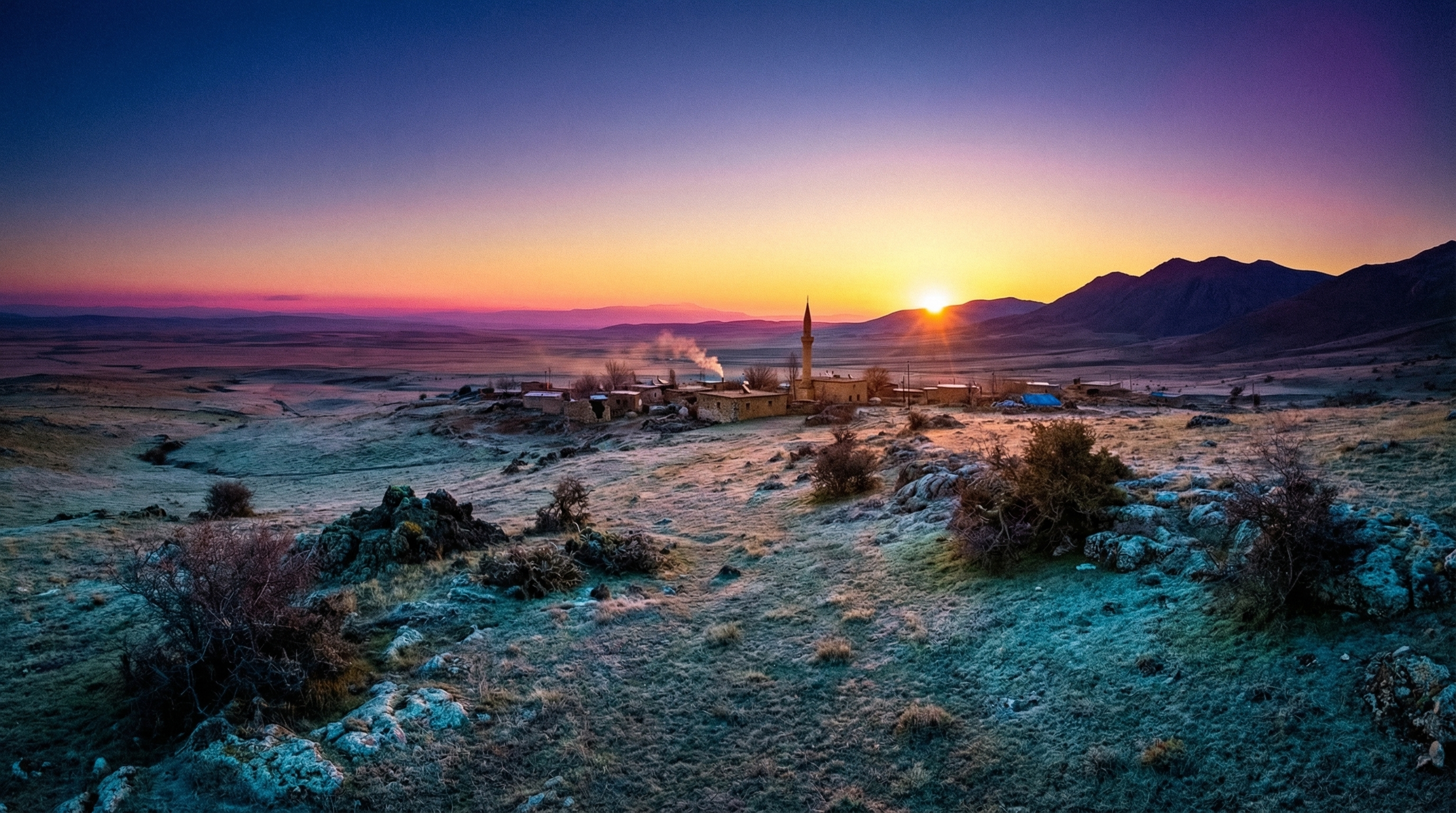
The Anatolian interior was defined by a central plateau rising to an average elevation of roughly one thousand metres, ringed by mountain ranges whose peaks exceeded four thousand metres in the east. The Pontic Mountains followed the Black Sea coast in a nearly continuous wall of forested ridges. The Taurus range defined the southern margin, its limestone escarpments dropping toward the Mediterranean coastal plain in gorges whose depth suggested the geological violence that had produced them. In the east, the highlands rose toward the volcanic peak of Ağrı Dağı — Mount Ararat — at 5,137 metres, the country's highest point, its snow-capped summit visible across the Armenian and Iranian borders and carrying mythological associations that predated every civilisation that had claimed the territory surrounding it.
Two major river systems — the Euphrates and the Tigris — had their headwaters in Turkey's eastern highlands, flowing southward through gorges and plains before entering the Mesopotamian lowlands of modern Iraq and Syria. These rivers had sustained the earliest urban civilisations in human history, and the territory through which their upper reaches passed had served for millennia as the corridor connecting the Mesopotamian heartland to the Anatolian plateau and, beyond it, the Aegean and European worlds. Everything that moved between these regions — people, goods, armies, knowledge in whatever form it was carried — traversed this corridor, making southeastern Anatolia a conduit whose importance to the transmission of civilisational development was difficult to overstate.
Deep History
The territory that became Turkey carried archaeological evidence of human habitation stretching back to the Palaeolithic, but it was the Neolithic period that produced the sites whose implications extended furthest.
Göbekli Tepe, in the hills of southeastern Anatolia near the modern city of Şanlıurfa, pushed the evidence of monumental architecture and organised ritual activity to approximately 9500 BCE — the very earliest stages of the Neolithic, a period when the conventional archaeological narrative had not expected to find structures requiring the coordinated labour of hundreds of people directed toward purposes that appeared ceremonial rather than practical. The site's massive T-shaped pillars, carved with animal reliefs that demonstrated sophisticated artistic capability, suggested that the impulse toward organised symbolic activity predated agriculture rather than following from it. The site was deliberately buried around 8000 BCE, its builders filling the enclosures with rubble and soil in an act of intentional concealment whose purpose remained the subject of scholarly debate — though the precision of the burial, and the care taken to preserve the structures beneath rather than destroy them, suggested that whoever buried Göbekli Tepe intended it to be found again, by someone who would understand what it represented when the conditions for that understanding had been prepared.
Çatalhöyük, on the Konya Plain in south-central Anatolia, provided one of the most extensively studied Neolithic settlements in the world — a proto-urban community of perhaps eight thousand people that flourished between approximately 7500 and 5700 BCE. Its densely packed dwellings, elaborate wall paintings, and evidence of complex social organisation represented a stage of human development that bridged the gap between mobile hunter-gatherer bands and the settled agricultural societies that would eventually produce the civilisations of Mesopotamia.
The significance of southeastern Anatolia's position — within the arc of territory stretching from the Euphrates headwaters through the upper Tigris valley — extended beyond what conventional archaeology documented. The region occupied the transitional zone between the Mesopotamian lowlands and the Anatolian highlands, and everything that moved between these two zones necessarily passed through it. When civilisations in the Mesopotamian heartland fell — as they periodically did, through conquest, environmental catastrophe, or the internal failures that complexity generated — the populations displaced by those collapses migrated along predictable routes, and the corridor through southeastern Anatolia was one of the most heavily travelled. Bloodlines that originated in the Euphrates valley dispersed northward and westward through this territory across centuries, their genetic material carried by refugees, traders, and migrants who had no idea that what they carried in their veins mattered to anyone beyond themselves.
The Succession of Empires
Anatolia's recorded history accumulated civilisations in layers that archaeological excavation continued to reveal and that the territory's geography made inevitable. Any landmass connecting Europe to Asia through a controllable set of straits would attract imperial attention, and Anatolia attracted it repeatedly.
The Hittites dominated the central plateau from approximately 1600 to 1178 BCE, maintaining a capital at Hattusa whose archives of cuneiform tablets documented diplomatic correspondence, religious rituals, and administrative procedures connecting Hittite Anatolia to the Egyptian, Babylonian, and Assyrian worlds. The Bronze Age collapse around 1200 BCE — whose causes remained debated but whose consequences included the Hittite empire's fall and the disruption of Mediterranean trade networks — led to a fragmentation that persisted for several centuries.
From that fragmentation emerged the kingdoms and city-states of the first millennium BCE: Lydia in the west, whose King Croesus gave Western civilisation a byword for wealth; Phrygia in the centre, whose King Midas contributed the myth of golden touch; the Greek city-states of the Aegean coast — Ephesus, Miletus, Halicarnassus — whose contributions to philosophy, science, and architecture operated within Anatolian territory long before Alexander carried Hellenism eastward by force.
The Persian Achaemenid Empire incorporated Anatolia from the sixth century BCE, connecting the peninsula to an administrative system extending from Egypt to Central Asia. Alexander's campaigns in the fourth century BCE, and the Hellenistic kingdoms that fragmented from his conquests — Pergamon, Pontus, the Seleucid territories in the southeast — maintained the cultural synthesis that characterised the post-Alexandrine world until Roman expansion absorbed them.
Rome held Anatolia for centuries, and when the empire split, the eastern half — governed from Constantinople — made Anatolian territory the core of a civilisation that would endure for a millennium.
The Byzantine Millennium
The Byzantine Empire preserved classical learning, developed distinctive architectural and artistic traditions, and maintained institutional continuity across centuries when western Europe could not. Constantinople's libraries and archives accumulated materials from across the Mediterranean, the Near East, and territories extending into Central Asia — not merely through the passive accumulation that any imperial capital generated, but through the active custodianship of institutions that understood the value of what they held and invested resources in its preservation.
Within these institutional frameworks, certain archival operations maintained purposes that extended beyond conventional scholarship. The empire's monastic system, its scriptoria, and its libraries provided cover for the systematic copying and redistribution of documents whose significance was invisible to anyone who did not understand what was being preserved and why. Materials that had survived the destruction of earlier repositories — fragments carried from Mesopotamian archives through centuries of transmission, copies of copies whose chains of custody stretched back to the Bronze Age — found in Byzantine institutional structures a custodial framework that could maintain them across centuries of political upheaval, doctrinal conflict, and the periodic crises that threatened the empire without ever quite destroying it.
In the decades preceding Constantinople's fall, Archive Keepers embedded within these institutions conducted a programme of systematic copying and redistribution — transferring priority materials to interim locations across the city's monasteries, private libraries, and the collections of Greek-speaking scholars. The programme was not merely preserving knowledge against the possibility of conquest. It was ensuring that specific documents — genealogical records, bloodline documentation, the particular materials that tracked the dispersal of genetic lineages whose continuation mattered for reasons most Byzantines could not have comprehended — survived the transition of imperial power that the siege of 1453 made inevitable.
The arrival of Turkic peoples from Central Asia, accelerating from the eleventh century with the Seljuk victory at Manzikert in 1071, initiated the demographic and cultural transformation that would eventually produce the nation-state of Turkey. The Seljuk Sultanate of Rum established itself on the central plateau, its mosques, medreses, and caravanserais representing the first layer of the Turkish-Islamic civilisation that would characterise the territory for the following millennium.
The Ottoman Empire
The Ottoman conquest of Constantinople on 29 May 1453 established the dynasty that would govern for 469 years. At its height in the sixteenth and seventeenth centuries, the Ottoman Empire extended across three continents — southeastern Europe, western Asia, and North Africa — governing a multiethnic, multireligious population through administrative structures whose sophistication contemporary European states could not match.
The millet system organised non-Muslim populations — Greek Orthodox, Armenian, Jewish — into self-governing communities with jurisdiction over their own religious, educational, and legal affairs. The arrangement was not equality; it was managed coexistence, pragmatic tolerance sustained by the understanding that the empire's economic health depended on communities whose commercial capabilities exceeded what the ruling Muslim establishment could provide independently. The system produced the cosmopolitan character that defined Ottoman cities — particularly Istanbul, where Greek, Armenian, Jewish, Levantine, and European communities maintained distinct institutional presences whilst sharing the commercial and residential spaces that urban density made communal.
The imperial administration generated documentation on a scale that dwarfed earlier regimes. Census records, property registers, commercial licences, legal proceedings, correspondence between provincial governors and the Sublime Porte — the bureaucratic apparatus produced a textual infrastructure within which genealogical research could operate with a granularity that previous centuries had not permitted. For organisations whose mission required tracking individuals through documentary evidence — following names across generations, monitoring the distribution of specific genetic lineages through marriage records and birth registers, identifying which branches of which families had proliferated and which had thinned — the Ottoman archival system represented a resource of extraordinary value. The Preservation established its Karaköy facility in Istanbul during the 1820s, exploiting the late Ottoman period's commercial loosening to create a consolidation point for materials that had been scattered across multiple regions during the preceding centuries.
The empire's gradual contraction through the eighteenth and nineteenth centuries — territory lost to Habsburg expansion, to Russian ambitions in the Black Sea and Caucasus, to nationalist movements in Greece, Serbia, Romania, and Bulgaria — produced a series of reform efforts whose ambition consistently exceeded their execution. The Tanzimat reforms of the mid-nineteenth century attempted to modernise the legal system, equalise the status of non-Muslim subjects, and restructure the military along European lines. The constitutional movements of 1876 and 1908 introduced parliamentary governance that successive sultans alternatively embraced and suppressed. The Young Turks, who seized effective power in 1908, pursued a programme of centralisation and Turkification that alienated the empire's non-Turkish populations and contributed to the catastrophic decisions that would follow.
War, Collapse, and the Birth of the Republic
The Ottoman Empire's entry into the First World War on the side of the Central Powers in November 1914 set in motion the sequence of events that destroyed the imperial system. The war brought military campaigns across multiple fronts — Gallipoli, where the 1915 defence against Allied invasion became a founding myth of Turkish national identity; the Caucasus front, where Ottoman and Russian forces fought in conditions of extreme cold and mountainous terrain; Mesopotamia and Palestine, where British campaigns gradually eroded Ottoman control.
The Armenian Genocide of 1915 — the systematic deportation and killing of the Armenian population of Anatolia, resulting in the deaths of an estimated one to one and a half million people — constituted one of the twentieth century's defining atrocities. The Ottoman government, dominated by the Committee of Union and Progress, conducted the operation under cover of wartime security measures, emptying Anatolia of a population that had inhabited the territory for millennia. The genocide's legacy remained a point of profound international contention; Turkey's official position denied the characterisation of genocide, a stance that strained diplomatic relations with nations that formally recognised the events for what they were.
The Ottoman defeat in 1918, the Allied occupation of Istanbul, and the partition proposals that threatened to divide Anatolia provoked the resistance that coalesced around Mustafa Kemal. Operating from the Anatolian interior, Kemal organised a military and political movement that fought a war of independence on multiple fronts — against Greek forces that had landed at Smyrna with Allied backing in 1919, against French and Italian ambitions in the south, against Armenian forces in the east, and against the Ottoman government in Istanbul that had accepted the Treaty of Sèvres.
The Turkish victory in the Greco-Turkish War, culminating in the recapture of Smyrna in September 1922, was followed by the population exchanges that forcibly relocated approximately 1.5 million Greeks from Anatolia to Greece and half a million Muslims from Greece to Turkey — demographic engineering on a scale that permanently altered the human geography of both nations.
The Republic of Turkey was proclaimed on 29 October 1923, with Mustafa Kemal as its first president and Ankara — a small Anatolian town chosen precisely for its distance from Istanbul's imperial associations — as its capital.
The Kemalist Revolution
The republic that Kemal — who adopted the surname Atatürk, "Father of the Turks," in 1934 — constructed from the Ottoman ruins represented one of the twentieth century's most thoroughgoing social transformations. The caliphate was abolished in March 1924. The Arabic script was replaced with a Latin alphabet in 1928, a change that overnight rendered the entire literate population unable to read their own historical documents — a rupture in textual continuity whose implications for anyone attempting to trace records across the Ottoman-Republican divide were immediate and severe. The legal system was secularised. The fez was banned. The Gregorian calendar adopted. Women received the vote in 1934.
The reforms were imposed with a speed and comprehensiveness that permitted no gradual adaptation. The result was a society simultaneously modern and traumatised — liberated from imperial structures that had constrained individual freedom and severed from the cultural continuity that had given those structures meaning.
The secularisation had a secondary consequence that its architects did not intend and likely did not anticipate: it created an operating environment in which organisations whose purposes transcended religious frameworks could function with reduced scrutiny. Under the Ottoman system, institutional life was mediated through religious structures whose oversight made covert operations more visible. Under the secular Republic, the institutional landscape diversified, the space between state and religion widened, and the particular kind of quiet, long-term archival and genealogical work that certain organisations conducted became less conspicuous within a society whose attention was directed toward the more visible project of national modernisation.
The capital's relocation to Ankara was more than administrative convenience. It was a statement that the new Turkey looked inward toward the Anatolian heartland rather than outward through Istanbul's imperial windows. Ankara grew from a provincial town into a national capital whose universities and government institutions attracted the intellectual class that the new republic required — including, by the late twentieth century, academics like Kemal Osman, a professor of Ottoman history at Ankara University, and his wife Elif, a librarian specialising in manuscript preservation, whose household produced a daughter in 1996 whose scholarly aptitude would eventually serve purposes neither parent was aware of.
The Mid-Century Republic and Its Oscillations
Atatürk died on 10 November 1938, and the republic passed to İsmet İnönü, who navigated Turkey's neutrality through the Second World War with a pragmatism that kept the nation out of a conflict whose geographic proximity made non-involvement a diplomatic achievement of considerable skill.
The transition to multi-party democracy in 1946 introduced a political dynamic whose oscillations between secular republicanism and popular conservatism would characterise Turkish governance for the following eight decades. The Democrat Party's victory in 1950 brought Adnan Menderes to power on a platform easing some Kemalist restrictions, including the restoration of the Arabic call to prayer. The military coup of 27 May 1960 removed Menderes, who was subsequently executed. The pattern had been set: the Turkish military understood itself as the guardian of Kemalist secularism and reserved the right to intervene when civilian governance deviated too far from that foundation.
The 1970s brought political violence between left-wing and right-wing factions that killed thousands. The military coup of 12 September 1980 imposed martial law, dissolved political parties, and produced a new constitution that concentrated executive power and restricted political activity. The 1980 intervention reshaped political culture, suppressed the left, and introduced a synthesis of nationalism and Islamic identity whose long-term consequences would prove more significant than the ideology it replaced.
Selim Yavuz Demirci was born on 20 June 1980, three months before the coup that would reshape the country he grew up in. His early years unfolded within a Turkey whose political landscape the military had redrawn and whose social tensions the new constitutional framework had suppressed rather than resolved — tensions that would surface again, in different forms, through the decades that followed.
The Kurdish Question and Southeastern Anatolia
Turkey's southeastern provinces — the territory through which the Euphrates and Tigris flowed southward toward the Mesopotamian plains — had been the site of a conflict whose roots extended to the republic's founding. The Kurdish population, estimated at fifteen to twenty million within Turkey's borders, constituted the country's largest ethnic minority, concentrated in the southeastern and eastern provinces whose mountainous geography had facilitated the maintenance of distinct cultural identity despite decades of assimilationist policy.
The Kurdistan Workers' Party (PKK), founded in 1978 and launching an armed insurgency in 1984, pursued Kurdish autonomy through guerrilla warfare that produced over forty thousand deaths across four decades. The conflict militarised the southeast, displaced rural populations, and created a security apparatus whose presence defined daily life in provinces where civilian governance operated under military oversight.
The southeastern provinces' significance extended beyond contemporary politics. The territory encompassed the upper Euphrates valley, the Tigris headwaters, and the transitional zone between the Anatolian highlands and the Mesopotamian lowlands — the same corridor through which dispersing populations had migrated northward for millennia following the periodic collapses that punctuated civilisational development in the lowlands to the south. The genetic material carried by those migrants — the bloodline markers whose distribution The Preservation had tracked since its founding — had proliferated through Kurdish, Turkish, Arab, and Armenian populations across the region, the southeastern provinces representing one of the highest concentrations of viable carriers precisely because the territory had functioned as a migration corridor for so long. Archaeological sites of extraordinary importance sat in landscape whose contemporary military restrictions on access inadvertently preserved what lay beneath the surface from the kinds of development that might otherwise have disturbed it.
Economic Transformation and the Erdoğan Era
The economic liberalisation initiated by Turgut Özal in the 1980s — deregulation, export orientation, integration with global financial markets — transformed Turkey from a closed, state-directed economy into one of the larger emerging markets. Istanbul's financial sector expanded. Manufacturing developed in Anatolian cities whose industrial capacity previous decades had not cultivated. Tourism grew into a major revenue source, the Mediterranean and Aegean coasts drawing millions of visitors.
The financial crisis of 2001 created the conditions for the political transformation that followed. The Justice and Development Party (AKP), led by Recep Tayyip Erdoğan, won a commanding parliamentary majority in November 2002 combining economic competence with moderate Islamic identity. The early years delivered genuine achievements: economic stabilisation, infrastructure investment, expansion of healthcare and education access, and EU accession negotiations signalling Turkey's European orientation.
The trajectory shifted through the 2010s. Constitutional amendments concentrated executive power. Media independence contracted. The failed coup attempt of 15 July 2016 produced a state of emergency whose consequences included mass dismissals, media closures, and the detention of tens of thousands. The centralisation of power and the contraction of civil liberties created an environment in which covert operations — both those conducted by the state and those conducted beneath its awareness — operated with reduced oversight, the apparatus of surveillance simultaneously more powerful and more distracted than it had been under the messy pluralism of earlier decades.
On 10 September 2018, in the Fatih district of Istanbul, an extraction operation moved eight individuals through a portal activated in a basement beneath the quarter's cobbled streets. Selim Yavuz Demirci coordinated the operation alongside Beatrix Cramer, the basement sanctuary transformed into a bridge between worlds whilst the city above continued its sixteen-million-person daily routine undisturbed. Istanbul's density had always made it hospitable to operations that required discretion without isolation, and the particular conditions of late-2010s Turkey — a security establishment focused on political threats rather than dimensional ones — provided cover that the operatives exploited with the precision that their respective organisations had refined across decades of working in environments where the margin between success and exposure was measured in details.
The Contemporary Nation
Turkey in the mid-2020s contained approximately eighty-five million people — overwhelmingly Muslim, constitutionally secular though that secularism's meaning had been progressively redefined, increasingly urban. Istanbul dominated with sixteen million inhabitants generating economic and cultural output that Ankara's political status could not counterbalance. But the country's depth extended far beyond its largest city: the Aegean coast's resort economies, the agricultural heartland of the central plateau, the industrial centres of Bursa, Kocaeli, and Gaziantep, the southeastern provinces whose Kurdish population maintained distinct identity within and sometimes against the national framework.
The territory's position at the intersection of continents continued to determine its function in ways that echoed every preceding era. Trade routes that had carried Mesopotamian goods to Aegean markets now carried containerised freight through the same geographic corridors. Migrant populations that had traversed Anatolia throughout recorded history now included millions of Syrian refugees whose presence transformed border-province demographics. The academic institutions that the Republic had built — Ankara University, Boğaziçi University in Istanbul, the network of research universities whose faculties included specialists in ancient Near Eastern languages and manuscript preservation — provided the intellectual infrastructure within which archival and genealogical research operated, some of it directed toward conventional scholarly purposes and some of it serving objectives that the institutions housing it had no reason to suspect existed.
The archival infrastructure that accumulated wherever documents and records flowed between civilisational centres found in Turkey the consolidation point that geography had always designated. Materials that had traversed the southeastern corridor from Mesopotamia, that had been copied in Byzantine scriptoria and Ottoman administrative offices, that had survived the alphabet change and the institutional ruptures of the Republican era, came to rest in repositories whose holdings reflected the full scope of what the territory connecting Mesopotamia to Europe had transmitted across twelve thousand years of continuous human habitation. In Istanbul's Karaköy district, beneath a shopfront selling antique maps, four millennia of accumulated documentation sat in climate-controlled chambers that the city above had no reason to know existed — the latest in a chain of custodial arrangements that stretched back to the desperate hours when an organisation formed in a falling city committed itself to a mission whose duration its founders could not have imagined and whose completion remained, four thousand years later, a matter of urgent and unresolved necessity.







