4128.61 · March 1, 1808 AD
Trees That Bleed
The road to Parramatta is not a road at all but merely an ambition carved through bush that bleeds amber resin and harbours creatures that can kill before sundown—and as William stumbles westward on ruined feet, a fifteen-year veteran of the colony begins teaching him the only lesson that matters: how to see this land before it destroys him.
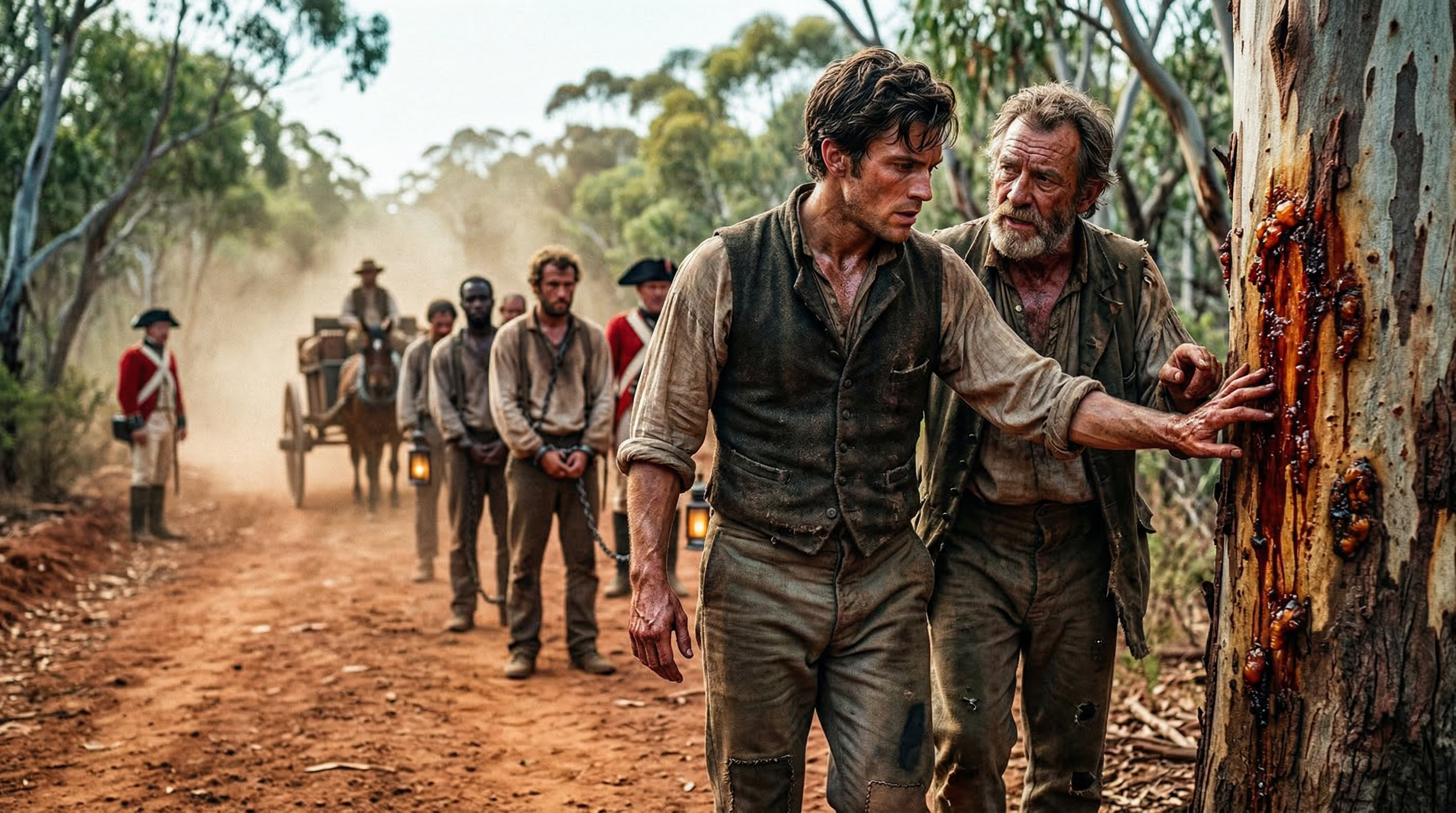
"This country doesn't hate you, lad. It just doesn't care whether you live or die. There's a difference, though it won't feel like one when you're dying."— Jeremiah Flint
The road out of Sydney was not a road at all, but merely an ambition—a suggestion of passage carved through the bush by the boots and carts of those who had come before. It wound westward from the settlement, climbing gradually into country that grew wilder with each mile, the timber-and-brick buildings of the colony giving way first to scattered huts, then to cleared paddocks, and finally to nothing but the grey-green tangle of the Australian bush pressing close on either side.
William marched with perhaps thirty other convicts, their chains creating a discordant percussion that accompanied every step. Guards flanked the column at intervals, their red coats already darkening with sweat beneath the climbing sun, muskets held ready across their chests. A sergeant rode at the head of the procession on a horse that seemed as ill-tempered as its rider, its hooves raising small clouds of dust that drifted back over the walking men like a benediction of dirt.
The morning had begun cool enough—that brief mercy of the hours before dawn when the air still retained some memory of the night's respite. But the sun had been above the horizon for scarcely an hour before that mercy was withdrawn. The heat descended upon them like a physical presence, pressing down upon heads and shoulders, wrapping around bodies in an embrace that grew tighter with each passing minute. By the time Sydney had disappeared behind them, hidden by a curve in the road and the intervening trees, William's shirt was already soaked through, the rough linen clinging to his skin in sodden folds.
He had thought he understood heat after his day and night in the colony. He had been wrong. That had been the heat of settlement, of harbour breezes and buildings that provided at least the illusion of shade. This was something else entirely—the heat of open country, of a sun that had nothing between itself and the earth but air that seemed to magnify rather than filter its fury. It wrapped around him like fever, infiltrated his lungs with each breath, pressed against his eyeballs until the very act of seeing became an effort.
The track they followed had been worn into the red earth by years of traffic—convict transports like their own, supply wagons carrying goods to the farms and settlements that dotted the interior, the occasional free settler travelling on business that was no concern of men in chains. In places, the passage of wheels and feet had carved ruts deep enough to twist an unwary ankle. In others, exposed roots crossed the path like tripwires laid by a malevolent earth. William learned quickly to watch where he stepped, to anticipate the obstacles that might send him stumbling and drag down the men chained to him.
The dust was inescapable. It rose from beneath their feet with each shuffling step, hung in the still air like a curtain, worked its way into every crevice and opening it could find. William tasted it on his tongue, felt it grinding between his teeth, discovered it caking in the corners of his eyes and the creases of his skin. It transformed the men around him into terracotta figures, their features obscured beneath masks of reddish-brown that made them all look eerily alike—a procession of clay men trudging toward some unknown kiln.
His feet had begun to complain before they cleared the last of Sydney's outlying huts. The blisters raised during yesterday's march through the settlement had not healed during the night, and now each step drove fresh agony through soles that seemed to have forgotten how to bear their owner's weight. The ground was unforgiving beneath his bare skin—pebbles that jabbed, roots that scraped, patches of earth baked so hard by the sun that they might as well have been cobblestones. By mid-morning, he could feel blood seeping between his toes, could see the dark stains his passage left upon the lighter dust of the track.
The bush closed around them as they moved further from the settlement, until the road became a tunnel through vegetation that seemed determined to reclaim whatever space civilisation had carved from it. Gum trees rose on every side, their trunks pale as bone where the bark had peeled away, dark and furrowed where it remained. The leaves that crowned them were not the green William knew from England—not the lush verdure of oak and elm and the hedgerows of his childhood—but something more muted, more silver, as though the colour had been bleached away by generations of brutal sun.
These trees bled. William noticed it first as a dark stain on one trunk, then another, then dozens more as his eyes learned to recognise the pattern. Resin oozed from wounds in the bark, hardening into amber tears that caught the filtered light and glowed like fragments of trapped sunshine. The sight was beautiful in a way that troubled him—beauty had no place in this march of the condemned, this shuffling procession toward years of servitude.
The smell of the bush was overwhelming, even through the dust that clogged his nostrils. Eucalyptus dominated—that sharp, almost medicinal scent he had first encountered on the dock, now intensified a hundredfold by the sheer volume of foliage surrounding him. But there were other notes beneath it, subtler fragrances that revealed themselves in waves as the road wound through different pockets of vegetation. Something sweet, like honey left too long in the sun. Something acrid, like smoke from a fire that had burned weeks ago and left its memory in the soil. Something else entirely, earthy and ancient, that seemed to rise from the land itself rather than from any particular plant.
The insects provided constant commentary. They buzzed and whirred and clicked in numbers that seemed impossible, invisible presences whose voices created a wall of sound that pressed against the ears from every direction. Flies discovered the column of sweating men and descended upon them with enthusiasm, crawling across exposed skin, seeking the moisture that gathered at the corners of eyes and mouths. William waved them away until his arms grew too tired for the effort, then simply endured, his face a landing ground for creatures whose persistence bordered on the demonic.
The man who fell into step beside him sometime in the late morning was older than most of the convicts in the column—perhaps fifty years of age, though the weathering of his skin made precise estimation difficult. His face bore the creases and furrows of long exposure to harsh conditions, and his eyes, pale blue beneath sun-bleached brows, held the particular quality of men who have seen too much to be surprised by anything new.
"Jeremiah Flint," he offered by way of introduction, his voice roughened by the dust but not unkind. "I noticed you watching the trees. Not many new men bother—too busy feeling sorry for themselves to see what's around them."
William considered the observation. "Hard not to notice," he said. "Nothing here looks like it should. Nothing sounds like it should. It's as though someone took England apart and reassembled it wrong."
Flint made a sound that might have been a laugh. "That's not far from the truth. This land's older than ours—older than we can properly imagine. Been sitting down here at the bottom of the world for so long it forgot what the rest of creation was doing. Grew its own trees, its own creatures, its own rules." He gestured toward a bird that had landed on a branch ahead of them, its plumage a shock of crimson against the grey-green foliage. "You'll never see one of those in England. Wouldn't survive the first winter. But here, in this country, it belongs. We're the ones who don't."
"You've been here long, then?" William asked.
"Long enough. Fifteen years, give or take. Came out in ninety-three, served my time, stayed on when my ticket came through." Flint's eyes swept across the surrounding bush with an expression that was difficult to read. "Had a farm for a while, up toward the Hawkesbury. Good land, if you knew how to work it. Which I did, eventually. Lost it to drought three years running, then lost everything else to a fire that took half the district." He shrugged, a gesture that encompassed an entire collapse of fortune with remarkable economy. "Started drinking. Made some bad decisions. And here I am, back in chains, walking the same road I walked as a young man."
"Any advice for someone just starting?" William asked. The question emerged before he could consider whether asking for counsel from a man who had clearly squandered his own opportunities made sense.
Flint walked in silence for several paces, his brow furrowed in thought. "Learn the land," he said at last. "That's the first thing. Everything else follows from that. This country will kill you if you don't understand it, and it won't care whether you deserve the dying or not. Learn what plants you can eat and which ones will poison you. Learn to read the weather before it reads you. Learn where water hides and how to find it when the creeks run dry."
He ducked beneath a low-hanging branch, and William followed suit, the leaves brushing against his face with a papery rustle. "Learn to work," Flint continued. "I don't mean just putting your back into the labour they assign you—any fool can do that until his body breaks. I mean learn what you're doing and why. The farm you're going to, they'll have you clearing land, planting crops, tending livestock. Pay attention. Ask questions when you can get away with it. The skills you pick up during your sentence are the skills you'll use to build something after."
"And the overseers?" William asked. "The guards?"
"Some are bastards. Some are decent men doing difficult work. Most are somewhere in between." Flint's voice dropped lower, though the guards were far enough away that normal conversation should not carry. "Don't give them reasons to notice you. Don't fight back when they're unfair—and they will be unfair, count on that—because fighting only gives them excuse to make your life worse. But don't grovel either. A man who grovels loses something he can never get back. Find the line between defiance and submission, and walk it like a rope across a gorge."
William absorbed this, adding it to the advice Tom had given aboard the ship, to the fragments of wisdom he had gathered during his time in the holding barracks. A picture was forming in his mind—not yet clear, but acquiring shape and dimension with each new piece of information. The rules of survival in this colony were not written in any book, were not proclaimed by any official voice. They passed from man to man in moments like this, purchased through suffering and transmitted through the strange fraternity of the condemned.
The sun continued its relentless climb, and with it the temperature rose until the very air seemed to shimmer with heat. William's throat burned with a thirst that the occasional sips of water the guards provided could not begin to satisfy. His head had begun to ache—a dull pounding behind his eyes that intensified each time he turned his gaze toward the unshaded portions of the sky. The dust coated his tongue so thickly that he could barely work up enough moisture to swallow.
Around him, the other convicts were suffering equally. Men stumbled and caught themselves on the chains connecting them to their neighbours. Conversations that had begun hopefully in the early morning had long since died away, replaced by the wordless communication of shared misery—exchanged glances, grim nods, the occasional hand extended to help a struggling companion over particularly difficult terrain.
One man fell. He was perhaps ten places ahead of William in the column, a thin figure whose name William had never learned. One moment he was walking; the next, his legs folded beneath him and he dropped to the dust like a puppet whose strings had been cut. The men chained to him stumbled, dragged sideways by his sudden collapse. Guards shouted and the procession lurched to a ragged halt.
William watched as they hauled the fallen man to his feet, watched them splash water on his face and hold a canteen to his lips. The man's eyes were glassy, unfocused, seeing something beyond the circle of concerned faces. Heat stroke, William thought, or something close to it. The sun had simply cooked him from the inside out until his body refused to carry him further.
"Can he walk?" the sergeant demanded from his horse, his voice carrying clearly through the still air.
The guards conferred. One of them shook his head. "Not far, sergeant. He's done in."
The sergeant considered this, his expression revealing nothing of whatever calculation was taking place behind his eyes. "Put him on the supply cart," he said at last. "We can't wait for stragglers, but I'll not leave a man to die on the road if I can help it."
They loaded the unconscious convict onto the cart that followed the column, his limp form disappearing among the barrels and crates of supplies. The chains were rearranged to close the gap his absence created. And then they were moving again, shuffling forward beneath the murderous sun, the brief interruption already fading into the general blur of the march.
The snake appeared without warning, emerging from the undergrowth directly into the path of the column. It was longer than William was tall, its body marked with bands of brown and cream that seemed to ripple as it moved. The convicts nearest to it froze, their chains going taut as the men behind them continued forward before realising what had caused the sudden halt.
"Nobody move," Flint said quietly, his voice carrying just far enough to reach those in danger. "Let it pass. It's not interested in us unless we give it reason to be."
The snake seemed to consider the assembled humans with something approaching contempt. Its tongue flickered out, tasting the air, reading whatever information the dust and sweat and fear of the convicts might provide. For a long moment, it remained motionless in the centre of the track, master of the situation, unhurried by the presence of creatures so much larger than itself.
Then, with a fluid motion that suggested complete indifference to its audience, it continued across the path and vanished into the bush on the other side. The leaves rustled briefly, marking its passage, and then there was nothing—no sign that the creature had ever been there save the racing hearts of the men who had witnessed its crossing.
"Brown snake," Flint said, resuming his stride as the column lurched back into motion. "One of the most venomous creatures in this entire godforsaken country, and that's saying something. A bite from one of those and you'll be dead before sundown—faster if it catches you somewhere the blood flows quick."
William stared at the spot where the snake had disappeared, half-expecting to see it re-emerge, perhaps accompanied by others of its kind. "Are there many of them?"
"More than you'd want to know about. Snakes, spiders, things in the water that'll take your leg off before you can scream. The bush is beautiful, lad, I won't deny that. But it's also trying to kill you, every moment of every day. Never forget that."
The afternoon brought no relief. If anything, the heat intensified as the sun reached its zenith and began its slow descent toward the western horizon. The road stretched before them in an endless ribbon of red dust, climbing and falling with the contours of the land, offering no destination visible enough to serve as encouragement. They might have been walking in circles for all William could tell—the bush looked the same in every direction, the same grey-green foliage, the same pale-trunked trees, the same indifferent sky pressing down from above.
His feet had passed beyond pain into something approaching numbness, a mercy that he knew was temporary and probably dangerous. The blisters had burst somewhere in the past hour, their contents mixing with the blood that had been seeping from torn skin since morning. Each step left a mark on the track, a crimson signature that would fade to brown as the sun dried it. He was not the only one bleeding—dark stains marked the passage of the entire column, a trail that any tracker could follow without difficulty.
The water ration came less frequently as the day wore on, the guards perhaps concerned about the supplies that must last until they reached their destination. William learned to hold each mouthful in his mouth as long as possible, letting it soak into the tissues of tongue and cheek before allowing himself to swallow. The technique did little to quench his thirst, but it created the illusion of abundance, a small psychological victory in a day otherwise devoid of them.
Flint remained beside him, his pace steady, his breathing controlled. The older man seemed to suffer less than the others, his body perhaps accustomed to such conditions through fifteen years of colonial existence. Or perhaps he simply concealed his suffering better, had learned through long experience that showing weakness invited exploitation.
"How much further?" William asked, the words emerging as barely more than a croak.
"We'll camp before nightfall," Flint replied. "Perhaps another two hours. Maybe three. The sergeant won't push us through darkness—too easy to lose men in the bush after sunset, and the paperwork when that happens is apparently more trouble than it's worth."
Two hours. Three. William fixed the numbers in his mind and used them as an anchor, something to cling to when his body insisted that it could not continue another step. Two hours. Three at most. Then rest, however inadequate. Then sleep, however troubled. Then tomorrow, and another march, and eventually—impossibly, necessarily—arrival at the place where his seven years of servitude would begin.
Despite the misery of the march, William found himself observing the country through which they passed with an attention that surprised him. Flint's words had planted something—a seed of curiosity that even exhaustion could not entirely suppress. This land was trying to kill him, yes. But it was also unlike anything he had ever seen, and some part of him, perhaps the part that had once dreamed of voyages and adventures before reality had intervened, wanted to understand it.
He noticed how the vegetation changed as they moved inland—the dense coastal scrub giving way to more open woodland, the trees growing taller and further apart, the undergrowth thinning until in places he could see for hundreds of yards through the trunks. The soil changed too, from the sandy red of the coastal track to something darker, richer, that suggested the possibility of cultivation.
He noticed the birds, so different from England's sparrows and robins. Parrots flashed through the canopy in bursts of crimson and emerald and brilliant blue, their colours almost violent against the muted backdrop of the bush. Cockatoos erupted from the trees at the column's approach, their white wings catching the sun, their shrieks expressing what might have been alarm or might have been mockery. Smaller birds he could not name darted between branches, their songs creating melodies that were strange but not unpleasant.
He noticed the way the light fell differently here than in England—sharper somehow, more direct, casting shadows with edges that seemed almost artificially defined. The sun itself appeared larger, fiercer, a more immediate presence than the pale disc that had presided over his Portsmouth childhood. Under this sun, a man could not pretend that the universe was indifferent to his existence. This sun noticed. This sun had opinions.
"You're learning," Flint observed, catching the direction of William's gaze. "Most men your age wouldn't bother. They'd stumble through their sentences with their eyes on the ground and their minds on what they've lost. But you're looking. That's good. That's the beginning of something."
"The beginning of what?" William asked.
Flint considered the question. "Understanding, maybe. Or acceptance. Or just the capacity to survive. Hard to say which, at this stage. Ask me again in seven years, if we're both still breathing."
William saw them from the corner of his eye—dark figures moving through the bush perhaps fifty yards from the track, their progress parallel to the column's but somehow smoother, more natural, as though they belonged to this landscape in ways the stumbling convicts could never hope to match. When he turned his head for a better look, they had vanished, melting into the vegetation with a completeness that made him question whether he had seen anything at all.
"Natives," Flint said quietly, not breaking stride. "They've been watching us since we left the settlement. Don't stare—they don't like it, and the guards get nervous when they think we're paying too much attention."
"What do they want?"
"To know what we're doing, probably. This is their country—was their country, before we came. They've seen enough columns like ours to know we're not a threat, at least not immediately. But they watch nonetheless. Keep track of our movements. Make note of where we're going and how many of us there are." Flint's voice held neither fear nor contempt, merely the neutral tone of a man stating facts. "We've pushed them off the good land, taken the places where they hunted and fished for thousands of years. Some of them have made peace with that, more or less. Others haven't. Best to be aware and careful."
William kept his gaze forward after that, but his awareness had expanded to include the trees at the edges of his vision, the spaces between the trunks, the places where shadow gathered thick enough to conceal a watching presence. The bush, which had seemed merely alien before, now felt inhabited—populated by eyes he could not see, by judgements he could not hear, by a history that had nothing to do with England or its empire.
The light had begun to soften when the sergeant finally called a halt. They had reached a clearing where previous transports had evidently camped before—the ground bore the scars of old fire pits, and the surrounding trees showed marks where branches had been cut for fuel. A small creek trickled through one edge of the space, its water brown with tannins but drinkable, a mercy that the convicts greeted with something approaching reverence.
"Make camp," the sergeant ordered, swinging down from his horse with the ease of a man who had not spent the day walking in chains. "No fires until full dark—don't want to advertise our position more than necessary. Water ration from the creek, supervised. Anyone who wanders beyond the perimeter answers to me personally."
The convicts dispersed through the clearing, seeking whatever patches of comfort the ground might offer. William found a spot beneath one of the larger trees, its trunk providing something to lean against, its branches filtering the last of the sun's assault into bearable fragments. He lowered himself to the earth with a groan he could not suppress and sat for a long moment simply breathing, letting his body acknowledge that the day's march was finally, blessedly, over.
His feet were a ruin. He examined them in the fading light, wincing at what he saw—blisters burst and raw, skin torn in strips from the soles, toes caked with a mixture of dust and dried blood that formed a grotesque paste. He would need to wash them in the creek, to clean the wounds as best he could before they turned septic. But for now, for just a few minutes, he could not bring himself to move.
Flint settled beside him, his own movements betraying a weariness his face had not shown during the march. "First day's the hardest," the older man said. "Your body hasn't learned yet what it's capable of. By the time you reach Parramatta, you'll be surprised how much you can endure."
"That's supposed to be encouraging?"
"It's supposed to be true. Encouragement and truth don't always travel together." Flint produced a small cloth from somewhere within his ragged clothing and began wiping the dust from his face. "Get yourself to the creek while there's still light. Clean those feet. Drink as much as you can hold. Tomorrow will come whether you're ready for it or not."
William followed the advice. The creek water was cool despite the day's heat, fed perhaps by springs that ran deeper than the sun's reach. He washed his feet carefully, hissing through his teeth as the water found each raw patch, each open wound. The bleeding had mostly stopped, but the skin that remained was tender, fragile, likely to tear again with tomorrow's march. He could only hope that the night's rest would grant some small measure of healing.
Rations were distributed as darkness claimed the clearing—the same hard bread, the same salted meat, the same inadequate portions that left the stomach longing for more. William ate slowly, making each bite last, washing down the dry mouthfuls with water he had carried back from the creek. Around him, the other convicts did the same, their faces lost in the gathering gloom, their silence speaking of exhaustion too deep for words.
The fires were lit once true night had fallen, small blazes that cast flickering circles of light across the clearing. The guards had posted sentries at the perimeter, their shapes visible against the stars when they passed between William and the sky. Beyond their watchful presence, the bush had come alive with sounds—the same insect chorus he had heard the previous night, joined now by rustlings and calls that might have been animals or might have been imagination filling the darkness with terrors.
William lay on his back and stared up at the canopy of leaves above him, their shapes black against a sky that blazed with more stars than he had ever seen. The constellations were wrong—not the patterns he had learned as a child, not the guides his father had pointed out over Portsmouth harbour. These were southern stars, arranged in formations that ancient peoples had named according to their own myths, their own needs. He searched for something familiar and found nothing.
Yet the wrongness no longer troubled him as it had that first night in Sydney. He was beginning, perhaps, to accept that this land would offer him nothing he already knew. Everything here must be learned anew—the stars, the trees, the creatures, the rules. He would either master that learning or be destroyed by it. There was no middle ground, no comfortable mediocrity that might carry him through unchanged.
Somewhere in the bush, a creature called out—a long, mournful sound that rose and fell like a voice crying for something lost. William listened until the cry faded into silence, then closed his eyes and surrendered to a sleep that came more easily than he had expected, his body's exhaustion finally overwhelming his mind's resistance.
Tomorrow, the march would continue. Tomorrow, Parramatta would draw closer. Tomorrow, the next chapter of his sentence would begin to unfold.
But that was tomorrow. For now, there was only the hard ground beneath his back, the unfamiliar stars above his face, and the strange lullaby of a land that had not yet decided whether to embrace him or destroy him.






