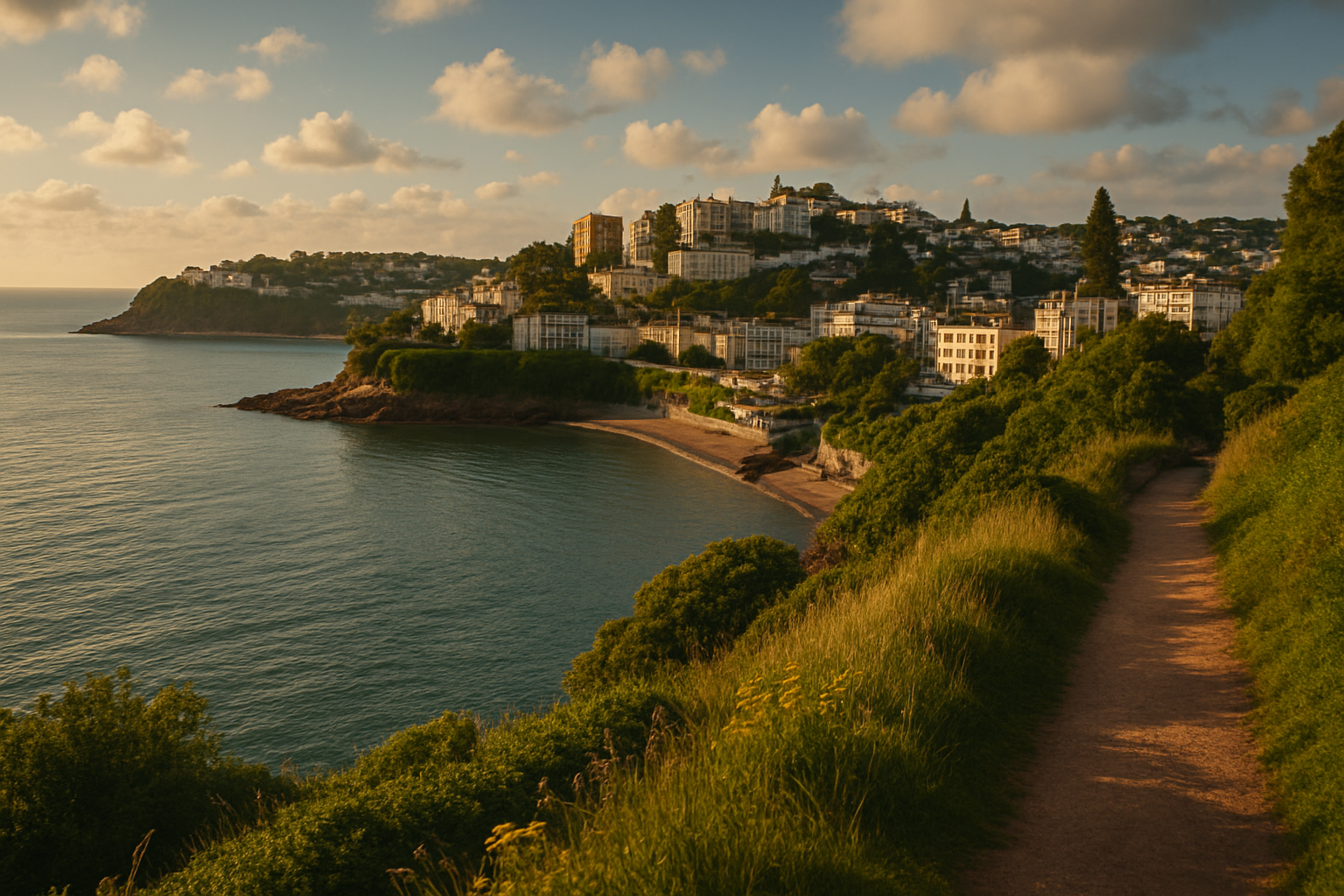
Torquay, Devon, England
Torquay is a seaside town on the sheltered northern shore of Tor Bay in south Devon, known for its mild climate, limestone cliffs, and palm-lined promenades. From its origins as the Saxon hamlet of Torre and a modest medieval fishing quay beneath the walls of a wealthy Premonstratensian abbey, it grew during the nineteenth century into one of England's most fashionable resort towns — the self-styled "English Riviera." Its history is layered: prehistoric caves, monastic wealth, Napoleonic anchorage, Victorian grandeur, and modern reinvention.
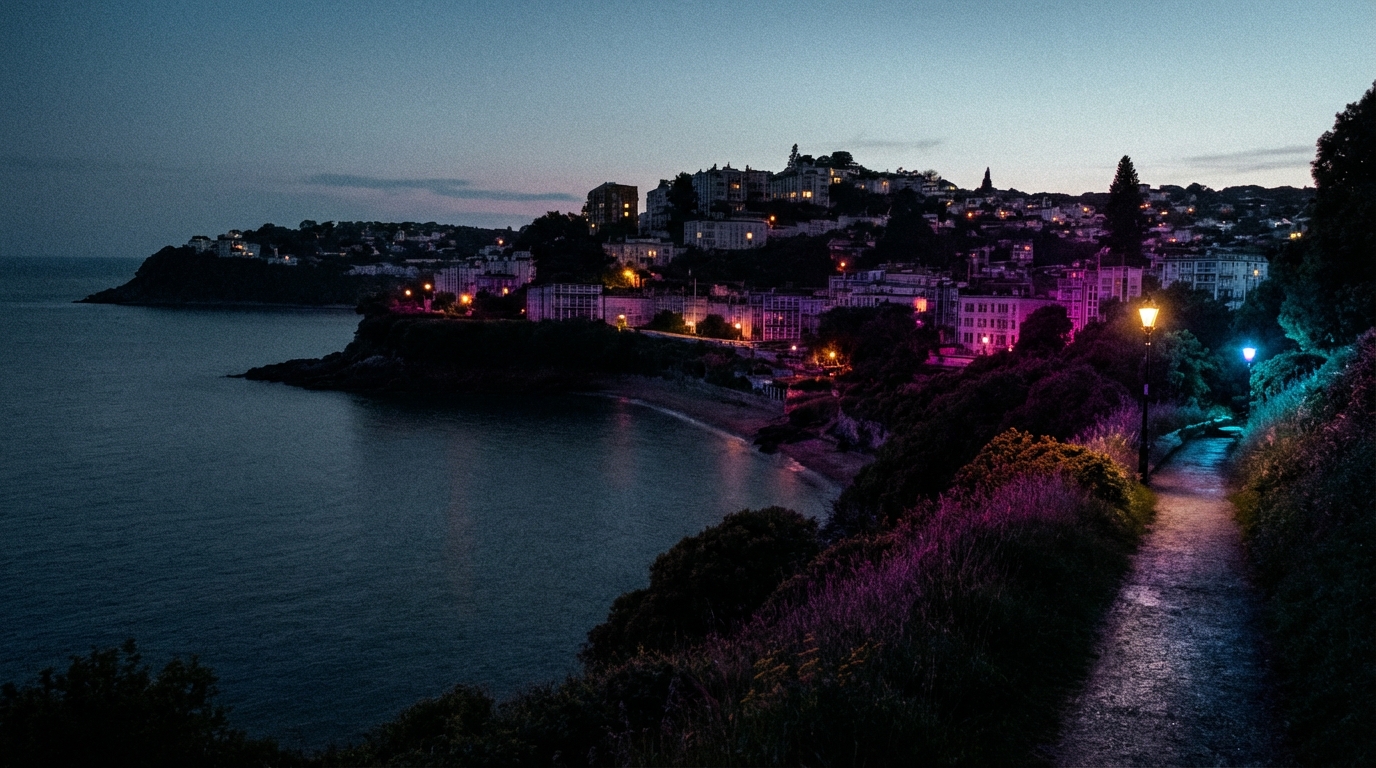
Prehistoric and Ancient Origins
The land around Torquay carries evidence of human habitation stretching back hundreds of thousands of years. Kents Cavern, a limestone cave system in the hills above the town, has yielded Palaeolithic hand axes and a maxilla fragment — known as Kents Cavern 4 — that may represent the oldest example of a modern human in Europe, dated to between 37,000 and 40,000 years ago. Bronze Age barrows and the Iron Age hillfort at Walls Hill near Babbacombe further attest to prehistoric activity in the area. Roman soldiers are known to have visited the cavern during the occupation of Britain, leaving offerings at a curious rock formation known as "The Face," though no evidence of permanent Roman settlement has been found in Torquay itself.
Saxon Settlement and Torre Abbey
The modern town developed around the Saxon hamlet of Torre — a name derived from the Old English torr, meaning a rocky hill or craggy peak, referring to the limestone outcrop on what is now Tor Hill. The Domesday Book of 1086 records the manor of Torre as a modest agricultural holding, its total population perhaps no more than a hundred souls. The wider area comprised several small manors: Cockington, held by the Norman William de Falaise; Maidencombe, passed from the Saxon Elmer to Hamond after the Conquest; and St Marychurch, held throughout by the Bishop of Exeter.
The event that shaped Torquay's early development was the founding of Torre Abbey in 1196, when William Brewer, lord of the manor of Torre, granted land to Premonstratensian canons from Welbeck Abbey in Nottinghamshire. Six white-robed canons established a monastery that would, by the time of its dissolution in February 1539, become the wealthiest house of its order in England, with an annual income of nearly four hundred pounds. The canons built with stone quarried from nearby Corbyn Head — with permission from the de Cockington family — and are credited with constructing the first fishing quay at the settlement, giving rise to the compound name that would evolve through Torrequay, Torkay, and Tor Quay before settling into its modern form. The monks also founded the nearby market town of Newton Abbot as the "New Town of the Abbots" in the early thirteenth century.
After the dissolution, the abbey passed through several hands before Sir George Cary purchased it in 1662. The Cary family — who had held lands in Cockington since the fourteenth century — would retain Torre Abbey until 1930, when it was acquired by Torquay Corporation and opened as a museum and art gallery. Between them, the Carys, the Palks, and the Mallocks owned the great majority of land that would become modern Torquay, and the decisions of these three families determined the character of the town's development for two centuries.
The Napoleonic Catalyst
Until the early nineteenth century, Torquay amounted to little more than a scatter of fishermen's cottages around the quay, with the separate hamlet of Torre clustered near its ancient parish church of St Saviour. The population of Tormoham parish — encompassing what would become Torquay — stood at just 838 in the first national census of 1801. The transformation began not with any conscious plan, but with Napoleon.
During the prolonged wars with France, Tor Bay's sheltered anchorage became a frequent station for the Channel Fleet. Officers' wives and relatives travelled to Torquay to be near the fleet, and many were struck by the town's mild climate — sheltered from northerly winds by the surrounding hills and warmed by its south-facing aspect. Word spread among the gentry and the medical profession that Torquay's air was beneficial for consumptives and convalescents, and what had been a fishing hamlet began its reinvention as a health resort. The connection between Torquay and the Napoleonic Wars reached its most dramatic point in July 1815, when the captured Napoleon himself was held aboard HMS Bellerophon in Tor Bay for two days before being transferred to HMS Northumberland for the voyage to St Helena. He reportedly admired the scenery, comparing it favourably to Porto Ferrajo on Elba.
Sir Lawrence Palk, 2nd Baronet, recognised the commercial potential and commissioned a new harbour, designed by John Rennie and completed in 1807, to replace the old dilapidated quay. Palk's solicitor, William Kitson — later remembered as the "Maker of Torquay" — oversaw much of the subsequent building, laying out villas and terraces in the Italianate style that Palk had admired during his Grand Tour. The Warberries and Lincombes districts were developed as exclusive residential areas, culminating in the elegant Hesketh Crescent, built in 1848 to designs by the Harvey brothers.
Victorian Resort
The arrival of the railway accelerated Torquay's growth dramatically. The South Devon Railway, engineered by Isambard Kingdom Brunel, opened its branch from Newton Abbot to Torre station on 18 December 1848, with the line extending to a seafront station in 1858 and onward to Paignton in 1859. A pivotal decision in the early days of the railway preserved Torquay's character: a public meeting initially voted to develop the town as an industrial port, importing raw materials through the harbour, but a second meeting that same afternoon reversed the decision, resolving to keep the railway at a distance from the harbourside. Torquay would remain a tourist town.
The population surged — from 838 in 1801 to over 11,000 by 1851 and nearly 25,000 by 1887 — as the town became one of England's most fashionable resorts. Its mild climate earned it the sobriquet "English Riviera" and favourable comparisons to Montpellier. Elegant terraces, Italianate villas, and sanatoriums sprang up along the hillsides above the bay. The Imperial Hotel hosted guests including Napoleon III, the Queen of the Netherlands, and Edward VII. The Bath Saloons complex, built on Beacon Hill promontory in 1857, offered ballrooms, concert halls, and sea-bathing facilities. Elizabeth Barrett Browning lived in Torquay from 1838 to 1841, sent by her doctor in hope that the climate might relieve her illness. Charles Kingsley, Rudyard Kipling, Oscar Wilde, and Arthur Conan Doyle all had connections to the town.
In 1872, Torquay was granted borough status, and in 1892 — the same year through trains were introduced — it received a Royal Charter, adopting the motto Salus et Felicitas: "Health and Happiness." Lawrence Palk, 1st Baron Haldon, built a second harbour in 1870, making the town popular among yacht sailors and facilitating imports of coal and wool from Australia. The Torquay Natural History Society, founded in 1844, opened Torquay Museum the following year — the oldest museum in Devon — and it was through the society's sponsorship that William Pengelly conducted his landmark excavations at Kents Cavern between 1865 and 1880, establishing the prehistoric significance of the caves.
Agatha Christie's Torquay
On 15 September 1890, Agatha Mary Clarissa Miller was born in Torquay, at the family home of Ashfield in Barton Road. She was christened at All Saints Church on Bampfylde Road — a church built with money from her own family. Her father, Frederick Miller, was a member of the Torquay Natural History Society and helped finance Pengelly's excavations at Kents Cavern, a place that would later inspire "Hampsley Cavern" in her novel The Man in the Brown Suit. Christie set many of her stories in thinly veiled versions of Torquay and its surroundings: the Imperial Hotel appeared under various names in at least three novels, and the town's harbourside, gardens, and coves provided settings for mysteries that would make her one of the best-selling authors in history. The Victorian mansion at Ashfield was demolished in 1961 to make way for an extension to South Devon College; a blue plaque was unveiled on the site in 2007.
Wars and Transformation
In 1902, the town launched its first advertising campaign aimed at attracting healthy summer visitors rather than winter invalids, marking a conscious shift from sanatorium to seaside holiday destination. The Great Western Railway promoted Torquay heavily after the First World War, during which the town had served as a location for military hospitals — many survivors of Gallipoli recuperated here — and as a troop staging area.
The Second World War brought a different urgency. Machine-gun posts and pillboxes were built along the coastline, naval guns were placed on Corbyn Head — echoing its fortification against Napoleon a century earlier — and the Local Defence Volunteers mustered six hundred men within days of Anthony Eden's broadcast appeal. Aircraft parts, including components for the Short Sunderland flying boat, were manufactured at a converted garage on the seafront. Torquay escaped the worst of the bombing that devastated Plymouth and Exeter, but the war years disrupted the tourist economy and accelerated changes already underway.
Tor Bay hosted the sailing events for the 1948 Summer Olympics — a brief moment of international visibility that hinted at post-war reinvention. But the collapse of domestic seaside tourism from the 1960s onward, driven by the rise of cheap package holidays to the Mediterranean, struck Torquay hard. The grand hotels saw fewer bookings. Seasonal employment became increasingly precarious. The town's working-class districts — Hele, Barton, Ellacombe — bore the brunt of economic stagnation, while retirees continued to settle in the more genteel quarters above the bay.
A Town of Contrasts
By the late twentieth century, Torquay's population was demographically split: affluent retirees drawn by the mild climate and coastal scenery on one side; long-term residents contending with limited employment, housing pressure, and the seasonal rhythms of an economy still dependent on tourism on the other. In the 1970s, Torbay — the unitary authority encompassing Torquay, Paignton, and Brixham, created in 1968 — faced significant challenges with substance misuse and poor conditions in houses of multiple occupation. Youth unemployment surged in the 1980s, and for those who fell through institutional cracks, the town's margins offered a precarious existence of seasonal work, rough sleeping, and transient accommodation.
It was into this Torquay — not the Torquay of palm-lined promenades and Agatha Christie walking trails, but the Torquay of council maisonettes off Windsor Road and condemned hotels behind Shedden Hill — that Daniel Arthur Brohm was born in 1960. The youngest of five children and the only son of Arthur Brohm, a bricklayer and war veteran, and Rita Macaulay, a kitchen porter of Irish extraction, Daniel grew up amid the slow decline of the trades. The family moved frequently between Brixham, Paignton, and Torquay in response to failed tenancies and unstable employment. After his mother's death in 1976, Daniel left school without qualifications. A brief scaffolding apprenticeship ended with injury and irregular attendance. By twenty, he had slipped from formal records into the loose networks of seasonal labour, rough sleeping, and squatted buildings that linked the coastal towns of Devon to the Welsh borderlands. He disappeared from Torquay's records in early 1989. What is known of what followed belongs to a different account entirely.
The Town Today
Modern Torquay had a population of approximately 52,000 at the 2021 census, forming the principal urban centre within the Torbay unitary authority (population 139,300). The wider area was designated the English Riviera UNESCO Global Geopark in recognition of its internationally significant Devonian-period geology — the fossil-rich limestones exposed along the coast contributed to the original definition of the Devonian geological period itself. Kents Cavern remains a major heritage attraction, while Torre Abbey — restored with a six-and-a-half-million-pound refurbishment completed in 2008 — serves as museum, art gallery, and community venue, housing the third-largest art collection in Devon and the contents of Frederick Thrupp's Victorian sculpture studio.
The harbour, the promenades, the palm trees that are not palms but New Zealand cabbage trees — these remain. The tensions between preservation and development, between the seasonal economy and the needs of year-round residents, between the sunlit postcard and the unlit alleyway, persist as they have for decades. Torquay continues to reinvent itself, as it has done since the first naval wives arrived during the wars with France and found the air agreeable. Whether the reinvention will prove equal to the challenges of the twenty-first century is, as yet, an open question.







