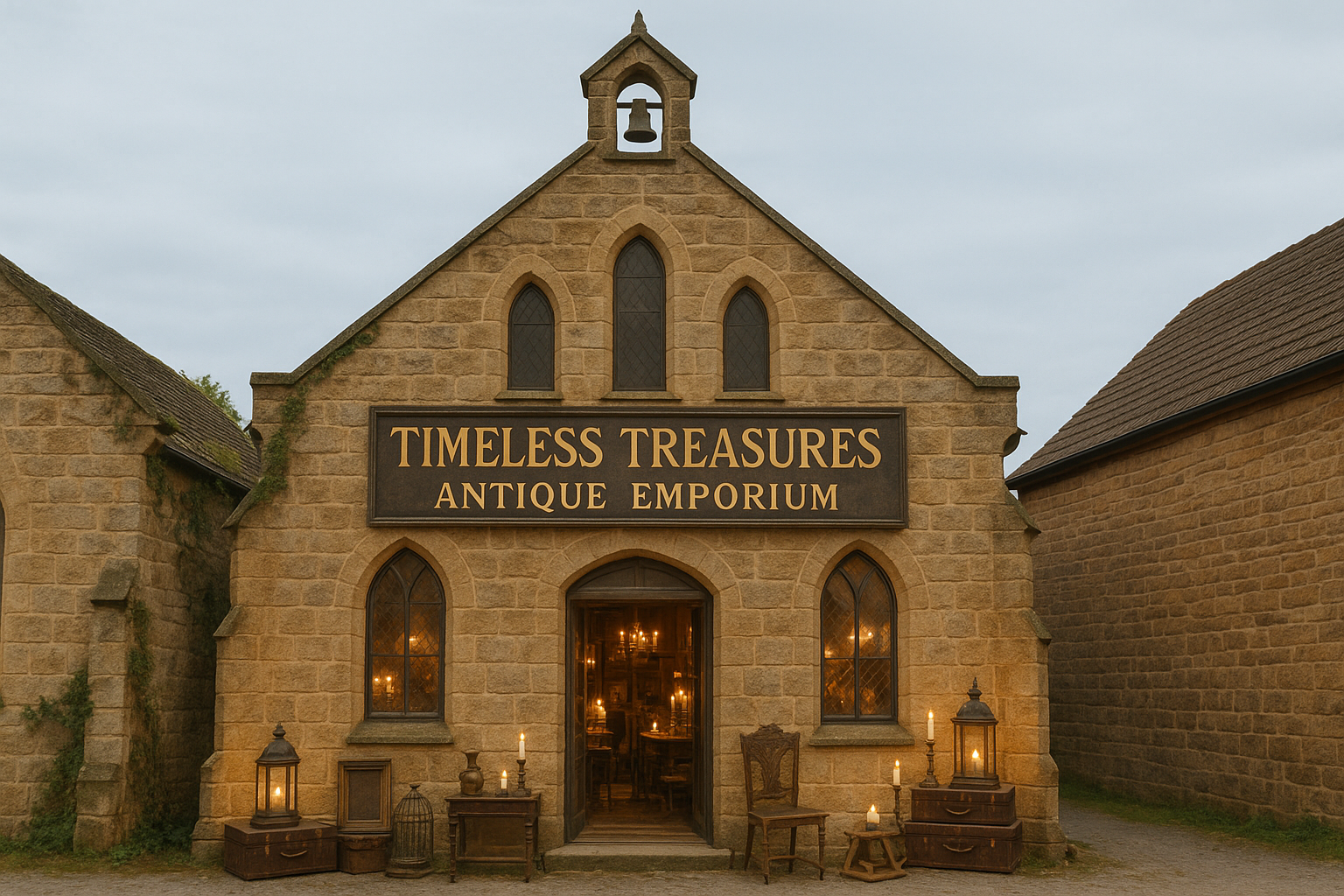
Timeless Treasures Antique Emporium, Tasmania
Timeless Treasures Antique Emporium was an eccentric antique shop housed in a converted 19th-century sandstone church at 42 Pioneer Lane, New Norfolk, Tasmania, operating from 2006 to 2015. Co-founded by Beatrix Cramer and Brody Taylor, the shop became renowned for its theatrical displays, rare Tasmanian artefacts, and whispered lore. Following Brody's murder in 2014 and subsequent legal disputes, the Emporium closed in October 2015, leaving behind a legacy of mystery and unaccounted-for treasures.

The Building and Its Bones
The structure that housed Timeless Treasures Antique Emporium possessed a history that long preceded its commercial incarnation. Built in the 1860s as a modest Anglican chapel during New Norfolk's post-convict settlement expansion, the sandstone building originally served a small congregation drawn from the town's growing agricultural and hop-farming community. The church, never grand by ecclesiastical standards, featured typical mid-Victorian colonial characteristics: lancet windows with simple timber frames, bluestone thresholds worn smooth by decades of Sunday traffic, hardwood flooring milled from Tasmanian oak, and a modest iron bell tower that had summoned the faithful for nearly a century before falling silent.
By the early 20th century, declining attendance and the construction of larger churches elsewhere in New Norfolk rendered the building redundant. It changed hands multiple times over subsequent decades, serving variously as a community hall, a storage facility for agricultural equipment, and briefly—during the 1970s—as a pottery workshop. Each incarnation left subtle traces: layers of paint on the original timber beams, mounting brackets in the walls, scuff marks on the stone floor. By the time Beatrix Cramer first laid eyes on it in early 2006, the building stood empty, slightly shabby, wedged between a florist and a funeral director at 15 Stephen Street, awaiting someone who could see past its worn exterior to the theatrical potential within.
The location itself carried symbolic weight that Beatrix intuited immediately. A former house of worship transformed into a repository of secular relics. A stone sanctuary converted into a marketplace of memory. The building's ecclesiastical bones—its arched doorway, its sense of vertical space, its quality of light filtering through old glass—lent the eventual shop an atmosphere that transcended ordinary retail. Customers often remarked upon entering that the space felt less like a shop and more like a shrine to forgotten things, a secular chapel where objects rather than prayers received reverence.
The conversion work undertaken by Beatrix and Brody in mid-2006 respected the building's architectural character whilst adapting it for commercial use. The interior walls, originally plastered, were stripped back to expose the sandstone, revealing the hand-worked surfaces beneath decades of paint. The hardwood floor, damaged in places by machinery from previous tenancies, was painstakingly restored by Beatrix's father, Brett Cramer, whose carpentry expertise proved invaluable. New shelving units, custom-built from salvaged timber, were installed along the walls and arranged in configurations that maximised display space whilst maintaining the building's sense of height and light.
The bell tower, though structurally sound, had lost its original bell to thieves sometime in the 1980s. Beatrix commissioned a replacement—not an exact replica but a lighter brass bell with a clearer, more delicate tone—and had it installed by a local metalworker with ecclesiastical restoration experience. She rang the bell personally to mark the start of seasonal sales, a gesture that some found charming and others slightly unnerving, particularly given the shop's proximity to the funeral director next door.
Outside, the building retained its modest Gothic Revival facade: dressed sandstone blocks, arched windows, and the original iron signage mounts, which Brody repurposed to support the new shop sign. That sign—hand-painted by Brody himself in curling serif script—became one of the Emporium's most recognisable features. The words "Timeless Treasures" appeared in faded gold leaf against a dark green background, with "Antique Emporium" rendered in smaller type beneath. The aesthetic effect was deliberately vintage, suggesting the shop had been there far longer than it actually had, as though it had always occupied that place on Stephen Street, waiting for the right eyes to find it.
The Partnership That Built a World
The true foundation of Timeless Treasures Antique Emporium was not architectural but relational—built upon the complex partnership between Beatrix Evelyn Cramer and Brody Alastair Taylor, whose complementary skills and contrasting temperaments created something neither could have achieved alone.
Beatrix, twenty years old when the shop opened in 2006, brought entrepreneurial boldness, aesthetic intuition, and a talent for theatrical presentation that transformed the act of browsing antiques into an immersive experience. Her eye for composition was remarkable—she could arrange disparate objects into groupings that suggested hidden narratives, emotional resonances, or visual poetry. A French perfume bottle positioned beside a rusted prosthetic leg. A taxidermied kestrel perched above a box of convict tokens. A butter churn paired with a 1930s Morse code transmitter. These arrangements defied commercial logic but hinted at stories that customers found themselves constructing, filling in blanks with their own imaginations.
Brody, twenty-eight when the partnership began, provided the scholarly backbone. His background in archival science and material history meant that every item in the shop—no matter how humble—received proper authentication, documentation, and contextualisation. He maintained hand-bound ledgers in which he recorded detailed provenance notes, cross-referenced attributions, and sketched structural details of particularly interesting pieces. His handwriting, precise and elegant, filled page after page with the kind of forensic attention that most dealers reserved for high-value items. To Brody, a chipped teacup with provenance mattered as much as a Victorian mourning brooch; both were repositories of human experience deserving respect and careful preservation.
Their working relationship operated according to an unspoken division of labour that evolved organically over the shop's early months. Beatrix managed front-of-house operations: greeting customers, staging displays, negotiating sales, and cultivating the theatrical atmosphere that made the shop memorable. She excelled at reading people, intuiting what they wanted before they articulated it, and crafting interactions that felt personal rather than transactional. Her charm was genuine but calculated, deployed with precision to create connection without overfamiliarity.
Brody worked primarily in the rear of the shop and in the locked back room that served as their workshop and research alcove. He catalogued new acquisitions, conducted authenticity assessments, performed minor restorations, and managed the shop's increasingly complex inventory system. Customers who lingered long enough might be invited to hear Brody's impromptu lectures on specific items—disquisitions on the social history of mourning jewellery, explanations of how to identify genuine convict-manufactured nails, or stories about the families whose names appeared in faded ink on the flyleaves of old prayer books.
Where they overlapped was in acquisition. Both travelled regularly across Tasmania, attending estate sales, rural auctions, and private clearances. Beatrix had a talent for identifying undervalued items and negotiating favourable terms, occasionally employing methods that didn't bear close scrutiny. Brody brought scholarly credibility and an ability to authenticate items on-site, preventing costly mistakes. Together, they built a reputation among collectors and dealers as knowledgeable, reliable, and occasionally willing to undertake acquisitions that more conventional dealers avoided—objects with murky provenance, items recovered from questionable contexts, or pieces that required significant restoration before they could be properly assessed.
The personal dimension of their relationship remained deliberately ambiguous to outsiders. They maintained separate residences—Beatrix in a small rental flat above a pharmacy in central New Norfolk, Brody in a rented cottage on the town's outskirts—but shared keys. They argued about pricing and attribution but moved through the shop's crowded aisles with unconscious choreography. Friends described them as "completing each other's sentences whilst disagreeing about every word." The relationship was never quite conventionally domestic, never fully resolved, existing in liminal space between business partnership and romantic entanglement, sustained by shared passion for material history and mutual recognition of complementary capabilities.
The Interior World: Atmosphere and Inventory
To enter Timeless Treasures was to step into a space that resisted easy categorisation. The shop was neither museum nor marketplace but something in between—a curated chaos where commercial transaction coexisted with aesthetic meditation and historical contemplation.
The interior was deliberately overcrowded, density being part of the experience. Tall cabinets lined the walls, their shelves arranged with items that seemed to defy both chronology and logic. A shelf might contain pressed tin ceiling roses, colonial-era apothecary bottles, vintage lockboxes, and mourning lockets, their grouping governed not by type or period but by some intuitive principle of visual harmony or thematic resonance that Beatrix alone fully understood. Narrow aisles wove between freestanding display units—mismatched pieces themselves, some antique shop fittings, others domestic furniture repurposed for commercial display.
The lighting was warm but uneven, achieved through a combination of original windows, carefully positioned lamps, and deliberate shadow. Beatrix understood that certain items revealed themselves better in partial darkness, that the play of light and shadow could transform ordinary objects into something mysterious or beautiful. The effect was theatrical without being artificial, creating pockets of discovery throughout the space.
The inventory itself reflected both scholarly specialisation and eclectic acquisition. Core categories included:
Tasmanian Colonial Material: Domestic implements, settler tools, agricultural equipment, and household objects dating from the 1820s through the early 20th century. This included butter churns, cast iron cookware, hand-forged hinges and latches, and the kind of utilitarian items that larger museums often overlooked. Brody's expertise in authentication meant that the shop's colonial holdings were among the most reliably attributed in Tasmania.
Mourning and Memorial Objects: A particularly notable collection of 19th-century mourning jewellery, memorial cards, hair work, and funeral ephemera. Beatrix found these items both aesthetically compelling and emotionally resonant, often arranging them in displays that honoured their original commemorative function. The collection included jet brooches, memorial rings containing plaited hair, photographic memorial cards, and elaborate Victorian mourning stationery.
Ephemera and Paper Goods: Handwritten diaries, field notebooks, correspondence, pressed flowers, annotated maps, and the kind of fragile paper materials that require careful handling. Brody maintained these items in archival-quality storage but displayed selected pieces in glass-fronted cases. The shop became known among collectors of Tasmanian manuscript material as a reliable source for unusual acquisitions.
Curiosities and Oddities: Taxidermied animals (primarily local birds and small mammals), medical instruments, optical devices, scientific apparatus, and objects whose function or origin remained ambiguous. This category reflected Beatrix's taste for the unusual and her belief that mystery itself had commercial and aesthetic value. A glass case near the front counter contained items that customers were invited to identify—unusual implements whose purpose had been lost, prompting speculation and storytelling.
Furniture and Architectural Elements: Whilst the shop's limited space prevented large furniture holdings, they maintained a rotating selection of smaller pieces—occasional tables, display cabinets, decorative mirrors—and architectural salvage including door hardware, stained glass panels, ceiling roses, and carved wooden details recovered from demolished buildings.
The back room, accessible only to Beatrix and Brody, contained additional inventory awaiting cataloguing, items undergoing restoration, and what Brody referred to as "the study collection"—objects acquired primarily for research rather than resale. This space also housed Brody's legendary ledgers, hand-bound volumes in which he documented the shop's complete holdings with cross-referenced notes and provenance sketches.
Persistent rumours suggested the existence of a "red ledger"—a separate record of discrete transactions, items sold off the official register, often for cash, to collectors who preferred privacy. Whether this ledger existed, what it contained, and where it might be located after Brody's death remained matters of speculation.
Community and Clientele
During its operational years, Timeless Treasures Antique Emporium cultivated a diverse clientele that extended well beyond typical antique shop patrons. The shop became a gathering point for several overlapping communities:
Heritage Tourists: Visitors drawn to New Norfolk by the town's colonial architecture and historical significance often discovered the shop through word-of-mouth or heritage trail recommendations. These customers appreciated the shop's authentic Tasmanian focus and Brody's ability to contextualise objects within broader historical narratives.
Local Collectors: A core group of regular customers, primarily based in southern Tasmania, who visited monthly or quarterly specifically to see new acquisitions. These collectors ranged from serious antiquarians with scholarly credentials to hobbyists with focused interests—mourning jewellery, colonial glass, Tasmanian pottery, or specific categories of domestic implements.
Interior Designers and Decorators: Hobart-based design professionals who valued the shop's unusual inventory as source material for residential and commercial projects. Beatrix cultivated these relationships carefully, understanding that designers provided steady business and often commissioned specific acquisitions.
The Object Historians: A informal network of amateur researchers, genealogists, and material culture enthusiasts who sought items with traceable Tasmanian origins. These customers valued provenance above aesthetics, often purchasing quite ordinary objects because of documented connections to specific families, locations, or historical events.
Beyond retail transactions, the shop served social and educational functions. Beatrix occasionally hosted evening events—candlelit storytelling nights where she shared the histories of specific items, or "oddity appraisal evenings" where customers brought mysterious objects for identification. These events blurred boundaries between commerce and community gathering, creating experiences that extended beyond conventional retail.
The shop also attracted a steady stream of browsers who might spend hours without purchasing anything—students researching local history, artists seeking inspiration, elderly residents who remembered items from their childhoods. Beatrix permitted this browsing freely, understanding that the shop's value extended beyond immediate commercial return.
The Golden Years and Growing Shadows
Between 2008 and 2012, Timeless Treasures Antique Emporium achieved a modest but sustainable commercial success that allowed both Beatrix and Brody to sustain themselves financially whilst pursuing work they found meaningful. The shop's profile was boosted significantly by a feature on ABC Hobart's weekend program Weekend Collector in 2010, which introduced the Emporium to a broader audience and generated increased tourist traffic.
Regional heritage publications regularly mentioned the shop in articles about Tasmanian antiques and material culture. The Tasmanian Heritage Festival included Timeless Treasures on its official trail in 2009 and 2011. Academic researchers occasionally contacted Brody for consultations on colonial-era material culture, recognising his expertise even if he operated outside formal institutional structures.
Yet beneath this surface success, complications were developing. Financial pressures increased as rental costs rose and economic conditions following the 2008 financial crisis affected discretionary spending on antiques. The shop's inventory had grown to the point where cataloguing and storage became logistically challenging. Beatrix's acquisition methods, whilst effective, occasionally generated ethical complications or raised questions about provenance that Brody found increasingly difficult to navigate.
The partnership itself, whilst professionally productive, carried emotional strains that both participants managed through work rather than resolution. Their relationship existed in perpetual ambiguity—committed enough to sustain shared enterprise, distant enough to avoid the vulnerability of complete intimacy. For Brody, who had left his marriage to Lauren Keenan to pursue this partnership, the unresolved nature of his connection with Beatrix represented both freedom and frustration.
By 2013, the shop had begun to feel less like a growing enterprise and more like a holding pattern. Beatrix, restless by temperament, started taking on side projects—occasional consultations for other dealers, private acquisitions for wealthy collectors, ventures that operated in grey areas between legitimate business and questionable opportunism. Brody, increasingly absorbed in his cataloguing work, withdrew further into the back room, spending long hours with his ledgers and restoration projects.
The comfortable synthesis that had characterised their early partnership was fraying, though neither fully acknowledged the deterioration until external catastrophe rendered such acknowledgement moot.
Catastrophe and Collapse
On 14 August 2014, Brody Alastair Taylor was found dead in a private storage unit in Moonah, Tasmania. The official ruling cited accidental death with contributing cardiac complications, but the circumstances—discovered by Beatrix's sister Gladys, investigated inadequately, and sealed quickly with bureaucratic efficiency—suggested violence deliberately obscured. Whether through institutional negligence or deliberate suppression, Brody's death was processed and closed without proper investigation, leaving those who knew him with unresolved grief and unanswered questions.
For Beatrix, the loss was catastrophic on multiple levels simultaneously. The personal devastation was obvious—Brody had been her partner, collaborator, and the person who understood most completely the peculiar logic by which she moved through the world. His absence left a void that no subsequent relationship would fill. But the professional and financial consequences proved equally destructive.
Brody's death triggered immediate complications regarding inventory ownership. His estranged family, with whom he had maintained minimal contact for years, contested Beatrix's claims to the shop's holdings. Legal disputes emerged over which items Brody had personally owned versus which belonged to the business entity. The shop's informal record-keeping—deliberately loose to accommodate grey-market transactions—now became a liability. Without clear documentation, Beatrix found herself unable to prove ownership of significant portions of the inventory.
Financial pressures that Brody had quietly managed through careful budgeting and strategic sales suddenly became overwhelming. The shop's business model had always operated on thin margins, sustained by Brody's ability to source items cheaply and Beatrix's talent for generating sales through theatrical presentation. Without Brody's cataloguing expertise and authentication capabilities, acquiring new inventory became risky. Without his steady presence managing back-end operations, the shop's operations deteriorated.
Beatrix attempted to continue operating through 2015, maintaining routines that no longer served any purpose beyond postponing collapse. She opened the shop according to the old schedule, arranged displays with diminishing care, served customers whose sympathetic glances felt like violations of privacy. The space that had once felt alive with possibility now felt like a mausoleum—every object a reminder of loss, every familiar corner haunted by Brody's absence.
By late 2015, the bank had initiated foreclosure proceedings. Mounting debts, unpaid rent, and legal costs from the dispute with Brody's family had created an untenable situation. On 15 October 2015, exactly nine years after the shop's opening, the New Norfolk police presided over the formal seizure of the premises.
Officer Karl Jenkins, whose relationship with Beatrix spanned years and involved numerous small favours and overlooked infractions, presided over the closure with visible discomfort. As the locks were changed and the premises secured, Jenkins discreetly palmed the spare back-door key and passed it to Beatrix—a gesture of compassion that violated protocol but acknowledged the inadequacy of official mechanisms for addressing genuine grief.
Beatrix staged a brief protest sit-in, supported by her parents Brett and Wendy Cramer, but the foreclosure proceeded regardless. The shop's contents—thousands of items representing nearly a decade of careful acquisition—entered legal limbo. Some pieces were eventually sold at auction to satisfy creditors. Others disappeared into private collections or storage facilities. Many of the shop's most unique items, including Brody's famous ledgers, were never accounted for in subsequent inventories.
The Shuttered Years and the Return
Between October 2015 and July 2018, the former Timeless Treasures Antique Emporium stood empty and secured. The building reverted to its landlord, who made several attempts to secure new tenants but found few takers for the oddly configured space with its ecclesiastical echoes and reputation for sad endings. The shop remained boarded, its windows dark, its interior gradually accumulating dust whilst New Norfolk moved on around it.
For Beatrix, those years represented a difficult navigation between grief, legal complications, and the necessity of survival. She moved through various short-term employments, none lasting more than a few months, her restless temperament and unresolved trauma making stable work difficult. She maintained minimal contact with the building itself, occasionally standing on the footpath outside but unable to cross the threshold into what remained.
On 26 July 2018, in the grey hours before dawn, Beatrix returned to the shuttered shop in circumstances that would prove transformative. Still wearing the black dress from Joel Gorsemann's memorial service the previous night, barefoot and wrapped in grief and determination, she made her way down the familiar alley to the back door.
The spare key that Karl Jenkins had provided years earlier remained in her possession—a small piece of metal that had assumed symbolic weight far beyond its practical function. But when Beatrix reached the door, she discovered that the building's new owners had installed additional security: a heavy padlock and chain that rendered her key useless.
The scene that followed—Beatrix yanking futilely at the padlock, pressing her forehead against the old timber door, confronting the physical manifestation of irretrievable loss—represented a culmination of years of unprocessed grief. The shop had become more than a failed business or abandoned building. It stood as monument to everything she had lost: Brody, their shared vision, the period of her life when she had built something meaningful.
What happened next involved the appearance of Leigh Trogaris, a stranger who would prove to be something more complex than coincidence. His intervention—providing warmth, producing bolt cutters through inexplicable means, cutting through the chains that secured the door—allowed Beatrix entry into the space she had been locked out of for nearly three years.
Inside, the shop revealed itself transformed by abandonment. Dust covered every surface. The theatrical arrangements Beatrix had once curated with such care had collapsed into disorder. Broken porcelain dolls scattered across the floor. Familiar furniture stood shrouded in grey light. The space felt simultaneously familiar and alien—recognisable in its bones but fundamentally altered by time and absence.
In that dust-laden silence, Beatrix confronted not just the physical remnants of the shop but the buried truths about casino debts, blackmail schemes, and the miscalculations that had cost Brody his life. The shop became a confessional, its objects bearing witness as she unravelled secrets to Leigh's gentle questioning.
The visit concluded with Leigh's offer of a Portal Key—a literal and metaphorical escape route to Clivilius, to dimensional flight, to a new world beyond Earth's constraints. Beatrix's refusal of that initial offer, her choice to remain and pursue earthbound healing rather than interdimensional escape, represented a significant choice about confronting rather than fleeing from consequences.
Though she would eventually accept a Portal Key and transition to Clivilius under different circumstances weeks later, that July morning in the shuttered Emporium marked a crucial threshold: the moment when the past finally released its grip enough to permit a different future.







