4344.40 · February 9, 2024 AD
Three Shekels of Silver
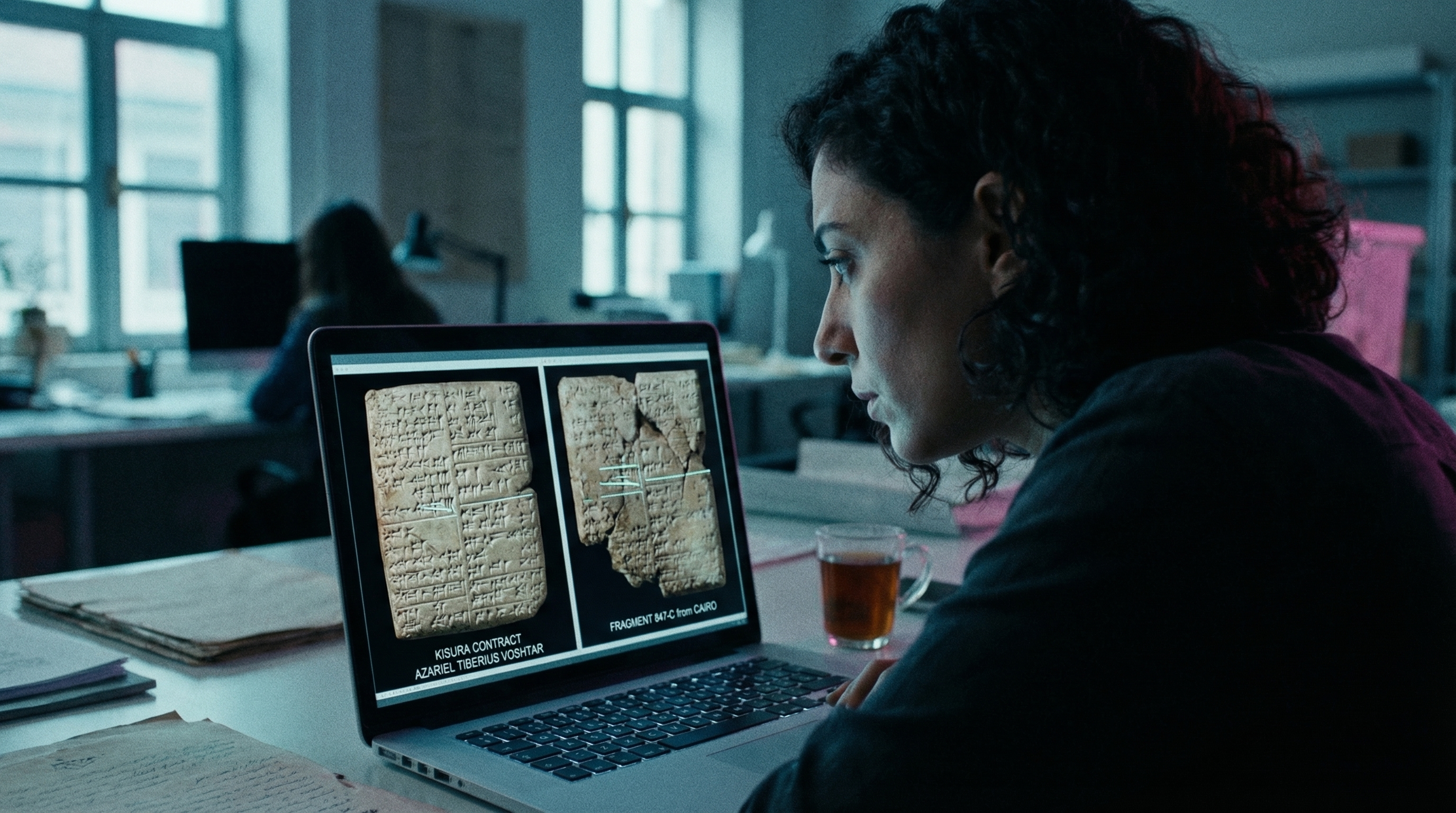
Photographs from the Cairo facility confirm what the sparse catalogue entry could not: Fragment 847-C bears the same scribal hand as the Kisura contract. Four cuneiform signs in the footer section identify Azariel Tiberius Voshtar as the scribe who documented a slave transaction in Larsa. Two documents, two cities, two continents of independent preservation. The man who built a city without slaves once held the reed that recorded their sale.
Deniz Kaya had been watching Mira Osman not-work for six days. The conservator's diagnostic instincts — honed across twenty-two years of assessing deterioration in materials that could not speak for themselves — had registered the symptoms with professional precision: Ottoman letters positioned under camera lights and left unphotographed, condition reports started and abandoned mid-sentence, a laptop opened and closed four times in ten minutes with no image captured between cycles. Deniz did not ask what Mira was waiting for. She noted the holding pattern, offered the Shelf 14 condition reports as an alternative that would occupy hands and eyes simultaneously, and returned to the Arabic astronomical treatise whose water damage she had been patiently reversing all week — her brush moving against the fourteenth-century parchment with the steady rhythm that the conservation lab demanded and that the younger woman at the adjacent bench could not currently sustain.
The Karaköy facility's second-floor lab held its usual Friday morning atmosphere. The environmental control system maintained its hum. Karaköy's waterfront traffic — horns, ferry blasts, the particular diesel-and-salt ambience of a port district that had served commerce since the Genoese colony — filtered through walls thick enough to reduce it to background haze. The light through the north-facing windows fell steady and cool across the two workbenches, illuminating the Arabic treatise at one and the untouched Ottoman correspondence at the other with the same impartial clarity that Mehmet Bey had designed these proportions to provide two centuries earlier.
Tariq al-Rashid's email arrived mid-morning. Six attachments. High-resolution photographs taken with raking light in a Cairo storeroom where Fragment 847-C had been waiting in a subsection that had needed reorganisation for years. The tablet appeared on the screen in the conservation lab: twelve centimetres by nine, broken at the upper left, its surface carrying the characteristic pitting of fire exposure — a conflagration that had destroyed whatever archive originally housed it and had, in destroying, baked the clay to a permanence that the parchment surrounding it had not survived. Mahmoud Farid, who had catalogued the fragment decades earlier, had assessed its contents with the efficiency of a man processing thousands of similar items: no historical significance. He had been working without the single piece of information that would have made the assessment wrong.
The bill of sale's surviving text recorded what Mesopotamian administrative routine required of such transactions. A formulaic opening. A gap where the buyer's name had been lost to damage. Fragments indicating the sale of multiple human beings — the cuneiform signs for slave and purchased unmistakable even in the degraded text. Partial physical descriptions, rendered in the clinical inventory language that Bronze Age commerce applied to people with the same procedural thoroughness it applied to grain. A price: three shekels of silver per head. A quantity obscured by a gouge in the clay — four people or seven, the numeral ambiguous, the difference between the two figures a matter of three human lives that the damage had made permanently unresolvable.
Three shekels of silver. The cost of a person in a Larsa marketplace, documented with the flat precision of a civilisation that had normalised the commerce of human flesh so completely that the transaction required nothing more than the standard bureaucratic apparatus — a buyer, a seller, witnesses, and a scribe to press the terms into wet clay.
The footer section had survived in better condition than anything above it. Shielded by its position at the tablet's base, it had escaped the worst of the fire damage that had consumed the upper text block. Tariq's raking light threw every surviving cuneiform sign into sharp relief. The standard closing formula was legible — transaction witnessed and recorded by the hand of — and then four signs. The first clear. The second slightly worn. The third and fourth unmistakable to anyone who had spent three weeks in a Karaköy conservation lab memorising the scribal characteristics of the hand on the Kisura contract.
Azariel. The personal name only, without the full formal identification. A working signature — the mark of a scribe performing a hired function, not entering into an agreement. The same leftward drift on horizontal strokes that appeared on the Kisura contract. The same consistent depth of impression. The same marginally wider spacing between signs, each symbol given room as though the scribe who formed them believed that even the components of administrative routine deserved space to exist independently. Two tablets, inscribed in two different cities, preserved through two chains of transmission that had carried one to a basement beneath a map shop in Istanbul and the other to a storeroom in Cairo — and the hand that had formed the cuneiform on both surfaces pressed reed into clay with identical characteristics.
The convergence was what The Preservation's four-thousand-year methodology was designed to produce: fragments that individually signified nothing, that in combination revealed what no single document could. Mahmoud Farid's assessment had been correct by every standard available to him. The significance was not in the fragment. It was in the relationship between this fragment and another that had not yet been found, in a facility Farid had no reason to consult, bearing a name no one had yet identified as worth searching for. The Kisura contract had changed the standards. The name existed now. The hand was known. And what that hand had recorded in Larsa was not grain storage but the sale of human beings — people priced at three shekels of silver, their descriptions catalogued like livestock, the transaction given the permanence of fired clay by a scribe whose distinctive leftward drift would have been invisible to anyone who had not first studied his work in a forgotten town called Kisura.
The man who held that reed in Larsa would eventually build Fordingrad. A city whose founding architecture made slavery not merely illegal but structurally impossible — the prohibition embedded in the civilisation's design rather than imposed upon it as a law that might be circumvented or repealed. Something during the wandering years had crystallised the conviction that produced that design. Something had shown Azariel Tiberius Voshtar that the clean cuneiform, the witnessed transactions, the three shekels of silver per head, represented not civilisation functioning as intended but civilisation failing at its most fundamental obligation. Fragment 847-C could not say whether this transaction was that something — could not reveal what the scribe had thought as he documented the sale of people whose names survived only as partial traces on fire-damaged clay. Administrative records did not confess. They recorded. But the record placed Azariel in the market, put the reed in his hand, and the city he later built stood in direct architectural opposition to everything the document he had made permanent represented.
Mira called Cairo from the conservation lab. Tariq al-Rashid answered with the unhurried voice of a man who had been expecting the call since he sent the photographs. The conversation lasted three minutes — long enough to confirm the identification, to establish that Fragment 847-C had been independently held in Cairo since at least the 1940s, and to arrange access to the facility's full Mesopotamian collection. Four thousand catalogued items. An unknown quantity of uncatalogued materials. If two documents had survived through independent chains of transmission, the archive that held the second might hold a third, a fourth, additional fragments of the wandering years that decades of cataloguing had dismissed under assessments that the Kisura discovery had rendered obsolete.
Deniz watched Mira reach for her coat without asking where she was going. The conservator offered the observation that the Shelf 14 reports could wait until Monday, and returned to the astronomical treatise whose fourteenth-century water damage would yield to patience and wheat starch paste in the way that the larger questions consuming her colleague would not. The investigation had outgrown the Karaköy facility. By the following morning Mira Osman would be in Cairo, standing in an archive she had never visited, beginning a search through a collection whose scale dwarfed the Istanbul holdings — the trail that had started in a mislabelled box in Sub-Level Three now extending across continents, following the hand of a man who had once recorded the price of human beings and had spent the rest of his life building a world in which that price could never be paid again.







