4338.10 · January 10, 2018 AD
Three on the Kitchen Table
Evening settles over Nathan Cowdrey's Hobart apartment and finds three Portal Keys arranged on the kitchen table like a problem that refuses to simplify. One has been bound by blood. One is in transit to Broken Hill. Three remain — each representing a decision not yet made, a person not yet chosen, a life not yet irreversibly altered. The city dims beyond the window. The keys do not glow, do not hum, do not offer guidance. They simply wait, as they have always waited, for someone to decide what happens next.
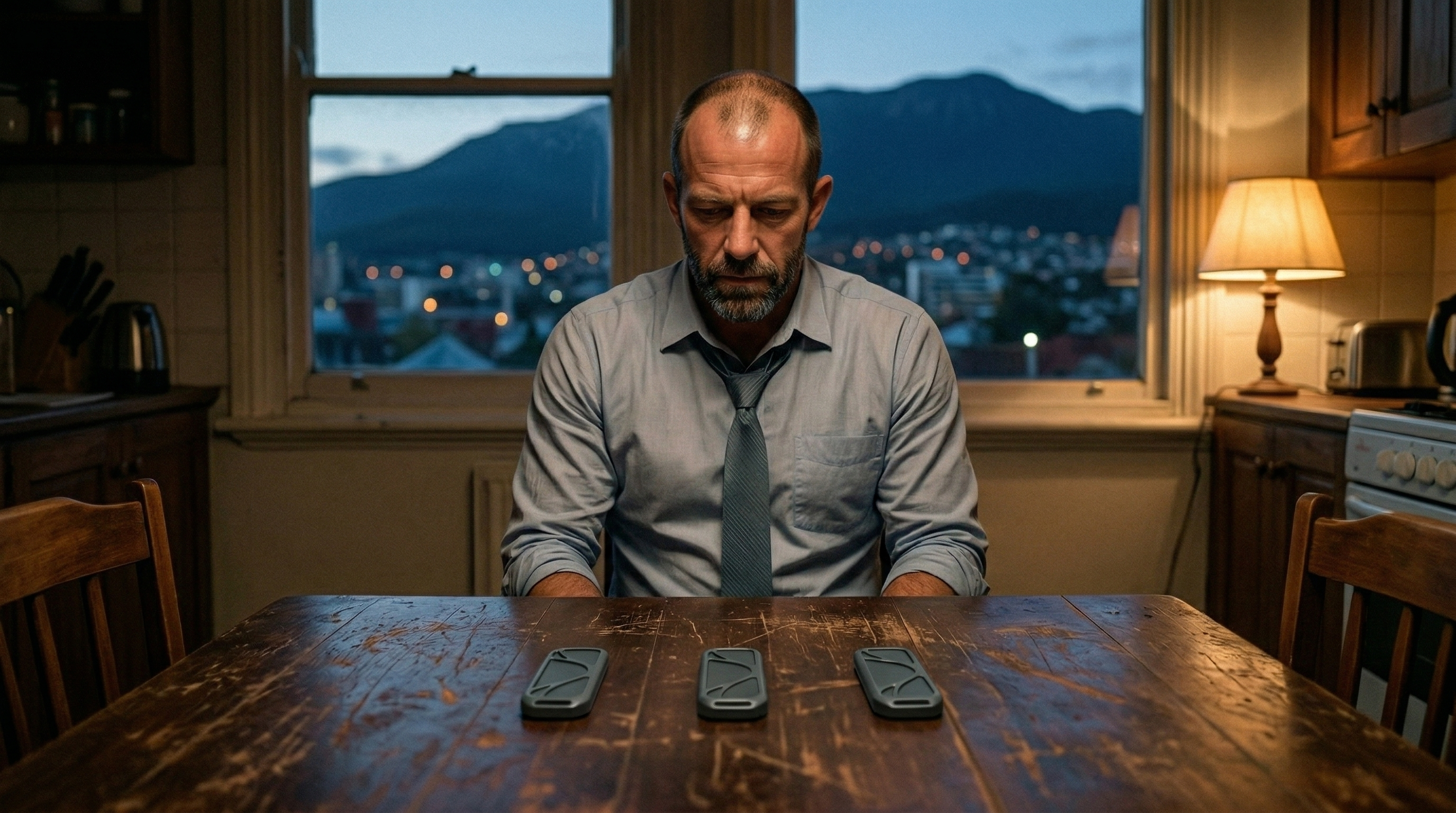
The apartment occupied the upper floor of a converted building in one of Hobart's inner suburbs, its rooms carrying the particular character of a space inhabited by a single person who had lived there long enough to stop noticing it. The kitchen table — pine, secondhand, scarred by years of use that predated Nathan Cowdrey's ownership — sat beneath a window that faced west toward kunanyi, and as the January sun descended behind the mountain's silhouette, the light that entered the room transitioned through a spectrum of diminishing warmth: amber to copper to the deep, bruised gold that preceded dusk.
Three Portal Keys lay on the table's surface in a loose arrangement that suggested they had been placed there individually rather than together — set down one at a time, each positioned with the careful deliberateness of someone handling objects whose properties remained only partially understood. They were identical in appearance: matte grey, thumb-sized, constructed from the unclassifiable material that absorbed light rather than reflecting it. In the failing afternoon glow they looked inert, unremarkable, the kind of objects that could sit on a kitchen table for years without attracting a visitor's attention.
They were not inert. One of their number had already demonstrated this in a government meeting room several hours earlier, drawing blood and opening a dimensional breach in a plasterboard wall. A second was currently somewhere within the Australian postal network, sealed in bubble wrap inside a padded envelope, travelling toward Broken Hill at whatever speed the express logistics chain could manage. These three remained — unbound, unassigned, their potential uncommitted to any particular future.
The apartment settled into its evening noises around them. Floorboards contracted as the day's heat withdrew from the building's timber frame, producing the small percussive reports that old structures offer as commentary on the passage of temperature. Pipes cooled and ticked. The refrigerator maintained its mechanical hum — that constant, low-frequency presence that occupants of small apartments learn to hear as silence rather than sound. Through the western window, the city was performing its nightly transition: porch lamps igniting along residential streets, the blue flicker of television screens appearing in lounge room windows, the headlights of evening commuters tracing their familiar routes home.
Nathan sat at the table with the stillness of someone who had exhausted movement. The day that was concluding had begun with a bus ride and a barista's smile and a bounce in his step that he could no longer locate in his body. Between that morning and this evening, he had discovered a handwritten summons from a friend who had subsequently disconnected his phone, lied to a colleague whose trust he valued, watched men in an unmarked van search a laneway café, received a padded envelope containing technology that predated recorded history, read a letter describing a parallel world administered by an artificial intelligence, activated one of the devices and crossed a dimensional threshold into a barren landscape of red dust and grey-green sea, telephoned his brother and described the impossible, and entrusted the Australian postal system with an object that could breach the boundary between dimensions.
The day did not deserve to be called a Wednesday. It had exceeded the category.
The three keys on the table represented the portion of the problem that remained unsolved. Five keys constituted a Guardian Clan, according to Seth's letter. Nathan had claimed one. Josh would receive another. Three seats at a table that Nathan had not built and did not fully understand remained empty, each one requiring a name, a face, a person whose life would be irrevocably rerouted by the decision to include them.
The room darkened around the table as the sun completed its descent behind kunanyi. The mountain's silhouette held its position against the sky — solid, geological, operating on timescales that rendered human decisions temporarily irrelevant. The keys did not respond to the changing light. They did not glow or pulse or emit the subtle vibrations that Nathan half-expected from objects that had already demonstrated capabilities beyond any technology he recognised. They sat on the pine surface with the patient indifference of things that had been waiting for a very long time and could wait considerably longer.







