4338.208 · July 27, 2018 AD
Three Hundred Metres of Green
Karen rejoins Chris beyond the riverbank to find he has acquired a shovel from an unlikely source and discovered something growing near the settlement's improvised latrine that no one planted deliberately. Together they use the last of their coriander seeds across a three-hundred-metre transect, every one of which germinates on contact. The soil beneath Bixbus is not an anomaly. It is a system, and it responds to everything.
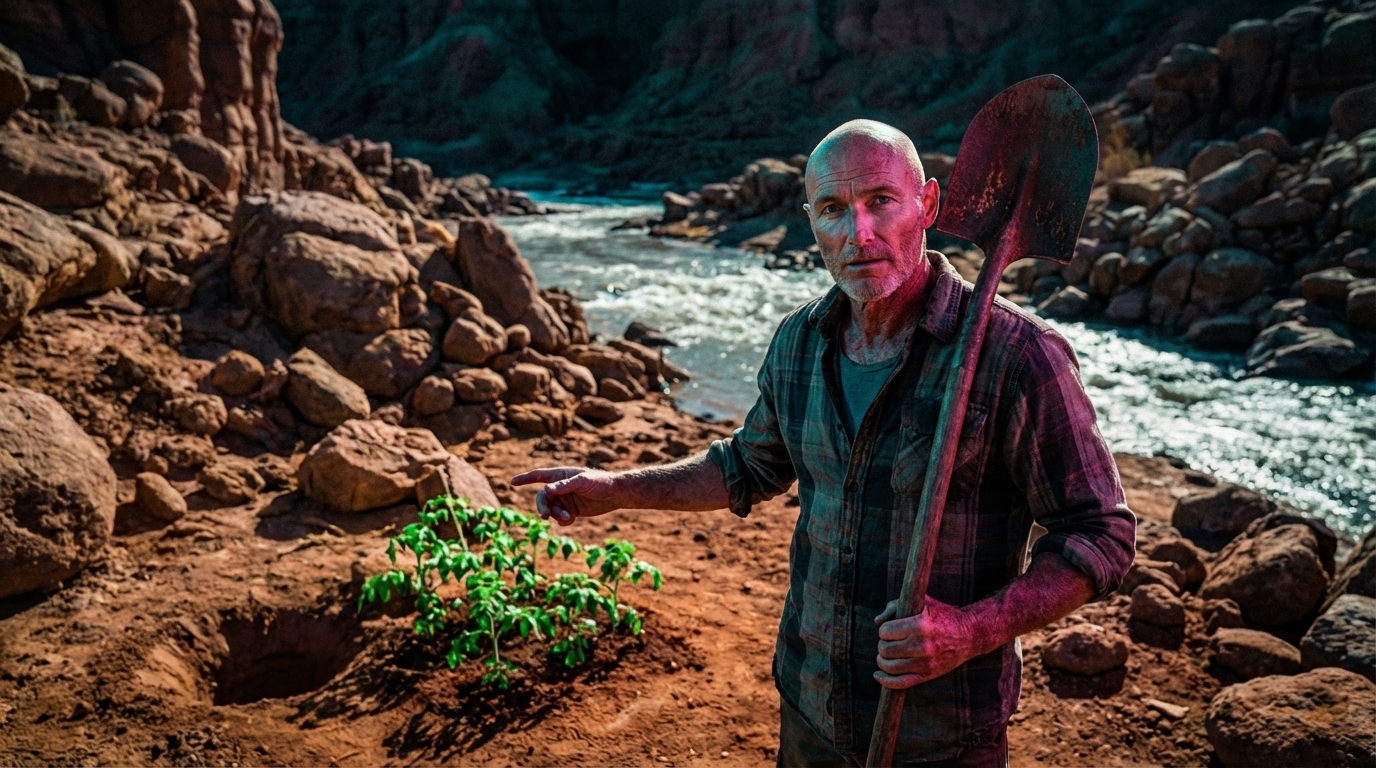
Chris Owen had ranged further from the river than Karen expected. She returned from the tent site to find his earlier position at the waterbank empty, the test holes he had dug standing open like unanswered questions in the exposed soil. A brief spiral of alarm resolved itself when she spotted him emerging from behind a rocky outcrop in the hillier terrain beyond the water, carrying a shovel that had not been in his possession when she left him.
The shovel's provenance was not glamorous. Chris had stumbled upon the settlement's improvised latrine, a site established by the earlier arrivals for the most fundamental of biological necessities. The tool had been left there, presumably by whoever had dug the original trench. But the shovel was not the significant discovery. Near the latrine, growing in soil that had received organic matter of an entirely unprocessed kind, Chris had found tomato seedlings. Not planted. Not tended. Volunteer growth, spontaneous and thriving, sprouted from seeds that had passed through human digestion and found their way into Clivilian earth through the most elemental of pathways.
The implications were not lost on either of them. Karen's initial reaction was visceral, the conservationist's instinct for ecological hygiene colliding with the scientist's recognition that the data did not care about propriety. These seedlings confirmed something the coriander experiments alone could not: the soil's generative capacity was not triggered solely by deliberate planting. It responded to any terrestrial organic material that breached the hard crust, regardless of how that material arrived. The earth beneath Bixbus did not distinguish between a seed pressed carefully into its surface by human fingers and one deposited through the crude mechanics of digestion. Both received the same extraordinary response. Growth, immediate and vigorous, in soil that should have sustained nothing.
Chris, characteristically, was already thinking past the discomfort to the practical significance. The tomato plants were robust, their deep green leaves vivid against the surrounding dust, their stems upright with the confidence of vegetation that had found conditions not merely adequate but ideal. If the soil could produce this from incidental waste, its potential for deliberate cultivation was greater than anything their coriander experiments had suggested.
They moved on from the latrine site and began what would become their most systematic investigation of the afternoon. Working together along the riverbank and then inland toward the camp, they planted their remaining coriander seeds at intervals across a transect of approximately three hundred metres. Chris broke through the hard crust with the newly acquired shovel, a significant improvement over the tent peg that had left his palms blistered and raw. Karen placed each seed into the exposed soil with the methodical precision of a researcher who understood that even in the absence of proper equipment, consistency of method was the foundation of reliable observation.
Every seed germinated. Approximately thirty plantings across three hundred metres of terrain, each one producing the same instantaneous response they had witnessed throughout the day. Shell cracked, root descended, stem rose, leaves unfurled. The repetition across such distance eliminated any remaining possibility that the phenomenon was localised. The living soil beneath the Clivilian crust was not a pocket or a seam but something far more extensive, a substrate of unknown depth and composition that lay dormant beneath the dust across what appeared to be the entire area surrounding the Bixbus settlement.
The last seed went into the ground with a quiet finality that Karen marked aloud. Their supply was exhausted. What had begun as a forgotten pocket of herbs intended for a friend's windowsill in Hobart had become the dataset for the first agricultural survey conducted in Clivilius, and the bag was empty. Chris had not realised how many they had used until Karen told him. The number and the distance surprised him. They had been so absorbed in the rhythm of the work, the cycle of dig and plant and watch, that the scale of their investigation had outpaced their awareness of it.
The trail of seedlings they left behind them marked the path of their afternoon like a line drawn in green ink across a page of red dust. Thirty small plants, fragile and vivid, each one a data point and a declaration. The soil of Bixbus was alive. It was responsive. It was widespread. And it was waiting for more than coriander.
Karen would need to ask Luke for a broader range of seeds when he next appeared. Legumes, root vegetables, grains, anything that could test the soil's range and begin to answer the question of whether this dimension could sustain not just growth but agriculture. Chris, walking beside her back toward the camp with the shovel resting across his shoulder, observed that they were going to be fine. Karen wanted to believe him. The evidence was encouraging. But the entomologist in her, the woman who had spent her career studying the delicate arithmetic of ecosystems, understood that extraordinary generosity in nature was never free. The soil gave without apparent limit. The question she could not yet answer was what it would eventually ask in return.







