4308.263 · September 19, 1988 AD
Thread and Dust
In the Dallow Residence on Chloride Street, Evelyn has been awake since before dawn, feeding fabric through her Singer in the half-dark whilst her daughters sleep. Violet stirs to the scent of eucalyptus and machine oil, her bedroom walls papered with maps and mysteries, her mind already roaming territories far beyond corrugated iron and red earth.
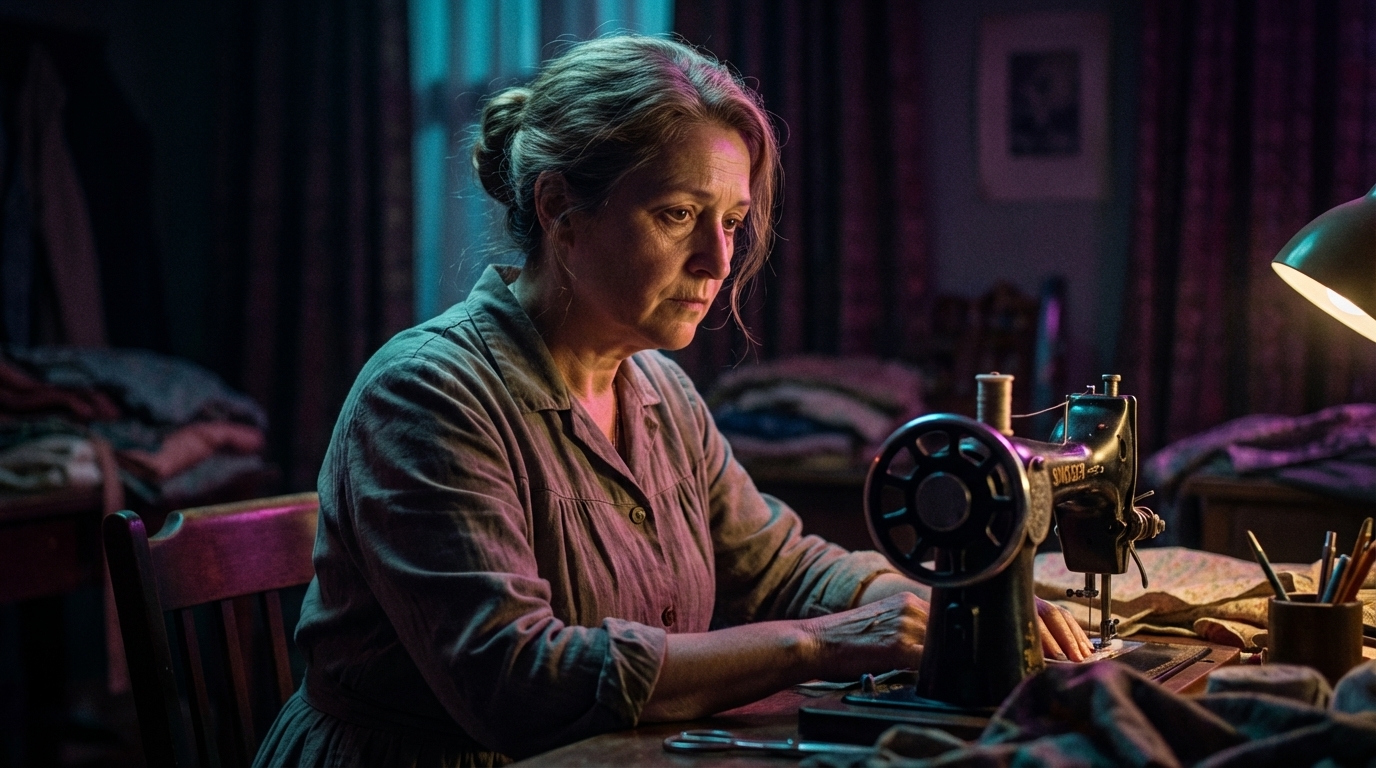
The Singer began its murmur in the dark.
Evelyn Dallow had been awake since half past four, drawn from shallow sleep by the particular restlessness that preceded a commission deadline. The sewing room — once intended as a second bedroom, claimed years ago by bolts of fabric and the rhythmic machinery of her livelihood — held the predawn stillness like a vessel holding water, and she moved through it with the certainty of a woman who could thread a needle without light. The machine she sat before had belonged to her mother, Mary Elizabeth Doyle, whose own nimble fingers had once fed cloth through its throat in the same town, in a house not so different from this one. The Singer carried that inheritance in its iron bones, and Evelyn honoured it by keeping the mechanism oiled, the bobbin wound, the tension calibrated with a precision that Mrs Helena Thornton would have approved of, even now, even twenty years after the apprenticeship on Argent Street had ended.
The garment taking shape beneath her hands was sky blue cotton with white piping and a delicate row of brass buttons — something new, something she wanted to give Violet for the Silverton trip that lay ahead. She had chosen the fabric carefully, knowing her eldest daughter's indifference to fuss and her instinct for comfort over decoration. The design was simple: clean lines, good construction, the kind of garment that would move with a body rather than against it. Every mother stitched love into cloth differently. Evelyn stitched it into the straightness of seams and the strength of hems, into buttonholes that would not fray and collars that sat exactly where they should.
The house held its breath around her. Down the hallway, in the bedroom whose door never quite closed properly, Violet slept in the particular abandon of the young — one arm flung above her head, sheets twisted into a nest, chestnut curls spread across the pillow in defiance of the brush that waited on the chest of drawers. In the smaller bedroom beyond, Jasmine slept with characteristic neatness, her covers pulled to her chin, her low ponytail undone for the night but still orderly in the way it fanned across the linen. Robert had left for the early shift at the mine before Evelyn woke, his departure marked only by the faint scent of dust and soap that lingered in the hallway and the hollow where his body had lain beside hers, already cooling.
The Dallow Residence absorbed these small hours with the patience of a structure that had stood for the better part of a century. Its weatherboard walls had sheltered miners' families through drought and dust storm, through the silver boom and the slow contractions that followed, through births and deaths and all the ordinary catastrophes that accumulated between. The corrugated iron roof ticked softly as the temperature shifted — the particular sound of metal expanding against timber, a language the house spoke every morning as the Outback surrendered the cold it had gathered overnight. Outside, the grapevine that shaded the front verandah hung motionless in the predawn stillness, its leaves dark against the lightening sky, and the first galahs had not yet begun their daily argument with the world.
Evelyn worked in the glow of a single lamp, its circle of warmth enclosing her like a cocoon. The rest of the sewing room existed in suggestion — the bolts of cloth leaning against the far wall, the patterns hanging from hooks like the shed skins of garments yet to be born, the pincushion bristling on the shelf beside a photograph of her parents on their wedding day. Thomas Edward Ashcroft and Mary Elizabeth Doyle, captured in silver halide, serious-faced and young, standing before St Matthew's Church in clothes Mary had made herself. Evelyn did not look at the photograph consciously. She did not need to. Its presence was as familiar as the machine beneath her hands, as the house around her, as the knowledge that she would lose her brother Andrew in 1972 and gain her first daughter in the same year, as though the universe demanded balance in its transactions of joy and grief.
She was thirty-eight years old. Her hair, once the same rich auburn that Violet's curls carried in certain lights, had begun its slow concession to grey — a strand here, a strand there, noticed in mirrors but not yet mourned. Her hands, which had spent twenty years feeding fabric through machinery, bore the particular calluses and muscle memory of her trade: fingertips sensitive enough to detect a single thread's deviation, palms strong enough to guide heavy wool through a reluctant feed. She wore her age the way the house wore its decades — with evidence of use and care in equal measure, the fine lines around her eyes mapping years of squinting at stitches and smiling at daughters.
The light changed gradually, the way it always did in the far west of New South Wales — not the sudden theatrical sunrise of coastal cities but a slow infiltration, pale gold creeping across corrugated iron and cracked earth and the eucalyptus trees that fringed the edge of town. The scent preceded the light, as it always did: eucalyptus, sharp and clean and almost medicinal, rising from dew-damp leaves and infiltrating the house through every gap in the weatherboard. It clung to everything in Broken Hill — the wooden fenceposts, the rusted tin sheds, the fabric of curtains and clothes and, Evelyn sometimes thought, the fabric of dreams themselves.
Somewhere beyond the walls, a mob of galahs found their voices, and the day cracked open like an egg.
In the bedroom at the end of the hall, Violet stirred.
The thin mattress creaked beneath her as she shifted, pulled toward consciousness by the scent of her mother's coffee — dark, rich, curling through the hallway like an emissary from the waking world. The window beside her bed stood slightly ajar, and the faded lace curtain lifted in a slow sway that cast moving shadows across the walls, leaf-patterns and light-patterns shifting like the pages of a story not yet committed to paper. For a moment she lay suspended between sleep and waking, her mind still tangled in the residue of dreams that clung like red dust to wet skin.
The room around her testified to who she was becoming. It was not a child's room, though childhood had not entirely released its claim — the hand-sewn quilt at the foot of the bed, stitched together by Evelyn from fabric scraps accumulated over years, belonged to a younger Violet, one who had not yet begun to plaster her walls with evidence of obsessions that ran deeper than decoration. The map of Australia, pinned to the western wall, bore the evidence of systematic dreaming: blue pins for places she had been, red for places she intended to reach, the paper soft and curled from years of handling. Yellowing news clippings hung at odd angles beside the mirror — a prospector vanished near Silverton in 1921, a council vote on heritage preservation, fragments of the unexplained that she collected the way other girls collected photographs of pop stars.
Her desk occupied the corner like a nest, its surface buried beneath torn exercise-book pages, battered library novels with cracked spines, and the particular disorder of a mind that consumed information faster than it could be filed. A dried wattle branch hung above the mirror, brittle and forgotten but not discarded — perhaps because discarding things required a decisiveness that conflicted with Violet's instinct to keep everything, to believe that even dead branches might yet prove useful. On the narrow shelves, her books stood in haphazard stacks: a dog-eared copy of Robyn Davidson's Tracks with a gum leaf pressed between its pages, volumes on geology and bush survival, out-of-print adventure novels whose margins bore her handwriting — questions, theories, sketches of footprints that belonged to no known animal.
She was sixteen years old, and the world owed her everything.
Her eyes opened — reluctant but immediately alert, pupils contracting against the eastern glow seeping between the curtain folds. There was a pause, the length of a held breath, before awareness settled into her limbs like water finding its level. She lay still, listening to the house: the tick of the hallway clock, the groan of plumbing pipes beneath the floorboards, and beneath it all, steady as a heartbeat, the distant murmur of her mother's Singer. That sound had accompanied every morning of Violet's life. She could no more imagine waking without it than she could imagine waking without air.
Her thoughts drifted, unhurried, into the wilderness beyond Broken Hill's edge — territory she knew not merely with her feet but with something deeper, something that felt almost ancestral. The Outback was not backdrop to her. It was participant, confessor, conspirator. Its breath stirred the branches of towering eucalyptus, whispering in languages older than English and older than fear. Gnarled gullies and dried riverbeds haunted the margins of her imagination, and she could remember — even as a small girl — pressing her palms to the hot cracked soil and marvelling at the way it stained her skin a ruddy orange. Others spoke of that country with caution or outright disdain. Violet thought of it with reverence, like one might think of a god: capricious, dangerous, and unknowably beautiful.
Down the hall, the Singer paused. Evelyn lifted the presser foot, trimmed a thread with the small silver scissors she kept on a ribbon around her neck, and held the garment up to the lamplight. The blue cotton caught the glow and held it. She turned the fabric, examining the seam she had just completed, running her thumbnail along the stitching to check for irregularities her eyes might miss. There were none. There never were, or rarely — and when there were, she unpicked and resewed without hesitation, because the difference between adequate and excellent lay not in grand gestures but in thousands of tiny decisions made correctly. Mrs Thornton had taught her that, and she had never forgotten.
From the hallway came the sound of a door opening, and then feet — bare, quick, light — crossing timber boards toward the kitchen. Jasmine. Always the first of the girls to rise after Evelyn, always moving with that quiet purpose that distinguished her from her sister's more theatrical relationship with mornings. Evelyn listened to her younger daughter's passage through the house and returned the fabric to the machine. There would be time to finish the garment later. The morning had shifted into its next phase, and the kitchen — with its scarred Formica table and temperamental Metters stove and the particular alchemy of pancake batter meeting hot butter — was calling.
She rose, pressing her palms briefly against the small of her back where the hours of sitting had gathered into a familiar ache, and followed the sound of her daughter toward the smell of coffee.
In her bedroom, Violet threw back the sheet with the sudden decisiveness that characterised everything she did. Her feet met the floorboards — cool timber, smooth in places, splintered in others — and she sat for a moment on the edge of the mattress, letting the morning settle into her bones. The squat clock on the bedside table, a relic from her father's youth with a yellowed face and worn hands, read just past six. Early enough to feel ahead of the day. Late enough that the house had already begun its waking rhythms without her.
She dressed quickly. Faded jeans bearing the accumulated history of climbs and crawls, the denim stiff where old mud had dried into memory. A loose pale blue shirt that had once been her father's, stolen permanently to her side of the laundry, smelling faintly of dust and sunlight. Boots — thick-soled, laced to the ankle, their leather moulded to the exact topography of her feet. She tugged the laces tight with quick fingers, glanced at the warped mirror on the chest of drawers, and gave her chestnut curls three perfunctory strokes with the brush before abandoning the effort. There were better campaigns to wage than the one against her hair.
The girl who looked back from the glass was not quite grown — caught in the particular hinterland between childhood and whatever came after, her face still soft with sleep but her eyes already sharp with the restlessness that defined her waking hours. She held her own gaze for a moment, as though checking that the person inside matched the person reflected, and then turned away.
The hallway stretched before her, narrow and dim, the old wall clock ticking its patient count of seconds. Photographs lined the walls in mismatched frames — the Dallow and Ashcroft families captured at various moments across the decades, their faces serious or laughing or merely enduring, depending on the occasion. Violet passed them without looking. She had memorised every face, every frame, every chip in the plaster that surrounded them. This house and its contents were mapped inside her as thoroughly as the Outback terrain she explored beyond its walls.
The smell of pancake batter reached her before the kitchen did, and beneath it, the dark gravity of coffee pulling her forward.







