Thomas William Kendrick
Thomas William Kendrick, born 3 April 1991 in Colchester, Clivilius, is a logistics coordinator whose life bridges the maritime traditions of his coastal hometown with the dynamic growth of Bixbus. Raised in a shipwright's household surrounded by salt air and timber, Tom brought his practical expertise inland as inter-settlement commerce expanded. His 2022 marriage to Earth-born Lisa Smith united two worlds, and together they are raising two children.
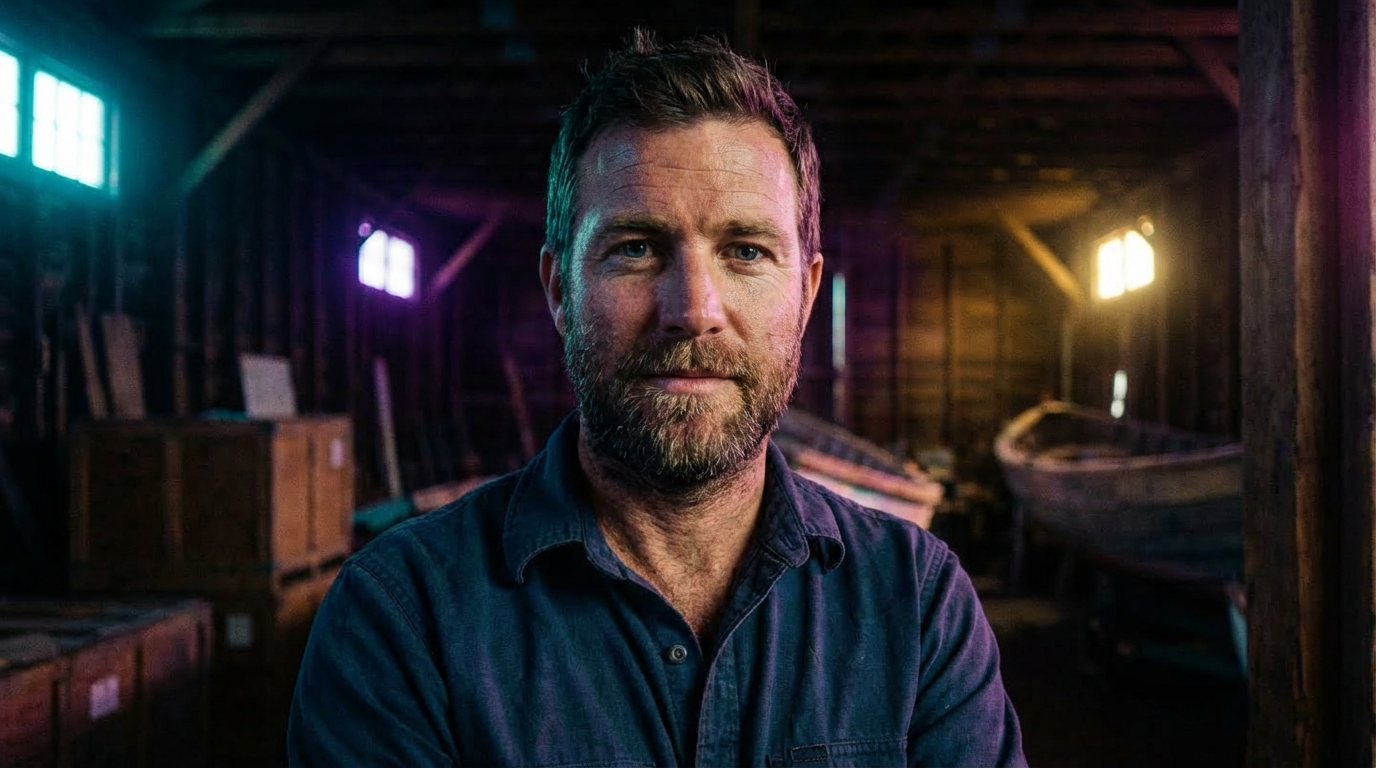
Birth and Early Childhood
Thomas William Kendrick was born on 3 April 1991 in Colchester, the bustling coastal settlement founded eighty years earlier by Captain Elias Renford. His arrival marked the third generation of Kendricks to call the maritime town home—his grandfather Arthur had been among the labourers who expanded the original harbour in the 1930s, and his father Harold had followed naturally into the shipyards that defined Colchester's identity.
Harold James Kendrick, born in 1962, was a shipwright whose hands had shaped more vessels than he could count. A quiet man with forearms like knotted rope, Harold approached both his craft and his family with the same methodical patience—measuring twice, speaking once, and trusting that steady work would yield steady results. He met Margaret Rose Ashford at a Renford Regatta dance in 1985, drawn to her quick laugh and the way she refused to be impressed by his attempts at charm.
Margaret, born in 1965 to a family with roots in Colchester's administrative class, worked in the offices of the Colchester Harbour Authority, managing the endless paperwork that kept ships moving and cargo flowing. Where Harold was deliberate and reserved, Margaret was brisk and sociable, her presence filling their modest harbourside cottage with conversation and the smell of baking. Their differences created friction as often as harmony, but their commitment to each other and their children never wavered, even when voices rose over dirty boots tracked across clean floors or Harold's tendency to disappear into his workshop for hours without explanation.
Tom's older sister Eleanor Grace had arrived in 1988, and her presence shaped his earliest years in ways he would only later appreciate. Three years his senior, Eleanor possessed their mother's sharp tongue and their father's stubborn determination—a combination that made her both fiercely protective of her younger brother and utterly intolerant of any weakness she perceived in him. Tom learned early that tears earned contempt rather than comfort from Eleanor, though she would bloody the nose of any child who dared threaten him.
Childhood in Colchester
The Colchester of Tom's childhood was a town defined by the rhythms of tide and trade. The cry of gulls served as his morning alarm, and the smell of salt and fish guts permeated everything—clothes, furniture, the very walls of their cottage near the harbour. It was not a glamorous upbringing, but it was secure in ways that many settlements across Clivilius could not claim. Colchester had weathered storms both literal and economic, and its people carried that resilience like a birthright.
Tom spent his early years trailing after his father through the shipyards, learning to identify wood types by smell and touch before he could properly read. Harold, though not demonstrative with affection, showed his love through inclusion—bringing Tom along to inspect hulls, explaining the physics of buoyancy in terms a child could grasp, trusting him with small tasks that made the boy feel essential. These hours in sawdust-scented workshops planted seeds of practical competence that would later flower into Tom's professional life.
Yet the shipyards also taught harder lessons. Tom was perhaps seven when he witnessed a crane accident that killed a young rigger, the man's body broken on the dock while his colleagues stood frozen. Harold had shielded Tom's eyes too late, and the image lodged somewhere deep. The sea and the work it demanded were not romantic—they took lives as readily as they gave livelihoods. This understanding matured Tom in ways his peers, children of shopkeepers and administrators, could not share.
His relationship with Eleanor remained complicated throughout childhood. She excelled at everything she attempted, from schoolwork to swimming to the sharp-tongued debates that were Colchester's favoured social sport. Tom, quieter and less obviously gifted, often felt himself measured against her and found wanting. Margaret's attempts to reassure him that he had his own strengths rang hollow when Eleanor's achievements were celebrated so visibly. Yet beneath the rivalry, genuine affection persisted—Eleanor taught Tom to swim in the harbour's calmer waters, and defended him against bullies with a ferocity that bordered on excessive.
Education and Adolescence
Tom's formal education began at Colchester Primary, a stone building perched on the cliffs above the harbour where generations of maritime children had learned their letters and figures. He was an adequate student—neither brilliant nor struggling, the sort of boy teachers remembered vaguely if at all. His strengths lay in practical subjects: mathematics came easily when applied to real problems, and he showed aptitude for understanding systems and processes that bored his more academically inclined classmates.
Secondary school brought new challenges and opportunities. The Colchester Secondary Academy drew students from across the settlement and its outlying areas, creating a more diverse social environment than Tom had previously navigated. He found his footing among the sons and daughters of tradespeople—young people who understood that education was preparation for work rather than an end in itself. His closest friend during these years was Marcus Webb, a fisherman's son whose irreverent humour and casual disregard for authority balanced Tom's more cautious nature.
It was during secondary school that Tom first became aware of the wider world beyond Colchester's harbour. News of developments in distant settlements filtered through—the growth of Bixbus following the Earth arrivals in 2018, the expansion of trade networks, the completion of rail links that were shrinking the distances between communities. These stories sparked something in Tom, a curiosity about possibilities beyond the shipyards that had seemed his inevitable destiny.
Eleanor, meanwhile, had departed for Xylora to pursue administrative studies, her ambition carrying her beyond Colchester's horizons. Her absence left a strange hollowness in the household—the constant comparison had been exhausting, but without it, Tom felt oddly unmoored. He began to consider, for the first time, what he actually wanted rather than simply accepting what seemed expected.
Higher Education and Career Beginnings
In 2009, Tom enrolled at the Colchester Institute of Technology, the prestigious institution founded by Dr. Margaret Hollis in the 1950s. Rather than following his father into shipbuilding, he chose to study Supply Chain Management and Maritime Logistics—a programme that combined his practical aptitude with the broader commercial awareness the changing economy demanded. Harold's reaction was measured disappointment poorly concealed, though he said nothing directly. Margaret, characteristically, declared it a sensible choice and reminded Harold that not everyone needed to swing a hammer for a living.
The Institute proved transformative. Tom discovered that his ability to see systems—to understand how parts connected to form functional wholes—was genuinely valuable. His professors recognised in him a talent for optimisation, for identifying inefficiencies and proposing solutions. He graduated in 2013 with honours, though the ceremony itself embarrassed him with its formality.
His first position was with the Colchester Harbour Authority, working in the logistics division that coordinated incoming and outgoing cargo. The work was detail-oriented and occasionally tedious, but Tom found satisfaction in the puzzle-solving aspects—ensuring that limited dock space accommodated maximum throughput, that perishable goods moved quickly whilst bulk materials waited their turn. He developed a reputation for reliability and quiet competence, the sort of employee supervisors valued precisely because he never demanded recognition.
These years also brought romantic entanglements, though none proved lasting. Tom dated casually—a clerk from the Harbour Authority offices, a teacher he met at a Regatta celebration—but found himself reluctant to commit. Something felt incomplete, though he could not articulate what. His mother despaired of grandchildren whilst Eleanor, who had married a Xyloran banker and produced twins with efficient promptness, offered unsolicited advice about lowering his standards.
The Expanding Region
The completion of the Bixbus-to-Xylora Rail Link in 2022 transformed Colchester's economic position, but the groundwork had been laid years earlier. By 2019, Tom had risen to a supervisory role coordinating land-sea cargo transfers, a position that brought him into contact with the growing network of inter-settlement commerce. He began travelling occasionally—to Xylora for trade negotiations, to smaller settlements establishing new routes—and each journey reinforced his sense that Clivilius was changing rapidly.
In late 2020, an opportunity arose that would reshape Tom's life. The Bixbus Central Logistics Office, newly established to coordinate the settlement's explosive growth, sought experienced personnel from across the region. The position was challenging, and Bixbus itself represented the frontier of everything new and possible. Tom applied almost impulsively, surprising himself as much as his family.
Harold's reaction was silence that spoke volumes. Margaret cried, then declared she had always known he was destined for greater things. Eleanor, visiting from Xylora, offered pragmatic advice about housing and the importance of establishing social connections in a new community. Tom packed his belongings in early 2021 and departed for Bixbus, leaving behind the only home he had ever known.
Arrival in Bixbus
The Bixbus that greeted Tom bore little resemblance to Colchester's established maritime elegance. Here was a settlement still defining itself, its streets a mixture of careful planning and improvised necessity, its population a blend of native Clivilians and Earth arrivals whose customs and assumptions sometimes clashed productively and sometimes simply clashed. Tom found the energy exhilarating and exhausting in equal measure.
His position at the Central Logistics Office proved demanding. The settlement's rapid expansion meant constant pressure—coordinating building materials, food supplies, technological imports, the thousand necessities of a growing community. Tom worked long hours and slept poorly, questioning his decision during particularly difficult weeks. Yet he also felt, for the first time, genuinely essential. His work mattered in immediate, visible ways that his Harbour Authority role never had.
Housing proved challenging. Tom initially shared accommodations with other transplanted professionals, a arrangement that provided company but little privacy. His social life consisted largely of after-work drinks with colleagues, conversations dominated by logistics problems and settlement politics. He was not unhappy, precisely, but neither was he building the meaningful connections his mother's letters persistently enquired about.
It was through his professional work that Tom first encountered the Bixbus Event Collective, the organisation founded by Lisa Smith to foster community connection through celebration. The Collective regularly coordinated with Logistics for venue supplies, equipment, and the thousand details that transformed empty spaces into gathering places. Tom's initial contact was purely transactional—ensuring tables and chairs arrived on schedule, coordinating delivery windows—but he found himself increasingly curious about the woman whose organisational abilities rivalled his own.
Meeting Lisa
Their first substantial conversation occurred in March 2022, during preparations for the Bixbus Founders' Festival. A supply chain disruption threatened the entire event, and Tom worked alongside Lisa for three consecutive days to source alternatives and restructure delivery schedules. He observed her under pressure—calm but not cold, decisive but willing to listen, exhausted but somehow still finding energy to thank the workers who made solutions possible.
Lisa, for her part, noticed the quiet Colchester man whose practical competence matched her creative vision. She learned, through fragmented conversations between crises, that he had never known Earth, that the world she had sacrificed so much to reach was simply home to him. The perspective fascinated her—here was someone for whom Clivilius held no strangeness, no sense of exile or loss, only the ordinary complexity of life as it had always been.
Their courtship unfolded gradually, neither rushing toward intimacy nor retreating from growing connection. Tom invited Lisa to dinner; she accepted. They discovered shared appreciation for quiet evenings, for competence in others, for the satisfaction of problems solved and communities strengthened. He met her family—the formidable Smith clan whose Earth origins and complicated dynamics initially overwhelmed him—and found himself welcomed with warmth that felt genuine rather than performed.
Lisa's history weighed between them, acknowledged but not dwelt upon. She had been married before, to a man on Earth who would not follow her through the portal. Tom understood, without needing lengthy explanation, that he was not a replacement but a new chapter—that Lisa's capacity for love had survived loss rather than being diminished by it. Her strength drew him, even as her occasional sadness reminded him of depths he might never fully comprehend.
Marriage and Family
Thomas William Kendrick married Lisa Victoria Smith on 12 November 2022, in a ceremony at the Bixbus Community Centre that united two worlds in more than metaphor. His parents travelled from Colchester, Harold uncomfortable in formal clothes but visibly proud, Margaret weeping with joy that had grown from despair of ever seeing this day. Eleanor attended with her husband and twins, offering genuine congratulations alongside inevitable observations about venue logistics that could have been improved.
Lisa's family embraced Tom with varying degrees of warmth. Noah Smith, his new father-in-law, studied him with quiet assessment before offering a handshake that conveyed approval. Greta's welcome was immediate and complete—she recognised in Tom the steadiness her daughter needed, the practical partnership that would complement Lisa's creative energy. The Smith siblings proved more complex to navigate: Eli's protective watchfulness, Charles's testing humour, Jerome's quiet observation, and the half-brothers Paul and Luke whose complicated histories Tom would only gradually come to understand.
Their first year of marriage brought the ordinary challenges of merging two lives—disagreements about household organisation, adjustments to each other's rhythms, the discovery that love required ongoing cultivation rather than simple achievement. Tom learned that Lisa's brightness could shade into anxiety when events demanded perfection she could not guarantee. Lisa discovered that Tom's steadiness sometimes masked uncertainty he struggled to voice. They navigated these revelations imperfectly, with arguments that occasionally flared and reconciliations that deepened their bond.
On 28 March 2024, Lisa gave birth to their first child, a daughter they named Ivy Greta Kendrick. Tom had suggested the name Ivy—representing growth and new beginnings in this world his daughter would inherit as her birthright. Lisa chose Greta to honour her mother, whose influence had shaped everything she had become. The combination pleased everyone, though Greta herself required several days to stop crying whenever she held her granddaughter.
Fatherhood transformed Tom in ways he had not anticipated. The weight of responsibility—this small life depending entirely on him and Lisa—clarified priorities that had previously seemed negotiable. He reduced his working hours, accepting the career limitations this implied, to be present for the daily rituals of feeding and bathing and simply being there. Harold, visiting to meet his granddaughter, observed the change with something like wonder; he had not been that kind of father, and seeing Tom become one stirred emotions he lacked words to express.
On 15 January 2026, Oliver Noah Kendrick arrived, completing—for now, they agreed—their family. The name honoured Tom's Colchester heritage with the classic solidity of Oliver, whilst Noah paid tribute to Lisa's father, the quiet mechanic whose strength had anchored the Smith family through every storm. Noah wept when he learned the name, a rare display of emotion that moved everyone present.







