Thomas Whitfield
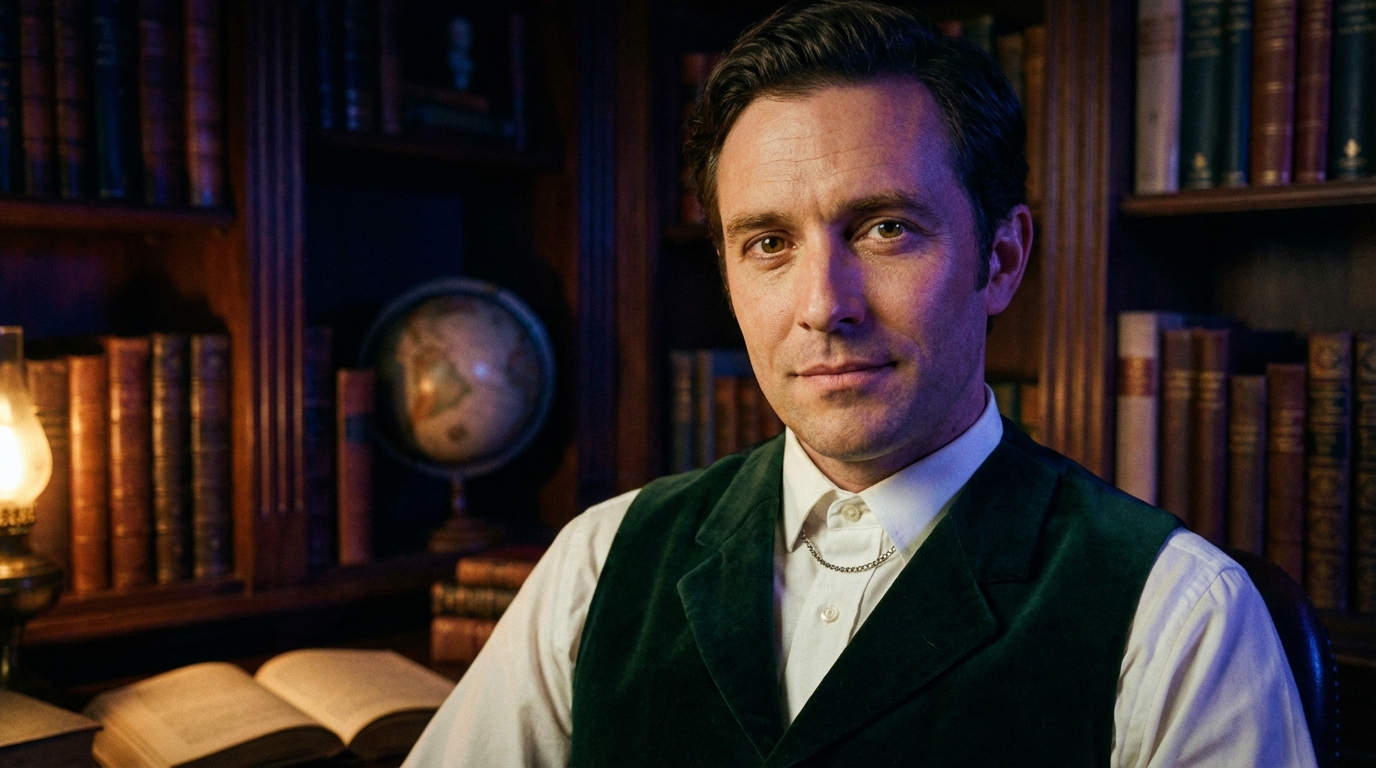
Thomas Whitfield, born in Horningsham, Wiltshire, in 1795, embodied the scholarly servant whose unwavering loyalty transcended mere duty. From blacksmith's son to distinguished head butler, his fifty-eight years at Jeffries Manor transformed him into the estate's living conscience. Through William Sr.'s mysterious disappearance, Madelyn's widowhood, and generations of family transitions, Thomas remained the steadfast guardian whose discretion, intelligence, and gentle wisdom anchored Tasmania's most enigmatic household until his death in 1875.
Wiltshire Foundations
Thomas Whitfield entered the world on 17 August 1795 in Horningsham, a small village in Wiltshire whose modest size belied its quiet dignity. The village clustered around the parish church with the comfortable compactness characteristic of rural English settlements, where everyone knew everyone else and generations lived their entire lives within sight of where they were born. For most residents, Horningsham represented not limitation but security—a place where social relationships formed the invisible architecture that held community together.
His father, John Whitfield, practised the blacksmith's trade in a forge that had served the village for generations. The rhythmic clang of hammer on anvil provided Horningsham's daily soundtrack, metal being shaped through heat and force into the tools that enabled agricultural life. John's hands bore the permanent marks of his profession—burn scars from flying sparks, calluses thick as leather from gripping hammers and tongs, fingers that had developed particular strength from years of manipulating hot iron. He approached his work with methodical care, understanding that a properly forged ploughshare or well-fitted horseshoe represented the difference between farmer's prosperity and failure.
Mary Whitfield née Fletcher brought to the household skills in domestic management that complemented her husband's craft. She maintained their cottage with efficiency born from understanding that working families possessed no margin for waste or disorder. Every shilling mattered, every scrap of fabric had potential use, every meal required careful planning to stretch limited resources across growing appetites. She sewed, mended, preserved food, tended their small garden, and managed the household economy with quiet competence that made modest means sufficient for respectable survival.
Thomas, the eldest of three children, grew up understanding both the dignity and the limitations of artisan life. His younger sisters, Elizabeth and Sarah, would eventually marry local men and remain in Horningsham, their lives following patterns traced by countless generations before them. But Thomas, even as a child, displayed qualities that suggested he might transcend the forge's inherited rhythms—an unusual quickness of mind, an instinctive sense of social dynamics, and a hunger for knowledge that no amount of blacksmithing could satisfy.
The village vicar, Reverend Augustus Pemberton, recognised Thomas's exceptional potential during the boy's sporadic attendance at the church's Sunday school. Most working-class children acquired barely functional literacy before economic necessity claimed their full attention. Yet Thomas absorbed learning with evident relish, asking questions that suggested genuine intellectual curiosity rather than mere rote memorisation. The vicar, himself a scholar frustrated by provincial isolation, found in young Thomas a willing pupil who might justify the clergyman's own underemployed gifts.
Pemberton took Thomas under his wing with informal mentorship that transcended the Sunday school's basic curriculum. The vicar loaned books from his own library—histories, philosophical works, classical literature—guiding Thomas through texts that would have remained forever inaccessible otherwise. They discussed ideas during Thomas's rare free hours, the elderly clergyman delighting in intellectual discourse with someone who understood and engaged rather than merely nodded politely. These conversations planted seeds that would flourish throughout Thomas's life—a love of learning for its own sake, an appreciation for nuanced thought, and understanding that education represented freedom from circumstance's tyranny.
The London Apprenticeship
At fourteen years of age, Thomas faced the decision that would determine his entire trajectory. The expected path led directly to his father's forge—learning blacksmithing through the traditional apprenticeship that had transmitted craft knowledge across generations. Yet Reverend Pemberton proposed an alternative that seemed almost fantastical: apprenticing Thomas to a butler in a wealthy London household. The vicar had connections through distant relatives, and the household sought an intelligent, presentable youth who might be trained in domestic service's higher echelons.
The opportunity sparked complex family discussions. John Whitfield harboured natural disappointment that his son would not continue the forge's operation. Yet he recognised that Thomas possessed qualities ill-suited to metalworking—a refinement of manner, an intellectual bent, a capacity for the nuanced social navigation that domestic service required. Mary understood perhaps more clearly than her husband that Thomas chafed against Horningsham's limitations, that keeping him in the village would waste talents that deserved broader scope. They gave their blessing with mixture of pride and apprehension, understanding this decision would likely mean permanent separation.
Thomas arrived in London in 1809, overwhelmed by the city's scale and complexity. The household where he apprenticed belonged to a prosperous merchant whose business success demanded domestic establishment befitting his station. The merchant, Mr Cornelius Hartwell, maintained a staff whose hierarchies and protocols seemed byzantine to country-raised Thomas. He entered this world at its lowest rung—a hall boy whose responsibilities included the dirtiest, most physically demanding tasks that kept the household functioning.
The work proved brutally exhausting. Thomas rose before dawn to light fires throughout the house, spent hours carrying coal and water, cleaned boots and brass fixtures, ran endless errands, and performed whatever other tasks senior servants required. His hands, which had never known forge work's calluses, developed new hardnesses from scrubbing and carrying. His back ached from constant bending and lifting. And the social dynamics amongst servants proved as complex as any aristocratic intrigue—petty tyrannies, shifting alliances, competitions for favour, and the constant tension between those with secure positions and those whose employment remained precarious.
Yet Thomas possessed advantages that enabled not merely survival but advancement. His Reverend Pemberton-fostered literacy exceeded that of most servants, allowing him to handle correspondence and records that baffled his peers. His natural intelligence helped him quickly master the intricate protocols governing upper servant behaviour. And perhaps most importantly, he displayed a quality that distinguished exceptional servants from merely competent ones—an intuitive grasp of discretion, understanding that truly valuable servants saw and heard everything whilst appearing to notice nothing.
Mr Hartwell's head butler, an elderly man named Charles Wickham, recognised Thomas's potential and took particular interest in his development. Wickham had spent forty years in domestic service, rising through merit and careful cultivation of skills to achieve head butler's prestigious position. He understood that superior service required more than mere competence—it demanded education in wines, cuisine, proper formal service procedures, household account management, and the subtle arts of managing both employers and fellow servants. He mentored Thomas systematically, sharing knowledge accumulated across decades of service in various grand households.
Rise Through Service
By age twenty, Thomas had progressed to under-butler position, a remarkable achievement demonstrating both his capabilities and Wickham's effective mentorship. The role carried significant responsibilities—managing junior staff, overseeing formal service during important dinners, maintaining household accounts, and serving as Wickham's deputy during the head butler's absences. Thomas approached these duties with meticulous attention to detail and quiet authority that commanded respect without requiring harsh discipline.
In 1815, opportunity knocked through the complex networks that connected England's servant class. A visiting dignitary, impressed by the seamless service during a dinner at the Hartwell household, inquired about the capable young man who had managed arrangements with such evident competence. This led to Thomas's engagement as under-butler in the household of Lord Ashton, an influential peer whose London residence and country estate required staff combining traditional service excellence with adaptability to aristocratic eccentricities.
Lord Ashton's household operated at level of grandeur exceeding anything Thomas had previously experienced. The formal dinners required managing teams of footmen in elaborate choreographed service. The wine cellars contained collections requiring genuine knowledge of viticulture and proper storage. The guests included politicians, artists, foreign dignitaries, and aristocrats whose specific preferences and protocols Thomas needed to master. Yet he thrived in this demanding environment, his combination of intelligence, learning, and practical competence making him invaluable to the household's smooth operation.
It was during his service with Lord Ashton that Thomas first heard discussions about Van Diemen's Land. The colony featured in conversations amongst Lord Ashton's guests—some discussed its role in the transportation system, others mentioned commercial opportunities, a few spoke of relatives or acquaintances who had emigrated seeking advancement impossible in England's rigid hierarchies. These discussions planted seeds in Thomas's imagination. What might life offer in a distant colony where social structures remained fluid enough that capable individuals might rise beyond their birth's limitations?
The idea grew through 1816 and early 1817. Thomas had achieved success in English service—a respected position in prestigious household, comfortable quarters, steady income, and prospects for eventual advancement to head butler position. Yet he chafed against certain realities of English domestic service. No matter how capable or educated he became, he would always remain fundamentally a servant, his worth measured entirely by how well he facilitated others' comfort. The colonies, by contrast, offered something England could never provide—the possibility that merit might matter more than birth, that dedication and intelligence might earn respect transcending master-servant hierarchies.
The Colonial Gamble
The decision to emigrate required courage that Thomas's Wiltshire parents could scarcely comprehend. He was abandoning security and status earned through years of dedicated service, trading known circumstances for complete uncertainty half a world away. Yet something in his character—perhaps the intellectual restlessness Reverend Pemberton had nurtured, perhaps ambition frustrated by English limitations—demanded he take the risk. In early 1817, Thomas gave Lord Ashton appropriate notice, received generous references attesting to his capabilities, and booked passage to Van Diemen's Land.
The voyage to Hobart tested every assumption Thomas held about his own resilience. The ship's cramped conditions, the months of tedious confinement, the constant proximity to strangers, the storms that terrified even experienced sailors—all created environment where maintaining dignity proved challenging. Yet Thomas endured with characteristic determination, using the voyage's enforced leisure to study what limited materials were available about colonial society and to prepare mentally for the transformations ahead.
He arrived in Hobart Town in mid-1817 to find a settlement hovering between raw frontier outpost and aspiring civilisation. The town possessed government buildings of surprising grandeur juxtaposed with rough structures that barely qualified as architecture. Convicts laboured under military supervision on public works whilst free settlers attempted to establish businesses and social structures modelled on English precedents. The entire settlement seemed suspended between past and future, its character still forming, its ultimate nature yet undetermined.
Thomas's reputation and references preceded him through the surprisingly efficient networks that connected colonial society. Word spread quickly that an experienced, educated butler from Lord Ashton's household had arrived seeking employment. Within days, he received an approach from William Jeffries Sr., a wealthy colonial entrepreneur whose grand new manor near Granton required head butler to establish and manage household operations. The position offered generous wages, accommodation, and opportunity to shape domestic establishment from its inception—precisely the scope Thomas had imagined when deciding to emigrate.
Establishing Jeffries Manor
Thomas's interview with William Jeffries Sr. revealed much about the man who would become his employer for the next four years. William possessed evident intelligence and driving ambition, combined with intensity suggesting depths Thomas couldn't immediately fathom. The master questioned Thomas extensively about his experience, his capabilities, his reasons for emigrating. He seemed particularly interested in Thomas's discretion, his ability to manage complex household operations, and his willingness to maintain standards of service despite colonial conditions' challenges.
William offered the position on terms that exceeded Thomas's expectations—substantial salary, comfortable quarters, authority to hire and dismiss staff as needed, and William's assurance that competent service would be appropriately valued. Thomas accepted immediately, recognising this represented exactly the opportunity he had sought. He would not merely work for William Jeffries but would help create something new—a household that combined English service standards with colonial circumstances' particular demands.
The manor itself was still under construction when Thomas arrived in late 1817. The Georgian sandstone structure was rising from Tasmanian earth under supervision of skilled craftsmen, its proportions announcing William's social ambitions. Thomas found himself involved not merely in household management but in the estate's very creation—advising on servants' quarters design, planning kitchen facilities, considering storage requirements, and anticipating the operational needs of grand establishment in colonial setting.
He threw himself into this work with passionate engagement. Here, finally, was scope for his accumulated knowledge and capabilities. He hired staff carefully, seeking individuals who combined competence with adaptability to colonial conditions. He established protocols and routines that balanced English formality with practical accommodation to Tasmania's realities. He ordered supplies, arranged for acquisition of furnishings and equipment, and coordinated the countless details necessary to transform empty rooms into functioning household.
When William departed for England in early 1818, ostensibly for business but actually to secure a wife, he entrusted Thomas with continuing the manor's preparation. This period of independent authority proved revelatory. Thomas discovered he possessed not merely service skills but genuine executive capability—the ability to make complex decisions, to manage competing demands, to anticipate problems before they materialized. The manor's completion proceeded smoothly under his oversight, ready to receive William and his new bride upon their September return.
Servant and Confidant
William's return with Madelyn Jeffries transformed the manor from construction project into living household. Thomas orchestrated their arrival with careful attention to creating proper impression—staff assembled in formal reception, rooms prepared to perfection, every detail conveying that Jeffries Manor represented establishment worthy of respect. His management during these crucial first weeks helped ease Madelyn's transition from English merchant's daughter to colonial mistress, his quiet competence providing reassurance amidst overwhelming change.
Yet Thomas soon recognised complexities beneath the surface propriety. William conducted mysterious business in his locked study, received odd visitors at unusual hours, and displayed mood swings that suggested stresses he refused to discuss. Thomas, trained to observe whilst appearing oblivious, noted these patterns with growing concern. His loyalty to William never wavered, yet he understood he served a man whose affairs extended into shadows Thomas could not fully illuminate.
The household's daily rhythms under Thomas's management achieved remarkable standard considering colonial limitations. Formal dinners matched London service quality, the manor's operations proceeded with clock-like precision, and guests consistently remarked upon the exceptional household management. Thomas took pride in these accomplishments whilst maintaining the self-effacing manner that marked superior servants—his work should be invisible, noticed only when absent.
His relationship with William evolved beyond mere master-servant formality into something approaching trust, if never quite friendship. William increasingly sought Thomas's counsel on matters extending beyond household management—seeking his observations about colonial society, his assessment of business associates' reliability, his thoughts on various practical concerns. Thomas responded with characteristic discretion, offering opinions when requested whilst never presuming to advise unasked. This delicate balance earned William's confidence in ways more assertive individuals never achieved.
The birth of William Jr. in November 1819 brought particular satisfaction to Thomas, who had orchestrated every detail of Madelyn's lying-in with meticulous care. He understood that this child represented not merely William's heir but the dynasty's continuation, the justification for everything William had built. Thomas's gentle encouragement of the nervous father-to-be, his efficient management of the household chaos surrounding birth, and his genuine pleasure in the family's joy revealed depths of feeling his professional demeanour usually concealed.
The Night of Mysteries
The events of 9 August 1821 would haunt Thomas for his remaining five decades. That morning, he had delivered the mysterious letter bearing its strange red seal, noting William's darkening expression as he read. Through the day, Thomas observed his master's increasing agitation whilst maintaining professional distance, understanding that William's troubled state required discretion rather than intrusive concern. The dinner Thomas served that evening passed in tense silence, William barely eating, Madelyn's worried glances meeting only impenetrable reserve.
When William retired to his study afterwards, Thomas completed his evening duties with practiced efficiency—ensuring the house was secured, the staff dismissed to their quarters, everything prepared for the household's nightly rest. Yet something troubled him, some instinct suggesting this night differed from others. He delayed his own retirement, finding tasks that kept him moving through the manor's corridors, drawn by unease he couldn't articulate.
The sounds from the basement came near midnight—muffled voices, the scrape of movement, something that suggested William had descended to the manor's lowest level. Thomas approached the basement door, hesitated, then descended the stairs towards light and voices below. What he witnessed there would remain seared in memory until death—convicts bound and struggling, Judge Holloway's presence inexplicably in the manor's depths, and most terrifying of all, the Portal's otherworldly luminescence filling the chamber with light that seemed to originate beyond normal reality.
The chaos that followed happened too quickly for Thomas to fully process. The convicts' desperate struggle, William's attempt to maintain control, bodies colliding in the Portal's eerie glow. Thomas watched, frozen by incomprehension, as his master tumbled through the shimmering gateway and vanished. He pursued the fleeing convicts up the stairs and out into the night, but they disappeared into darkness whilst behind him the Portal flickered and died, leaving only silence and the terrible knowledge that William Jeffries had vanished into something beyond Thomas's capacity to explain or understand.
He spent that night in his quarters, wrestling with impossible questions. What had he witnessed? How could he explain what defied all rational explanation? Should he report what he had seen, knowing no one would credit testimony about otherworldly gateways and vanishing masters? By dawn, Thomas had made his decision—he would report William's disappearance but would describe only what could be understood: his master had been missing since the previous evening, the house locked as usual, no signs of forced entry or struggle visible to ordinary inspection.
Guardian Through Crisis
The investigation that followed tested Thomas's discretion and loyalty as nothing before. Constable Broadmoor questioned him repeatedly about the night's events, seeking any detail that might illuminate William's fate. Thomas answered with scrupulous honesty about observable facts whilst omitting the inexplicable—he had locked up the manor as usual, noticed nothing unusual, discovered William's absence the following morning along with everyone else. His steady demeanour and consistent testimony eventually satisfied authorities, though lingering questions remained about whether the loyal butler knew more than he admitted.
Detective Inspector Lockhart's arrival brought more intensive scrutiny. The inspector recognised that head butlers typically possessed intimate knowledge of household affairs, that loyalty might inspire protective deception, that servants' testimony required careful evaluation. Yet Thomas's character, confirmed by inquiries extending to his London service, suggested genuine trustworthiness rather than calculated performance. Lockhart eventually concluded that whatever Thomas knew, it fell short of explaining William's disappearance.
For Madelyn, suddenly alone with infant son and vanished husband, Thomas became anchor providing stability amidst chaos. He managed the household's operations whilst she navigated official interrogations and social speculation. He fielded inquiries from concerned associates and curious gossips with diplomatic skill that protected Madelyn's dignity. And he provided quiet reassurance during her moments of private despair—not overstepping proper bounds, but offering steadfast presence that conveyed unwavering support.
His decision to remain at Jeffries Manor despite scandal's taint demonstrated loyalty transcending mere employment. Other positions would have been available—his capabilities and references ensured that. Yet Thomas felt profound responsibility towards Madelyn and young William Jr., understanding they needed his continued service during this vulnerable period. More privately, he carried knowledge about William's fate that bound him to the manor in ways he could never fully articulate. He had witnessed something impossible, and that witness created obligation to remain, to protect the family, to guard secrets he couldn't share even if anyone would believe them.
The Decades of Devotion
Through the 1820s and into the 1830s, Thomas became Jeffries Manor's steadfast constant as everything else evolved. Madelyn transformed from dependent wife to formidable businesswoman, her management of William's enterprises demonstrating capabilities that surprised colonial society. William Jr. grew from infant to schoolboy to young man, his development proceeding under Thomas's benevolent observation. The manor itself transitioned from scandal's shadow to respectability, Madelyn's competent stewardship eventually overcoming whispers about her husband's mysterious disappearance.
Thomas mentored young William Jr. with particular dedication, seeing in the boy hope for the family's future. He taught him not merely formal manners but deeper lessons about character, responsibility, and the obligations wealth and position carried. Their relationship transcended typical servant-master dynamics—Thomas became something like surrogate grandfather, offering guidance with gentle wisdom that respected the boy's intelligence whilst shaping his developing character.
When William Jr. assumed control of the family enterprise in 1837, Thomas felt profound satisfaction that his decades of service had helped preserve William Sr.'s legacy for the next generation. He had kept faith with his vanished master by protecting what William had built, ensuring son could inherit intact empire despite the scandal that might have destroyed it. This accomplishment mattered to Thomas more than any personal recognition—he had fulfilled duty extending beyond employment contract into realm of moral obligation.
The 1840s and 1850s brought inevitable physical decline, yet Thomas maintained his standards even as age demanded concessions. He moved more slowly through familiar corridors, relied increasingly on younger staff for physically demanding tasks, and occasionally forgot details his memory once retained perfectly. Yet his fundamental competence never wavered, his authority amongst staff remained unquestioned, and his value to the Jeffries family transcended mere household management.
The Scholar Servant
Throughout his colonial decades, Thomas maintained the intellectual life Reverend Pemberton had nurtured in distant Wiltshire. His personal library, carefully accumulated through years of purchasing books from visiting ships and colonial booksellers, became his sanctuary. He read widely—histories of ancient civilizations, philosophical treatises, classical literature, contemporary novels, scientific works explaining the natural world. These books represented not mere entertainment but lifelong conversation with minds spanning centuries and continents.
He corresponded with Reverend Pemberton until the elderly clergyman's death in 1834, their letters discussing ideas and books with intellectual engagement Thomas found nowhere else in colonial Tasmania. These exchanges sustained Thomas through difficult periods, reminding him that service needn't preclude thought, that managing silver and supervising footmen didn't exhaust his capabilities or define his worth.
His rare leisure moments found him lost in books, spectacles perched on his nose, oblivious to surroundings as he travelled through text to ancient Rome, Renaissance Florence, or philosophical arguments about nature and existence. Staff learned to respect these intervals, understanding that their butler's reading represented something essential to his character, not mere idiosyncrasy to be mocked.
This scholarly bent influenced his approach to service. He brought intellectual rigor to household management, systematizing operations with logical precision, approaching problems analytically, and continuously seeking improvements based on accumulated knowledge. His methods, whilst rooted in English service traditions, incorporated innovations born from applying intelligence to practical challenges.
Final Years and Quiet Passing
By the 1870s, Thomas had become Jeffries Manor's living history, having served longer than anyone could remember, his presence so integral to the estate that imagining it without him seemed impossible. He moved through familiar rooms with the authority of long tenure, his opinions sought on matters great and small, his approval mattering to successive generations of Jeffries family members.
Yet age's toll became increasingly evident. He experienced episodes of confusion, mistaking present for past, addressing long-dead William Sr. as if he still lived. His hands trembled when performing tasks once executed with unconscious precision. And he tired easily, his legendary stamina depleted by eight decades of living and fifty-eight years of dedicated service.
Thomas Whitfield passed away peacefully on 23 November 1875, aged eighty years. Death came during sleep in his comfortable quarters above the servants' wing—rooms that had been his home longer than anywhere else in his life. Staff discovered him in the morning, lying as if merely sleeping, his expression peaceful, a book fallen from his relaxed hand. The manner of his passing seemed fitting—gentle, quiet, undramatic, like the man himself.
The funeral drew attendance that testified to the respect Thomas had earned across six decades. Jeffries family members across three generations attended, honouring the man who had served them with unwavering loyalty. Staff past and present came to pay respects to the butler whose standards and character had shaped them. And representatives of colonial society attended, recognising that Thomas Whitfield had been more than mere servant—he had been exemplar of what dedicated service combined with intelligence and integrity might achieve.
His burial in the family cemetery on Jeffries Manor grounds represented unprecedented honour for a servant. Yet the family insisted—Thomas had earned this final recognition through lifetime of devotion that transcended employment. The modest headstone recorded essential facts: his name, his dates, and the simple phrase "Faithful Servant, Trusted Friend." Those words captured truth that elaborate eulogy could not improve: Thomas Whitfield had served faithfully, been trusted completely, and earned genuine friendship despite the social chasm supposedly separating masters from servants.







