
Thomas Nathaniel Jeffries
Thomas Nathaniel Jeffries (1851–1923), the fourth child of William Edward Jeffries Jr. and Ellen Amelia Cross, was born at Jeffries Manor in Granton, Tasmania. An Edinburgh-trained engineer, he modernised the family's agricultural operations and founded the Hobart Electric Tramway Company, becoming one of Tasmania's foremost advocates for public infrastructure. His 1885 commission of Tom Roberts' painting The Drovers' Campfire concealed a cryptic map to buried family secrets whose significance would not emerge for over a century.
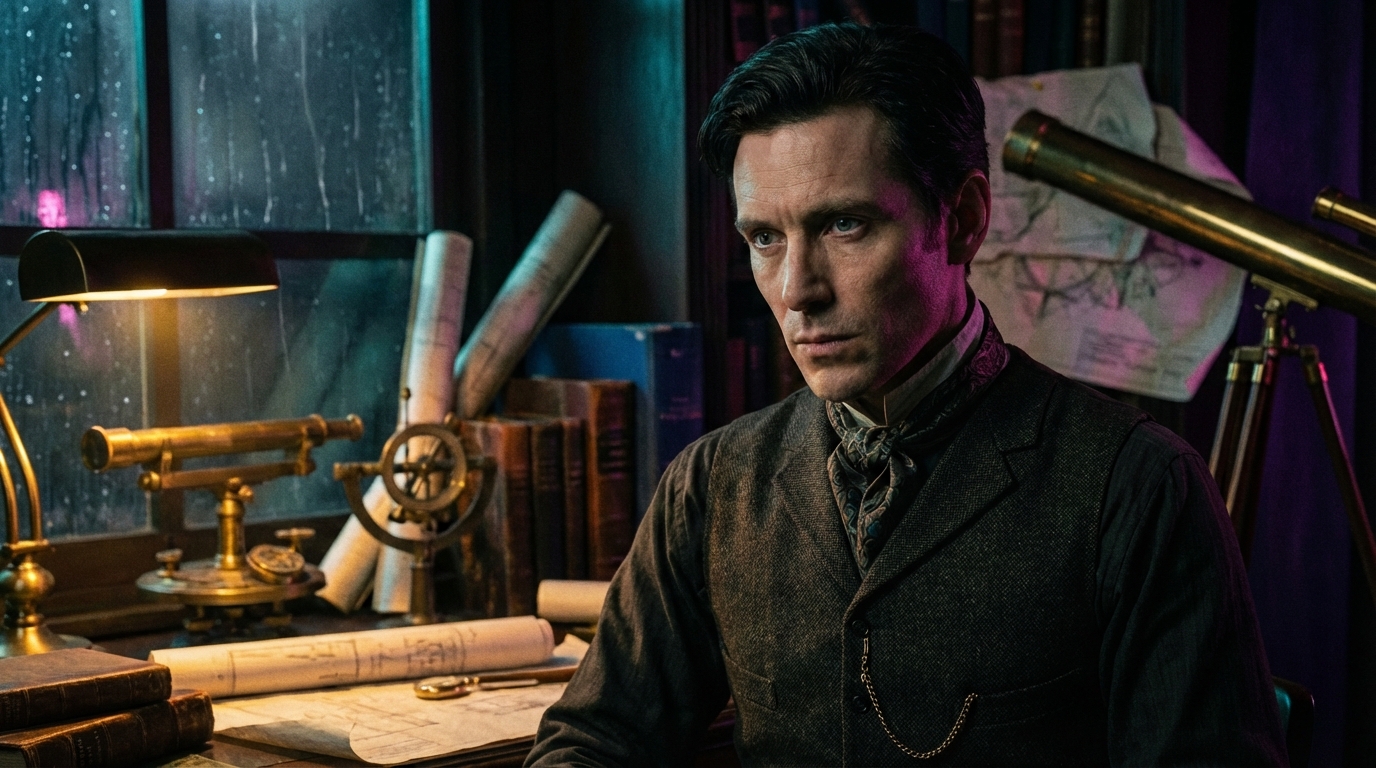
Childhood and Early Aptitudes (1851–1867)
On 5 March 1878, Thomas married Margaret Louise Sinclair, the daughter of Robert Sinclair, a prominent Hobart merchant, and his wife Mary. Margaret was a woman of quiet intelligence and practical temperament whose merchant family background provided her with an understanding of commercial life that complemented Thomas's technical orientation. The union represented both personal affection and the kind of strategic alliance that Jeffries marriages had traditionally served — Margaret's family connections strengthened the Jeffries position within Hobart's mercantile networks, whilst Thomas's engineering credentials and family name offered the Sinclairs access to Tasmania's landed elite.
The couple settled on the outskirts of Hobart, establishing a household that reflected Thomas's preference for functionality over ostentation. Their home, whilst comfortable and well-appointed, lacked the imposing grandeur of Jeffries Manor — a deliberate choice that signalled Thomas's desire to build his own identity rather than inhabit his father's shadow. Margaret managed the domestic sphere with capable efficiency, creating an environment of warmth and stability that Thomas, whose professional commitments frequently took him across the colony, relied upon more than he perhaps acknowledged.
Between 1880 and 1885, Thomas and Margaret had three children. Robert, born in 1880, inherited something of his father's mechanical aptitude and would eventually pursue his own career in engineering. Clara, born in 1882, developed literary interests that drew her toward writing. Samuel, the youngest, arrived in 1885 and gravitated toward the natural sciences, his curiosity about the Tasmanian landscape expressing itself through systematic study.
Thomas Nathaniel Jeffries was born on 9 November 1851 at Jeffries Manor in Granton, Tasmania, the fourth child and third son of William Edward Jeffries Jr. and Ellen Amelia Jeffries (née Cross). His father, a Cambridge-educated lawyer who had dedicated his career to transforming the family's controversial fortune into a respected colonial enterprise, was then at the height of his commercial influence. His mother, the youngest daughter of Judge Abraham Isaac Cross and Elizabeth Harriet Cross (née Hawkins), had brought to the Jeffries household an intellectual rigour and philanthropic conviction that permeated every aspect of the children's upbringing.
Thomas arrived into a household already dense with established personalities. His eldest sister Madelyn Elizabeth, six years his senior, had assumed the protective authority natural to a firstborn daughter. His brother William, four years older, had already begun exhibiting the possessive competitiveness that would define his adult character. His sister Elizabeth, just two years ahead of him, was developing the quiet artistic temperament that would make her Tasmania's most celebrated watercolourist. When his younger brother Edwin arrived in March 1853, Thomas found himself occupying the middle ground of the family — neither heir nor youngest, neither the artistic daughter nor the political schemer, but something distinct and, in some ways, more practically useful than any of them.
From an early age, Thomas displayed a fascination with how things worked that set him apart from his siblings. Whilst William studied ledgers and Elizabeth sketched gardens, Thomas dismantled household mechanisms to examine their components and reassembled them — sometimes successfully, sometimes not — with a persistence that amused the manor's servants and occasionally alarmed its housekeeper. His mother recognised in this mechanical curiosity something worth cultivating rather than correcting. Ellen, whose own upbringing had emphasised the complementary natures of intellectual inquiry and social responsibility, encouraged Thomas's aptitude whilst ensuring he understood that technical skill carried moral obligations. When he constructed a model water pump at the age of eight, she persuaded him to install it at a local orphanage rather than display it in the manor's drawing room — a lesson in applied compassion that Thomas would remember throughout his life.
His education, conducted by private tutors at Jeffries Manor from approximately 1857, followed the broad curriculum his parents established for all their children: literature, languages, music, history, and the natural sciences. Thomas distinguished himself in mathematics and the physical sciences, subjects that rewarded the systematic thinking and practical curiosity that came naturally to him. He struggled more with languages and the finer points of literary analysis, though he developed a respectable competence in Latin under the same rigorous instruction that had produced his brother's fluency. His father, recognising in Thomas a temperament fundamentally different from William's commercial instincts, introduced him to the workings of the family estate from a young age — not the financial abstractions of Jeffries Industries, but the tangible operations of agriculture, irrigation, and land management that sustained the family's wealth at its most basic level.
The broader atmosphere of Jeffries Manor during Thomas's childhood was shaped by tensions he perceived without fully understanding. His father's progressive withdrawal into the obsession with his own father's disappearance in 1821 created a household in which ambition and melancholy coexisted uneasily. Thomas observed the effect upon his mother — the careful diplomacy she deployed to maintain family cohesion, the quiet frustration she recorded in private journals — and absorbed from it an instinctive wariness of the consuming preoccupations that seemed to afflict Jeffries men. Where his brother William would later replicate their father's obsessive patterns almost exactly, Thomas drew a different conclusion: that a man's energies were better spent building something useful than excavating mysteries that resisted resolution.
Edinburgh and Engineering (1871–1875)
In 1871, at the age of twenty, Thomas departed Tasmania for Scotland, enrolling at the University of Edinburgh to study engineering. The decision reflected both his established aptitudes and his family's recognition that the Jeffries empire, for all its commercial breadth, lacked the technical expertise necessary for genuine modernisation. His father supported the choice, understanding that the agricultural and industrial foundations of the family fortune required innovation to remain competitive. His mother, characteristically, saw the opportunity in broader terms — an Edinburgh education would expose Thomas to progressive ideas about technology's social applications that might temper the purely commercial instincts of his elder brother.
Scotland proved transformative. Edinburgh in the 1870s was a centre of engineering innovation, its university producing graduates who would reshape infrastructure across the British Empire. Thomas thrived in an academic environment that rewarded practical problem-solving over rhetorical elegance, and his coursework in civil engineering provided the theoretical foundations for the agricultural and infrastructural projects he would later pursue in Tasmania. He excelled particularly in hydraulics and mechanical design, disciplines that addressed directly the challenges he had observed on the family estate — inadequate irrigation, outdated farming equipment, and the inefficiencies of manual labour that constrained productivity despite abundant land.
Beyond the lecture halls, Edinburgh broadened Thomas's social and intellectual horizons in ways that Tasmania's insular colonial society could not have achieved. He encountered students from across Britain and its colonies, exchanged ideas with young engineers who would go on to build railways in India and bridges in Africa, and developed an understanding of technology as a force for social improvement rather than merely a tool for profit extraction. His exposure to Scotland's own history of industrial transformation — the coal mines and shipyards and textile mills that had reshaped Lowland society within living memory — impressed upon him both the possibilities and the human costs of rapid mechanisation, a duality that would inform his approach to development throughout his career.
Thomas graduated with honours in 1875 at the age of twenty-four. He returned to Tasmania carrying not only an engineering degree but a conviction, shaped by four years of study and observation, that the colony's economic future depended upon the modernisation of its agricultural base and the development of public infrastructure capable of connecting its scattered settlements into a functioning economy.
Return to Tasmania and Agricultural Modernisation (1875–1885)
Thomas's homecoming coincided with a period of significant change within the Jeffries family. His father, entering his late fifties, had begun the withdrawal from public life that would characterise his final years. William III, now approaching thirty, had assumed increasing responsibility for Jeffries Industries' commercial operations, displaying the ruthless business acumen that would make him both wealthy and widely distrusted. The family dynamic into which Thomas returned offered both opportunity and constraint — opportunity because the estate's agricultural operations desperately needed the technical expertise he had acquired, constraint because his brother's territorial temperament left little room for challenges to established authority.
Thomas navigated this terrain with characteristic pragmatism. Rather than compete with William for control of the broader commercial empire, he focused his energies upon the agricultural operations that formed the estate's productive foundation — the land itself, its yields, its systems of irrigation and soil management. He introduced mechanised farming equipment that substantially improved crop productivity, implemented advanced drainage and irrigation schemes drawing upon his Edinburgh training in hydraulics, and established selective breeding programmes for the estate's livestock that enhanced both wool and dairy output. These innovations, practical and quantifiable in their results, earned him respect within the Tasmanian farming community and demonstrated that the Jeffries name could stand for genuine progress rather than mere accumulation.
His approach to modernisation, however, was not without its complications. His mother, Ellen, initially welcomed his improvements — particularly the mining safety equipment he developed for the family's extractive operations, which reflected the social responsibility she had always advocated. Yet as Thomas's ambitions expanded, Ellen grew concerned that his enthusiasm for industrial progress was outstripping his attention to its human and environmental consequences. The tension between innovation and care, between efficiency and compassion, became a recurring theme in their relationship — never rupturing the deep affection between mother and son, but introducing a note of maternal anxiety that Thomas found difficult to address without abandoning projects he believed served the greater good.
Marriage and Family Life (1878–1900)
On 5 March 1878, Thomas married Margaret Louise Sinclair, the daughter of Robert Sinclair, a prominent Hobart merchant, and his wife Mary. Margaret was a woman of quiet intelligence and practical temperament whose merchant family background provided her with an understanding of commercial life that complemented Thomas's technical orientation. The union represented both personal affection and the kind of strategic alliance that Jeffries marriages had traditionally served — Margaret's family connections strengthened the Jeffries position within Hobart's mercantile networks, whilst Thomas's engineering credentials and family name offered the Sinclairs access to Tasmania's landed elite.
The couple settled on the outskirts of Hobart, establishing a household that reflected Thomas's preference for functionality over ostentation. Their home, whilst comfortable and well-appointed, lacked the imposing grandeur of Jeffries Manor — a deliberate choice that signalled Thomas's desire to build his own identity rather than inhabit his father's shadow. Margaret managed the domestic sphere with capable efficiency, creating an environment of warmth and stability that Thomas, whose professional commitments frequently took him across the colony, relied upon more than he perhaps acknowledged.
Between 1880 and 1885, Thomas and Margaret had three children. Robert, born in 1880, inherited something of his father's mechanical aptitude and would eventually pursue his own career in engineering. Clara, born in 1882, developed literary interests that drew her toward writing. Samuel, the youngest, arrived in 1885 and gravitated toward the natural sciences, his curiosity about the Tasmanian landscape expressing itself through systematic study. Thomas proved a more attentive father than his own had been — perhaps conscious of the emotional distance that William Jr.'s obsessions had created within the Jeffries household, he made deliberate efforts to involve himself in his children's lives and education, though the demands of his expanding professional commitments inevitably created periods of absence that Margaret was left to manage alone.
The Drovers' Campfire (1885)
In April 1885, Thomas commissioned the renowned Australian artist Tom Roberts to create a painting that would celebrate the drovers whose labour had been central to Tasmania's pastoral economy. Roberts, already gaining recognition for his plein air landscapes and his commitment to depicting the realities of Australian rural life, spent several weeks travelling with droving parties through the Tasmanian interior, documenting their routines, their campfire gatherings, and the landscapes through which they moved their stock.
The resulting work, completed in August 1885, depicted a group of drovers gathered around a campfire beneath a vast starlit sky, their weathered faces illuminated by flickering flames. The Drovers' Campfire was installed in the grand hall of Jeffries Manor, where it was received as a masterful celebration of colonial pastoral life — a fitting tribute from a family whose fortune had been built upon the very land these men traversed.
What only Thomas and a handful of trusted confidants understood was that the painting contained something beyond artistic merit. Hidden within the composition — encoded in the arrangement of stars, the positioning of figures, the patterns of shadow and firelight — were symbols that formed a cryptic map. These markers pointed to a concealed location on the Jeffries estate where Thomas had buried a cache of artefacts and documents chronicling aspects of the family's history that could not safely be committed to conventional archives. The precise nature of these materials — whether they related to his grandfather's disappearance, to the darker origins of the family fortune, or to discoveries Thomas had made during his own investigations into the Jeffries past — remained a secret he guarded throughout his life. The painting's re-emergence in 2023 would reignite efforts to decode its hidden elements, adding another layer of intrigue to a family whose history seemed determined to resist final resolution.
Public Infrastructure and Industrial Expansion (1880–1910)
Thomas's most enduring contribution to Tasmanian life extended well beyond the family estate. His founding of the Hobart Electric Tramway Company represented the intersection of his engineering expertise, his business acumen, and his genuine conviction that public infrastructure served the common good. The tramway, which modernised Hobart's transportation system and improved connectivity for residents across the city's expanding suburbs, demonstrated that commercial enterprise and social benefit need not operate as competing interests. The project drew upon the full range of Thomas's Edinburgh training — electrical engineering, civil works, project management — and established his reputation as one of Tasmania's foremost advocates for infrastructure development.
His involvement in mining operations proved more contentious. Thomas invested in copper and tin extraction, overseeing technological improvements that increased both efficiency and, initially, safety standards. His development of improved ventilation systems and reinforced timbering techniques reflected the social consciousness his mother had instilled, and the early years of his mining ventures were marked by a genuine concern for worker welfare that distinguished him from the more exploitative operators who dominated the industry. Over time, however, the pressures of commercial competition and the demands of shareholders pushed Thomas toward practices that compromised the standards he had originally established. Production targets crept upward, maintenance schedules stretched, and the careful balance between profit and safety that had characterised his early operations gradually eroded — a drift that troubled him privately even as he struggled to resist the economic logic that drove it.
In 1887, Thomas established the Jeffries Trust for Agricultural Innovation, a foundation dedicated to funding research into sustainable farming practices and providing grants for new agricultural technologies. The Trust represented his most deliberate attempt to institutionalise the values his mother had impressed upon him — the conviction that wealth carried obligations to the community from which it was derived. It funded improvements in soil management, water conservation, and crop diversification that benefited Tasmanian farmers well beyond the boundaries of the Jeffries estate, and its establishment marked Thomas as a man who understood that innovation without social purpose was merely clever selfishness.
Family Fractures and the Burden of Loyalty (1880–1920)
The death of William Edward Jeffries Jr. on 18 August 1880 exposed fault lines within the Jeffries family that Thomas's father's authority had partially obscured. The will's equitable division of the estate among all five children, with Ellen serving as executor, prevented the concentration of power that William III had anticipated, and the resulting resentment shaped the family's dynamics for decades.
Thomas found himself caught between warring factions. William III, who had inherited their father's obsessive temperament alongside his commercial ambitions, grew increasingly erratic as his investigation into their grandfather's disappearance consumed his attention. Edwin, the youngest sibling, pursued political influence with a calculating ruthlessness that made Thomas deeply uncomfortable — not because Thomas opposed political engagement in principle, but because Edwin's methods involved manipulation, information-trading, and the exploitation of family connections for personal advantage. The rivalry between these two brothers escalated throughout the 1880s and 1890s, drawing Thomas into conflicts he had neither the temperament nor the desire to manage.
His mother's death on 5 September 1898 removed the one figure who had possessed the moral authority and diplomatic skill to moderate these tensions. Ellen's passing left a void that no one in the family could fill — she had been the household's conscience, its mediator, and its emotional anchor, and without her steadying presence, the centrifugal forces within the Jeffries clan accelerated unchecked. Thomas mourned his mother with a depth of feeling that surprised those who associated him primarily with engineering practicalities. She had shaped his character more profoundly than any other influence, and her death confronted him with the uncomfortable recognition that the values she had instilled — pragmatism tempered by compassion, ambition restrained by duty — were not qualities the rest of his family shared in equal measure.
His sister Madelyn's death on 12 June 1918 further diminished the circle of siblings who had once filled the halls of Jeffries Manor. William III had died in 1905, consumed by the same obsessive investigation that had corroded their father's final years. Edwin survived, but the relationship between the two remaining brothers had deteriorated to the point where communication occurred primarily through intermediaries and lawyers. Thomas maintained closer ties with his sister Elizabeth, whose quiet life in Battery Point offered a refuge from the political and commercial conflicts that dominated the broader family.
Suspicious Death and Unanswered Questions (1923)
Thomas Nathaniel Jeffries died on 14 March 1923 at the age of seventy-one. The official record attributed his death to causes consistent with a man of his years who had spent a lifetime in physically demanding work. Yet the circumstances surrounding his passing invited questions that the family's surviving members and associates could not satisfactorily answer.
Thomas had, in his later years, become increasingly involved in the consolidation and protection of family records — an activity that placed him in possession of documents and artefacts whose significance extended beyond mere genealogical interest. His commissioning of The Drovers' Campfire nearly four decades earlier had demonstrated his willingness to employ elaborate means of concealment, and there were indications that his final years had been occupied with arrangements designed to ensure that certain materials survived whatever disruptions the future might bring. Whether these activities attracted attention from parties who preferred certain aspects of the Jeffries history to remain undiscovered — and whether Edwin's political rivalries had created enemies who viewed Thomas as a vulnerable point of access to the family's secrets — remained matters of speculation rather than established fact.
What was clear to those who knew Thomas was that his death carried an air of incompleteness — as though the careful, methodical engineer had been interrupted in the middle of a project he had not yet finished. The hidden map within The Drovers' Campfire awaited discovery. The cached documents on the Jeffries estate remained buried. And the broader mystery of the family's origins — the disappearance of William Thomas Jeffries Sr. in 1821, the dark bargain that had built the fortune, the secrets that each generation had attempted to excavate or conceal — passed onward, unresolved, to descendants who would not begin to unravel its full dimensions for another century.
His children established the Thomas Jeffries Memorial Fund in his honour, providing scholarships for engineering students and supporting technological advancement across Tasmania. The memorial reflected the public face of Thomas's life — the builder, the innovator, the man who had electrified Hobart's streets and modernised its farms. It said nothing of the cryptic painting, the buried cache, or the questions that followed him to his grave. Those elements of his story belonged to a different kind of legacy — one that would not be claimed until the painting resurfaced in 2023, and the symbols hidden within its firelit composition began, at last, to yield their secrets.







