Thomas Edward Ainsworth
Thomas Edward Ainsworth (1774–1855) was a Yorkshire landowner's son, explorer, and cartographer who became the founding leader of Brierly in Clivilius. Recruited by his boyhood friend Jonathan Blackwood, he was the first of the settlement's five Guardians to cross through, on 10 March 1810, and led its building through the hard early years. With his wife Eleanor he raised both a family and a community on the Whitmore River, charting the surrounding wilderness, until his death five years after hers.
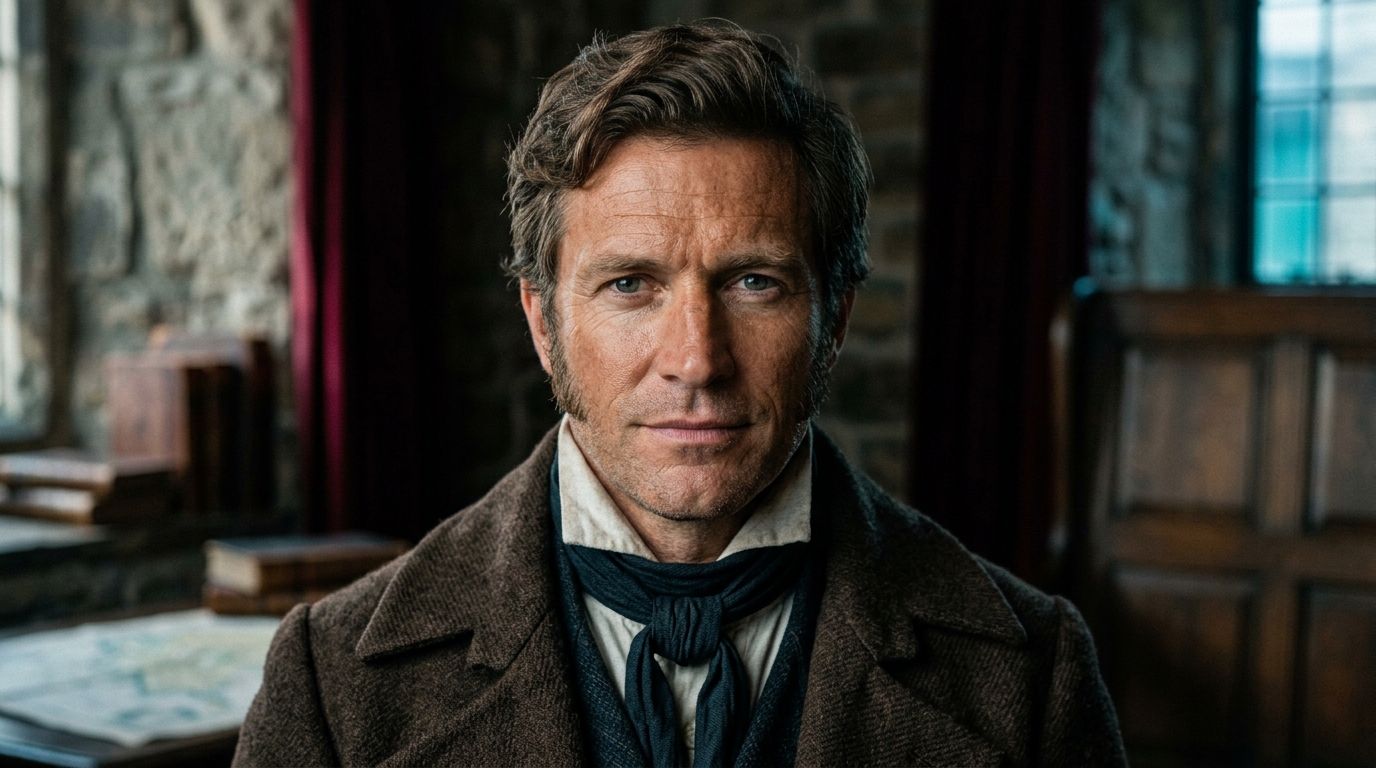
The Yorkshire Boy and the Open Moor
Thomas Edward Ainsworth was born on 15 September 1774 in the village of Haworth, set high on the moors of the West Riding of Yorkshire. He was the eldest son of Edward Ainsworth, a landowner whose family had held and worked the same fields for generations, and of Eleanor Ainsworth, a devout and exacting woman who kept the household and its conscience. From his earliest years Thomas was given to understand that land was not merely owned but answered for, and that a name carried obligations as surely as it carried privileges.
The moor was his first teacher. Beyond the garden wall the country opened into heather and gritstone and weather that changed its mind by the hour, and Thomas walked it in every season. He was rarely alone. His younger brother William trailed after him, and so did Jonathan Blackwood, a boy from the same parish whose friendship would outlast their childhood by half a lifetime and carry consequences neither could have imagined. Together the three of them mapped the becks and the sheep tracks, named the outcrops, and treated the whole bleak upland as a kingdom held in trust for them alone.
What set Thomas apart, even then, was the way he looked at ground. Where other children saw a hill, he saw a route over it; where they saw a stream, he traced it to its source. He filled the margins of his lesson books with rough plans of the land around Haworth, and he begged paper from his mother so that he might draw the moor as a bird would see it. The habit never left him. Long before he had a word for it, Thomas was a cartographer, reading the world as a thing to be charted and understood.
Family Tree
A Surveyor of His Own Country
As Thomas grew into a young man, the moors of Haworth proved too small a kingdom. He took to travelling, at first across the dales of his own county and then further afield, into the fells of the north, the flat fen country of the east, and the wooded valleys of the west. He went on foot and on horseback, carrying notebooks bound against the rain, and he returned from each journey with pages crowded by observation: the lie of a valley, the temper of a river, the way a road ought to have run had anyone troubled to survey it properly.
These were not idle wanderings. Thomas approached the land of England with the discipline of a man taking inventory, and his journals grew into a private atlas of places few of his neighbours would ever see. He sketched coastlines and bridge crossings, noted the quality of soil and the set of the prevailing wind, and corrected, with some satisfaction, the errors he found in the printed maps he carried. To chart a thing accurately, he believed, was the first act of mastering it, and mastery of unfamiliar country was the nearest thing he knew to joy.
His reputation spread modestly among those who valued such men. He was known as good company on a hard road, level-headed in difficulty, and possessed of an almost stubborn confidence that any wilderness could be read if one only paid it sufficient attention. He was also, by temperament, a leader; men deferred to him without quite deciding to, and he assumed responsibility as naturally as he drew breath. These were the qualities that would one day be recognised by an old friend, and turned towards an end neither of them could yet have named.
Eleanor of Bristol
In 1801, on a journey that carried him to the south-west, Thomas attended a social gathering in the port city of Bristol and there met Eleanor Sinclair. She was the daughter of Captain Henry Sinclair, a naval officer often away at sea, and of Amelia Sinclair, née Grey, who ran a modest and well-kept boarding house through which a steady tide of travellers passed. Eleanor had grown up amid talk of distant coasts and the comings and goings of strangers, and she had acquired both a curiosity about the wider world and the practical competence of a young woman who had long helped manage a household.
Thomas was captivated. Eleanor was intelligent and composed, gifted in painting and well read, and she met his restless talk of far country not with alarm but with interest. For her part she found in the Yorkshireman a seriousness of purpose that matched her own. Their courtship was not long. They were married on 14 June 1802 and settled together in Thomas's home country in the West Riding, where Eleanor took up the life of a landowner's wife and Thomas continued, between obligations, to travel and to chart.
For the better part of a decade they lived in this fashion, their partnership steadied by mutual respect and a shared appetite for the unfamiliar. Eleanor managed their affairs with the same sure hand her mother had taught her, and Thomas came to rely on her judgement as much as on his own. It was a marriage of two capable people who had each found in the other a willing accomplice, and when the great upheaval of their lives arrived, they would meet it not as one venturer and one follower, but as equals stepping through together.
The Proposition of Jonathan Blackwood
The friend of Thomas's boyhood had not stood still. In the years since they had roamed the moor together, Jonathan Blackwood had come into knowledge of a kind that few on Earth possessed. He had become a Guardian, one of those rare individuals entrusted with a Portal Key and charged with opening new settlements in Clivilius, a world reached only through doorways bound to the blood of those who held them. Blackwood had been established in that other world for some time when, in 1808, he turned his mind to the founding of a settlement of his own design, and to the question of who might be fit to raise it.
He thought of Thomas. He needed five, for Guardians worked in companies of five, a Guardian Atum bound by a single purpose, and he sought in each a particular strength. To Thomas he offered the leadership and the surveyor's eye; alongside him he gathered Elizabeth Carrington for her knowledge of growing things, George Henry Whitmore for the vine and the craft of wine, Mary Ellen Fairchild for healing and the care of bodies, and Robert Samuel Aldridge for the raising of walls and roofs. It was, by any measure, an extraordinary proposition: to leave the known world entirely and build a community from bare ground in another.
Thomas did not hesitate long. Here at last was a wilderness beyond any he had charted, a country no map of England could contain, and the chance to be not merely its surveyor but its founder. He spoke of it with Eleanor, who understood at once both the magnitude of the risk and the impossibility of his refusing it, and who chose to go with him rather than be left behind to wonder. Their decision made, the Ainsworths set their earthly affairs in order and turned towards a threshold no one in Haworth would have believed existed.
First Through the Door
On 10 March 1810, Thomas Edward Ainsworth pressed his Portal Key and crossed into Clivilius, the first of the five Guardians to set foot upon the ground they had been given to settle. What met him was not welcome. The land along the Whitmore River was barren and silent, scoured by an unfamiliar weather, offering neither shelter nor any sign that men had ever stood there before. A lesser man might have read the desolation as a verdict. Thomas read it as a beginning.
He walked the ground in those first days as he had once walked the moors of his boyhood, taking its measure. He traced the river to where it rose in the highlands and followed it down to where it lost itself in the wetlands to the south-east; he marked the rises that would carry buildings clear of flood, the flats that might in time bear crops, the line a road should follow. Where others would see only emptiness, Thomas was already drawing the settlement that did not yet exist, fixing it in his mind and on paper before a single stone had been laid.
This was the work for which his whole restless life had prepared him. Every journey across England, every corrected map and rain-stained journal, had been an apprenticeship for these weeks of solitary reckoning on the banks of the Whitmore. By the time his fellow Guardians and the first settlers were ready to follow, Thomas had ceased to see a wilderness at all. He saw Brierly, whole and thriving, and he had only to summon the others and begin the long labour of making the vision true. For those first weeks he was, in the most literal sense, almost the only human soul in a world, and he met the strangeness of that not with dread but with the steady attention of a man who had always preferred a map to a crowd.
Raising Brierly
On 10 May 1810, the first settlers came through to join the Guardians, bringing tools, seed, livestock, and the provisions on which the infant settlement would depend. They were for the most part country people out of rural England, accustomed to hard work and plain living, and they arrived to find Thomas waiting with the ground already surveyed and the plan of the place laid out. He rallied them with a confidence that steadied their fear, parcelled the labour, and set the building of Brierly in motion before the season turned.
The early years asked everything of them. The weather of Clivilius was its own master, the soil yielded slowly, and there were seasons when survival itself was in question. Through them Thomas led not by decree but by example and by the trust the settlers placed in him, while his fellow Guardians turned their gifts to the common work. George Whitmore set the first vines into Clivilian ground in 1815; Robert Aldridge raised the dwellings and, on 20 July 1816, began with Thomas the building of the Town Hall that would become the settlement's beating heart; Mary Fairchild tended the sick and brought the children safely into the world; Elizabeth Carrington coaxed crops and gardens from the stubborn earth.
Even as he governed, Thomas never set aside his charts. He ranged out from the settlement to map the country beyond it, fixing the highlands and the wetlands and the safe routes between, and the maps he made passed into the hands of every settler who ventured past the edge of the known. They turned an unknown world into a navigable one and brought wanderers home alive. He taught a handful of younger settlers to read his charts and to add to them, so that the knowledge would not die with him, and in time the surveying of Clivilius became a craft handed down rather than a gift held by one man alone. By 1820, when the community gathered for its first Harvest Festival and the ceremony of the First Pour, Brierly had become what Thomas had seen on his first lonely survey: not a foothold, but a home.
The Cartographer's Hearth
For all that he gave to the settlement, Thomas's deepest labours were also the most private. On 17 November 1814, after years in which the hardships of the founding had left no room for children, Eleanor gave birth to their first child, a son they named Edward. He was the first child born in Brierly, and his arrival was kept by the whole community as a sign that the settlement had put down roots that would hold. Two more followed: Charlotte in 1816 and William in 1819, until the Ainsworth household stood as a small emblem of the larger one Thomas had built around it.
Eleanor was the steady centre of that home and no small part of the settlement's strength. The competence she had learned in her mother's boarding house she now turned to the ordering of a frontier community, and the painter's eye she had brought from Bristol she turned upon the rugged country of Clivilius, setting down its colours and contours in pictures that gave the settlers a way of seeing beauty in the hard land they had chosen. In counsel she was Thomas's equal, and he leaned on her judgement through every trial the early years produced.
By his own hearth, in the evenings, Thomas returned to his maps and journals. He kept recording the world he had made and the one he had left, filling volume after volume in a hand grown familiar to his children, and these papers became the settlement's first archive of itself. To his son and daughters he was both the father of the family and, in some larger sense, the father of the place they lived in, and the distinction between the two was never quite clear to them, for in Brierly it was never quite clear to anyone.
The Long Evening
The decades carried Brierly from a desperate beginning into something settled and sure. The vines matured, the Town Hall filled with the business of a living community, the Harvest Festival came round each September as faithfully as the season, and the children of the founders grew up knowing no other home. Thomas, ageing now, gave the daily governing over by degrees to younger hands and to the council of leaders and landholders the settlement had grown, content to watch the thing he had imagined go on without needing him at its centre. He had never wished to be a ruler, only a maker; once the making was done, he was content to let the settlement govern itself through the council and customs it had grown.
His last great sorrow came on 29 August 1850, when Eleanor died. They had been married eight-and-forty years, had crossed between worlds together and raised a settlement and a family in a country neither had been born to, and her loss left him a widower in the home they had made from nothing. For five more years he lived among his children and grandchildren and the community that still called him its founder, his maps and journals about him, the moors of Haworth a lifetime and a world away.
Thomas Edward Ainsworth died on 7 November 1855, in his eighty-second year. Brierly mourned him as it had mourned no one before, for he was the first of the five to set foot on its ground and the man whose vision had given the settlement its shape. He was laid to rest in the earth he had surveyed and named, and the volumes of charts and journals he left behind passed into the keeping of the place he had made, the truest record of how an empty stretch of river country had become a home. That autumn the Harvest Festival was kept in his memory, and the settlement he had founded went on without him.







