4338.208 · July 27, 2018 AD
This Fucking Dust
The brief triumph of Luke's BMW becomes another humiliation when Paul buries it in dust within a hundred metres, and the mockery that follows cuts deeper than it should. As the day stretches on and exhaustion compounds with failure after failure, something in Paul begins to fracture. When Luke arrives with more belongings for people who barely have shelter, the dam finally breaks, and Paul discovers that rage has been waiting just beneath the surface all along—rage at the dust, at his helplessness, at becoming someone he doesn't recognise.
"There's a moment when you realise you're not angry at the dust or the heat or your brother—you're angry at yourself for all the ways you don't measure up to what this place demands."
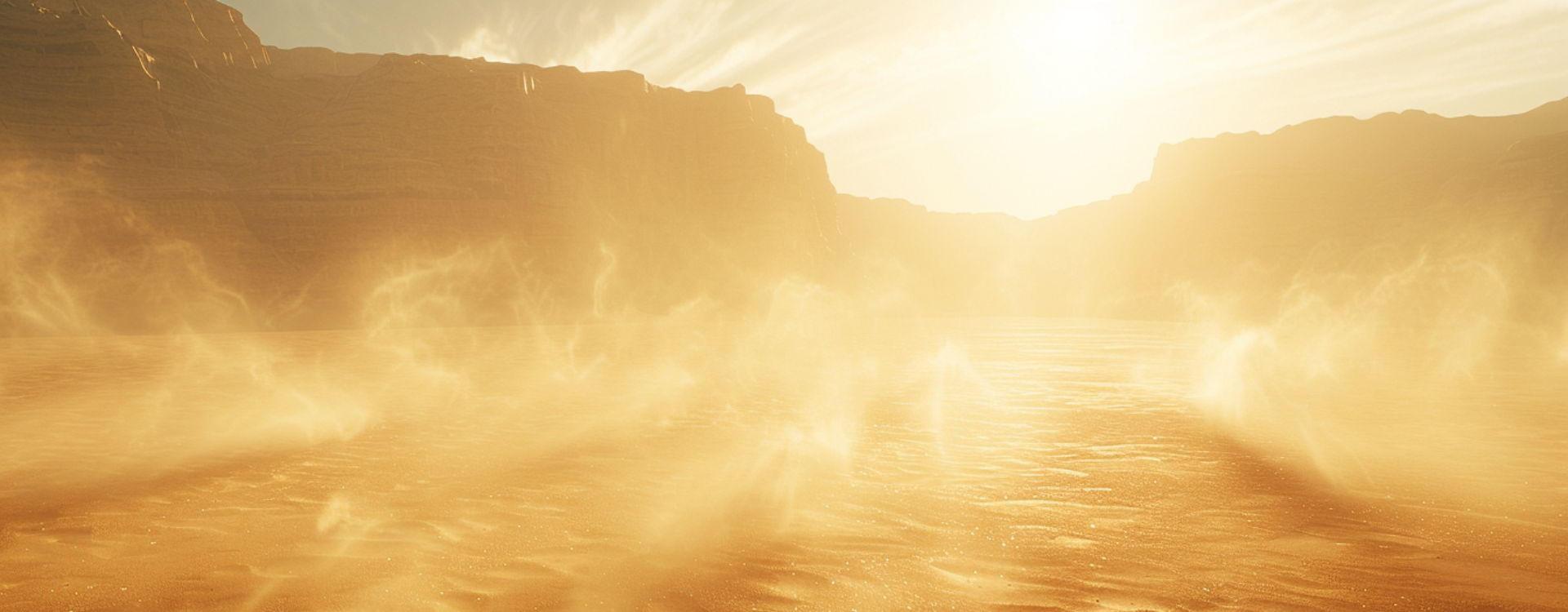
I wiped the sweat from my forehead, the gritty sensation of dust mingling with perspiration serving as a harsh reminder of the environment's unforgiving nature. The mixture formed a paste on my skin, and I could feel it caking in the creases of my forehead, around my eyes, in every fold and crevice of my face. It was in my ears. Between my fingers. Grinding against my teeth every time I swallowed. My feet dragged through the thick, omnipresent dust, each step a laborious effort that echoed the desolation of our surroundings.
Pausing, I shook out the fine, pervasive dust from my shoes for what felt like the umpteenth time, my mind bitterly comparing this to the more forgiving sands of a beach—or even the rugged terrain of Broken Hill. This was a different beast altogether, a relentless, suffocating blanket that seemed to seep into every crevice, both physical and emotional. Beach sand stayed where you put it. Broken Hill dust could be washed away. This dust was alive. It followed you. It hunted you. It waited for the moment you thought you had escaped it, then reappeared in your food, your clothes, your lungs. It was patient in a way that felt almost malicious, as if the landscape itself had decided we didn't belong here and was slowly, methodically trying to drive us away.
The sudden, familiar rumble of the ute's engine cutting through the still, heavy air propelled me into action, my jogging pace a futile attempt to escape the omnipresent dust cloud that trailed my every move. As I approached, Kain greeted me with the window wound down, the interior of the vehicle a brief, tantalising glimpse into a world less choked by dust. The cabin looked almost clean. Almost civilised. I found myself irrationally envious of the few minutes he had spent inside it.
"No Luke?" I inquired, trying to keep the worry out of my voice.
"Nope," Kain responded—a verbal shrug that did little to assuage the knot of worry forming in the pit of my stomach.
I couldn't help but wonder about Luke's whereabouts and the silent pressures we all navigated beneath the surface of our makeshift community. Where was he? What was he doing? When would he return? The Portal was our lifeline—our only connection to Earth, to supplies, to any hope of building something sustainable here. And Luke was the only one who could operate it. Every hour he was gone was another hour we were isolated, vulnerable, dependent on whatever he had already brought through.
"Need a lift back?" Kain offered, breaking through my reverie.
"Nah. All good," I replied, brandishing the pen and folded paper I had been safeguarding in my back pocket as if they were talismans against the uncertainty of our situation. "I'll do an inventory and then I'm going to make Luke some lists."
My voice carried a determined undertone, a commitment to getting things done. Lists I could do. Organisation I could handle. It was one of the few skills from my old life that translated to this new one. In Broken Hill, I had managed supply chains and logistics, had coordinated shipments and schedules and the thousand small details that kept a business running. Here, those same skills felt simultaneously vital and useless—vital because someone needed to track what we had, useless because no amount of organisation could conjure supplies from thin air.
Kain's laughter, light and unburdened, floated through the air. "Your inventory will be easy. I think it's mostly just large shed materials left."
His words, though meant in jest, anchored me back to the purpose of my endeavour. The task of inventory, simple as it might appear, was a linchpin in the delicate machinery of our operations. I was acutely aware of the weight of responsibility that came with construction, far removed from the hobbyist projects of my past. This wasn't about assembling a child's playhouse for Rose or piecing together a computer desk from an IKEA box; the stakes were infinitely higher, with real consequences for failure.
If we got the material lists wrong, Luke would bring the wrong supplies. If we brought the wrong supplies, the sheds wouldn't get built. If the sheds didn't get built, everything would be buried in dust. The chain of cause and effect stretched out before me, each link vital, each potential failure catastrophic. And somewhere in that chain was me—a businessman trying to be useful in a world that had no use for businessmen.
"They're making quick work with the tent. I'm sure Glenda will enjoy helping you with the slabs," I offered, an attempt to bridge my concerns with the ongoing efforts back at camp.
"Okay," Kain responded tersely, the finality of the conversation underscored by the revving engine and the subsequent kick-up of dust as he drove the ute back towards camp.
I stood there, a solitary figure amidst the swirling dust, watching the vehicle's rear tyres bite into the soft earth. The worry lines deepening on my forehead were a mirror to the tracks left by the ute, a physical manifestation of my internal fears.
He'll be lucky if he doesn't get bogged, I thought, the irony of which might become painfully apparent to me before the day was through.
The Drop Zone, a sprawling expanse of dust and ambition, had quickly sapped what little energy I had mustered that morning. After a solitary, contemplative lap around the perimeter—counting boxes, noting labels, trying to impose some order on the chaos—I found myself gravitating towards an unassuming box, its surface dust-coated yet inviting. Settling down, the heat enveloped me like a suffocating blanket, and a sense of exhaustion washed over me, leaving me feeling utterly deflated.
With a heavy sigh, I smoothed out a piece of paper along my thigh, the texture of the material a startling reminder of the roughness of my hands, dry and gritty from the relentless dust. When had my hands become this rough? In Broken Hill, they had been soft—the hands of a businessman who hired others to do the physical work. Hands that signed contracts and shook other hands and typed emails about quarterly projections. Now they were cracked and calloused, the skin split in places from the constant exposure to dust and sun. I barely recognised them as my own.
Despite the overwhelming odds, a flicker of hope persisted within me—hope that Luke might procure the right materials for my ambitious project. It was a long shot, given our isolated circumstances and the specific needs of the Drop Zone, yet the possibility of contributing to something tangible spurred a rare surge of optimism. So, with deliberate care, I began to jot down the requirements in very general terms at the top of the page: long posts and shade cloth – the Drop Zone needs some shelter.
The words, simple yet laden with the weight of our collective need for respite from the relentless sun, seemed to echo the urgency of our situation. Every piece of equipment, every box of supplies, everything Luke brought through the Portal ended up here first, baking in the heat, coating in dust. Food spoiled. Fabrics faded. Metal grew hot enough to burn bare skin. If we could build some kind of shelter, some kind of protection—it would change everything. It would be my contribution. My mark on this place.
Time became a blurred notion, lost amidst the concentration and the relentless heat that made the sweat trickle down my face incessantly. It was during this haze of focus and discomfort that the bright colours of the Portal abruptly shattered my concentration, its vibrant swirls igniting a spark of excitement within me.
The arrival of the charcoal BMW, gliding to a stop just a few metres from the Drop Zone's modestly pillared entrance, was a spectacle that momentarily lifted the oppressive atmosphere. Admiration washed over me, a brief respite from the day's drudgery. The car was beautiful—sleek lines, expensive paint, the kind of vehicle I might have owned back in my old life if I'd chosen flash over function. Claire had always wanted something like this, something that announced our success to the neighbours. I had insisted on practicality. Now, looking at this machine gleaming in the sun, I wondered if I had been wrong about that too.
Yet, as the vehicle came to a halt, a flicker of curiosity morphed into intrigue. I squinted against the glare, the silhouette of an additional passenger momentarily catching my attention. The question of who it could be lingered in the air, an unresolved puzzle that was quickly overshadowed by the sudden appearance of a large golden retriever leaping from the car.
The dog's majestic form, a burst of energy and fur, trotted past with an air of purpose, oblivious to my presence. Its bark, both joyful and commanding, seemed to herald its arrival as it made a beeline towards the camp.
"Lois!" Luke's voice cut through the stillness as he emerged from the car.
What the hell is Luke thinking bringing yet another dog here!
My frustration bubbled up, manifesting in a silent, theatrical gesture of disbelief towards the sky. In this landscape, every new mouth to feed was another day's worth of resources stretched thinner. We could barely keep ourselves fed and watered—the river was our only source of fresh water, and food came through the Portal in quantities that Luke determined, on schedules that Luke controlled. Now there were three dogs to care for? Henri and Duke, who belonged to Luke and Jamie. And now this golden bundle of enthusiasm, bounding across the dust as if she owned the place.
"Glenda's," Luke explained briefly, as if the mere mention of her name should clarify any and all concerns.
I could only offer a noncommittal shrug in response, the dog already forgotten as my interest pivoted towards the vehicle. Glenda had earned the right to have her dog here—she had saved Joel's life, had worked harder than anyone to establish the camp, had contributed in ways I could only envy. If anyone deserved a companion, it was her.
"Nice car," I commented, my fingers tapping against its hood with an appreciative rhythm. The sleek lines of the BMW contrasted sharply with the rugged backdrop of the desert. The metal was warm under my touch—not the scalding heat I had expected, but a pleasant warmth that spoke of quality engineering. The paint was flawless, unmarked by the dust that covered everything else. It looked like it had just rolled off a showroom floor.
"Do we get to keep it?" I asked, half-joking yet secretly hopeful.
"Of course," Luke responded, his casual affirmation catching me off guard. "The keys are in the ignition."
"Sweet," I murmured, allowing myself a moment of unabashed pleasure as I sank into the front seat.
The interior's cool luxury was a refreshing departure from the harsh, unforgiving environment outside. Leather seats that cradled my body like they had been designed specifically for me. Climate control that promised relief from the endless heat. A dashboard that looked like it belonged in a spaceship, all digital displays and gleaming surfaces. For a moment, I could almost forget where I was. Could almost pretend I was driving to a business meeting, to a restaurant, to anywhere but this dust-choked wasteland.
"Have you got Joel's address yet?" Luke inquired, snapping my attention back to him.
"Yeah," I replied, fishing the torn piece of paper from my back pocket and handing it over.
A grin tugged at my lips as I watched his reaction, knowing full well the assumptions that would dance through his mind at the sight of the barely legible scrawl. The handwriting looked like a spider had dipped its legs in ink and crawled across the page.
"Joel wrote it," I hastened to add, eager to absolve myself of any blame for the illegible handwriting that barely passed for an address.
"Oh," Luke murmured, his reaction subdued, betraying a hint of surprise. "Nice."
"Hey!" I called out, extracting myself from the cocoon of the car as Luke began to distance himself. "Are you going to help?"
My gesture encompassed the vehicle, heavily laden with supplies that whispered promises of progress and backbreaking labour in equal measure. The back seat was piled high with pillows, blankets, bags, and cases—other people's belongings, other people's comforts, brought through the Portal while I sat in the dust making lists.
"Can't," Luke replied with a straightforwardness that bordered on dismissive.
He brandished the torn piece of paper like a shield, a flimsy excuse that nonetheless granted him passage away from the physical toil awaiting us.
"Joel's waiting," he called over his shoulder, his form retreating towards the swirling colours of the Portal.
Then, just like that, he was gone, swallowed by the kaleidoscopic gateway that connected our worlds. The Portal's vibrant hues faded, leaving me alone with the car, its cargo, and a sense of abandonment that was becoming all too familiar in this landscape of survival and sacrifice. Luke appeared, delivered something, and vanished—leaving the rest of us to deal with whatever he had brought. It was always like this. He was the god of this place, descending from on high to bestow gifts, then retreating to his heavenly realm while the mortals scrambled to make use of his bounty.
Closing the car door behind me, I felt a surge of excitement mixed with a touch of reverence for the task at hand. Turning the key in the ignition, the car purred to life, a symphony of perfection that momentarily eclipsed everything else. A wide grin spread across my face, unbidden yet genuine, as I whispered to no one in particular.
"Such a beautiful car."
My eyes danced over the interior, taking in the luxury of the leather that peeked out from under an assortment of pillows, blankets, and an array of bags and cases—a juxtaposition of opulence and practicality that somehow seemed fitting for our odd existence. I adjusted the mirrors. Ran my hands over the steering wheel. For just a moment, I felt like myself again. Like the Paul who had driven to work every day, who had control over his life, who knew what he was doing.
With a final, affirming rev of the engine, I guided the shiny vehicle over the crest of the first hill, the thrill of the drive igniting a flicker of joy within me. Plumes of dust billowed into the air behind me, marking my passage through this desolate landscape.
"Woo!"
The exultation slipped from me as the car fishtailed down the hill, a moment of exhilaration that was abruptly snuffed out as the vehicle came to an unexpected and jarring halt.
The world seemed to stop. The engine was still running, but the car wasn't moving. Something was wrong.
I attempted to restart the car, turning the key with a mixture of hope and urgency even though the engine was already running. My foot pressed the accelerator, and the engine responded with a healthy roar—but the wheels just spun. The sound was wrong. Desperate. Futile. I pressed harder, panic rising in my chest, and the back wheels dug themselves deeper into the unforgiving dust until they, and my spirits, ground to a halt.
Climbing out to assess the situation, the depth of it hit me hard. The wheels had buried themselves so deeply that the bottom of the bumper was barely an inch above the ground. The beautiful charcoal paint was now coated in red-brown dust, the sleek lines obscured by the very landscape I had been trying to traverse. The luxury car looked like it had been attacked by the earth itself, swallowed halfway and left to die.
"Shit!"
The word was a cry of frustration, echoing starkly against the silence of the barren landscape. I had warned Kain about getting bogged. I had worried about the ute sinking into the dust. I had stood there feeling superior, thinking he'll be lucky if he doesn't get bogged—and here I was, having done exactly what I had feared, in a car that wasn't even mine, within a few hundred metres of the Drop Zone.
The irony was so perfect it was almost funny. Almost. If I hadn't wanted to scream, I might have laughed.
With a huff of disappointment that felt heavy in my chest, I resignedly removed the key from the ignition, my actions automatic as I began to unload several bags from the car. To my chagrin, they turned out to be dog food—a small consolation, but one I clung to nonetheless. I couldn't bear the thought of returning to camp completely empty-handed, not after the brief taste of freedom the car ride had offered. Not after the joy I had felt, however briefly, before the dust claimed another victim.
And so, with my enthusiasm deflated and the weight of failure pressing down on me, I began the short but now seemingly insurmountable trek back to camp. The bags felt heavier with each step, a physical manifestation of my disappointment. I was almost there, on the cusp of a small victory—a moment of competence, of contribution, of proof that I belonged here. Yet, as I marched back to face the others, the dust clinging to my shoes and the dog food cradled in my arms, I couldn't help but feel the sting of what could have been.
Another failure. Another item on the growing list of things I couldn't do.
As I made my way into the heart of our burgeoning camp, the declaration fell from my lips with a mix of resignation and determination.
"We need a road."
The moment my presence was noted, Lois, a bundle of unrestrained joy, abandoned Joel's side to greet me. Her tail was a frantic pendulum of excitement as she bounded towards me, her enthusiasm a stark contrast to the weight of the situation I was bearing. She didn't know about the car. Didn't know about my failure. She just saw a human and decided that human deserved her love.
Tossing the car keys to Glenda with a casual flick of my wrist, I set down the bags of dog food with a thud, the dust rising around us like a slow exhale. Crouching to meet Lois, her affectionate lick across my cheek sparked an immediate smile despite everything.
"Ooh, you're a gorgeous girl," I murmured, my fingers lost in the thick fur of her head, each scratch a momentary escape from the harsh reality awaiting us just over the hill. At least someone was happy to see me. At least someone didn't care that I had just buried a luxury car in the dust. At least someone thought I was worth greeting with joy.
"My car's here?" Glenda's voice, tinged with a mix of surprise and concern, cut through the moment. The keys dangled from her hand, a symbol of both hope and the complications that came with it.
"Yeah," I responded, distracted, my attention wholly claimed by Lois, whose demands for affection provided a brief, cherished respite. "It got bogged just over the hill."
The admission was made with a heavy heart. I couldn't look at Glenda as I said it. Couldn't face the disappointment or—worse—the understanding that would be in her eyes. I had taken her car, her beautiful car, and buried it in the dust within minutes of sitting behind the wheel.
"We definitely need a road," Kain said, his laughter light and mocking, attempting to slice through the tension.
"I wouldn't be laughing if I were you," I retorted, the jest tinged with an edge of reality. "You want to be the one to collect the stuff in it or dig it out of the dust?"
"Honestly," Glenda exhaled in a huff. "This camp is like living with a bunch of children sometimes."
Her stride towards the car, with Lois and Duke trailing loyally behind, was a mix of determination and resignation, bracing herself for yet another obstacle. I deserved that. We all knew I deserved that. The sting of her words was worse than any mockery Kain could have offered.
Kain and I exchanged a glance, an unspoken acknowledgment of the absurdity and complexity of our situation. Then Jamie spoke, his joke a light-hearted attempt to ease the tension—though it felt more like salt in a wound.
"I don't think she's got any children."
"I heard that!" Glenda's call, sharp and clear, reverberated back to us from halfway across the camp, a reminder of her ever-vigilant presence.
"Come on," Kain urged, nodding towards Glenda's retreating figure.
As we made our way across the uneven terrain, the absence of our newest additions to the camp sparked a question that had been lingering at the back of my mind.
"Hey, where are the new people?" I asked, curious about their whereabouts.
"Karen and Chris?" Kain echoed, as if to confirm whom I was inquiring about amidst our ever-growing assembly of settlers.
"Yeah," I affirmed.
Jamie's shoulders lifted in an indifferent shrug, his silence speaking volumes of our collective awareness—or lack thereof—of each other's movements.
"They've gone for a walk," Kain finally disclosed.
"Oh, the lagoon?" The question left my lips tinged with a knowing smile, the mention of the lagoon bringing forth images of tranquillity and sensual energy—the one place in this landscape that offered something approaching beauty.
"Pretty sure they went upstream," Kain corrected, redirecting my mental map of their possible retreat.
Our focus shifted abruptly as Jamie, crouching beside the car's hopelessly buried back wheel, let out a mix of astonishment and amusement.
"Fuck! You've done a good job, Paul."
His voice was laced with a sarcastic commendation, drawing a tight line of frustration across my forehead. The wheel was buried up to the hub. The undercarriage was scraping the dust. It looked like the landscape had tried to swallow the car whole—and had very nearly succeeded.
"It all happened so quickly," I defended, the words barely covering the embarrassment and haste that had led to the car's unfortunate demise. One moment I was driving, feeling alive for the first time in days. The next moment I was stuck, the dust claiming me as it claimed everything else.
"I bet it did," Jamie retorted, the undercurrent of humour in his voice matched by Kain's soft chuckle.
The camaraderie, though strained by the situation, was a thin veneer over the underlying tension. They were laughing at me. Not with me—at me. The distinction mattered more than it should have. Rolling my eyes, I turned away, eager to escape the spotlight of their amusement.
"You're not staying, Paul?" Glenda's voice called out, a mix of surprise and reproach halting my retreat.
"I don't think Luke's done yet," I replied. The words, while true, were a thin veil for my desire to distance myself from the immediate failure and perhaps find solace in whatever new arrival lay ahead. My steps, determined yet heavy, carried me away from the group. Away from Jamie's mockery. Away from my own humiliation.
The sound of soft steps trailing behind me prompted a pause in my stride. Turning slightly, I saw Lois, her attention momentarily caught by the mundane allure of the desolate landscape.
"Come on, Lois," I encouraged, a faint smile breaking through as she dutifully followed, after stopping to sniff at nothing-in-particular and squatting to pee. At least I had company. At least someone wanted to be near me, even if that someone was a dog who had known me for less than an hour.
"Luke!"
The call left my throat more as a plea than a summons, echoing off the dusty landscape as Lois and I stood sentinel atop the final hill. The sight of him, hastily abandoning an armful of belongings by the Portal only to vanish without a trace, sparked a flare of frustration within me. The fact that he hadn't even bothered to take it to the Drop Zone—where I had spent the morning creating systems, making lists, trying to impose some semblance of order—struck me as both reckless and disheartening.
Was this how it was going to be? Luke bringing things through whenever he pleased, dumping them wherever was convenient, leaving the rest of us to sort through the chaos? The Drop Zone existed for a reason. The inventory existed for a reason. But none of that mattered if Luke wouldn't use the systems we were trying to build.
By the time Lois and I made our way down to the Portal, the heat and the exertion were evident in her laboured panting. The air was thick, almost tangible with the heat that shimmered off the barren earth. She was struggling—this beautiful dog who had bounded so joyfully from the car just hours ago, now reduced to panting and shuffling by the relentless conditions.
"We'll just see what Luke is doing and then we'll get you back to camp for some water," I assured her, the promise feeling hollow even as I made it. I was exhausted. She was exhausted. And here we were, trudging through the dust because Luke couldn't be bothered to carry his deliveries the extra fifty metres to the Drop Zone.
Lois's attempts to find a comfortable position to rest, her awkward shuffling and resettling, painted a picture of discomfort that resonated deeply with me. The dust was hot beneath her paws—I could see her lifting them, one at a time, trying to escape the burning ground. The sun beat down mercilessly. When she finally stood still, her gaze lifted to mine, eyes brimming with a sadness that mirrored my own sentiments. The dust, invasive and relentless, seemed to sap the vitality from us both.
"I know," I found myself empathising openly as I crouched to offer her a comforting pat, my hand finding the soft fur behind her ears. "This dust is horrible, isn't it?"
The words were a whispered acknowledgment of our shared plight, a moment of connection in the midst of our struggles. Here I was, talking to a dog about the dust. Here I was, finding more comfort in her silent companionship than in any human interaction I'd had today. She didn't judge me for bogging the car. She didn't mock me for my failures. She just looked at me with those sad, tired eyes and let me scratch behind her ears.
Faced with the task of dealing with an abandoned suitcase, my gaze drifted back towards camp, the distance looming like a chasm filled with heat and exhaustion. My eyes closed against the daunting prospect, a silent plea for respite from the relentless sun.
It's too far, the thought echoed in my mind, a sentiment that bore the weight of the day's challenges and the cumulative toll of our circumstances. The very idea of undertaking another trek back to camp, under the scorching sun and with the dust swirling around me, felt like too much to bear in that moment. But what choice did I have? Leave the suitcase here to bake in the heat? Let whoever owned it wonder where their belongings had gone?
With a resigned determination, I lifted the suitcase and carried it to the Drop Zone. One trip at a time. One task at a time. That was all I could manage.
Bending to collect the second suitcase, the world around me felt like it was closing in, the boundaries between frustration and resignation blurring. Then, as if on cue, Luke materialised through the swirling colours of the Portal, his arms full of more belongings, his expression casual and unbothered.
"Who's all this for?" The question burst from me, a mix of curiosity and a growing frustration that I found increasingly difficult to keep at bay.
"Oh," Luke began, his casual demeanour in stark contrast to the tension I felt. "The suitcases are for Karen and Chris, the large backpack over there is for Kain, and these—"
He gestured with a nod towards the small bags still clutched in his grasp.
"—are Joel's."
I was about to respond, to articulate the mixture of disbelief and concern that was brewing within me, when Luke cut me off with a continuation that felt almost dismissive in its casualness.
"And I may as well bring a few things through with me whenever I come and go from different locations, so expect the random."
Random!
The word echoed in my head like a siren, its implications unsettling. This randomness, this unpredictability, it was the straw that broke the camel's back, shattering the fragile veneer of my composure. All morning I had been making lists. All morning I had been creating systems. All morning I had been trying to bring some order to this chaos—and now Luke was telling me to "expect the random"?
Something was breaking loose inside me—some dam that had been holding back days of frustration and fear and helplessness. I could feel it cracking, could feel the pressure building behind it, and I knew I should stop, should take a breath, should walk away before I said something I couldn't take back. But I couldn't stop. The words were already rising, already pushing past my lips.
"You can't just bring random crap through," I found myself saying, the volume of my voice a testament to the mounting pressure within.
"It's not crap! These are people's belongings!" Luke's retort was swift, his frustration mirroring my own as he dropped the bags in a gesture of defiance. His face was flushed now, his casual demeanour cracking.
"What the hell are they supposed to do with it all?" My voice rose in anger, a part of me detachedly recognising the irrationality of my outburst, yet powerless to rein it in. The words poured out, unstoppable. "It's not like we have anywhere to put anything! Hell, we don't have houses. We may as well be living in dog kennels!"
"Far out, Paul!" Luke's exclamation, his hands thrown up in a gesture of exasperation, felt like a physical blow. "Give me a break. I'm only trying to make things more comfortable and homely for you all."
"Homely!" The word tasted bitter as I spat it back at him. "You can hardly call this homely!"
In a fit of frustration, I scooped up a handful of the omnipresent dust, throwing it into the air as if to punctuate my point. The red-brown powder cascaded around us, coating everything, proving my point even as I made it. It settled on Luke's shoulders, on the bags at his feet, on my own outstretched hand.
"This fucking dust is everywhere and it is driving me fucking nuts!"
Luke's response was laughter, a sound that felt jarringly out of place in the heat of our argument. The sound grated on my already frayed nerves. He was laughing. Laughing at my frustration. Laughing at my breaking point. Laughing at me the way Jamie had laughed, the way Kain had laughed, the way everyone seemed to laugh at the businessman who couldn't do anything useful.
"Just fuck off, Luke," I muttered, a mixture of anger and resignation fuelling my words.
Hefting the backpack over my shoulders and grabbing another smaller bag, I turned to Lois. She was watching me with those patient eyes, tail wagging uncertainly, as if she wasn't sure whether to be worried or encouraging.
"Come on, Lois. Let's get you some fucking water."
As we began our retreat, a heavy sigh escaped me, a sound laden with weariness and a dawning realisation.
I'm starting to sound like Jamie already.
The thought was sobering, a reflection of the strain that this new existence imposed on me, warping my interactions and testing my limits in ways I could never have anticipated. Jamie, with his constant complaints and bitter remarks. Jamie, who seemed to find fault in everything and everyone. Jamie, who told people to fuck off as casually as other people said hello. Was that who I was becoming? Was the dust and the heat and the isolation slowly grinding me down into someone I didn't recognise?
I trudged back toward camp, Lois at my heels, the bags heavy on my shoulders and the shame heavier still. I had yelled at my brother. I had cursed and thrown dust and told him to fuck off. And somewhere beneath all that anger, beneath all that frustration, I knew the truth: I wasn't angry at Luke. I was angry at myself.
Angry at my helplessness. Angry at every task I couldn't complete, every skill I didn't have, every failure that seemed to pile up faster than I could count them.
The businessman who couldn't pour concrete. The manager who couldn't erect a tent. The driver who got a car bogged within a hundred metres. The father who couldn't reach his children. The husband whose marriage had been dying long before he stepped through that Portal.
What good was I here? What could I possibly contribute to a community that needed builders and farmers and people who could actually do things with their hands?
The dust swirled around me as I walked, and I let it. Let it coat me. Let it claim me. Because what else was there to do? I was already covered in it. Already drowning in it. Another layer wouldn't make any difference.
Tomorrow would be better. It had to be.
But today, the dust had won.







