4310.286 · October 13, 1990 AD
Thermometer Games
Luke awakens to find Gloria gone and his mother’s presence filling the void with suffocating control. Behind her careful smiles and gentle touches, he begins to glimpse something darker—proof that even care can be weaponised.
“Sometimes the scariest lies are the ones whispered while someone strokes your hair and calls you ‘darling’.”
Light woke me.
Not the harsh fluorescent glare of the hospital—that was always there, humming and buzzing in the background like an insect that never slept. This was different. Softer. Golden. The gentle fingers of morning sun reaching through the gaps in the blinds, painting stripes across my face, across my closed eyelids, turning the darkness behind them into something warm and amber.
I didn't want to open my eyes.
There was something wrong. I knew it before I was fully awake, before my brain had caught up with whatever my body already understood. A wrongness in the air, in the quality of silence, in the feel of the sheets beneath me. Something fundamental had shifted while I slept, and some deep animal part of me wanted to stay in the darkness behind my eyelids, wanted to pretend I was still dreaming, wanted to keep the truth at bay for just a few more seconds.
But the light was insistent. The morning was insistent. And slowly, reluctantly, consciousness seeped back into my mind like water filling a cup.
The first thing I noticed was the emptiness.
It pressed against my left side—a void where warmth should have been, where the solid presence of another body should have been. My hand was outstretched across the mattress, fingers curled loosely around nothing, reaching for something that wasn't there. The sheets beneath my palm were cool. Not cold, not yet, but cooling. As if heat had been there recently and was now fading, escaping into the air, becoming nothing.
I opened my eyes.
The ceiling stared back at me. White. Flat. Marked with the familiar pattern of cracks I'd memorised during countless sleepless nights—the one that looked like a river, the one that looked like a lightning bolt, the one that looked like Gloria's profile if you squinted just right.
Gloria.
The name hit me, and suddenly I was fully awake, my heart hammering against my ribs. I sat up too fast, the blood rushing from my head, making the room swim and tilt around me. My hand pressed against the mattress for balance, and that's when I realised—
I was in my own bed.
Not Gloria's bed, where I'd fallen asleep. Not tucked against her side with her arm around me and her heartbeat in my ear. My own bed, with its own sheets, its own pillow, its own particular way the mattress sagged in the middle. Someone had moved me during the night. Someone had lifted me out of Gloria's arms and carried me here and tucked me in without waking me.
The transition felt wrong. Violent, almost. As if I'd been ripped from one reality and dropped into another, the seams between them still raw and bleeding.
My gaze swung to the left, to where Gloria's bed should have been a tangle of sheets and magazines and chocolate wrappers, to where Gloria herself should have been sleeping or waking or already sitting up with her Walkman, ready to share whatever song had captured her heart that morning.
Her bed was empty.
Not just empty—made. The sheets were pulled tight, tucked under the mattress, not a wrinkle or fold out of place. The pillow was centred perfectly, plump and undented, as if no head had ever rested there. The blanket was smooth, the hospital corners sharp enough to cut.
It looked like a bed waiting for a patient. A bed that had never been slept in. A display model in a furniture store, not a place where a real girl had laughed and dreamed and told secrets and held her best friend while he cried.
"Gloria?"
My voice came out small. Cracked. Barely a whisper in the silent room. The word hung in the air like a soap bubble, fragile and iridescent, trembling on the edge of bursting.
"Are you awake?"
Silence answered me.
Not comfortable silence, not the quiet of someone sleeping peacefully, not the soft rhythms of breathing and shifting and being alive. This silence was different. Heavier. It pressed down on the room like a physical weight, filling all the spaces where sound should have been, where Gloria's presence should have been.
I stared at the empty bed, my brain struggling to make sense of what my eyes were seeing. The flatness of the sheets. The perfect smoothness of the pillow. The absence of any shape beneath the covers, any indication that anyone had been there at all.
Gloria never left. That was one of the fundamental rules of my universe, as unchangeable as gravity or the taste of hospital food. Gloria was always here when I woke up, always ready with a smile or a joke or a plan for how we'd pass the endless hospital hours. Even when she had to go for treatments—the ones that made her tired and sick, the ones she never complained about but that left shadows under her eyes—she always told me first. Always promised she'd be back soon.
She wouldn't have left without saying goodbye. She wouldn't have.
"Gloria?" My voice was louder now, tinged with something that felt like panic but that I didn't want to call panic because panic meant something was really wrong. "Gloria, where are you?"
The room gave me nothing. Just the hum of the ventilation system, the distant beep of machines in other rooms, the muffled sounds of the hospital waking up around me. The walls seemed to lean inward, the space shrinking, the air growing thick and hard to breathe.
I looked for signs of her. Evidence that she'd been real, that yesterday had been real, that the laughter and the biscuits and the warmth of her arms around me hadn't been just another dream.
Her Walkman was gone from the bedside table. The silver rectangle that was always there, always within reach, always ready to share its treasures—vanished. The earphones that had trailed across the pillow, that had leaked tiny tinny music into the quiet of the room—gone.
But the chocolate biscuits were still there. The packet sat on the table, half-empty, the wrapper folded over neatly the way Gloria always did it, careful and precise even with something as simple as biscuits. And on the wall above her bed, the get-well cards were still taped in place—slightly crooked, because she'd insisted on putting them up herself, refused help even when her arms got tired.
She'd been here. She'd been real. The evidence proved it.
So where was she now?
My mind raced, grasping for explanations, for anything that would make sense of this wrongness.
"Maybe she got moved to a different room," I said aloud. The words echoed in the emptiness, sounding hollow and desperate even to my own ears. But I clung to them anyway, because the alternative—the thing lurking at the edges of my thoughts, the thing I wouldn't let myself look at directly—was too big and too terrible to face.
They moved kids all the time in hospitals. I knew that. I'd seen it happen, beds shuffled around like pieces on a game board, patients appearing and disappearing according to rules none of us understood. Maybe Gloria had gotten sicker in the night. Maybe they'd moved her somewhere with more machines, more nurses, more of whatever she needed to get better.
But why wouldn't they tell me? Why wouldn't they wake me up, let me say goodbye, let me—
"Maybe she's playing hide-and-seek," I said, louder now, forcing confidence into my voice. Gloria loved games. She loved surprises, loved making the boring hospital days feel like adventures. Maybe this was just another one of her schemes, like the wheelchair races or the midnight ice cream missions she was always planning but never quite pulling off.
Maybe she was hiding somewhere right now, watching me, covering her mouth to keep from laughing as I called her name. Maybe in a moment she'd jump out from behind a curtain or burst through the bathroom door, grinning that grin of hers, crowing about how she'd fooled me, how I should have seen my face.
"I'll go find her," I declared, throwing back my covers with sudden determination. The cool air hit my legs, raising goosebumps, but I barely noticed. Action was better than sitting here, wondering, worrying. Action was better than letting the silence press in until I couldn't breathe.
I would check the common room first—Gloria sometimes went there early to claim the good chair by the window. Then the nurses' station, where she charmed extra treats from whoever was on duty. Then the—
"Good morning, Luke."
The voice came from the doorway, and everything inside me went cold.
I knew that voice. I knew it better than any other voice in the world—it had sung me lullabies, whispered me stories, told me everything would be alright more times than I could count. It was my mother's voice, and it should have been comforting, should have been the most welcome sound in the world.
Instead, it sent a shiver down my spine that had nothing to do with the cold air on my bare legs.
Something was wrong with that voice. Something was wrong with its timing, with its brightness, with the way it seemed to fill the room and push everything else out. Mum visited early, yes—she liked to arrive before the day shift started, liked to have time alone with me before the nurses and doctors took over. But this was too early. The morning rounds had barely begun; I could hear them just starting in the corridor, the familiar sounds of carts and clipboards and quiet conversations.
And there was something else. Something in the quality of her greeting, the particular shade of warmth she'd painted it with. It was too bright. Too cheerful. Like a sun that was shining too hard, trying to burn away shadows it didn't want anyone to see.
"Good morning, Mum," I called back, forcing my face into a smile that felt like a mask. The expression sat wrong on my features, too tight, too fixed, but I held it in place anyway. I'd learned, somewhere along the way, that Mum liked smiles. That things went better when I smiled, when I played along, when I didn't ask too many questions.
She glided into the room.
That was the only word for it—glided. Her movements were smooth and graceful, practised, like a dancer hitting her marks. She was dressed impeccably, the way she always was: a cream blouse pressed to perfection, not a single wrinkle daring to mar its surface; a tailored skirt that fell to exactly the right length; shoes that clicked softly against the floor with each step. Her makeup was flawless, foundation and powder and something that made her lips shine, all applied carefully even though it couldn't have been later than seven in the morning.
She looked like she was going to a nice lunch, not visiting a hospital. She looked like someone playing the role of a mother, hitting all the right notes, wearing all the right costumes.
Her smile was wide. Her eyes were bright. And she didn't look at Gloria's bed.
Not once. Not even a glance. Her gaze swept across the room—my bed, the window, the bathroom door, me—but it skipped over that empty space like it wasn't there. Like Gloria's bed had become invisible, had ceased to exist, had been erased from reality along with whatever it was Mum didn't want to see.
The absence of that glance was louder than a scream.
"Are you feeling better this morning?" she asked, crossing to my bed and settling onto the edge of the mattress. Her weight made it dip, tilting me slightly toward her. The scent of her perfume washed over me—jasmine and vanilla, her favourite perfume, but stronger today. Much stronger. As if she'd applied extra, layer upon layer, building a wall of fragrance around herself.
What was she trying to cover up? What smell didn't she want me to notice?
"Much better," I replied automatically. The words came out before I could think about them, the expected response, the safe response. "I think I'll be ready to go home today."
I watched her face as I said it. Watched carefully, the way Gloria had taught me, looking for the things people tried to hide.
"Dr Schofield said so too, yesterday," I continued. "He says my vitals are looking healthy... whatever that means."
I added the last part with a touch of childish innocence, the kind of thing a six-year-old would say, the kind of thing that made adults smile and relax and think you weren't paying attention. But I was paying attention. I was paying very close attention.
And I saw it.
A flicker. Just for a moment, just a fraction of a second. Something that crossed my mother's face like a shadow passing over the sun—there and gone so fast I almost missed it. Her jaw tightened. A muscle jumped beneath the smooth surface of her foundation. Her eyes, for just an instant, went hard and flat, like stones at the bottom of a river.
Annoyance? Disappointment? Fear?
It was gone before I could name it, replaced by her usual composed expression, her usual careful smile. But I'd seen it. I'd been watching for it, and I'd seen it.
"Oh," she said, rising from the bed. The word was too light, too airy, floating on the surface of her voice like something that didn't want to sink. "That's great news."
But her hands were smoothing her skirt. Pressing out wrinkles that weren't there, straightening fabric that didn't need straightening. A nervous gesture I'd seen a hundred times before, usually when things weren't going the way she'd hoped.
I watched her move across the room.
Her steps were purposeful, directed, the movements of someone who knew exactly where she was going and what she would find when she got there. She went to the side table next to my bed—not Gloria's side table, not the one with the biscuits and the empty space where the Walkman should be, but mine—and pulled open the top drawer.
Her hand emerged holding a thermometer.
The sight of it sent a wave of cold through my stomach. Not quite fear, not quite dread, but something close to both. Something that lived in the space between the two, something that made my skin prickle and my heart beat faster.
I knew this routine. I knew it so well I could have done it in my sleep—had done it in my sleep, probably, during all those nights when Mum stayed over and I woke to find her checking my temperature, my pulse, my breathing, always checking, always watching, always waiting for something to go wrong.
But today, the routine felt different. Today, it felt like a trap being set.
Mum crossed to the small basin in the corner of the room, the one near the bathroom door. She turned on the tap, and the sound of running water filled the space—a white noise that seemed to swallow everything else, that seemed to build walls around the two of us, sealing us off from the rest of the hospital, from the rest of the world.
I watched her let the water run over her hand. Testing the temperature. Waiting. The seconds stretched out, elastic and strange.
Steam began to rise from the basin.
Not a lot—just a wisp, a curl of vapour that caught the morning light and disappeared. But I saw it. The water wasn't just warm. It was hot. Much hotter than it needed to be for anything a thermometer might require.
She placed the thermometer under the stream of water, holding it there, letting the heat soak into the glass and metal.
"Why do you need to wet the thermometer?" I asked.
The question slipped out before I could stop it, and immediately I wished I could take it back. It felt dangerous, that question. It felt like picking at a scab, like poking a sleeping animal, like stepping onto ground that might give way beneath my feet.
But I'd promised Gloria. I'd promised I'd keep asking questions.
"Oh, it helps to turn it on," Mum said. Her voice was light, casual, not looking at me. "It makes it easier to tell what your temperature is."
The lie slid off her tongue so smoothly, so easily, that I almost believed it. Almost. But I'd seen nurses use thermometers dozens of times, and they'd never run them under water first. They just took them out of their little cases and stuck them under tongues or into ears, quick and efficient, no ritual involved.
Why was Mum doing it differently?
I filed the question away with all the other questions I couldn't answer, all the other things that didn't quite make sense. The drawer in my mind where I kept the mysteries was getting full. Soon there wouldn't be room for anything else.
She came back to my bed.
Sat down beside me again, closer this time. Close enough that I could smell the jasmine and vanilla of her perfume mixing with something else underneath—something chemical, something sharp, something that might have been hospital soap or might have been fear. Her eyes met mine, and I saw that brightness again, that intensity that seemed too much for the early morning, too much for a simple temperature check.
"Now, open your mouth so I can put this under your tongue," she instructed. Her voice was gentle. Patient. The voice of a mother taking care of her sick child. "We need to make sure you don't have a fever."
"But the nurse will soon be—" I started.
Her eyes changed. Just for a moment. Just long enough for me to see something flash behind them—warning, maybe, or command—before the gentle mask slid back into place.
I opened my mouth.
The thermometer slid under my tongue, smooth and warm. Too warm. Warmer than my body, warmer than the air, warmer than anything that was supposed to go in my mouth. The heat of it was strange, almost pleasant at first, but there was something wrong about it too. Something that made my tongue want to recoil, my throat want to close up.
"Now make sure you keep still or it will break," Mum said, her voice taking on a harder edge. "You know what happens to boys who break thermometers, don't you? The mercury inside is poisonous. Very, very poisonous."
The words were a warning. A threat dressed up as concern. I heard the message beneath them, the promise of consequences if I didn't cooperate, if I didn't sit still, if I didn't play along with whatever game this was.
I nodded carefully, trying not to move my head too much, trying not to disturb the thermometer that sat heavy and hot on my tongue. The taste of metal filled my mouth, mixed with something else—something chemical, something bitter, something that might have been medicine or might have been lies.
My eyes drifted to Gloria's empty bed.
The question burned in my throat, trapped behind glass and mercury: Where is she? What happened? Why won't anyone tell me?
But I couldn't ask. Couldn't speak. Could only sit still and wait while the heat of the thermometer did whatever it was supposed to do.
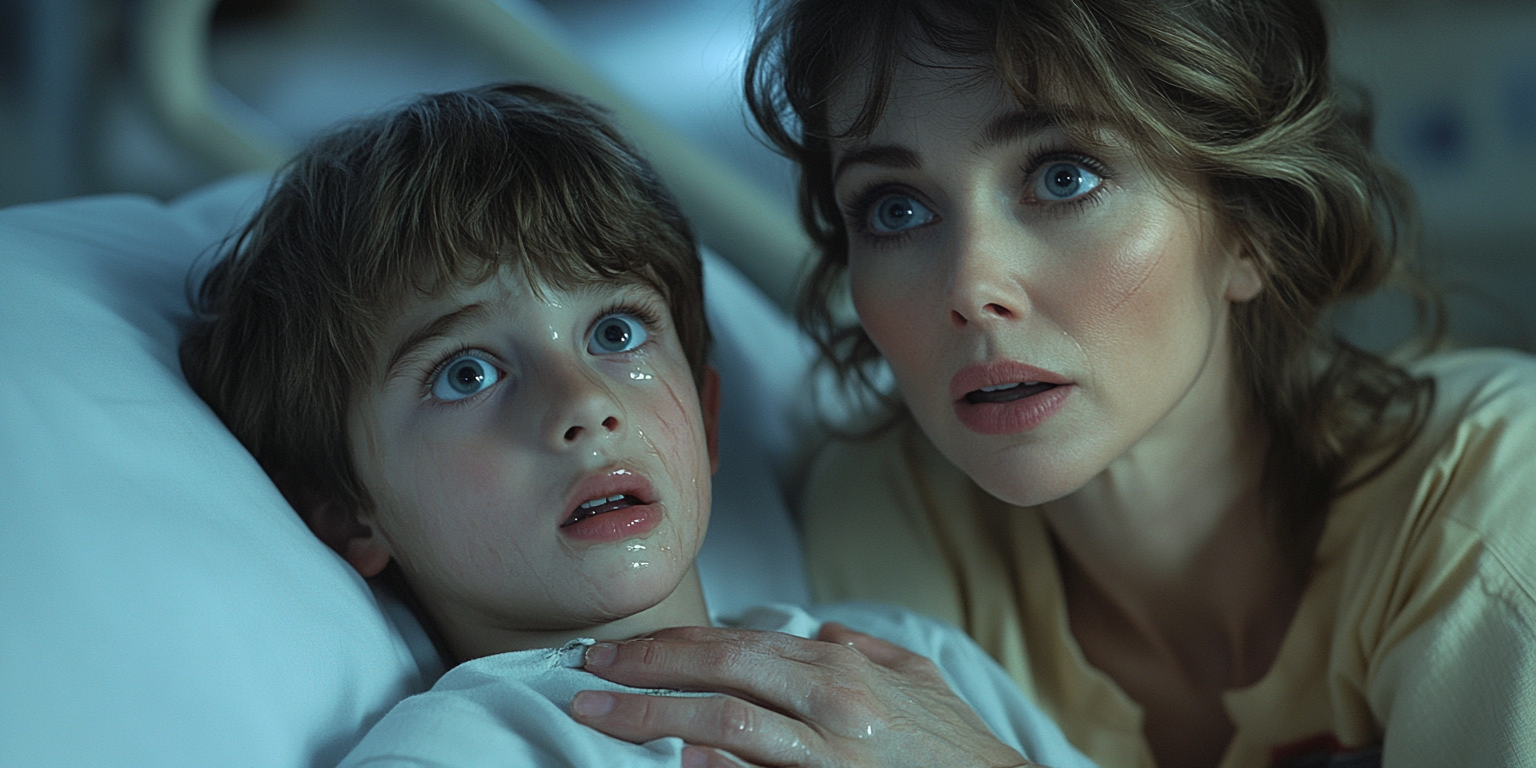
"Let me check your head too," Mum said.
Her right hand—the one that had been under the hot water, the one that had held the thermometer under the steaming stream—reached out and pressed against my forehead.
The touch should have felt cool. Foreheads were always being checked for fever, and the checking hand was always supposed to feel cool against the warm skin, a point of reference that told you if something was wrong.
But her hand wasn't cool. It was warm. Damp. The heat from the water still clinging to her skin, radiating into my forehead like a sunburn in reverse.
And suddenly I understood—or started to understand—what she was doing.
Her warm hand against my cooler forehead. The way it would make my skin feel cold in comparison. The way she could frown and look concerned and say hmm, you still feel a bit hot even though I wasn't hot at all, even though there was nothing wrong with me, even though—
"Hmm, you still feel a bit hot," she said, and the words were exactly the ones I'd expected, sliding into place like a key into a lock. "Are you sure you're feeling okay?"
Her hand moved from my forehead to the side of my head, her damp fingers trailing across my temple, my cheek, my ear. The touch was almost gentle. Almost tender. The way she used to touch me when I was very small, when I couldn't sleep, when she would stroke my hair and hum lullabies until the darkness didn't seem so scary anymore.
Her fingers circled my left ear. Once. Twice. Tracing the shell of it, the curved ridge at the top, the soft lobe at the bottom. It tickled slightly, and I had to fight the urge to squirm away.
Then she began to play with my earlobe.
At first it was nothing. Just her fingers, gentle and absent, the way you might fidget with a button or a piece of string while your mind was somewhere else. Her thumb on one side, her forefinger on the other, rolling the soft flesh between them.
But then something changed.
Her hand went still. Her eyes locked onto mine. And I saw something in her gaze that I had seen before—yesterday, when she'd found me with Dr Schofield, when she'd dragged me back to this room, when she'd told me no more walks, no more talks, no one takes my son anywhere without permission.
Hardness. Intensity. A look that promised pain.
The stinging started slowly. A pinch that barely registered at first, that my brain tried to explain away as accidental, as careless, as something that didn't mean what it seemed to mean. But it grew. Her thumbnail was digging into the soft flesh of my earlobe, pressing deeper, sharper. Her forefinger provided pressure from the other side, trapping the skin between them, squeezing.
I couldn't move. The thermometer was still in my mouth, the threat of poison mercury holding me frozen. The pain in my ear built and built, a sharp bright point that grew larger with each passing second, that radiated outward into my jaw, my neck, my whole head.
My eyes began to water.
I couldn't help it. The tears came without permission, welling up and spilling over, rolling down my cheeks in hot silent streams. I tried to blink them away, tried to stay still, tried to be brave the way Gloria had said I was, but the pain was too much and I was too small and my mother's fingers were crushing my earlobe like they wanted to tear it off.
Through my tears, I saw her watching me.
Her face was calm. Almost peaceful. There was no anger there, no cruelty, nothing that looked like a mother hurting her child. Just a quiet, clinical attention, as if she were conducting an experiment and I was the subject, as if she were taking notes on my reactions, measuring my pain, calculating exactly how much pressure was needed to achieve the desired result.
"Are you feeling sick?" she asked.
Her voice was soft. Concerned. Loving, even. The voice of a mother worried about her child, a mother who only wanted to help, a mother who would do anything to make things better.
But her thumbnail was still digging into my ear, and the pain was still growing, and the tears were still falling, and I understood—finally, horribly, completely—that this was not about checking my temperature. This was not about making sure I was okay.
This was about getting me to say what she wanted me to say.
"No," I tried to respond, but the word came out garbled around the thermometer—"Nuh"—unintelligible, useless. A flash of irritation crossed my mother's face, there and gone in an instant, but I saw it. I saw everything now.
Her grip tightened.
The pain spiked, sharp and bright, and I felt something give way—the skin breaking, maybe, or just my resistance, my will to fight, my belief that if I was good enough and still enough and obedient enough, she would stop hurting me.
"Are you feeling sick?" she asked again, and this time there was an edge beneath the softness, a demand hidden inside the question. Her eyes bored into mine, and I saw what she wanted, saw the answer she was waiting for, saw the single acceptable response that would make the pain stop.
I thought of Gloria. Her empty bed. Her promise that I'd figure things out. Her voice in my dreams, telling me to keep asking questions, to be brave, to remember that I was stronger than I knew.
I thought of Dr Schofield. His careful questions. His offer of help. The way he'd mouthed I'm here as Mum dragged me away.
I thought of all the episodes. All the seizures. All the times I'd woken up in hospital with no memory of what had happened, with only Mum's descriptions to tell me what had gone wrong.
I thought of the hot water on the thermometer. The warm hand on my cooler forehead. The way everything was backwards, upside down, designed to make me look sick when I wasn't sick at all.
But I was six years old. And she was my mother. And the pain in my ear was a white-hot scream that drowned out everything else.
I nodded.
Yes. Yes, I was feeling sick. Yes, whatever you want. Yes, just please, please stop hurting me.
Immediately, her grip loosened.
Not all the way—her fingers still rested on my earlobe, a reminder, a promise that the pain could return if I gave the wrong answer again. But the crushing pressure eased, and I gasped around the thermometer, my whole body sagging with relief.
"Oh, my poor baby," she cooed.
Her voice had transformed. Gone was the hardness, the demand, the edge of something dangerous lurking beneath the surface. Now she was all softness, all warmth, all motherly concern. As if the last few minutes hadn't happened. As if she hadn't just hurt me on purpose, hadn't just squeezed tears out of me, hadn't just forced me to lie about being sick.
"That's no good," she continued, her voice dripping with manufactured sympathy. "We'd better get the doctor to come and have a look at you."
Her free hand reached for the call button on the side of my bed. She pressed it, and the soft chime echoed through the room—a sound I'd heard hundreds of times before, a sound that usually meant help was coming, comfort was on the way.
Now it sounded like a death knell. The end of my morning of freedom. The end of my chance to find Gloria, to ask questions, to figure out what was happening. The end of any hope I'd had of going home.
"Mummy's here," she said softly.
Her hand released my ear at last and moved to my hair, stroking it gently, tenderly, with the same fingers that had just caused me so much pain. The contrast was dizzying, nauseating—love and hurt tangled together so tightly I couldn't tell where one ended and the other began.
"Mummy will take care of everything. You just need to trust me, Luke." Her eyes met mine, and I saw something in them—a plea, maybe, or a warning, or both. "You trust Mummy, don't you?"
I nodded.
The thermometer was still in my mouth. The taste of metal and heat and lies sat heavy on my tongue. My ear throbbed where her thumbnail had pressed deep against the skin, and I could feel something wet there—blood or tears or both—that I couldn't wipe away, couldn't acknowledge, couldn't let myself think about.
Outside, footsteps approached. A nurse responding to the call button, coming to see what was wrong, coming to hear my mother explain that I was feeling sick again, that my temperature was elevated, that I wasn't ready to go home after all.
Coming to write down the lies as if they were truth.
And somewhere in the back of my mind, in the drawer where I kept all the things that didn't make sense, a new understanding was taking shape. A terrible understanding. An understanding that changed everything I thought I knew about my mother, about my illness, about the endless cycle of hospitals and symptoms and episodes that had defined my entire short life.
But I couldn't look at it yet. Couldn't face it. Could only sit still with the thermometer in my mouth and the tears drying on my cheeks and my mother's hand stroking my hair, gentle as a lullaby, soft as a lie.
Gloria's bed stayed empty. Gloria's question stayed unanswered.
And somewhere far away, in a part of my heart I couldn't reach anymore, something was breaking. Something that would never quite heal.







