Theodore James Cartwright
Theodore James Cartwright (2 November 1849 – 15 February 1923) was a Boston-born architect who served as Vice President and founding partner of Killerton Enterprises from its establishment on 15 June 1874. Son of the architect Jonathan Cartwright, educated at Boston Latin School and the Boston Architectural College, he was Francis Killerton's closest collaborator in the firm's founding years — the visual intelligence behind the investor campaign, the lead architect of the San Francisco Civic Center, and the man who gave ancient Mesopotamian construction knowledge its legible, modern architectural form.
Beacon Hill: The Cartwright Household
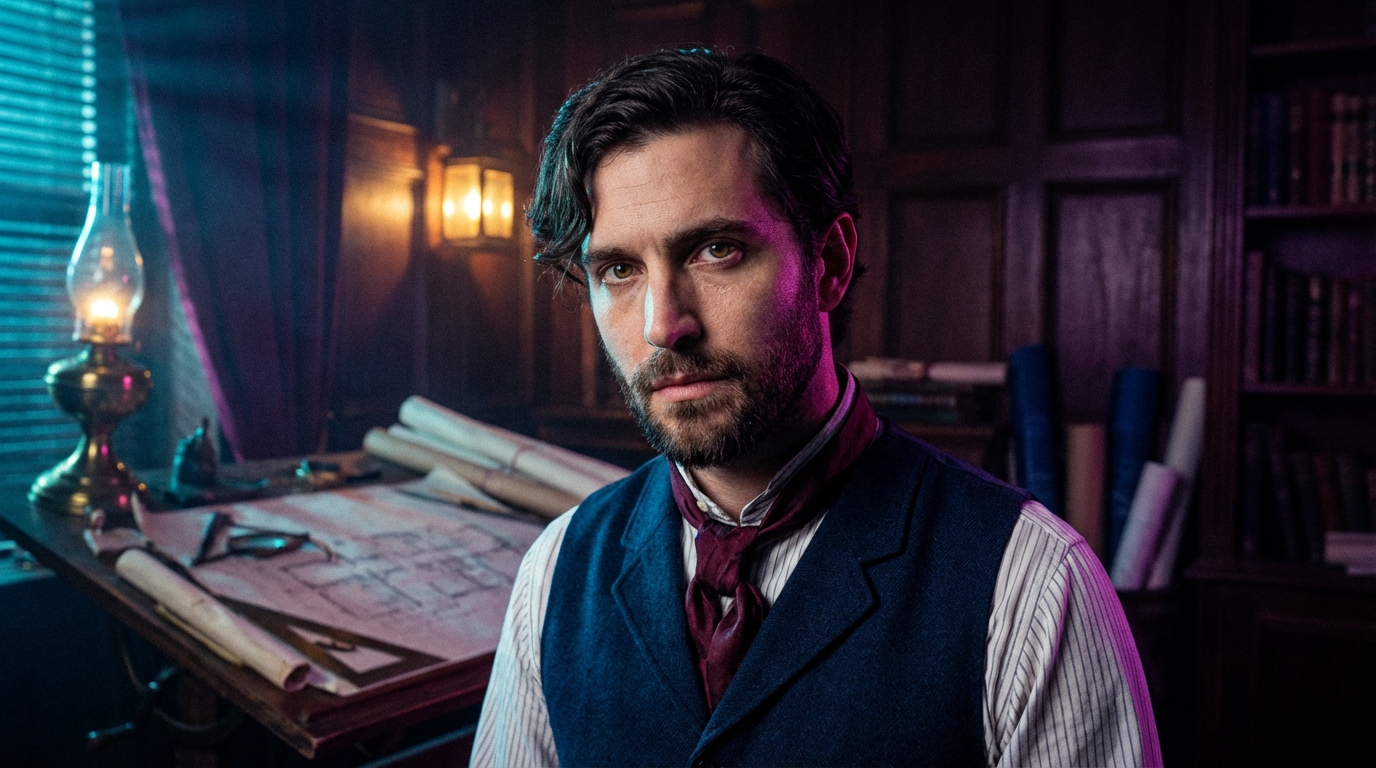
Theodore James Cartwright was born on 2 November 1849 in Beacon Hill, Boston — the neighbourhood of Federal and Greek Revival brick townhouses, iron railings, and gas-lit streets that served as the residential heartland of the city's professional establishment in the mid-nineteenth century. He was the eldest son of Jonathan Cartwright, an architect of settled reputation in the Boston classical tradition, and Margaret Cartwright, a gifted pianist whose musical seriousness gave the household its second register of disciplined attention. The family occupied a tall, narrow townhouse on Pinckney Street, its lower storey partly given over to Jonathan's draughting studio, where the paraphernalia of architectural practice — drawing boards, rolls of detail paper, triangles and T-squares, the balsa-and-card models of buildings that existed first only in his father's imagination — was as much a part of the domestic environment as the piano in the front parlour and the smell of Margaret's Sunday cooking drifting from the kitchen below.
Theodore was, from the earliest age at which children make such decisions, his father's student. He spent long afternoons in the studio watching Jonathan receive clients and reviewing drawings, listening to the conversations about proportion and precedent and the particular demands of Boston's existing urban grain that shaped every commission the firm undertook. By the time he was ten he could read an architectural plan with reasonable fluency; by twelve he was making his own sketch proposals for buildings he observed on family walks, critiquing their detailing with an earnestness that his father found both amusing and instructive. Margaret's piano gave him the other half of his aesthetic formation — the understanding that beauty required structure, that the most apparently spontaneous artistic achievement rested on a foundation of technical rigour that only long practice could produce, and that the relationship between discipline and imagination was not a tension to be resolved but a productive friction to be cultivated. Both parents shaped him, and both parents' contributions are visible in the architect he became: his father's classical precision in the buildings, his mother's sensitivity to how things are heard and felt rather than merely seen in the way he talked about them.
Jonathan's practice was a firm of modest scale but solid standing — the kind of Boston architectural office that built for the institutional clients who valued reputation over novelty, that produced churches and civic buildings and the occasional domestic commission for families whose social position required that their houses be designed rather than simply built. Theodore grew up understanding that architecture was a profession, which is to say it carried obligations — to the client, to the building's users, to the city in whose fabric every new structure intervened — that mere technical competence did not automatically discharge. This understanding did not produce in him the self-important solemnity that afflicts some people raised in professional households; it produced instead a kind of practical seriousness, a habitual attentiveness to what was actually required and how it might most honestly be achieved, that was more useful in practice than solemnity tends to be.
Boston Latin School and the Charles River: 1865–1868
Theodore enrolled at Boston Latin School in the autumn of 1865, at sixteen — the age at which the school expected its entering students, and young enough that the four years ahead of him would complete rather than begin his intellectual formation. He excelled in mathematics and the physical sciences, as his father's training had primed him to, and found in geometry particularly the conceptual language that connected the visual world of architectural drawing to the abstract world of spatial reasoning. His Latin was serviceable rather than brilliant; his Greek rather worse. The school's classical curriculum was not Theodore's natural element, and he was frank enough with himself to acknowledge that the subjects he was most gifted in were the ones most directly useful to the profession he had already decided to enter, rather than the humanistic foundations that Boston Latin considered the proper basis of an educated man. He completed the programme with top honours in 1868, the accolades reflecting genuine mathematical ability rather than universal breadth.
Outside the classroom, he rowed. The school's crew practised on the Charles in the early mornings, and Theodore took to the sport with a commitment that surprised people who knew him primarily as a draughting-room creature — the early starts in all weathers, the physical demands of the stroke, the discipline of fitting individual effort into the rhythm of a boat that moved only when its crew moved together. It taught him things about patience and collective work that no lesson in geometry addressed, and the friendships formed on the river — the particular quality of intimacy that shared physical effort in cold water produces — were among the more durable ones of his school years.
Boston Architectural College: 1868–1872
Theodore enrolled at the Boston Architectural College immediately on graduating from Boston Latin, and spent four years acquiring the formal vocabulary and technical methods that his father's studio had prepared him to absorb with unusual speed. He arrived already fluent in architectural drawing — the facility with plan and section and elevation that most of his contemporaries had to develop from nothing was already natural to him — and the college's instruction allowed him to develop that facility into something more theoretically grounded and more historically informed than Jonathan's practice had required.
His abiding interest, which crystallised during these years into the intellectual position that would define his subsequent career, lay in the question of how the formal language of ancient architecture — the proportional systems and structural logic of the classical world — could be brought into genuine productive relationship with contemporary materials and methods, rather than simply reproduced as historical pastiche or discarded as irrelevant antecedent. This was not, in 1870, a fashionable position. The dominant architectural culture of the period moved between Gothic revival and Italianate revival and the various other historicisms that Victorian taste sanctioned, with relatively little interest in the genuine synthesis that Theodore was working toward — the architecture that absorbed its historical precedents rather than merely cited them, that used the past as a living source rather than a decorative vocabulary.
His final year project — a competition design for a new city hall integrating classical and modern elements with a formal coherence that his examiners found both technically accomplished and architecturally original — earned him the kind of public recognition within the college that signals a career beginning in earnest rather than merely concluding a course of study. He graduated in 1872 with the professional conviction of a young architect who knows, with reasonable confidence, what he is for.
It was during the college years, through the overlapping professional culture of Boston's academic institutions, that Theodore formed his friendship with Francis Charles Killerton — then reading civil engineering at MIT, a short walk across Cambridge from the Architectural College's Boston premises. Francis was a man of a different intellectual temperament: contained where Theodore was expansive, structural where Theodore was spatial, interested in the mechanics of how buildings stood rather than in the aesthetic and experiential dimensions of what they were. The friendship was precisely the kind that forms between people whose intelligence is complementary rather than identical — each capable of following the other into territory that was not his own primary ground, and each made better by the encounter with a mind that worked differently. They met through a mutual acquaintance in the autumn of 1871, were on easy terms by Christmas of that year, and remained in contact through the period between Theodore's graduation and the summer of 1873 that changed both their lives.
Cartwright & Sons: 1872–1873
Theodore joined his father's firm on graduating, entering Cartwright & Sons as a junior architect and beginning the practical education that no degree program fully provides. Under Jonathan's mentorship he worked on several substantial Boston commissions — contributing to the design work for the Boston Public Library and the reconstruction of the Old South Meeting House, both of which placed him alongside experienced craftsmen and immersed him in the detailed negotiations between design intention and building reality that classroom exercises simulate but cannot reproduce. He learned the resistances of actual materials and the limits of actual budgets, developed the diplomatic skill required when a client's requirements and an architect's convictions diverge, and acquired a practical respect for the tradesman's knowledge that sat well alongside his theoretical formation.
He was content at the firm, and would likely have remained content — building a practice within his father's institution, taking on more responsibility as his competence proved itself, eventually becoming a partner — had the summer of 1873 not provided an alternative. Jonathan, who had watched his son's intellectual restlessness with the affectionate patience of a man who had spent his own career within the conventions of a well-established practice, was perhaps less surprised than Theodore expected when he announced, in the late summer of that year, that he was leaving for San Francisco.
The July 1873 Dinner and the Decision to Join Francis
Francis had returned from Mesopotamia in early 1873 carrying knowledge that had no adequate precedent in contemporary engineering or architectural practice. The expedition to the ancient site of Ur — undertaken with his great-uncle Henry Killerton and the archaeologist Victor Armitage — had produced a collection of artefacts and a body of technical understanding about ancient construction methods that Francis believed were not merely historically interesting but practically recoverable. He sought Theodore out in early summer, and they met for dinner on the evening of 1 July 1873.
The conversation lasted most of the night. Francis described what he had found in Mesopotamia — the structural principles, the material practices, the understanding of how earth and water and natural materials could be worked with rather than simply overcome — and the company he intended to build around the integration of that knowledge with modern construction. He wanted Theodore as his Vice President: not simply as an employee architect but as a founding partner, the person whose visual intelligence and design capability would give the technical vision its architectural form.
Theodore did not decide that evening. He spent a week thinking it through — the security of the established Cartwright practice against the uncertainty of a new venture in a city he had never visited, the known satisfactions of working within a professional tradition against the less legible satisfactions of helping to build something that did not yet exist. What decided him, ultimately, was the intellectual content of what Francis was proposing. The integration of ancient Mesopotamian knowledge with modern construction was precisely the historical-modern synthesis that his final year project had been an early attempt at — the architectural problem he had been circling since his time at the college, now appearing in a form more ambitious and better resourced than anything he could have conceived independently. He wrote to Francis on 8 July and accepted.
The Investor Campaign and the Road to San Francisco: 1873–1874
The months between his acceptance in July 1873 and the formal founding of Killerton Enterprises in San Francisco on 15 June 1874 were the most intensively collaborative of Theodore's professional life. The task was to translate Francis's vision into a form that prospective investors — Boston bankers, Manhattan developers, San Francisco financiers — could examine, evaluate, and ultimately fund, and Theodore's contribution to this task was the drawings and architectural models that gave the vision physical form.
He worked at Ashwood Manor through the high summer of 1873, producing a body of illustrated material — plans, elevations, perspective sketches, material sample boards — that showed what the synthesis of Mesopotamian structural principle and modern construction technique actually looked like as architecture. The illustrations were not merely decorative. They were arguments: demonstrations that ancient knowledge could produce buildings of a quality and a character that conventional contemporary practice could not match, rendered with sufficient technical precision that a financially sophisticated viewer could assess them as proposals rather than fantasies. Francis provided the strategic narrative; Theodore provided the visual evidence that the narrative was grounded in something real.
The investor meetings through the late summer and autumn of 1873 — George Cunningham, Isabel Morgan, Richard Harrison Thornton, Margaret Bradford, Lawrence William Chambers — followed a consistent pattern. Francis presented the vision; Theodore unfurled the drawings and walked the investors through what they showed. The drawings did their work, meeting after meeting, converting careful scepticism into financial commitment in a way that words alone, however persuasive, would not have managed. Isabel Morgan, who was not a woman easily convinced of anything, committed fifteen thousand dollars after examining Theodore's models for a quarter of an hour in her Manhattan office. Lawrence Chambers's investment of one hundred and fifty thousand dollars — the largest and most consequential of the founding capital — followed a similar demonstration at which Theodore's architectural presentations, the relationship note records, provided the visual language that made Chambers's commitment legible to him as a rational act.
He also witnessed, at Ashwood Manor in July 1873, the formal induction of Miriam Ashcroft — the moment at which Killerton Enterprises' connection to the Guardian Order was made explicit to the founding partners. What he made of it privately is not recorded. What is clear is that he absorbed the implications without apparent crisis — that the company he had agreed to join carried obligations to something older and less visible than a construction firm's normal purposes was, for a man formed by his father's insistence that architecture served posterity as well as clients, less surprising than it might have been for someone without that formation. He was not initiated into the Order as Edward Killerton would later be; his relationship to it was of a different kind — witness, collaborator, the architect who gave the Order's recovered knowledge its contemporary built form — and that relationship suited his temperament better than formal membership would likely have done.
Marriage to Elizabeth Harding
Theodore married Elizabeth Harding in the spring of 1874, a few weeks before Killerton Enterprises' formal establishment in San Francisco. Elizabeth was the daughter of Robert Harding, a prominent Boston banker whose Beacon Hill household was part of the same professional social world in which the Cartwrights had moved for a generation. She was twenty-four years old to Theodore's twenty-four — they had known each other through the overlapping social circuits of Beacon Hill since Theodore's adolescence, had moved from acquaintance to friendship during his years at the Architectural College, and had been understood by both their families to be heading toward marriage for long enough that the announcement, when it came, surprised nobody.
Elizabeth was a landscape painter of genuine ability — not a gifted amateur in the polite Victorian sense of a woman who did watercolours on fine afternoons, but a serious practitioner who studied the New England landscape with the patient and methodical attention of someone who intended to understand it rather than merely record it. Her work was exhibited twice at the Boston Athenæum during the 1870s and sold modestly but consistently to collectors whose taste ran toward the quiet naturalism that characterised her best canvases. She shared Theodore's understanding that art required rigour, approached her own practice with the same seriousness he brought to his, and had no patience for the social performance of artistic sensibility that was common among the class they both inhabited.
The marriage produced two children: Jonathan Jr., born in February 1876 and named for his Cartwright grandfather, and Clara, born in September 1878. The household they established first in Boston — a Beacon Hill house a few streets from Jonathan Sr.'s Pinckney Street residence, large enough for a draughting room and a painting studio on the upper floor — was an environment shaped by the same assumptions that had governed the Cartwright household of Theodore's childhood: that serious work and serious conversation were the primary purposes of a domestic life, and that everything else should be arranged around them. Elizabeth's social instincts were warmer and more generous than this description implies — the soirées they hosted became genuinely lively occasions, drawing together Boston's intellectual and artistic community in the mixture of professional seriousness and personal warmth that the best of such gatherings achieve — but the warmth was in service of substance rather than a substitute for it.
San Francisco and the Founding of Killerton Enterprises: 1874
Theodore arrived in San Francisco in the early months of 1874, leaving the Boston winter for a California that was unlike anything in his New England formation — the scale of the light, the character of the landscape, the particular energy of a city that was still, in 1874, in the confident middle of its own invention. Elizabeth arrived some weeks later, once the domestic arrangements had been made, and the two of them established themselves in a rented house in the Western Addition that served as both residence and working space through the firm's founding year.
The founding documents of Killerton Enterprises were executed at San Francisco City Hall on 15 June 1874. Theodore's signature appeared third of four on the Articles of Co-Partnership — a legal fact of modest appearance that carried, for him, the weight of everything that had led to it: the July dinner, the Ashwood Manor drawings, the investor meetings, the months of preparation that had produced a company capable of existing in the world. He was twenty-four years old and had been working toward something of this kind since the afternoon in his father's studio, perhaps thirty-five years ago in spirit though only a few years ago in fact, when he had understood that architecture was the work he was going to do.
He was appointed Lead Architect formally at a strategic planning meeting in August 1874, the title formalising a role he had been exercising from the beginning. The San Francisco Civic Center was the commission that gave the role its defining early expression — a major public building that drew on Theodore's accumulated thinking about the integration of classical and modern, that incorporated the Mesopotamian structural principles that Francis's expedition had recovered, and that demonstrated, in built form and at civic scale, what Killerton Enterprises existed to do. The building occupied him through the remainder of 1874 and into 1875, absorbing the full range of his professional capabilities and producing, in the end, a structure that bore the marks of serious architectural conviction rather than simply competent construction.
The Opulent Gathering at the Nob Hill Mansion on the evening of 5 August 1874 — held to celebrate the Civic Center's groundbreaking — was the social event of the firm's first San Francisco season, and Theodore attended it with the mixed feelings of a man who had discovered, only days before, that the Civic Center's foundation accounts had been systematically defrauded. He had been quietly investigating the financial irregularities for several days, had documented what he found with the same methodical precision he brought to structural analysis, and had shared his concerns with Francis in private. The evening was a celebration of a project that was simultaneously being undermined from within, and Theodore moved through it carrying that knowledge behind the composure of a man who had learned, in his father's studio and at Boston Latin and through two years of professional practice, that professional composure was a genuine virtue rather than merely a social performance.
When Mayor Alvord was poisoned during the evening's toast, the composure was tested more severely. Theodore assisted Dr Pearson in the immediate chaos, helped manage the practical crisis with the directness that his character provided, and found himself, in the days that followed, drawn into an investigation whose threads ran through the very project to which he had given his best professional effort. The financial corruption and the poisoning were not, it eventually emerged, unrelated. He emerged from the investigation without suspicion attaching to him, but the summer of 1874 left its marks — a sharper awareness of the distance between what a civic project announces itself to be and what it sometimes conceals, a somewhat less confident faith in the social world in which business was conducted, and a lasting preference for the cleaner certainties of architectural work over the human complications that surrounded it.
The Civic Center and the Character of Theodore's Architecture
The San Francisco Civic Center was completed in June 1875 and inaugurated on 17 June, when Theodore addressed the gathered crowd and explained what the building had tried to be. His speech was, by the accounts preserved, more philosophical than technical — an account of what architecture owed to its historical precedents and what it owed to the people who would use it, of how the Mesopotamian structural principles incorporated into the building's foundation and load-bearing systems were not antiquarian gestures but genuine engineering improvements, of how the classical proportional language of the elevations was not nostalgic pastiche but a considered argument about what civic buildings should feel like from the street. The crowd received it with the polite puzzlement that philosophical speeches at building inaugurations generally receive, and with a genuine admiration for the building itself that was more personally meaningful to him than the applause.
What distinguished Theodore's architecture from the prevailing practice of his period was not primarily a formal innovation — he was not a revolutionary stylist in the manner of a Richardson or a Sullivan — but a quality of intellectual engagement with the question of what buildings were for that produced work of unusual seriousness and endurance. He believed, and the buildings expressed the belief, that construction was an act with consequences that extended well beyond the immediate client and the immediate commission — that the buildings a city accumulated across generations constituted a form of civic argument, and that architects who approached their work with anything less than full consciousness of this responsibility were doing something less than architecture deserved.
This conviction, which his father had instilled and Francis had given new dimensions by connecting it to the recovered knowledge of ancient building cultures, shaped every significant project Theodore worked on through the subsequent decades of his career at Killerton Enterprises. He was not an easy collaborator — his standards were precise and he was reluctant to accept compromises that he believed would undermine the integrity of a design — but his colleagues found him fair, his clients found him honest, and the buildings found their way to completion with fewer of the painful expedient adjustments that more accommodating architects routinely accept.
Later Life in San Francisco
Theodore and Elizabeth remained in San Francisco, establishing over the subsequent decades the household that became one of the city's recognisable intellectual gathering places — a Pacific Heights residence, eventually, not far from the Killerton house, where Elizabeth's paintings hung alongside architectural drawings and the Thursday evening gatherings drew engineers, architects, scientists, artists, and the occasional politician into conversation that was substantive enough to justify the inconvenience of crossing the city on a weekday night. Jonathan Jr. grew up in this environment and studied architecture himself, spending time in his father's practice in the 1900s before establishing his own firm in Los Angeles in 1905. Clara, the younger child, married a physician named Arthur Whitfield in 1901 and settled in Pacific Heights a few streets from her parents; she and Theodore remained close through the remainder of his life, and it was in her home rather than his own that he spent the last weeks before his death.
The 1906 earthquake was, for Theodore, the most professionally consequential event since the founding of the firm. He was fifty-six years old, had been practising in San Francisco for thirty-two years, and watched the destruction of the April morning with the particular grief of an architect who had devoted his working life to building a city that the earth had just unmade in forty-five seconds. The rebuilding work that followed consumed the next decade and placed the integration of seismic resilience into architectural design — a problem that the Killerton practice had been approaching through the ancient structural knowledge Francis had recovered, and that George Killerton's Stanford thesis had formalised — at the absolute centre of Theodore's professional attention. His contribution to the rebuilding was substantial and unglamorous: the careful, methodical work of reviewing and improving building designs, insisting on foundation specifications that the urgency of reconstruction routinely encouraged people to economise on, and arguing — sometimes losing the argument — for the slower, more expensive approach that built genuine resilience rather than the appearance of it.
Elizabeth died in the autumn of 1918, in the same weeks that the Spanish influenza was moving through San Francisco with the virulence that killed more people in that city than the earthquake had. She had been unwell through much of that year — a heart condition diagnosed in 1915 had been managed carefully but was never fully resolved — and the influenza reached her when her reserves were already depleted. She died at home on 14 October 1918, aged sixty-eight, with Theodore and Clara present. Theodore was sixty-eight himself. He had been married to Elizabeth for forty-four years, and the quality of the silence that settled over the Pacific Heights house in the weeks after her death was the particular silence of a household whose animating intelligence has departed.
He continued working, as architects of his generation and temperament tend to do — the practice smaller now, the commissions fewer and less ambitious, but the engagement with the problems genuine rather than habitual. He spent more time writing than he had previously — essays on architectural history, reflections on the relationship between ancient and modern construction that drew on fifty years of thinking about the subject, correspondence with younger architects who sought his view on questions of practice and principle. He was, in this late period, a figure of considerable quiet authority in San Francisco's architectural world: old enough to have personal knowledge of the city's entire history of modern construction, honest enough to say clearly what he thought about it.
Death: 15 February 1923
Theodore James Cartwright died on 15 February 1923 at Clara's Pacific Heights home, of heart failure, at the age of seventy-three. He had spent the previous week at Clara's house, a visit that had begun as a social call in early February and extended as it became clear that his energy was not returning to the level it had been. Dr Arthur Whitfield, his son-in-law, attended him through the final days. He died on a Tuesday morning, in the upstairs bedroom that looked out over the bay, with Clara beside him and Jonathan Jr. having arrived by overnight train from Los Angeles the previous evening.
Francis Killerton survived him by just over two years, dying in January 1925. Of the four signatories to the Killerton Enterprises founding documents of 15 June 1874, Theodore was the second to die. He had been present at the company's creation, had given it the architectural intelligence that made its founding vision legible and fundable, had designed the buildings through which its philosophy was most publicly expressed, and had spent nearly fifty years in the professional partnership that the July 1873 dinner had begun. Jonathan Jr. continued his practice in Los Angeles. Clara kept the Pacific Heights house for several years after her father's death before selling it in 1927. Elizabeth's paintings were distributed among the family's children and grandchildren, and a small number entered the collections of the California School of Design.







