4338.10 · January 10, 2018 AD
The Yellow Package
Nathan reaches Cornerstone Café half an hour early and spends it watching a white van with no markings on it, and two men who are not lost. Then Seth is behind him—unslept, bleeding slightly, refusing to sit down, speaking like a man who has rehearsed this and knows he gets one attempt. He leaves Nathan holding a yellow envelope and an instruction he cannot understand.
"You can be handed a thing so heavy that the moment of taking it is the last ordinary moment you get."
The lift doors opened onto the ground floor lobby, and I stepped out into the artificial coolness with something approaching relief. The marble gleamed beneath the fluorescent lights, that same sickly institutional glow I had walked through barely four hours ago—though that morning's version of myself now felt like a stranger, someone I had known briefly and would likely never encounter again.
The automatic doors parted, and the day arrived against my face with an actual physical weight to it, the way it did in January when the wind had stopped.
The cloud had closed over completely while I'd been upstairs. The heat that had merely been warm at seven was trapped beneath it now, thickened, gone perfectly still—not a breath of movement anywhere on Collins Street, the harbour breeze that had carried salt to me that morning simply switched off. The sun was up there somewhere behind all that grey, diffused into a flat white glare that came from every direction at once and made me squint rather harder than direct light ever would have. And the air had a taste in it—something metallic, and mineral, and faintly like rain that had not arrived yet and was thinking about it.
Nineteen minutes until noon. Cornerstone Café was perhaps a ten-minute walk—less if I hurried, which I had no intention of doing. The surplus time stretched before me like a gift I wasn't certain I wanted, additional minutes in which to marinate in the anxiety that had been building since I'd first seen that yellow square affixed to my monitor.
I turned left onto Collins Street, joining the lunchtime flow of office workers released from their various institutional holdings. The footpath was crowded but navigable, that particular density of pedestrian traffic that required constant minor adjustments—a slight sidestep here, a momentary slowing there—the unconscious choreography of urban movement. Normally I found this dance mildly irritating, an obstacle between myself and wherever I was going. Today the crowd felt almost comforting, a buffer of anonymous bodies between myself and whatever waited at the other end of the walk.
The sandstone buildings lining the street had been storing heat since dawn and were giving it back now with interest, radiating it into the still air so that walking past them felt like passing an open oven. A bus rumbled by, and its diesel exhaust hung in the windless street rather than dispersing, and I breathed it in and found, absurdly, that I liked it—that after ten years on this island the smell of a Metro bus labouring up Collins Street had somehow filed itself away in me under the general heading of home, which was not a thing I would have admitted to anybody at the time, and which I did not much care to admit to myself either.
My shirt had already begun to adhere to my back, the morning's stress-sweat compounded by the trapped heat and the rapid pace I had unconsciously adopted despite my intention to walk slowly. My body, it seemed, had its own agenda—one that prioritised arrival over delay, answers over the comfortable purgatory of not-yet-knowing.
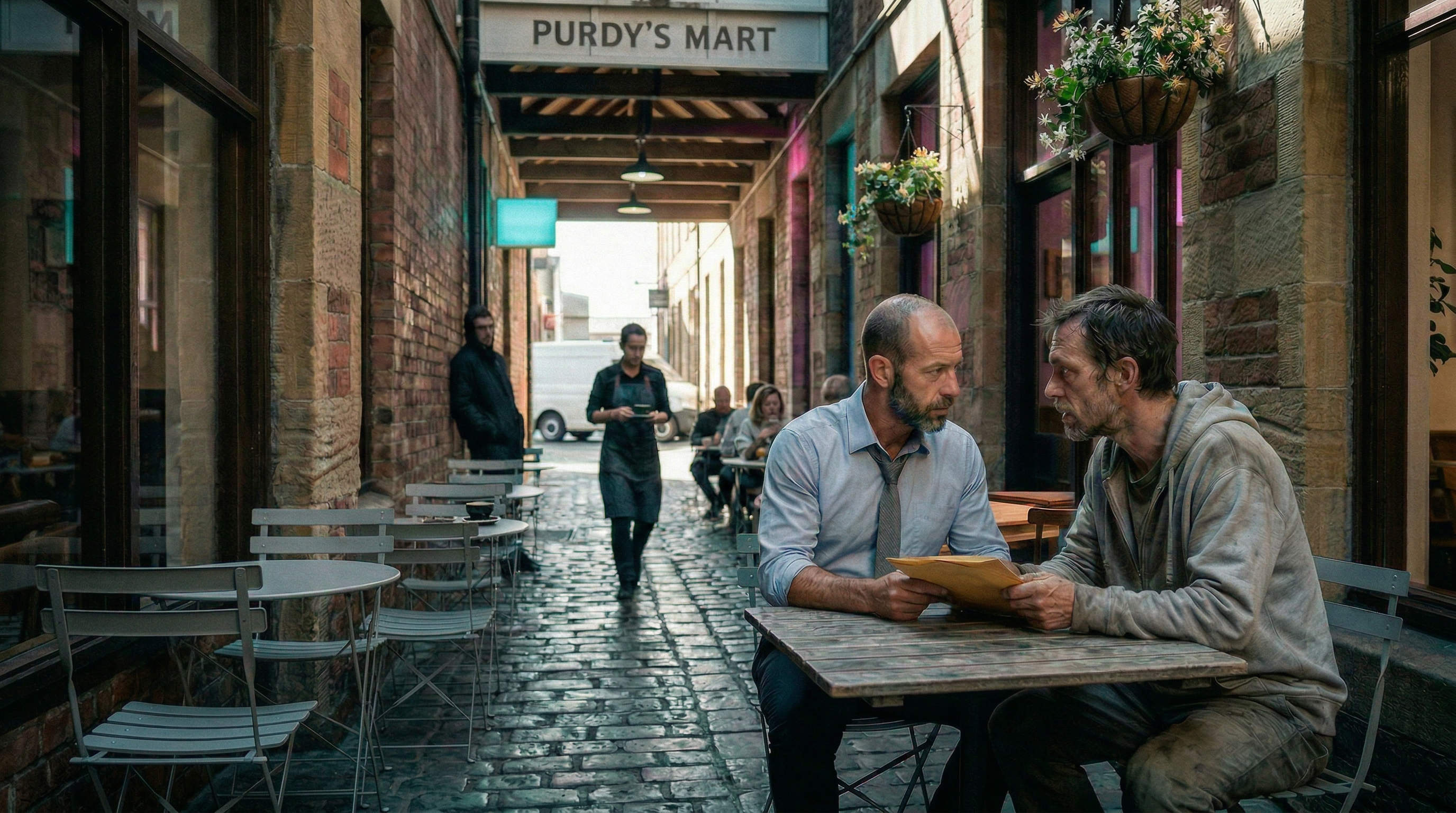
The route was familiar territory, etched into my mental map through years of repetition. Seth and I had been coming to Cornerstone since my second month in Hobart, when he had declared it the only acceptable venue for the kind of conversations we preferred to have—the ones that ranged across conspiracy theories and government cover-ups, the ones that would have raised eyebrows in more conventional establishments. The café sat halfway down Purdy's Mart, a narrow laneway off the main thoroughfare, sheltered from casual observation by the geometry of the surrounding buildings. Private without being secretive, Seth had said approvingly on that first visit. The perfect spot for people who preferred their discussions un-overheard.
I wondered now whether that preference for privacy had been merely philosophical, or whether Seth had always known, on some level, that a day like this might eventually arrive.
The entrance to Purdy's Mart appeared on my left, that familiar gap between buildings that had become as much a landmark in my Hobart geography as the mountain or the river. I turned into it, leaving the glare of the main street for the sheltered dimness of the passage. The temperature dropped a degree or two almost immediately, the towering sandstone walls on either side blocking whatever light was managing to force its way through the cloud. But the stillness followed me in. The laneway held the heat like a held breath.
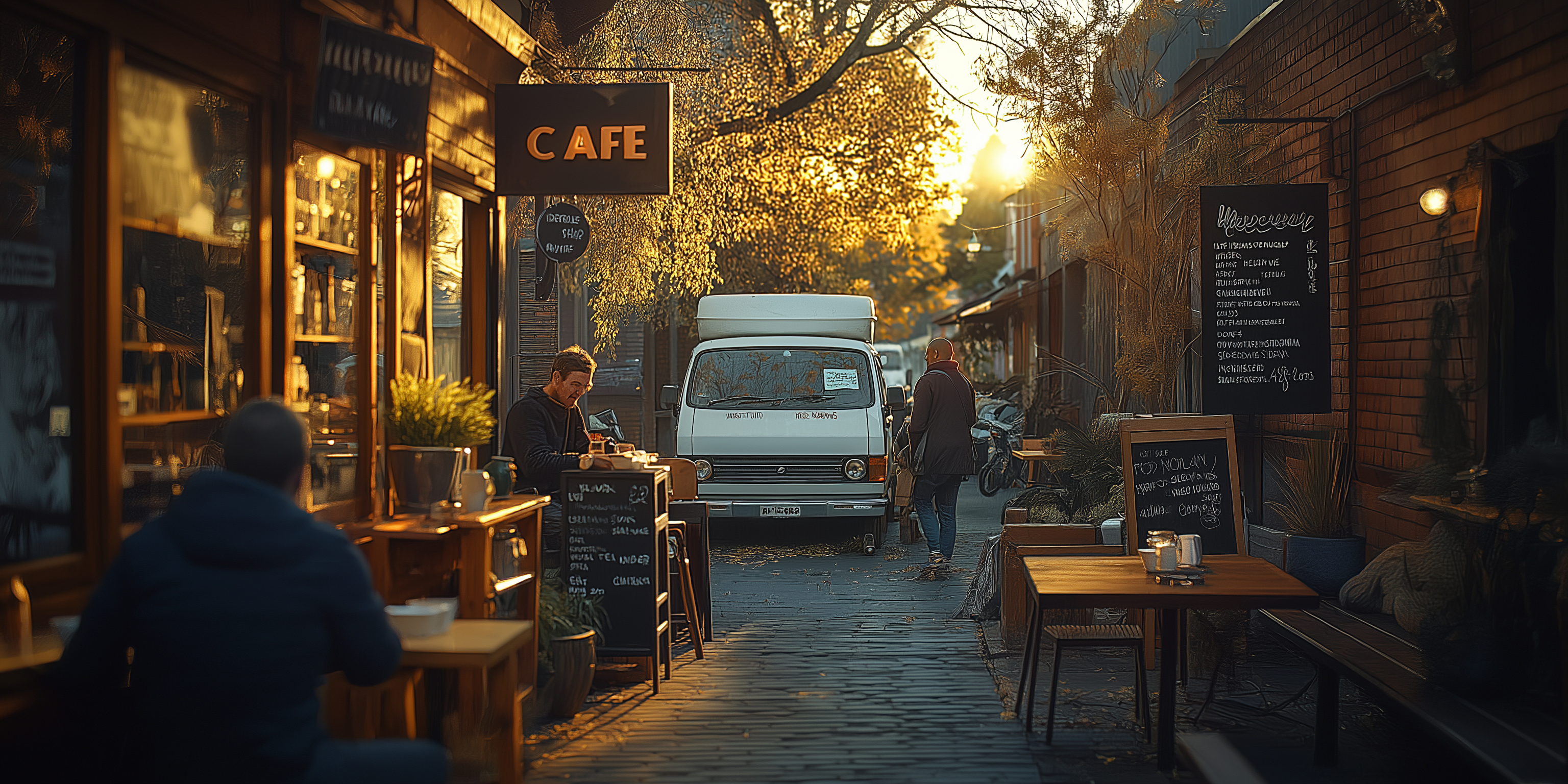
Cornerstone announced itself with a modest hand-painted sign and a cluster of small metal tables arranged on the cobblestones outside. The place had been operating since the early 2000s, predating the wave of Melbourne-influenced specialty coffee culture that had transformed Hobart's café scene in recent years. It retained an older aesthetic—less polished, less self-conscious, genuinely bohemian rather than performatively so. The menu was chalked up on a board, the staff had known what I drank by my third visit, and nobody in that laneway had ever once used the word provenance.
The cobblestones beneath my feet had been worn smooth by generations of foot traffic, their irregular surface requiring a certain attentiveness that I welcomed as a distraction from the churning of my thoughts. Purdy's Mart smelled of coffee and old stone and something floral from the hanging baskets that decorated the entrance—jasmine, perhaps, or honeysuckle, the sweetness cutting through the earthier notes of the passage.
I ordered at the counter—a long black, because anything milkier felt like too much commitment in my current state. The barista was unfamiliar, a young woman with intricate sleeve tattoos and the efficient movements of someone who had made thousands of coffees and would make thousands more. She didn't ask my name or attempt conversation, for which I was obscurely grateful, and she tipped her head towards the laneway tables when she handed the cup across. The ceramic clinked against its saucer, the sound absurdly magnified in my heightened state of awareness.
I took a small table outside and began people-watching in an earnest attempt to divert my increasingly agitated mind until Seth's arrival. The weathered, pockmarked walls rose on either side, silently chronicling Hobart's colonial past. A string of fairy lights zigzagged overhead between the buildings, their whimsical charm washed out to nothing in the flat grey light—waiting, like the rest of us, for something to change.
The coffee's aroma spiralled upward, a markedly different blend from my morning ritual at Blackwood & Co, earthier, with distinct notes of chocolate and citrus that would normally have commanded my full sensory attention. Today it served merely as a prop in what increasingly felt like an elaborate stage play in which I'd been cast without receiving the full script.
The accumulated tension of the morning had settled into my shoulders and neck, a physical weight that no amount of conscious relaxation could dislodge. I rolled my head slowly, feeling the vertebrae click and protest, the muscles tight as cables beneath the skin. My jaw ached from unconscious clenching, and I forced myself to relax it, feeling the strange vulnerability of a slackened mouth.
The caffeine from Blackwood & Co had long since metabolised into a jittery residue that this coffee would only amplify. I knew I should switch to water, give my overtaxed nervous system a reprieve from the chemical stimulation. But the ritual of coffee—the warmth of the cup, the familiar bitterness—provided a thin veneer of normality that I wasn't prepared to abandon. Not yet. Not until I understood what was happening.
The next twenty minutes crawled by. The lunchtime crowd began filtering in, a tapestry of office workers in varying gradations of business attire, tourists consulting phones and guidebooks with furrowed brows, and locals who navigated the space with the unhurried confidence of territorial regulars. I found myself studying each face with unusual, almost forensic intensity, searching for—well, I wasn't entirely certain. Some sign. Some indication that might explain Seth's message and his subsequent silence.
A cluster of Japanese tourists paused to photograph the café's historic façade, their excited chatter forming a melodic counterpoint to the ambient noise. A courier on a bicycle wove with balletic precision through the labyrinth of scattered tables. A woman in a crisp navy suit with immaculate gold accessories spoke rapidly into her phone about quarterly projections and stakeholder expectations, and I envied her with an intensity that shocked me.
Under normal circumstances this tableau would have been pleasantly diverting, a welcome break from the sterile monotony of office existence. Today each movement, each interaction, each fragment of overheard conversation seemed freighted with potential significance, coded messages waiting to be deciphered.
I checked my phone again—the gesture had become compulsive, a tic I couldn't seem to suppress. No new notifications. Seth's continued silence a void that grew more ominous with each passing minute. My message still showed only a single grey tick. Sent but undelivered. As though Seth had ceased to exist in any form that telecommunications infrastructure could locate.
The thought made my stomach contract unpleasantly, and I set the phone face-down on the table, as though removing it from my line of sight might somehow reduce its power over my attention.
With still no sign of Seth, I was approaching the final reluctant sip of my now-tepid coffee when a white van pulled abruptly to a stop at the top of the laneway.
It's not particularly unusual, I reminded myself sternly. There's a car park just around the corner. Delivery vans stop here constantly, and cars get lost and need to turn around, since it's a no-through road and pedestrian traffic only down the lane. The logical part of my brain attempted to file the vehicle as another unremarkable occurrence in the choreography of a busy city centre.
The rest of me was not remotely persuaded by any of that, and went on watching.
It was the whiteness that did it. No company logo, no signwriting, no bumper sticker, not so much as a scratch to give it a history. In a city where every working vehicle wore its use somewhere on its panels, this one stood out precisely because it tried with such determination not to.
Two figures occupied the front seats. Their faces remained indistinct at that range, but their postures communicated a vigilant alertness rather than the relaxed demeanour of lost tourists consulting a map or delivery drivers checking an address.
I'm still waiting for Seth anyway, I reasoned, deciding to observe a little longer. The cup in my hand had gone entirely cold, forgotten.
After a brief but intense exchange between the two men—heads inclined towards each other in a manner that suggested urgent consultation rather than casual conversation—the passenger got out and walked past me with studied nonchalance. His gait was purposeful but visibly attempting not to appear so, like a man making a concerted effort to look as though he weren't in a hurry. He began peering through the café windows with affected casualness, as though searching for something. Or, more disturbingly, someone.
My mouth had gone completely dry. I made myself lift the cold cup and drink out of it anyway, on the theory—and I was entirely conscious of how thin the theory was, even at the time—that nobody looks twice at a man who is drinking a coffee, because a man who is drinking a coffee is simply having his lunch.
He was unremarkable in the way that suggested deliberate cultivation—medium height, medium build, hair neither too long nor too short, clothing that would blend into any crowd without leaving an impression. The kind of man a person's eye would slide straight past in a police line-up, memorable only for being unmemorable. But there was a quality of controlled precision in his movement that contradicted the anonymous packaging. Each window was examined methodically, his gaze sweeping the interior with a thoroughness that spoke of training rather than of ordinary social behaviour. His reflection superimposed itself on the glass as he worked, a translucent double image laid over the diners inside, so that I sat there and watched a ghost search a room full of people who had no idea that he was there.
I found myself shrinking slightly in my chair, an instinctive attempt to reduce my visual profile despite knowing rationally that the gesture was pointless. If they were looking for someone—if they were looking for me—my presence at this particular table was hardly subtle. I was sitting exactly where Seth would expect to find me, in the exact spot we had occupied for a decade of lunches. Predictable. Exposed.
The van's horn blared with startling volume. A cluster of pigeons erupted into panicked flight and my hand jerked reflexively, nearly toppling the cup. The noise redirected both my attention and the window-man's back towards the vehicle. The driver was holding a mobile phone out of the window, waving it about with frantic urgency, the gesture containing an unmistakable alarm that sat jarringly at odds with their previous attempt at inconspicuousness.
The second man abandoned his inspection immediately and broke into a controlled jog back to the van, his pretence at casualness entirely discarded. The movement had the economy of law enforcement or the military—nothing like the ungainly hurry of someone who had simply taken a wrong turn. The moment he was seated, the van accelerated away, its tyres emitting a brief screech that reverberated off the sandstone and momentarily drowned the ambient chatter.
As it disappeared around the corner, I became acutely aware that I had been holding my breath, my lungs burning slightly with the need for oxygen. The lunch crowd continued their conversations uninterrupted, seemingly oblivious to what had just transpired, and their normality suddenly appeared bizarre in its incongruity with my experience.
But the incident had left me with a creeping, visceral certainty that something was fundamentally wrong. Seth's note, his uncharacteristic silence, and now this—it all felt connected in ways I couldn't yet articulate but could intuitively sense, like disparate pieces of a puzzle gradually revealing a picture I did not want to see completed.
I checked my watch. 12:10.
Seth was late—not exactly out of character, but after the whole 12pm sharp insistence, it felt wrong. Another strange wrinkle in an already uneasy morning. I scanned the café entrance and the surrounding laneway again, a low hum of tension settling behind my sternum.
The seconds stretched into minutes, each one landing with the weight of an hour. And I found myself doing something I had never done in my life: cataloguing escape routes. The laneway entrance behind me. The café interior, which presumably had a rear exit through the kitchen. The narrow gap between the buildings opposite, which might lead somewhere or might dead-end in a courtyard of rubbish bins. I noted the positions of the other patrons and assessed which ones would impede a rapid departure. I calculated the distance to the street.
It was the sort of tactical inventory that belonged in Seth's paperbacks and not in my actual life, and the fact that I was compiling it—efficiently, thoroughly, with the same part of my brain that mapped process bottlenecks for a living—frightened me a good deal more than the van had.
Because the men in that van had been looking for someone. And they had gone in a hurry, warned of something approaching.
What if they had been looking for Seth?
What if they had found him?
The thought arrived with sickening clarity, and my stomach dropped as though I had missed a step on a staircase. The lunchtime noise carried on around me—clinking cutlery, low laughter, the distant hiss of the machine—but it reached me strangely muffled, as though I were listening through glass. The world I had woken up in that morning no longer quite fitted.
I was gathering myself to stand, to leave, to abandon this increasingly frightening rendezvous when—
"Don't move."
The voice came from directly behind me and I nearly went out of the chair.
"It's not safe."
"Seth—" I tried for a laugh. It died somewhere around my collarbone.
"I mean it. No sudden movements."
He had come from somewhere behind me—not from the laneway entrance where I had been watching, but from the café interior or some side passage I hadn't known was there. The realisation that he had been close enough to observe me without my knowing, close enough to have watched the van and its occupants, added another layer to a nervous system already carrying more than it could hold.
The Seth standing over me was barely recognisable as my friend of ten years. His usually immaculate business attire was rumpled and pulled about, the blue cotton shirt darkened with irregular patches of sweat despite the shade. The meticulously maintained beard I had often quietly envied was unkempt and wild. Beneath his eyes, deep bruise-coloured circles suggested he had not encountered sleep in days.
Up close it was worse. His skin had acquired a greyish pallor beneath the olive, as though he hadn't seen proper daylight in a week. A small cut on his jawline, half-hidden by the beard, looked a day old at most—the blood dried and still on it, never cleaned, never dressed. His hands trembled with a fine, continuous vibration.
And his eyes. Those eyes, always alight when he was mid-theory, mid-flight, mid some magnificent unprovable connection between a mining licence and a cabinet reshuffle—those eyes now held something I had never once seen in them, in ten years, in any circumstance whatsoever, and it took me an absurdly long moment to identify it, because it had simply never been in the available range: my friend Seth Holder, who had spent a decade being delighted by the idea that the world was run by people who did not want him to know things, was frightened out of his wits.
"Sit down," I said. "Sit down and tell me what's—"
He didn't sit.
He stood over me with one hand resting on the back of the empty chair and he did not sit down in it, and I found that I could not stop looking at the chair, because in ten years of lunches and pints and long unproductive afternoons I had never once conducted a conversation with Seth Holder in which he was not already sprawled in a seat like a man who owned the building.
"I haven't got long," he said. "I need you to listen and not talk. If you talk, I'll lose my place. I've only got this once."
My mouth moved anyway—what's happening, are you in trouble, why didn't you answer me—but nothing came out of it, and I understood, distantly, that this was the second time today I had failed to say the thing I meant to say, and that both failures were going to cost me.
He glanced up the laneway. Once, twice, quick and furtive.
"There's something that needs doing," he said, "and I can't do it anymore. So it's yours."
"Whatever it is, we can—"
I had no idea how I meant to finish that sentence. We can what? Sort it out? Ring somebody? It was what I would have said to a man who had lost his job, or been left by his wife, and I was saying it to a man with a day-old cut on his jaw who had not slept since the weekend.
He reached into a battered leather satchel—a bag I had watched him carry for years, now scuffed and stained in ways that spoke of rough handling and hard travel and a life a very long way from office-to-café—and drew out a padded yellow envelope, and put it into my hands.
It was heavier than it had any right to be. Something inside it shifted and settled with a soft, weighted rustle.
"Everything's in there. Read it alone. Not out here, not in front of anyone." His grip closed over mine on the paper, damp, shaking, his pulse hammering through the contact far too fast for a man standing still. "Choose wisely. That's the important part. Are you listening to me? Choose wisely."
"Choose what?"
He looked at me. And something in his face gave way.
"You were the only one I could think of," he said. "I'm sorry about that."
Not I'll see you soon. Not I'll be in touch. An apology, delivered as a farewell—as though being chosen were something he had done to me, and knew it, and could not undo it, and had come here anyway.
A seagull landed on the cobbles beside our table and regarded us with opportunistic hope, and it belonged to another world entirely.
Seth tapped the envelope twice, hard, with two fingers.
"Be careful, Nathan."
And then he was moving.
I sat frozen for a full second—one absurd, unforgivable second—staring at the sweat patches spreading across the back of his shirt as he went. His usual gait was a kind of languid amble, a man with nowhere he urgently needed to be. This was something else. Shoulders hunched, head turning slightly side to side, the walk of a man expecting to be intercepted.
"Seth!"
My chair scraped. The cup went clattering around the table and I grabbed for it on reflex and steadied it onto its saucer—which was, in the event, what I elected to do with the one second I had—and by the time I looked up he was gone. Completely. Absorbed into the thickening lunchtime crowd as suddenly and comprehensively as he had appeared.
"Bloody hell," I hissed through my teeth.
The precise spot where he had stood was now occupied by a young couple, affectionate, heads together over a tourist map, and the sheer ordinariness of them made me question for a moment whether I had hallucinated the whole thing.
I lowered myself back into the chair and stared at the envelope.
It was unremarkable. The kind sold in every office supply shop in the country. It sat on the table in front of me and seemed to pulse.
My hands, I noticed distantly, were shaking. Not the fine tremor I had felt in Seth's grip but something coarser, a visible vibration that made the paper rustle where my fingers rested against it. Whatever reserves of composure I had been running on since eight o'clock that morning were now comprehensively spent.
I pressed my palms flat against the tabletop and made myself breathe. Coffee. Jasmine. Old stone. The ordinary smells of an ordinary place on an ordinary Wednesday.
Except nothing was ordinary anymore, and I suspected nothing was going to be ordinary again for quite some time.
My fingers had begun sliding towards the corner of the seal before I was fully aware of it, and I stopped them.
Read it alone. Not out here, not in front of anyone.
Purdy's Mart suddenly felt appallingly exposed. Too many windows overlooking this table from the buildings above. Too many phones on too many tables, every one of them a camera. And that van had come here looking for someone—had searched these windows, these faces, these tables—and had left in a hurry when warned of something approaching.
Which meant they could come back. Might already be coming back, circling the block, repositioning now that they knew where to look.
My heart was going at a tempo that owed as much to caffeine as to fear, and I couldn't easily separate the two anymore. The paranoia that had been a decade-long running joke between Seth and me had stopped being funny somewhere in the previous four minutes, and had quietly reclassified itself, without any assistance from me, as the only sensible way to be thinking.
I stood, and slid the envelope inside my shirt, where it lay flat and warm against my chest.
I left a ten-dollar note under the saucer—too much for a single long black, but I hadn't the patience to wait for change—and walked out of Purdy's Mart without looking back at the table, or the seagull, or the couple with the map standing where my friend had said goodbye to me.
The office was ten minutes' walk away, and I spent every one of those minutes attempting to work out what a man could possibly mean by instructing me to choose wisely and then declining, entirely, to tell me what it was that I was choosing between—and I arrived at the lobby doors with nothing at all.







