4338.10 · January 10, 2018 AD
The Wait
The requirements document will not resolve into meaning, the message to Seth is still undelivered, and the morning has congealed into something Nathan has to push through by the minute. He only has to get out of the building. But Verity Sloane is a forensic accountant, the arithmetic of his early lunch does not add up, and she is not the sort of person who needs to ask a question to get an answer.
"You learn what you actually believe about a situation by noticing what you catch yourself searching for."
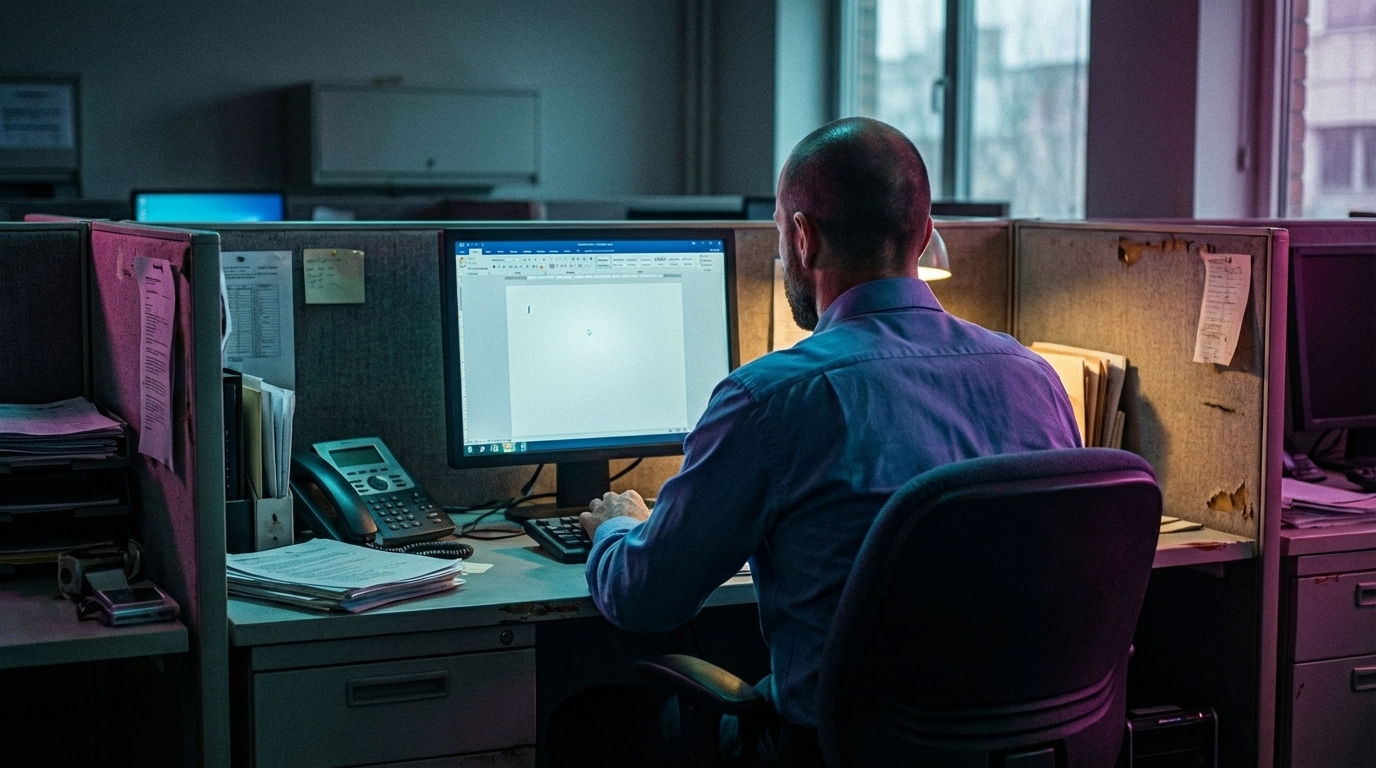
The cursor blinked at me with rhythmic indifference.
I had been staring at the same email for—I glanced at the clock in the corner of my screen—twenty-three minutes. The words refused to coalesce into meaning, each sentence dissolving the moment my eyes moved to the next, leaving no trace of comprehension in their wake. Something about stakeholder requirements. Something about system integration timelines. The Inteq OneGov upgrade, that sprawling state-wide initiative to consolidate fragmented service portals into a single unified platform, demanded my attention with bureaucratic insistence.
I couldn't give it.
The draft requirements document sat open in another tab, its hundred-plus pages of technical specifications representing weeks of collaborative effort from analysts across three departments. Normally I could skim this material, identifying gaps and inconsistencies while simultaneously composing diplomatic feedback that wouldn't offend the original authors. It was a skill I'd cultivated over years of government work—the ability to critique without antagonising, to suggest improvements without implying incompetence.
Today the words blurred together. Legacy integrations. Data migration protocols. User acceptance testing frameworks. Each phrase registered as individual sounds rather than meaningful concepts, as though the document had been written in a language I'd once spoken fluently but had somehow forgotten overnight.
Compared to the mystery of Seth's cryptic note, all of it felt like static.
I shifted in my chair, crossing my legs at the ankle. The position felt wrong almost immediately, a vague discomfort radiating up through my lower back. I uncrossed them, planted both feet flat on the floor. Worse. I tucked my left foot beneath me, then my right, then abandoned the attempt entirely and stretched both legs out beneath my desk until my shoes bumped against the modesty panel with a soft thud.
The woman at the desk diagonal to mine—Patricia? Priscilla? I could never remember—glanced up at the sound, her expression flickering with mild irritation before returning to her screen. I mouthed an apology she didn't see and retracted my legs, folding them back into something approximating a normal seated position.
Nine-seventeen. I had been at my desk for barely an hour, and already the morning stretched behind me like a week.
The office was beginning to fill now, that gradual accumulation of bodies and voices that transformed the early-morning sanctuary into something busier, louder, more demanding. Colleagues arrived in clusters, dropping bags and comparing holidays, their conversations washing over me in waves I couldn't quite parse. Someone had spent a fortnight at Bicheno. Someone else had discovered a restaurant in North Hobart, the new one with the degustation menu, apparently worth the wait for a booking. Normal things. Ordinary things. The stuff of a regular Wednesday morning.
I checked my phone again. The message to Seth remained suspended in digital limbo—sent but undelivered, that single grey tick unchanged since I'd first noticed its stubborn solitude. I had checked perhaps fifteen times in the past hour, each glance a small act of magical thinking, as though my attention might somehow compel a response into existence.
Nothing.
I opened a new browser tab and typed Seth's name into the search bar, then deleted it again immediately, and sat there rather appalled at myself, because I had not been idly curious. I had been going somewhere quite specific. What had I imagined I was going to find? A news article that explained the whole thing? A statement from somebody? An obituary?
That was the word. That was the word my fingers had been travelling towards while the rest of me was still pretending to be conducting a general enquiry, and I sat in front of an empty search bar in a government office at half past nine in the morning and understood that some part of me—some part that had not troubled to inform the rest—had already worked out what it thought had happened to Seth Holder, and had begun quietly looking for the confirmation.
I pushed back from my desk as though the computer itself had become dangerous.
This was absurd. Seth had left a note asking to meet for lunch—unusual, yes, but hardly cause for the kind of catastrophic thinking currently colonising my mind. People left notes. People asked for discretion. There were a hundred innocent explanations, any one of which was more plausible than the dark scenarios my imagination insisted on constructing.
And yet.
Don't ask questions. Don't tell anyone.
Those weren't the words of someone planning to share good news over a chicken schnitzel. Those were the words of someone who had calculated the risks of communication and determined that digital channels couldn't be trusted. The words of someone operating, however temporarily, outside the normal parameters of friendship.
I stood up. Sat down. Stood up again. My body couldn't seem to find a configuration that didn't feel like waiting, and waiting had become intolerable. The nervous energy that had manifested as a bounce in my step a few hours ago had curdled into something more restless, more agitated.
The clock read nine-thirty-two.
Two and a half hours. One hundred and fifty minutes. Nine thousand seconds. Each unit of measurement felt equally impossible, equally endless, a sentence to be served in increments of mounting anxiety.
I forced myself back to the requirements document, scrolling through pages I'd already failed to comprehend, searching for some anchor point that might tether my attention to the task at hand. Section 4.2.3: Authentication Protocols. The words swam before me, technical jargon arranging and rearranging itself into configurations that stubbornly refused to communicate meaning.
The system shall support multi-factor authentication via SMS, email, and authenticator application...
SMS. Text messages. The normal way people communicated when they wanted to reach someone quickly. Not Post-it notes left on desks in buildings they had no legitimate reason to enter.
I closed the document. This time I didn't bother reopening it.
Thankfully, most people were still away on their Christmas and New Year break, leaving the office in that peculiar state of post-festive limbo where nothing felt entirely real or entirely urgent. Skeleton crew. That was the phrase, wasn't it? The minimal staffing that kept essential functions operational while the majority of the workforce recovered from holiday excess.
The skeleton crew suited my current state perfectly. Fewer eyes to notice my distraction, fewer conversations to fake my way through, fewer opportunities for someone to ask if I was feeling all right and force me to manufacture a plausible response. I could sit here and slowly disintegrate, and no one would be any the wiser.
A phone rang somewhere across the office, its shrill tone cutting through the ambient murmur. I flinched, actually flinched, my shoulders jerking upward in a spasm of misdirected alertness. It wasn't my phone. Of course it wasn't. My phone sat silent on my desk, its screen dark, stubbornly empty of anything from the one person I needed to hear from.
Patricia-or-Priscilla glanced my way again, her expression now edging from mild irritation towards genuine concern. I arranged my features into something I hoped read as professional absorption rather than incipient breakdown, turning to my monitor with exaggerated focus. The performance felt transparent, but she returned to her work without comment.
Ten-forty-seven.
I found myself cataloguing the ways in which time had betrayed me. How it had flowed so easily this morning—the walk from the bus stop, the café, the bounce through the streets—each moment melting into the next. And how it had congealed since the note, transforming into something viscous and unyielding, each second requiring effort to push through.
My leg had developed an involuntary bounce, my heel lifting and dropping against the thin carpet in a rhythm I couldn't seem to control. The movement was small enough to escape casual notice but persistent enough to become maddening. I pressed my palm against my thigh, willing the muscles to still, but the moment I released the pressure, the bouncing resumed.
Eleven-oh-three.
The view from the window offered no comfort. The Derwent still sparkled, the sailing boats still traced their leisurely paths across the harbour, but the scene felt like a photograph now—static, unreachable, belonging to a version of the morning that had ceased to exist.
I tried the breathing exercise I'd learned years ago from a counsellor—four counts in, hold for seven, out for eight. The rhythm was supposed to activate the parasympathetic nervous system, to convince the body that no threat was present even when the mind insisted otherwise. I made it through three cycles before abandoning the attempt. My lungs didn't want to cooperate, each inhalation feeling somehow insufficient, each exhalation incomplete.
Eleven-thirty arrived like a small mercy, the numbers on my screen changing over with what felt—finally—like forward momentum. Still thirty minutes until noon, but the psychological barrier of half-past-eleven felt significant somehow, a threshold crossed.
My mind thoroughly unsettled and utterly incapable of concentrating on anything remotely resembling work, I decided to leave for Cornerstone Café earlier than necessary. The café was barely a ten-minute walk from the office, but I couldn't bear to remain in this liminal space any longer. The walls seemed to be closing in with subtle persistence, the distance between my desk and the exit expanding with each passing minute.
Besides, I told myself, standing and pushing my chair under my desk with perhaps more force than strictly necessary, nobody here will even notice I'm gone.
The thought wasn't entirely truthful. Even with the skeleton crew, absences were noted, patterns were observed. Hobart's government offices possessed that particular quality of places where everyone knew everyone's business—not through malice, necessarily, but through the simple mathematics of a small city and a smaller professional community. Someone would notice. Someone would remember. But I couldn't bring myself to care.
I gathered my wallet and phone with movements that I desperately hoped appeared casual to any observing eyes. The screen remained stubbornly notification-free. I slipped the device into my pocket, where it pressed against my thigh alongside the folded square of yellow paper.
A glance out the window showed that the cloud cover had thickened, the sky taking on that particular grey density that often preceded summer storms here. The weather could shift so quickly on this island, our position in the path of the roaring forties making meteorological stability something of a local joke. Sunshine one moment, deluge the next, and back again before a man had time to locate an umbrella. Mount Wellington had gone entirely, swallowed from the base up, and I couldn't decide whether I found its absence ominous or simply typical.
I was ten steps from the door when it opened.
Verity came through it with a manila folder under one arm and a takeaway coffee in her free hand, and she stopped when she saw me, and I understood with absolute clarity that there was no version of the next thirty seconds in which I left this building cleanly.
"You going for coffee?"
"Early lunch," I said.
She looked at me. Then at the door behind me. Then back.
"It's twenty to twelve."
"Hence early."
She let that sit. Verity was extraordinarily good at letting things sit, and I had watched her do it to other people for three years with a kind of appalled admiration—she would ask a perfectly reasonable question and then simply decline to fill the silence that followed it, and people would fall into that silence entirely of their own accord and lie there talking until they had said something they had not intended to say. I once saw a manager confess to a fortnight of missed deadlines that nobody had asked him about, unprompted, in a project meeting, because Verity had not said anything for eleven seconds.
I did not fall into it, which I would dearly have liked to attribute to strength of character, and could not, because the actual reason was that my throat had closed and I was for the moment physically incapable of producing sound.
"Want some company?" She lifted the coffee an inch. "I've had mine. I could still eat."
Any other day I would have said yes before she finished the sentence. Lunch with Verity was the only hour of the working week I actively looked forward to—she was funnier than anyone in this building had any right to be, and she was the only person here who would tell me plainly when I was being an idiot. She was twenty-seven and she had been running rings around men twice her age since the week she arrived.
"I—" The word came out and then stopped, which was the worst thing it could possibly have done. "I need some personal time."
Personal time. I heard it leave my mouth and understood immediately what I had done. I had never asked for personal time in my life. I talked. That was my entire method for handling anything: talk at Verity until the thing stopped being frightening. Milk, no sugar, somewhere with bad lighting and decent chips.
Something happened behind her eyes. It was not surprise—I had never once seen Verity Sloane surprised by anything, and I had watched her be told some genuinely remarkable things—it was something further back than that, and slower, and it did not reach her face at all.
"It's a ten-minute walk," she said.
I didn't answer.
"You're leaving thirty minutes early."
Not a question. She put the arithmetic down on the carpet between us in precisely the way she put down a discrepancy in a set of accounts—without one word of accusation anywhere in it, which was the thing that made it unbearable. In three years I had never once heard her accuse anybody of anything. She simply arranged the numbers where a person could see them, and then she stopped talking, and left the numbers to do the rest of it themselves.
She thought this was about OneGov. I could see her arriving there and I let her go. The procurement decisions that didn't quite add up, the contractor relationships she'd been quietly documenting since winter, the pattern she couldn't yet name and had twice asked me whether I could see. I'd told her both times that I couldn't—and that had been perfectly true, which was becoming, I noticed, an increasingly unusual condition in my dealings with Verity Sloane.
"Fine," she said.
And she stepped aside.
It was the stepping aside that finished me, and I had not braced for it at all, because I had spent the preceding twenty seconds constructing and discarding answers to a series of questions which she then declined to ask. She had stood in front of me and watched me lie to her, and she had filed it away somewhere in that meticulous archive of hers, and she had moved out of my path and let me through the door.
"See you this afternoon," she said, and went to her desk without looking back.
The corridor was empty save for the usual institutional furnishings—the dying potted palm by the fire escape, the motivational posters with their relentlessly upbeat messaging, the water cooler that nobody ever seemed to use but which was nonetheless refilled with religious regularity.
My footsteps echoed against the polished floor, each sound seeming to broadcast my departure to the entire building. The rhythm was too fast, too urgent, the pace of a man fleeing rather than a man going to lunch. I made myself slow down, adopting the unhurried gait of a person with nothing to hide and nowhere particularly pressing to be, and the effect must have been considerably worse than whatever I had been doing before.
I pressed the call button. The lift announced its arrival with a soft chime.
Eleven-forty-one. Nineteen minutes until noon.
The doors opened onto the empty cabin, and I stepped inside, and there they were again in the mirrored walls—an infinite regression of Nathans, each one slightly smaller, slightly more distant, disappearing into some vanishing point I still couldn't locate. They had been remarkably cheerful the last time I had looked at them, on the way up, with a coffee in one hand and nothing whatsoever on my mind, and I could not now have told anybody what they were, and I did not look at them for very long.
The doors closed, and the lift began its descent, and I stood in the middle of all those diminishing copies of myself with my hands in my pockets and one of them closed around a folded square of yellow paper, and I could not for the life of me have explained, to any reasonable person, what it was that I was so frightened of.







