4105.112 · April 22, 1785 AD
The Turning
When the baby presents shoulder-first, Elizabeth Jeffries must endure an agonising ordeal whilst a gentleman doctor and seasoned midwife fight to turn the child—and in the golden aftermath, a dockworker makes a vow over his newborn son that the dangerous wharves of Portsmouth may not let him keep.
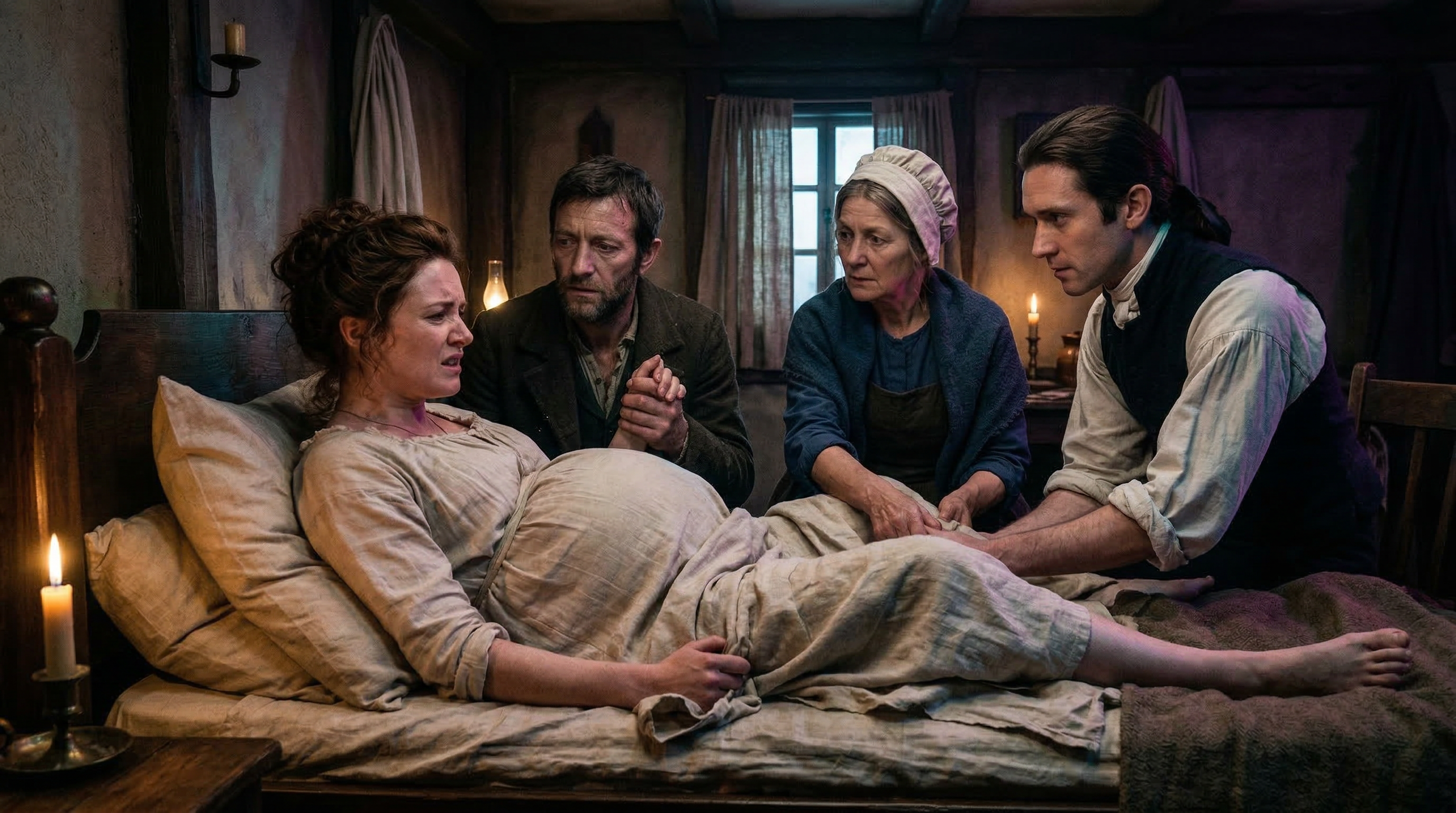
"My mother lived through worse. So will I."— Elizabeth Jeffries
The hours stretched long.
Elizabeth had lost all sense of time. The world beyond the cottage walls had ceased to exist—there was only this bed, this room, this relentless tide of pain that rose and fell and rose again, each wave cresting higher than the last. She clung to Edward's hand as a drowning woman might cling to a spar of driftwood, feeling the roughness of his calloused palm against her fingers, drawing what strength she could from his presence.
Mrs Hawkins moved about the room with the unhurried confidence of long experience, her voice a steady counterpoint to Elizabeth's ragged breathing. "That's it, dearie. You're doing beautifully. Let the pain come and let it go. Don't fight it—your body knows what it's about."
Easy words to speak, Elizabeth thought bitterly, when you're not the one being torn apart from the inside. But she bit back the retort, saving her breath for the work ahead. There would be time enough for sharp words later, God willing. If she survived this. If the child survived.
Dr Whittaker had completed his examination and withdrawn to confer with the midwife in the far corner of the room. Elizabeth could not hear their words, only the low murmur of their voices, but she saw the way Mrs Hawkins's brow furrowed, the way the doctor's mouth thinned into a grave line. Something was wrong. She had suspected it for weeks—had felt it in her bones, in the secret chambers of her heart—and now her fears were being confirmed in whispered consultations she was not meant to overhear.
"Edward." Her voice came out as a croak, barely audible. "Edward, what are they saying?"
Her husband's face was pale beneath its weathering, his dark eyes bright with fear he was trying desperately to hide. "Nothing to fret over, love. Just talking through the particulars, that's all. You know how these medical folk are—always conferring about this and that."
He was lying. She could always tell when Edward lied; he had never had the gift for it. But before she could press him further, another contraction seized her, and all thought dissolved into a white blaze of agony.
When the pain released her at last, she found Dr Whittaker standing at the foot of the bed, his grey eyes kind but serious. "Mrs Jeffries," he said, "I must be frank with you. The child is not positioned as we would like. It seems to be presenting shoulder-first rather than head-first, which will make the delivery more... challenging."
Elizabeth felt the blood drain from her face. She had heard stories—every woman had heard stories—of babes stuck fast in the birth canal, of mothers who laboured for days only to die in the attempt, of children born blue and silent, strangled by their own cords. Her own mother had nearly died bringing Samuel into the world, had bled so badly that the physician had despaired of her life. The memory of that terrible night, when Elizabeth had been sent to pray with her siblings whilst their mother fought for survival in the next room, came flooding back with suffocating force.
"What does that mean?" Edward demanded, his voice sharp with fear. "What are you saying? Is she going to be all right? Is the baby—"
"It means," Dr Whittaker said calmly, "that we shall have to help the child turn. Mrs Hawkins has considerable experience with such matters, and I have assisted in similar cases before. It will not be pleasant, Mrs Jeffries, and I will not pretend otherwise. But I have every confidence that we can bring your baby safely into the world."
Elizabeth looked up at him—this educated gentleman who had no reason to trouble himself with the wife of a common dockworker—and saw no deception in his face. He believed what he was saying. Whether his confidence was justified, only time would tell.
"Do what you must," she said. Her voice sounded strange to her own ears—steady, resolute, as though it belonged to someone far braver than she felt. "Just save my child."
The next hours were the worst of Elizabeth's life.
She had thought she understood pain. She had broken her arm as a child, falling from a tree she had been forbidden to climb. She had burned her hand badly on a laundry copper, the scar still visible on her palm. She had endured toothache so fierce it had kept her weeping for three days until the barber-surgeon could be fetched to pull the offending molar.
None of it had prepared her for this.
Mrs Hawkins worked with her hands whilst Dr Whittaker guided and instructed, their voices blending into a meaningless drone beneath the roaring in Elizabeth's ears. She felt pressure, manipulation, the terrible sensation of her body being used as an instrument for purposes beyond her control. The pain came in waves that seemed to have no peak and no trough, only an endless, grinding agony that left her gasping and sobbing.
"Hold her steady, Mr Jeffries," she heard Mrs Hawkins say from somewhere very far away. "That's it. She's doing well. Just a bit more, now."
Edward's arms were around her, his body braced behind hers, lending her his strength. She could feel him trembling—or perhaps that was her own body shaking—but his voice in her ear was steady. "I'm here, Lizzy. I've got you. You're the bravest woman I've ever known. You can do this. You can."
She wanted to tell him that she couldn't, that she was not brave at all, that she was terrified and exhausted and wanted nothing more than for this to be over, one way or another. But the words would not come. All she could do was endure, moment by moment, breath by breath, whilst her body fought to bring forth the life within it.
"There!" Dr Whittaker's voice cut through the haze of pain, sharp with triumph. "The child has turned. Well done, Mrs Hawkins—well done indeed. Now, Mrs Jeffries, when the next pain comes, I need you to push. Push with everything you have."
Elizabeth barely had time to register his words before the contraction struck. It was different this time—more focused, more purposeful, her body suddenly knowing what it needed to do. She bore down with a strength she had not known she possessed, a primal force rising up from somewhere deep within her, and she heard herself cry out—not in pain alone, but in fierce, wordless determination.
"That's it!" Mrs Hawkins urged. "I can see the head! Keep going, dearie—one more push like that and you'll have your baby in your arms!"
One more push. Elizabeth gathered herself, drawing on reserves she had not known existed. She thought of Edward, of the life they had built together, of the future they had dreamed of on long winter nights when the fire burned low and they held each other close against the cold. She thought of her mother Mary, who had survived Samuel's terrible birth against all odds, who had taught Elizabeth that women were stronger than any man gave them credit for. She thought of her father George, who would be waiting anxiously for news, who had blessed her marriage to Edward despite his reservations about a dockworker's prospects.
And she thought of the child within her, struggling to be born, fighting its way into a world that would offer it no guarantees, no promises, nothing but the chance to live and love and suffer and triumph as all humans must.
And she pushed.
The world seemed to hold its breath. Time stretched and warped, each second lasting an eternity. Elizabeth felt pressure, then release, then a strange emptiness where fullness had been—and then, cutting through the silence, a sound she would remember until her dying day.
The cry of a newborn child.
"A boy!" Dr Whittaker announced, his cultured voice warm with genuine pleasure. "A fine, healthy boy!"
Elizabeth collapsed back against Edward's chest, her body suddenly boneless, emptied of everything but relief. Tears streamed down her face—she could not have stopped them had she tried—and she heard Edward making sounds that might have been laughter or sobs or some combination of both.
"A boy," he kept saying, his voice cracking. "We have a son, Lizzy. A son."
Mrs Hawkins had taken the child—still wailing his outrage at being expelled from his warm sanctuary—and was cleaning him, wiping away the blood and birth-matter, checking his fingers and toes, peering into his tiny face with an appraising eye. "Strong lungs on this one," she remarked with satisfaction. "Listen to him! He'll be heard clear to the dockyard, I shouldn't wonder."
Dr Whittaker was attending to Elizabeth now, ensuring that all was well, that there was no excessive bleeding, that her body was recovering as it should. She barely noticed his ministrations. Her eyes were fixed on the small, squirming bundle in Mrs Hawkins's arms, on the red and wrinkled face that was somehow the most beautiful thing she had ever seen.
"Let me hold him," she said—demanded, really, her voice hoarse but fierce. "Please. Let me hold my son."
Mrs Hawkins smiled, the expression transforming her weathered face into something almost lovely. "Of course, dearie. Of course." She wrapped the baby in a clean cloth and crossed to the bed, placing the precious burden in Elizabeth's waiting arms.
He was so small. That was Elizabeth's first coherent thought—so impossibly, terrifyingly small. She had held babies before, had helped care for Margaret's children and the infants of neighbours, but this was different. This was her child, her flesh and blood, this tiny creature who depended upon her for everything.
His crying had subsided to a soft, hiccupping whimper. His eyes—unfocused, a murky blue that might darken with time—seemed to search her face, though she knew he could not truly see her yet. His fist, no larger than a walnut, waved aimlessly in the air before finding his mouth, which he began to suck with single-minded determination.
"Hello, little one," Elizabeth whispered. The words felt inadequate—how could any words be adequate for this moment?—but she said them anyway. "Hello. I'm your mother. I've been waiting so long to meet you."
Edward leaned over her shoulder, his stubbled cheek rough against hers, and together they gazed down at their son. She felt his breath catch, felt the shudder that ran through him, and knew that he was as overwhelmed as she.
"He's perfect," Edward said, his voice barely above a whisper. "Lord above, Lizzy, look at him. He's absolutely perfect."
He was not, of course. His head was misshapen from the difficult passage through the birth canal, his skin mottled and patchy, his features squashed and swollen. But in that moment, to his parents' eyes, he was the most perfect creature that had ever drawn breath.
Dr Whittaker straightened from his examination, looking satisfied. "Mother and child are both doing well," he announced. "You had a difficult time of it, Mrs Jeffries, but you came through admirably. The child appears healthy and vigorous. With proper care, I see no reason why he should not thrive."
"Thank you, Doctor." Elizabeth looked up at him, her eyes bright with tears she did not trouble to hide. "Thank you for coming. For helping. I don't know what we would have done—"
Dr Whittaker held up a hand, cutting off her gratitude with a gentle smile. "You would have managed, Mrs Jeffries. Mrs Hawkins is more than capable. But I am glad I could be of service." He glanced at Edward. "Your husband mentioned some concern about my fee. Let us say no more about it. Consider this my gift to welcome your son into the world."
Edward's face worked with emotion. "Sir, I cannot—we cannot accept—"
"You can and you will." The doctor's voice was firm but not unkind. "I have more than enough, Mr Jeffries. You have a family to provide for. Put your coin towards this little fellow's future, and we shall call it even."
He gathered his bag and moved towards the door, pausing to exchange a few final words with Mrs Hawkins. Elizabeth watched him go, this gentleman who had treated them with such unexpected kindness, and felt something shift in her understanding of the world. Not all those born to privilege were cruel or indifferent. Some, at least, remembered their common humanity.
The morning had worn on towards noon by the time Mrs Hawkins finished her work. She had changed the bedding, disposed of the soiled linens, ensured that Elizabeth was comfortable and the baby clean and swaddled. Now she stood by the bed, her worn leather bag in hand, looking down at the little family with an expression of weary satisfaction.
"He'll need feeding soon," she said. "Put him to your breast when he fusses—your milk won't come in proper for a day or two yet, but what you have will be enough to start him. And don't be surprised if it hurts at first. Your body needs time to learn, same as his."
Elizabeth nodded, storing away the advice. She had so much to learn, so many questions she had not even thought to ask yet. The enormity of the task before her—raising this child, keeping him fed and warm and safe in a world that could be so harsh—threatened to overwhelm her.
But when she looked down at the sleeping face of her son, the fear receded. She would learn. She would manage. Women had been doing this since the beginning of time, after all, and most of them had known far less than she did. Her own mother had raised four children to adulthood, had taught Elizabeth everything she knew about keeping a household, about stretching a shilling until it screamed, about finding joy in small things when large happinesses seemed beyond reach. If Mary Whitehall had managed, then so could her daughter.
"What will you call him?" Mrs Hawkins asked.
Elizabeth looked at Edward, and he looked back at her, and in that glance passed a whole conversation—memories shared and unspoken, losses mourned and joys celebrated, a future imagined in all its uncertainty.
"William," Elizabeth said softly. "After my grandfather. William Jeffries."
She thought of the old man who had died when she was still a girl—her mother's father, William Turner, a rope-maker whose weathered hands had seemed to her child's eyes as ancient and gnarled as oak roots. He had been kind to her, had carved her wooden toys and told her stories of the sea, had called her his little sparrow and slipped her sweets when her mother wasn't looking. She still missed him, even now, all these years later.
"William," Edward repeated, testing the name on his tongue. "It suits him, I think. A strong name. A good name." He paused, then added quietly, "And Thomas for his middle name. After the best friend a man could ask for."
Elizabeth smiled, understanding at once. Thomas Pritchard had been Edward's mentor and protector on the docks for over a decade, had helped shape the raw youth into the steady man she had married. It was fitting that their son should carry something of that friendship into the future.
"William Thomas Jeffries," she said. "Yes. That's who you are, little one."
The midwife smiled. "A fine name for a fine boy. May he live up to it." She moved towards the door, then paused, turning back. "I'll look in on you tomorrow, see how you're both getting on. In the meantime, rest as much as you can. You've earned it."
And then she was gone, and Edward and Elizabeth were alone with their son for the first time.
For a long moment neither of them spoke. The cottage was quiet save for the soft sounds of the baby's breathing, the distant cry of gulls, the muffled noises of Portsmouth going about its business beyond the walls. Sunlight streamed through the small window, falling in a golden stripe across the bed, illuminating the scene like a painting in a church.
"I'm a father," Edward said at last, his voice filled with wonder. "I'm actually a father."
"You are." Elizabeth smiled up at him, exhausted beyond measure but happier than she could ever remember being. "How does it feel?"
He shook his head slowly, as if words had failed him. Then he reached out and touched his son's cheek—the lightest touch, as though he feared the child might shatter—and something in his face seemed to break and rebuild itself all at once.
"I keep thinking of my father," he said quietly. "Of the day he died. I was twenty yards away, Lizzy. Twenty yards, and I couldn't do anything. I just watched." His voice caught. "I watched him die, and there was nothing—nothing I could do to save him."
Elizabeth reached up and touched his face, feeling the dampness on his cheeks. She knew this grief, had seen it surface in unguarded moments throughout their marriage—the weight of witness, the helplessness of having been there and being unable to change what happened.
"I swear to you," Edward said, his voice rough with emotion. "I swear to you both. I will do everything in my power to stay alive. To be here. To watch this boy grow into a man. I know the docks are dangerous—I know any day could be my last. But I will be careful, Lizzy. I will come home to you every night. I will not leave you alone in this world if there is any way I can prevent it."
It was not a promise he could truly make, and they both knew it. The docks claimed lives without warning or reason, took men who were careful and lucky alike. Richard Jeffries had been an experienced hand, had known every danger, and still the timber had found him. But Elizabeth understood what Edward was really saying—that he would fight for every day with them, that he would not grow careless or indifferent, that their lives mattered enough to him to make the struggle worthwhile.
"I know," she said simply. "I've always known. That's why I married you, Edward Jeffries. Not because you could give me riches or fine things, but because I knew—I knew in my heart—that you would never stop trying. Never stop fighting for us."
He bent and kissed her, a gentle press of lips that tasted of salt and gratitude and bone-deep relief. Then he kissed the baby's forehead, his lips barely brushing the soft skin, and William stirred in his sleep and made a small sound that might have been contentment.
"William Thomas Jeffries," Edward whispered. "Welcome to the world, my son. It's not always a kind place, and I cannot promise you it will be easy. But I can promise you this—you will never doubt that you are loved. Never, so long as I draw breath."
Outside, the bells of St Thomas's Church began to toll the noon hour, their deep voices rolling across Portsmouth like a benediction. And in a modest cottage on Hanover Street, a new family lay together in the golden light of a spring morning, bound by blood and love and the fierce, fragile hope that was the birthright of every child born into an uncertain world.






