4237.60 · March 1, 1917 AD
The Southern Order
Superintendent Edwin Heyward had served under three commissioners, policed districts from the Huon to the midlands, and survived thirty years in a force that rewarded endurance more reliably than talent. On 1 March 1917, he was handed the largest of Tasmania's three new divisional commands — an area stretching from the Parliament steps to the Central Highlands — and given no additional officers, no additional funding, and an Argyle Street headquarters that flooded every time the Hobart Rivulet rose above its banks.
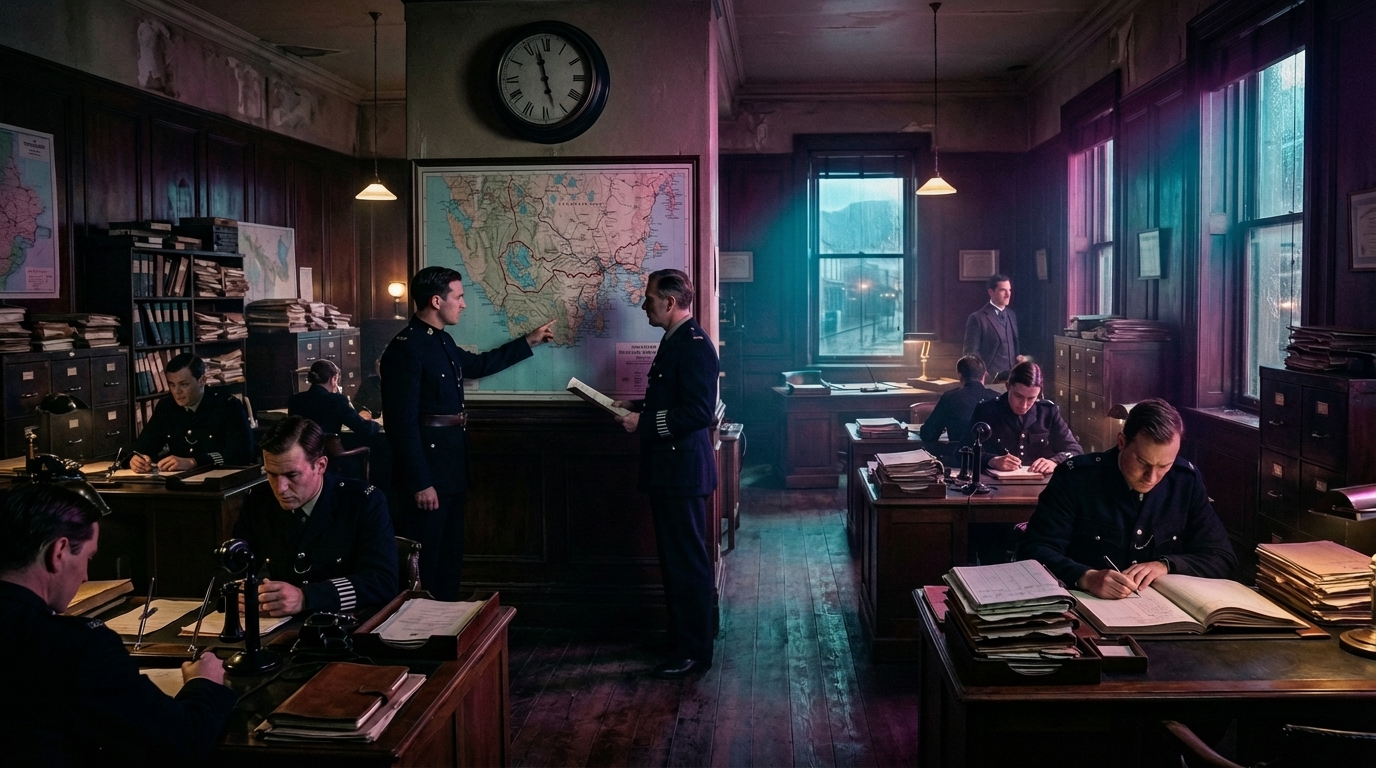
The command looks impressive on paper. Southern Division: Hobart and everything south of the Lake Highway. The state capital, the principal port, the Derwent Valley's farming settlements, the Huon's orchards, the Channel's fishing villages, the D'Entrecasteaux coast where timber cutters operate beyond reliable communication, and the Central Highlands where population is measured in single figures per hundred square kilometres. Approximately 80,000 residents, 18,000 square kilometres, and the seat of government within walking distance of the superintendent's office.
The reality is less impressive. Heyward inherits five former district commands whose inspectors resent the loss of autonomy, whose procedural customs vary so widely that evidence handling in New Norfolk follows different protocols than evidence handling in Huonville, and whose officers have been depleted by the same enlistments that forced the reorganisation in the first place. His headquarters on Argyle Street is a sandstone building constructed in the 1860s for a constabulary that numbered fewer than fifty men. The basement floods. The single telephone line serves an entire floor. The evidence room shares space with brooms and mop buckets.
Heyward does not complain. He has never been the complaining sort, which is partly why Ninnis chose him and partly why three decades of service have left him a superintendent rather than a commissioner. He unpacks his effects into the corner office on the first floor, requests a second telephone line — denied on grounds of expense — and begins the work of turning five independent fiefdoms into a single functioning command.







