4338.207 · July 26, 2018 AD
The Seat Beside Me
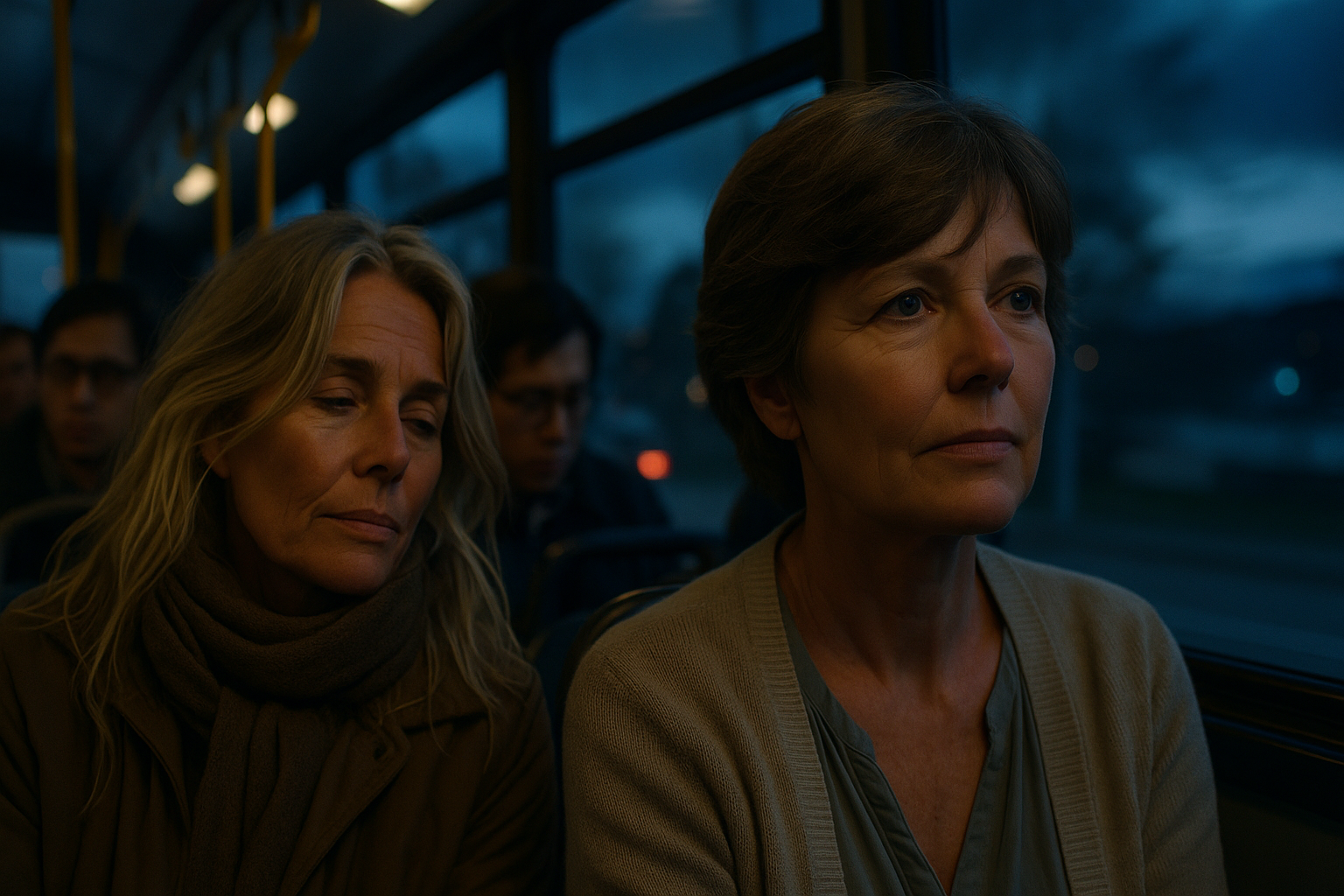
A cold Hobart evening finds Jane at the bus stop, weary from the day and from the unanswered things still rattling quietly in her mind. But when she and Karen share a familiar ride home, what begins in silence unfolds into something deeper—two friends side by side, carrying what neither could on their own.
It had been one of those Hobart afternoons where the cold didn’t quite register until it hit your bones — not the theatrical kind, just the slow, marrow-deep seep that crept past coats and sleeves and settled where your body remembered old injuries. I shifted from foot to foot under the bus shelter on Elizabeth Street, trying to coax some feeling back into my ankles. The wind threaded through the gap in my coat like a nosy cat — persistent, familiar, just impolite enough to be noticed.
Damp cobblestones glinted with the last of the rain, slick and uneven beneath my boots. The kind of pavement that always reminded me to walk with purpose but not hurry. One wrong step and you’d end up on your side, dignity bruised more than hip.
Down the line, a young couple were murmuring in hushed irritation — something about whose turn it was to cook. They weren’t arguing exactly, not properly, just bickering with the rhythm of people who’d done it often enough to refine the art. Their frustration had a softness to it, like old jumpers stretched out of shape.
Someone coughed behind me. Twice. That careful, apologetic kind of cough people do when they don’t want to be noticed but don’t want to be ignored either. I didn’t turn around. I kept my arms folded, elbows drawn close, my eyes fixed ahead — watching the buses inch through traffic like tired animals returning to the yard. There was a certain comfort in their slow inevitability, a kind of creaking reliability I understood. The world moved. You kept pace. Even if it was all uphill.
It was that time of day when the streets began to loosen. The lunch crowd long gone. Students slouching under the weight of oversized bags. Office workers retreating behind the fortresses of their take-away coffee cups. And those familiar faces from Glenorchy and Berriedale — not people I knew by name, but by gait, by coat colour, by the way they carried their fatigue like shopping bags: evenly distributed, unwilling to spill.
The air was thick with the city’s usual cocktail — diesel, cold metal, a faint undercurrent of something yeasty. That bakery across the road, still steaming up its windows like it always had, sent out a warmth I hadn’t expected. I’d assumed it had closed, truth be told. It looked like the kind of place that should’ve folded years ago — clinging on through pure stubbornness and habit, like an old uncle who refused to sell the house.
Still there. Still baking. Fog on the windows, loaves pale and stoic behind glass. Something about it made my throat tighten in that strange, involuntary way — not quite emotion, but something close to recognition.
Then I felt it.
Not the sound of her boots exactly, but the shape of her presence. There was a rhythm to the way Karen moved — not heavy, not hurried, but full of energy trying to stay inside a human frame. I felt her before I saw her. The cadence of her breathing. The low hum of someone carrying a day that didn’t fit neatly into a sentence.
“Oh my god, I can't believe it's still here!”
Her voice sliced through the lull — not sharp, just sudden. Edged with warmth, surprise, and something else. Something deeper. Nostalgia, perhaps, though the word never quite suited her.
I turned — a little too quickly, truth be told. My heart kicked up against my ribs before I could remind it to behave. She was closer than I’d expected, her grin arriving before her full shape did.
“Oh Karen,” I laughed, hand flying to my chest in mock alarm. “You almost scared me to death.”
She smiled — sheepish, unrepentant. Typical. The kind of smile that arrived fully formed and unapologetic. Always three thoughts ahead of herself and only halfway through deciding which ones she wanted to share.
Her cheeks were flushed from the wind, and despite the fatigue around her eyes — that gentle darkness that softened her face and told on her no matter how hard she tried to mask it — there was still that spark. That thing in her that lit up when something in the world stirred her just enough to make her speak without permission.
Her gaze drifted back to the bakery.
Still there.
Still steaming up its glass, resisting time in the way some buildings do when they’re held together by memory more than mortar.
She laughed, and the sound caught oddly in the air — like a coat snagged on a splinter. Not false, just… frayed.
“I needed a good chuckle after the day I’ve had,” she said, rubbing the back of her neck with the same motion she used when she was trying to scrape away more than just physical tension.
I didn’t ask.
I never did. Not straightaway. She’d get there, eventually — around the time the bus was halfway up the hill, when the world outside had blurred into light smudges and the heat from the vents made everything feel briefly suspended. That was how it worked with us. These edges of the day we shared — small exchanges, half-finished conversations that only made sense because they didn’t need to.
She stood beside me, close enough that our sleeves brushed — wool on wool, faint static.
And just like that, I felt the day settle.
The noise, the files, the login errors, the unanswered call, the name I hadn’t said aloud in years — all of it folded slightly, like sheets smoothed down at the end of a long shift. Not gone. Just… quieter.
“You too, hey?” I said, glancing sideways at Karen.
She didn’t answer straightaway, not with words, but her shoulders gave the faintest sigh — that subtle drop people make when they know they’re seen. She looked tired in a way I recognised, not just from her but from a hundred late clinics and early mornings and small waiting rooms with their too-bright lights and too-thin chairs. The kind of tired that sinks deeper than your limbs — where the day hasn’t just passed, it’s pressed down.
Bone-deep.
Her skin was pale under the fluorescent shelter light, hair pulled back too quickly, scarf not quite tucked right. Whatever day she'd had, it hadn’t allowed for mirrors or second glances. I understood that. Some days, you just get through.
Just the words, spoken low and even, were enough. She didn’t need comfort — not the wrapped-up-in-a-blanket kind, anyway. What she needed was space that didn’t ask for more than she could give. Someone to acknowledge the weight without trying to lift it.
Karen gave a slight nod and motioned for me to go ahead in the line.
I didn’t argue. She knew I wasn’t the lingering sort. I never had been. I moved with the kind of momentum that came from long years of shift work, of knowing exactly when to move forward and when to hold still. Timing was everything in my world — on wards, in cars, at doorways. You moved with purpose or you didn’t move at all.
I climbed the steps with my usual rhythm — deliberate, unhurried. There was a posture I carried onto buses, one I’d never quite unlearned. As though I expected the space to push back, to ask questions. It never did, but still, I entered as if I were defending a place in it.
My card tapped the reader with a clean beep.
That sound had become one of the fixed points in my day — tap, chime, forward motion. A modern mantra. A small permission slip to keep going.
The heat hit me just past the driver’s cabin. That strange, bus-brand of warmth: stale and damp, tinged with wet wool and the lingering trace of someone’s forgotten lunch. Not unpleasant, just familiar. It smelled like hundreds of days layered over each other.
I made my way down the aisle, letting my gaze pass gently across the rows — not hurried, not too direct. I had a mental checklist I followed without thinking now. No screaming toddlers. No visible damp patches. No seats facing backwards. No sharp smells or crinkled snack wrappers wedged into upholstery.
One spot. Halfway down. Window seat open. A patch of safety.
“Here. I’ve saved you one,” I called back, patting the worn vinyl beside me. The seat was cracked — not freshly, but in that long-term way, like something soft that had gradually given way. A bit spongy on one side, slumped slightly toward the window. But it was ours. The sort of spot we always landed in if we could help it.
I gave her a smile — open and easy. The kind I didn’t hand out to just anyone. I wasn’t one for display, but when I gave warmth, it stayed given.
Karen made her way down the aisle with the kind of tall, folded-in manoeuvring she’d perfected over years of public transport. She didn’t walk so much as negotiate space. Her limbs adjusted like coat racks in tight hallways, polite but efficient, aware of every pair of knees and swinging backpack.
She slid in beside me, immediately beginning her usual ritual of rearranging herself — elbows pulled close, knees shifted sideways, satchel looped carefully beneath her feet. It always looked a bit like she was assembling herself in a too-small storage unit.
“Sorry,” I said, catching the contorted angle she’d landed in. “Didn’t look like we had many options.”
“We never do this late in the day,” she replied, glancing out the fogged-up window. “It’s basically dark already.”
Her voice was quieter than usual — lower, dulled at the edges. The kind of tone people get when winter’s started to settle in their bones and they haven’t yet decided whether to fight it or surrender to it. I recognised that, too. I’d felt it earlier, just before stepping into the bakery light, when the sky had turned grey without warning and the temperature dropped half a degree too quickly.
I followed her gaze. The window had already begun to cloud over with condensation, a soft bloom with each of our breaths. The city beyond was slipping into its evening costume — shopfronts glowing in amber, headlights stretching across the puddles like threads pulled through silver fabric. Everything moved slower now, more deliberately.
“I know,” I said. My own breath left a faint ghost on the glass. I kept my voice level, steady — but there was softness in it too. That weight-sharing sort of softness. Not a fix, not a solution, just a willingness to be beside something without trying to change it.
“Middle of winter. Days will start getting lighter again, soon.”
I didn’t believe it would help — not really. Not with the look on her face and the heaviness in her shoulders. But that wasn’t the point, was it? You didn’t need to chase the darkness out of a friend. You just had to sit beside them until the streetlamps came on.
She shivered.
I felt it more than saw it — the slight, involuntary movement beside me. Not dramatic, just a subtle draw inward. Cold from the window, probably. These buses always felt one insulation layer short of kindness. Warm in theory. Not quite in practice.
I adjusted my scarf — not for temperature, but for presence. It was a quiet gesture. Straightening. Grounding. A kind of posture I kept when I knew I couldn’t change anything, but could still be something steady next to it.
We didn’t need to talk.
Not yet.
Not in the early minutes, where the city was still clinging to the day and the bus hadn’t found its rhythm. We had hills ahead of us, trees silhouetted in the half-light, and a silence that we’d earned — earned over shared commutes, missed connections, and the kind of friendship that didn’t announce itself but settled in quietly like furniture you stopped noticing because it simply belonged.
So we sat. Shoulder to shoulder. Wrapped in wool, weariness, and a stillness that didn’t need tending.
Outside, the world moved. Inside, we let it.
The bus lurched forward, as it always did coming off Argyle Street — a mechanical groan like it resented the slope, like the engine itself had questions about the necessity of uphill travel. I braced instinctively, one hand on the seat in front, feet angled just so — long-ingrained habits from years of night shifts and medical vans with dodgy suspension. My body knew how to anticipate uneven ground, even if the timetable didn’t.
The windows had fogged thick now, the outside world reduced to a canvas of breath and condensation, layered over with city weather. Streetlamps bled into the mist, puddled light swirling into abstract shapes. Silhouettes of cars passed like shadows behind a veil. A cyclist flashed by — or rather, the brief red pulse of one — so quick and faint it might have been imagined.
There was no view now, not really. Just movement, muted by fog and fluorescent light.
Inside, though, the world had narrowed. Compressed.
Just the hum of tired conversation from somewhere up front. The quiet rustle of jackets being adjusted, the occasional metallic click of someone’s zip or keyring. The odd cough, muffled by scarves, apologetic in nature — no one wanting to call attention to themselves.
This hour always made the bus feel less like transport and more like a holding bay. A vessel of human leftovers, drifting slowly between obligation and rest. We weren’t travellers, not really — just people in limbo. The end of the day gathering us up like breadcrumbs in a coat pocket.
There was a particular stillness to it tonight. Not peaceful, exactly. Just… resigned.
That kind of hush that settles when no one has the energy to perform themselves anymore. No laughter to prove resilience. No overly loud phone calls. No exaggerated sighs of boredom. Just a soft, collective folding inward.
Everyone retreating. Into their bags, their jackets, their breath.
I saw it in the way people cradled their things, bags held close to the chest, shoulders slumped inward, hands gripping items that had no immediate purpose. The kind of posture that suggested fatigue not just of body, but of being witnessed.
The air was dense with it. Not stale, but thick. Late winter exhaustion, quietly shared.
I adjusted the weight on my lap — slowly, without thought — my old Landcare tote softening further under its own burden. One of the straps had begun to fray near the seam, threads curling out like unwound promises. I’d meant to stitch it weeks ago. I’d even laid out the thread — waxed linen, good quality — and then left it sitting on the sideboard, untouched.
The bag sagged against my knees, giving way slightly as I shifted.
It bore a faint coffee mark near the edge — pale and ringed, like a watermark left on a letter long ago. I’d stopped noticing it most days. But tonight, it seemed to catch in the light, faint but persistent.
Karen glanced down — not for long, just enough to see the motion. Her eyes didn’t linger. They never needed to. She simply registered it — in that way of hers — acknowledged the gesture without naming it, like a dancer adjusting to a partner’s slight weight shift.
That was how we worked. Silent choreography. No one calling steps aloud. We just moved together in small, practical synchrony.
She knew what a full bag meant. What its slump and crumple said about a day’s demands. Errands run on tired legs. Clinic pamphlets I was meant to sort and hadn’t. Apples I’d packed that morning and forgotten to eat. A folded newsletter from the office that I hadn’t had the heart to throw out, though I hadn’t read it either.
We never had to explain the detritus of our days. It was all there, in weight and shape and the way you held something too long after it stopped being useful.
The bus bounced — sharper than expected — over that familiar pothole near Burnett Street. The one that never got patched, no matter how many reports were filed.
I heard a dull thud from Karen’s satchel. Something inside it shifting — a book, perhaps, or the edge of a lunchbox unsettled. The noise was soft, but it held weight, like an object remembering it hadn’t quite been put away properly.
Karen didn’t flinch. But I felt her stillness change. Subtle, but there. Her body pulled in slightly, breath paused, as if the sound had reminded her of everything she was carrying — not just in her bag, but in her spine, her eyes, the corners of her mouth.
I knew that feeling.
I knew the way a single shifted object could be enough to bring the day back in a rush. You held yourself together all afternoon, and then the strap on your bag slipped, or your pen fell, and suddenly everything tilted. Not dramatically. Just enough to notice.
Sometimes you didn’t need to name the weight. You just had to hold still long enough for someone else to notice you were holding it.
I didn’t reach for her. Didn’t speak. Just adjusted my scarf again — gently — and let my presence press a little more solidly against the edge of her own.
Outside, the fog thickened. A veil of cloud and bus-glass. The world beyond was gone now, hidden behind layers of breath and weather and light that no longer meant direction.
Inside, we sat in our shared patch of heat.
Not speaking.
But not alone.
I’d felt it before she spoke — the subtle tilt in her frame, the way her shoulders dropped just slightly, as if the act of being still had finally become too heavy. The breath that followed came a second too late, like her lungs had needed prompting. Karen had her tells, and I’d learned them over a dozen winters’ worth of shared bus stops and mismatched timetables.
They weren’t dramatic. They never were. That wasn’t her way. But they were there — in the delay between thoughts, in the slight narrowing of her eyes when something pressed too close to the surface. If you knew how to read her, she was almost generous with it.
“So why are you so late today?” I asked, keeping my tone casual.
Not indifferent — never that. Just worn-in. Comfortable. Like a jumper with the elbows gone soft. The kind of tone you use when you know the answer might be layered — sharp in places, tangled in others — but worth asking anyway. There was no hurry in the words, just invitation.
Besides, I already had a version of the answer. Her voice earlier had told me more than the words themselves. I knew that edge. I’d heard it when budgets were cut and when grant applications came back stamped Deferred. I’d heard it on wet mornings after fieldwork, when the rain had soaked her through and she still had to talk to people who didn’t care where the frogs bred or which patch of land had been quietly gutted of canopy.
She let out a sigh.
One of those long ones that comes from somewhere near the ribs — not performative, not even all that audible. Just the kind of exhale you make when there’s no room left for the breath you’ve been holding. The kind that’s not quite a scream, but isn’t silent either.
“Oh,” she said.
That was all at first. But I could already hear the shift — the sound of flint catching against steel. Not fire yet. Just the possibility of it. The kind of flintiness that creeps in like cold through an old window — subtle, insistent, hard to ignore once it’s there.
“We’ve got no staff and incompetent management to thank for that.”
It hit with a crack. Sharper than she probably meant it. But not unfair.
Karen’s frustration never exploded. It was more precise than that. It came out like a chisel — weighted, aimed. You could tell she’d been holding it back for a while, managing it, shaping it into something that wouldn’t spill. And now the seams were showing.
“So nothing unusual,” I said, quick as a scalpel.
It wasn’t flippant. Just reflex. A small incision to release a little pressure. Levity, but only the lightest kind — carefully applied. I’d spent too many years around people who mistook jokes for dismissals. I’d learned that it’s not about making someone laugh. It’s about letting them breathe.
“No. I guess that’s not unusual, is it,” she replied.
And there it was — the tiniest curve of a smile, ghosting across her face before vanishing. Not wide. Not even relaxed. But real.
I didn’t need her to laugh.
I just needed her to feel seen. Held in place, not by explanation, but by recognition. That, sometimes, was more than enough.
Karen’s voice had that undertow again — the current that always ran beneath her when something mattered. You could hear it even when the subject sounded technical. It was the sound of someone trying to explain something deeply felt, even if the language had to pass through layers of restraint first.
It was the same tone she used when talking about riverbanks and bird migratory routes. When she mapped pollination corridors with the same care other people reserved for family trees. It wasn’t sentimentality. It was knowledge lived-in so long it had become personal.
“I’ve been working on a submission to local council to expand a parcel of land for the further protection of a species of Lucanidae,” she said.
And there it was — that quiet shift.
Still tired, yes. Still held in by the frame of her coat and the dimness of the hour. But underneath it: lift. A subtle rise in her words, like a hand resurfacing after a long dive.
I tilted my head slightly toward her, listening — not just with ears, but with that stillness you offer when someone starts speaking from their centre. You learn to recognise that frequency. Especially with Karen.
There were times when I didn’t follow half the science she rattled off. I couldn’t always keep up with the taxonomies or the Latin names or the layered reasoning behind corridor expansion versus managed microzones. But I never doubted its importance. Not once.
She spoke about habitat buffers and beetle niches the way others spoke of childhood songs or handwritten recipes — with a tenderness that didn’t require translation. Not for effect. Never for attention. But because these things lived inside her now. Fixed points on her internal map.
She couldn’t not speak of them.
And I couldn’t not listen.
“Oh, right,” I said.
Just two words, soft and simple. But I meant them.
Not a placating nod, not a filler. Just my way of saying I’m with you — that I was still tuned in, still walking beside her in this little trail of thought she'd started weaving. I knew she wasn’t done. Karen rarely was, not when the subject had lodged itself under her fingernails and taken root behind her eyes.
She smiled faintly and added, “It’s a Stag Beetle.”
And there it was — that flicker of pride. Barely there, but unmistakable. A tiny flare of light through the usual restraint she wore like a buttoned coat. Karen wasn’t one to grandstand. If anything, she folded herself too tightly sometimes — voice tempered, enthusiasm reined in so as not to draw unnecessary attention. But the pride was real, and it slipped through before she could rein it back in.
I smiled too, letting my voice warm a little in response. Matching her shape.
“Of course. I know how much you love bugs.”
It wasn’t teasing — not truly. Just an echo of shared language. Something familiar we’d circled around before. But I saw it at once — the way her shoulders moved, just slightly, almost like a muscle memory firing too early. That word — bugs — had struck her funny. Not because it was wrong, necessarily, but because it wasn’t quite right. I already knew what was coming.
“No, they’re not bugs. They’re—” she started, voice edging toward correction, that habitual reflex winding itself up before she paused.
I cut in gently. “Beetles.”
The word sat between us with just enough softness to keep it from being a jab. I wasn’t mocking her. This was our rhythm. Her precision, my approximation — orbiting the same facts from different directions. And always finding our way back.
The amusement in my voice wasn’t meant to tease. Just to take the sting out. To show her I saw the difference — even if I sometimes blurred the lines for shorthand.
“See, you do know,” she said.
And this time, her smile was full. Honest. Not wide, not flashy — but open. It held something warmer than relief. Like gratitude without the ceremony.
I turned to her slightly, catching the way the bus’s overhead light brushed against her cheekbone — soft, golden, fleeting. Her face was still tired, still edged with the day’s residue, but there was colour in her again now. A thread of self returning.
“Oh, I know. I just forget sometimes,” I said, giving a small shrug.
And I did. I forgot the taxonomic boundaries. The proper names. The Acts and species codes and scientific divisions.
But never the things that mattered.
Karen had that tone again — the one that curled a little tighter when she felt misunderstood, even in passing. Not defensive, exactly. Just… taut. Like something small but precious had been bent the wrong way. I knew that feeling too.
And it wasn’t about the beetles. Not really. It never was.
It was about being heard. About knowing that someone else cared enough to hold the same thread, even just for a minute. About not being the only person still at the table long after the meeting ended and the lights were turned off.
“It’s not something new,” she said, a bit sharper than I think she meant to. “They’ve always been beetles. They’re in the Tasmanian Threatened Species Protection Act.”
I turned to her properly this time, letting the space between us still — no more movement, no distractions. The kind of attention you offer without speaking it aloud.
Her face was caught partly in shadow from the dim bus lighting, but I saw it clearly enough — the tight set of her jaw, the slight flare in her nostrils, the faint line between her brows. The flicker of someone who’s spent all day defending something important, only to be met again by a world that doesn’t quite listen.
I didn’t flinch.
I didn’t need to. This was familiar terrain for me — the raw edge where conviction meets fatigue. I’d spent years walking into rooms where people were brittle, resentful, or too tired to articulate their own sadness. Where words came out sideways and sharp. The trick wasn’t to fix it. The trick was to stay. Stay steady. Let it land. And hold the air clear long enough for them to breathe again.
“Oh, I don’t doubt they are,” I said, quiet but firm. Just enough weight behind it.
No apology. No humour. Just a soft confirmation that I was still here. That I was listening.
Her mouth opened slightly — a breath caught between response and reconsideration.
But I shifted the moment gently, like turning a stone over with your foot to see what’s underneath without disturbing the moss too much. Not because I wanted to avoid the subject, but because I knew — instinctively — she didn’t want to sit in that sharpness for too long. Not tonight.
Sometimes, the kindest thing you can do is not ask someone to keep explaining why they care.
I turned slightly in my seat, letting the motion speak for me. Not dramatic, not abrupt. Just a subtle change in rhythm. A soft reset.
The bus gave a familiar jolt as it slowed toward a red light. Outside, the world glimmered briefly — the bright signage of the bottle shop flaring across the fogged windows, distorted like a memory half-recalled. Inside, our little pocket of heat remained steady.
I let the moment settle like dust before the next breeze.
The bus gave a soft jolt as it rounded the corner by the old theatre — that familiar lean in the frame, like it remembered once having grace but had since surrendered to groaning suspension and damp roads. The lights overhead flickered briefly, as they often did on that bend — a momentary flutter, then back to their dull hum.
Karen was quiet beside me. Had been since the last exchange. Not a silence of tension or withdrawal, but that deeper sort — the kind that hummed softly with unfinished thought. Thought still mid-sentence in the mind.
I glanced sideways.
Her shoulders had shifted again, subtly rounded now, the kind of posture you adopt when you're either gathering yourself or letting yourself go unnoticed. The corners of her mouth had softened into a downward drift — not quite a frown, but the slope of someone winding down without resolution.
Something practical stirred in me.
Not urgency. Not alarm. Just that quiet, old instinct — the one shaped by years of responding to need before it asked. When you’ve worked in community health long enough, you start to feel it before the words arrive. A kind of weight in the air. The space between a sigh and a confession.
“So, with you being so late tonight, how are you getting back home? Is Chris waiting for you at the usual spot?” I asked.
I kept my tone light — or tried to. Just offhand enough not to spook anything. But the question was deliberate, and I already suspected the answer. Her silence had told me more than she realised. The absence of a plan, the way her hand hadn’t reached for her phone. The walk tucked into the corners of her expression like something she hadn’t wanted to name.
She didn’t meet my eyes straightaway.
Instead, she frowned, eyes drifting down to her lap where her phone sat unlit, unresponsive. No blinking notifications. No comforting hum of connectivity. Probably no reception again — or the battery doing that thing where it dies suddenly when the weather turns cold.
“I’m not sure yet,” she said, voice low, tired. That particular tired, not from exertion but from shouldering too much with too little return. “Earlier I told him to go home as usual and I’d let him know what time to come and get me. But I haven’t been able to reach him as yet. I may have a lengthy walk ahead of me.”
I didn’t answer straightaway.
Because that didn’t sit right. Not one bit.
The walk from Glenorchy out past Berriedale, and then up into Collinsvale? In this cold? On this night? With that half-finished look in her eyes and the air already biting through wool?
Absolutely not.
“Don’t be silly, dear friend,” I said, already reaching across and placing a hand on her arm.
Not forceful. Just there. Just enough pressure to be felt — a quiet anchor. That’s all it ever needed to be. Not some dramatic overture. Just: I see you. You’re not doing this alone.
“Message Chris and tell him not to worry about it. I’ll take you home tonight.”
There was a beat.
Then she turned and looked at me — properly.
And in that small tilt of her head, I saw the whole story unfold behind her eyes. The push and pull. Relief creeping in like warmth through a doorway. Guilt standing stiff-backed just behind it, not wanting to let go. I recognised that internal war well. Karen wouldn’t ask. Not ever. But that didn’t mean she didn’t need to be offered.
“You can’t do that,” she said, the words spilling out like a reflex. “Wouldn’t Valerie have dinner ready and waiting for you by now?”
I nearly smiled. Not because it was funny. But because it was sweet of her to think so. Predictable, in the best way.
Val knew me. Knew us. She’d probably taken one look at the sky and the clock and assumed I wouldn’t be home for hours. She didn’t wait on hot meals or hard timelines. Not anymore. Ours was the kind of arrangement stitched with understanding — worn in, but still strong.
“Of course I’ll take you,” I said, firm and clear.
No room for argument. No soft edges to blur the line.
“We can’t very well have you walking all the way from Berriedale to Collinsvale in the cold and dark now, can we.”
That was that.
She didn’t argue after that — not properly. I could see it in her posture. The way something released beneath her collarbones. Her chin stayed lifted — pride never fully set down — but the resistance eased. The weight shifted. Not gone, but shared.
It wasn’t charity.
It was friendship.
And friendship — the real kind — didn’t show up with fanfare or gold stars. It showed up like this: in coat sleeves brushing, in hands placed gently on forearms, in warm cars on cold nights. In knowing someone well enough to see the gap forming before they ask you to help fill it.
Just: I’ve got you.
And I did.







