4338.10 · January 10, 2018 AD
The Ritual
Hobart is already warming as Nathan steps off the morning bus and into the ritual that holds his life together: the same walk, the same café on Salamanca Place, the same barista whose name he has spent six months deliberately not learning. It is a small, perfect thing, and he has built more of himself on it than he realises. For now, everything is exactly as it should be.
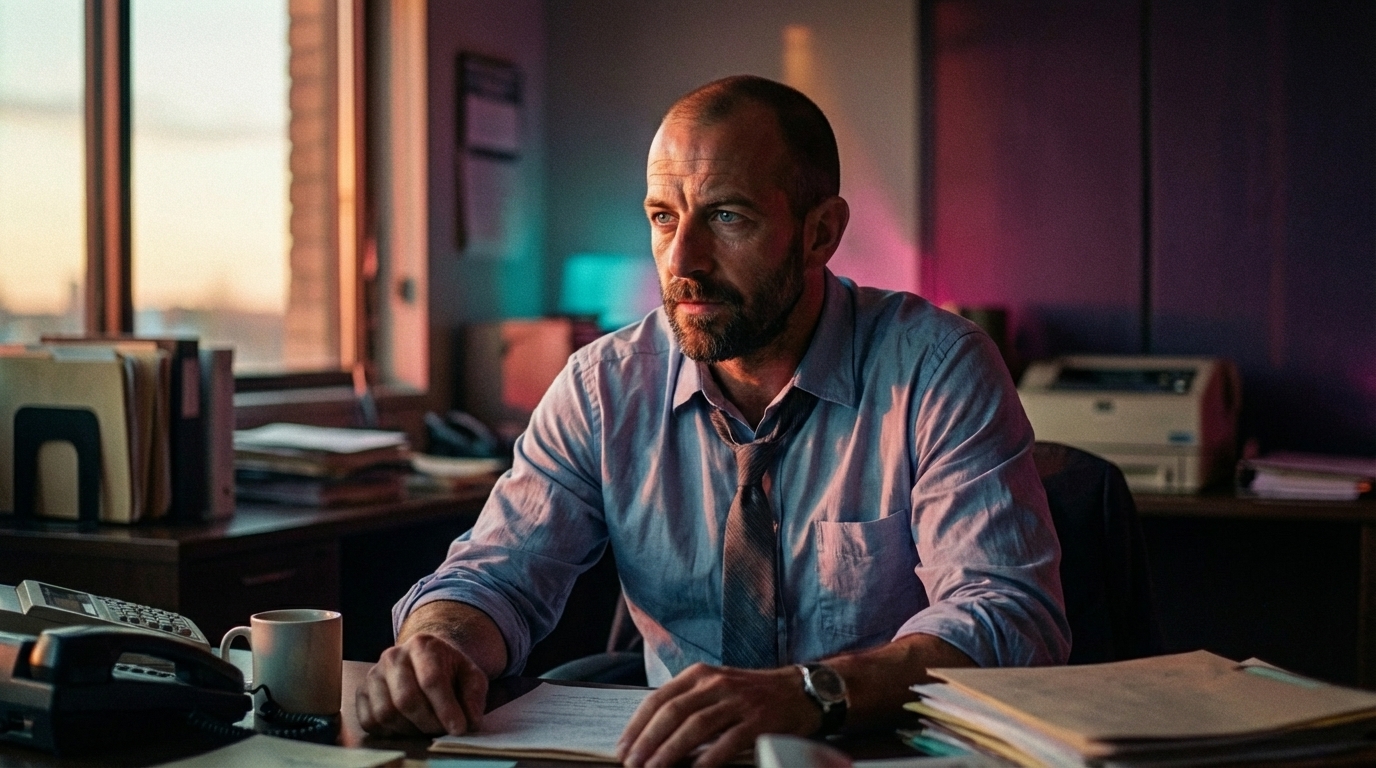
“There’s a fine line between routine and ritual—but the moment something disturbs it, you realise just how much you were depending on its spell.”
The air was already warm, though a breeze drifted in from the Derwent River, carrying that distinctive promise of relief that only Hobart's maritime climate could deliver. I could taste the salt on my lips if I concentrated—that faint mineral tang that reminded me, even in the heart of the CBD, that the ocean was never far away. Mount Wellington loomed in the west, its massive silhouette dominating the skyline. The mountain's presence felt both protective and vaguely ominous in the flat early light, its dolerite columns catching the sun in ways that made the peak appear almost alive, breathing slowly beneath its mantle of ancient stone.
Kunanyi. I was trying to discipline myself to use the name, though after a decade in Tasmania, old habits still clung with stubborn persistence.
"It's going to be another scorcher," I muttered to myself, alighting from the final step of the bus with a little jump. My feet landed with a peculiar lightness that sent a subtle shockwave through my pressed chinos—that curious sensation of weighing slightly less than physics should permit. I paused on the footpath, momentarily disoriented by the feeling. It had been happening more frequently these past months, this fleeting disconnection between expectation and reality, as though my body and mind were operating on slightly different frequencies that only occasionally synchronised.
The bus exhaled its hydraulic sigh behind me and pulled away, leaving me standing in a small cloud of diesel fumes that the morning breeze quickly dispersed. Already the pavement was beginning to radiate warmth through the soles of my leather shoes—that particular dry heat that Hobart summers delivered with increasing intensity each passing year. By noon, this concrete would be brutal. But for now, in these precious early hours, the city still belonged to those of us who had learned to love its quiet moments.
The sandstone buildings of the CBD were already beginning to absorb the morning sun, their colonial façades warming from cool grey to a honeyed amber as I walked. I loved watching this transformation—the way Hobart seemed to wake in stages, its nineteenth-century bones slowly remembering the warmth of countless summers past. There was something comforting about a city built from local stone, as though the buildings themselves had grown organically from the landscape rather than being imposed upon it.
I maintained that inexplicable bounce in my step as I navigated the gradually filling streets. A woman in a charcoal suit glanced at me as she passed, her expression flickering briefly with something between curiosity and mild concern—the look reserved for adults who appear unreasonably cheerful before eight in the morning. I offered her a small smile, which she did not return.
Fair enough. Not everyone appreciated morning people.
The truth was, I needed this. The ritual of it. The predictability. My life had become a carefully constructed architecture of small certainties, and this morning walk—this specific route, at this specific time, towards this specific destination—formed one of its load-bearing walls. Remove it, and I wasn't entirely certain what might collapse.
I turned onto Salamanca Place, where the historic warehouses had long since surrendered their maritime purposes to house galleries, restaurants, and the kind of boutique shops that sold artisanal candles at prices that made my eyes water. The Saturday market crowds were days away, and in their absence, the cobblestones possessed a meditative quality, my footsteps echoing softly against the worn stone. A seagull watched me pass from its perch atop a cast-iron bollard, its yellow eye tracking my movement with that peculiar intensity that always made me feel vaguely judged.
Blackwood & Co sat where it had always sat, halfway along, its broad windows catching the morning light and its small cluster of outdoor tables already occupied by the earliest of the early risers, hunched protectively over their phones and their newspapers in the manner of people who had not yet decided to be awake. I could smell it well before I reached the door—that rich, faintly ridiculous aroma of freshly ground beans mingling with something sweeter, the croissants that emerged from the kitchen each morning in a state of golden, buttery perfection that seemed to me entirely unreasonable for a Wednesday.
I wouldn't necessarily classify myself as a coffee snob—though I suppose anyone who religiously patronises the same café every morning might protest otherwise. But I maintained, to anyone who cared to listen, that it wasn't merely the coffee itself that kept me returning, even if it was demonstrably superior to the bland swill served up at most other establishments dotting the waterfront. The beans were single-origin, ethically sourced, roasted locally in small batches by a bearded gentleman in New Town who treated coffee production with the reverence most people reserved for religious observance.
No, I was selective about the staff.
"Life can be unpleasant enough as it is," I would tell anyone who dared question my intentions, though in truth, few ever did. "Why get off to the wrong start with some surly, grumpy, morose barista?"
Nobody had yet presented a compelling counterargument. Perhaps because they knew, as well as I did, that there was considerably more to it than simply avoiding morning churlishness.
The café itself was a slice of Melbourne transplanted into Hobart's historic heart—all exposed heritage sandstone and industrial lighting, with strategically placed Tasmanian natives in handcrafted ceramics dotting the windowsills. Native pepper and leatherwood honey featured prominently on the menu, that particular brand of Tasmanian provenance that tourists found charming and locals had learned to expect. The aesthetic walked a careful line between rustic authenticity and calculated cool, the kind of place that appeared effortlessly stylish while clearly having invested considerable effort in achieving precisely that impression.
I pushed through the door, and the entire familiar apparatus of the place closed over me at once—the heat of it, the noise of it, the smell of it, the whole warm inhabited weight of a room that had been going since half past six—and I let it happen, gratefully, exactly as I had let it happen every morning of my working life. The hiss of steam from the espresso machine. The low murmur of early morning conversation. The subtle undercurrent of some remix—was it Drake? Or perhaps one of those other artists my younger colleagues discussed with such passionate intensity?—pulsing through the speakers at a volume designed to energise without overwhelming.
And there he was.
My barista. Though of course he wasn't mine in any meaningful sense—merely the object of a thoroughly catalogued fascination that I had never quite summoned the courage to act upon. He stood behind the counter with his back partially turned, executing some preparatory task that I couldn't quite identify, his movements carrying that particular efficiency of someone who had performed the same actions thousands of times until they had become an extension of thought itself.
The stubble. That was always the first thing I noticed—that carefully maintained scruff that caught the morning light streaming through the café's harbour-facing windows, transforming the ordinary act of existing into something approaching art. Honey-brown, darker at the jaw, lighter near the ears. I had catalogued its variations across seasons and days with embarrassing thoroughness, noting how it grew slightly longer on weekends, how the summer sun brought out copper undertones that winter seemed to suppress.
He turned, and there it was: the smile. Not the performative customer-service variety that most retail workers deployed like a shield, but something warmer, more genuine—as though my arrival constituted a small but meaningful event in his morning. The slight dimple appeared in his left cheek, precisely where I knew it would be, and I felt that familiar flutter behind my ribs that I had long since stopped trying to rationalise away.
"The usual?" he asked, though we both recognised it wasn't really a question. His voice carried that particular hybrid of mainland and Tasmanian accent that I'd noticed was becoming more prevalent among the younger crowd—a sort of cosmopolitan Australian that seemed to transcend the formidable barrier of Bass Strait.
I nodded, not trusting my voice to emerge at the correct pitch. Pathetic, really, for a man of thirty-three to be rendered semi-mute by a smile and some well-groomed facial hair. And yet here I stood, week after week, month after month, performing the same wordless ritual while carefully avoiding the question that would transform this comfortable ambiguity into something that required actual navigation.
What was his name?
I didn't know. After six months of near-daily visits, I still didn't know. The omission had evolved from accidental oversight into deliberate preservation, a mystery I was consciously choosing not to solve. There was something rather enchanting about these wordless morning encounters, these small moments of connection that felt somehow more significant for their very simplicity—as though they existed slightly outside of time, untethered from the complications of the real world.
If I learned his name, I would have to do something with that information. I would have to acknowledge him as a complete person with a history and preferences and perhaps a boyfriend or girlfriend waiting at home. The fantasy—such as it was—would collapse under the weight of reality, and I wasn't certain I was prepared to sacrifice this small, perfect thing on the altar of actually knowing.
I watched him work, allowing myself the indulgence of open observation. There was an undeniable artistry to his movements—the precise tamping of the coffee grounds, the careful positioning of the cup beneath the group head, the rhythmic whir of the machine. He reached for the milk pitcher, and I found myself holding my breath slightly as he began the steaming process, his wrist executing that perfect circular motion that produced the micro-foam necessary for latte art.
The milk transformed under his attention, developing that glossy, paint-like consistency that separated competent baristas from true craftsmen. I had watched him perform this particular operation several hundred times by then, and I had somehow never got tired of it, which was a mildly humiliating thing to have to concede about a man in an apron pouring warm milk into a cup.
He poured with confidence, the white stream cutting through the crema in a controlled arc, and I watched the familiar rosetta pattern emerge on the surface of my latte. Each leaf unfurled with a symmetry almost mathematical in its exactness. A small signature, repeated daily, as consistent as a handwritten name.
"Thank you," I said, accepting the cup with what I hoped was a casual smile rather than the slightly besotted one I suspected I was actually wearing. The cup was warm against my palms, the heat seeping into my skin with that particular comfort that only a well-made coffee could provide. The aroma rose in a fragrant cloud—dark chocolate, stone fruit, something almost floral beneath it—and I inhaled deeply, letting the scent momentarily transport me.
Our fingers didn't touch during the exchange. They never did. But the space between them felt charged somehow, electric with all the things I would never say.
"Have a good one," he offered, already turning towards the next customer in the queue that had formed behind me.
"You too." The words emerged automatically, the same words I offered every morning, as much a part of the ritual as the coffee itself.
I stepped away from the counter and moved towards the door, weaving between the growing queue and the occasional tourist consulting their phones with that distinctive mix of excitement and bewilderment that marked visitors to the island state. The café existed as a perfect cross-section of Hobart itself—historic and modern, local and cosmopolitan, earnest and slightly pretentious all at once.
My traitorous body, which had apparently agreed to whatever the speakers were doing without troubling to consult me about it first, carried me out through the door and along the waterfront still moving faintly to the beat, and there was something about these morning encounters that left me feeling as though I had borrowed a small quantity of his youthful energy and was carrying it away with me like a talisman against the mundane realities of another day at the office.
The sun had climbed higher now, and its light was coming off the water of Constitution Dock in a way that broke the whole harbour into several thousand separate pieces, not one of which would hold still for a second. The fishing boats bobbed gently at their moorings, their reflections fragmenting and reforming with each small wave. Even the prospect of another unseasonably warm Hobart day couldn't diminish my curious buoyancy.
A hot coffee. A warm smile from a cute, stubbled face. Truly the perfect start to any morning.
As I made my way through the increasingly crowded streets, past the sandstone façades that whispered of Hobart's colonial past, I couldn't help but wonder if today might be the day I finally summoned the courage to ask his name. But then again, perhaps not. Perhaps tomorrow. Perhaps never. Some mysteries were better left unsolved, their power residing precisely in their incompleteness.
A peculiar thought struck me then, causing my step to falter momentarily: what if these morning interactions were the most authentic part of my day? What did that say about the remainder of my existence?
I pushed the question aside—there would be time enough for existential inventory later—and resumed my bounce towards the office, the unnamed barista's smile still doing whatever it was that it did to me, and the coffee hot in my hands, and the entire disproportionate happiness of the thing so far in excess of anything that had actually occurred that I would have been thoroughly embarrassed had there been anybody present to observe it. The city opened before me in the golden morning light, full of promise and possibility, and I allowed myself to believe, just for these few precious minutes, that everything was exactly as it should be.
The office building rose ahead, its modern glass façade incongruous against the heritage streetscape, and I felt the familiar micro-adjustment that preceded every working day—the slight straightening of posture, the subtle shift in expression from private contentment to professional neutrality. But not yet. Not quite yet.
I had a few more steps of freedom remaining, a few more moments to exist in that liminal space between the person I was in the café and the person I became at my desk. I intended to savour every one of them.







