4338.204 · July 23, 2018 AD
The Ribbon of Ink
As Paul drives through the vast darkness between Broken Hill and Adelaide, the empty highway becomes a confessional where he confronts the uncomfortable truths about his failing marriage, his complicated brotherhood, and the unspoken vow that's pulling him towards Tasmania. When a kangaroo explodes from the scrub and Claire's thirteenth call lights up his silenced phone, Paul realises that some disasters can't be outrun—they can only be survived.
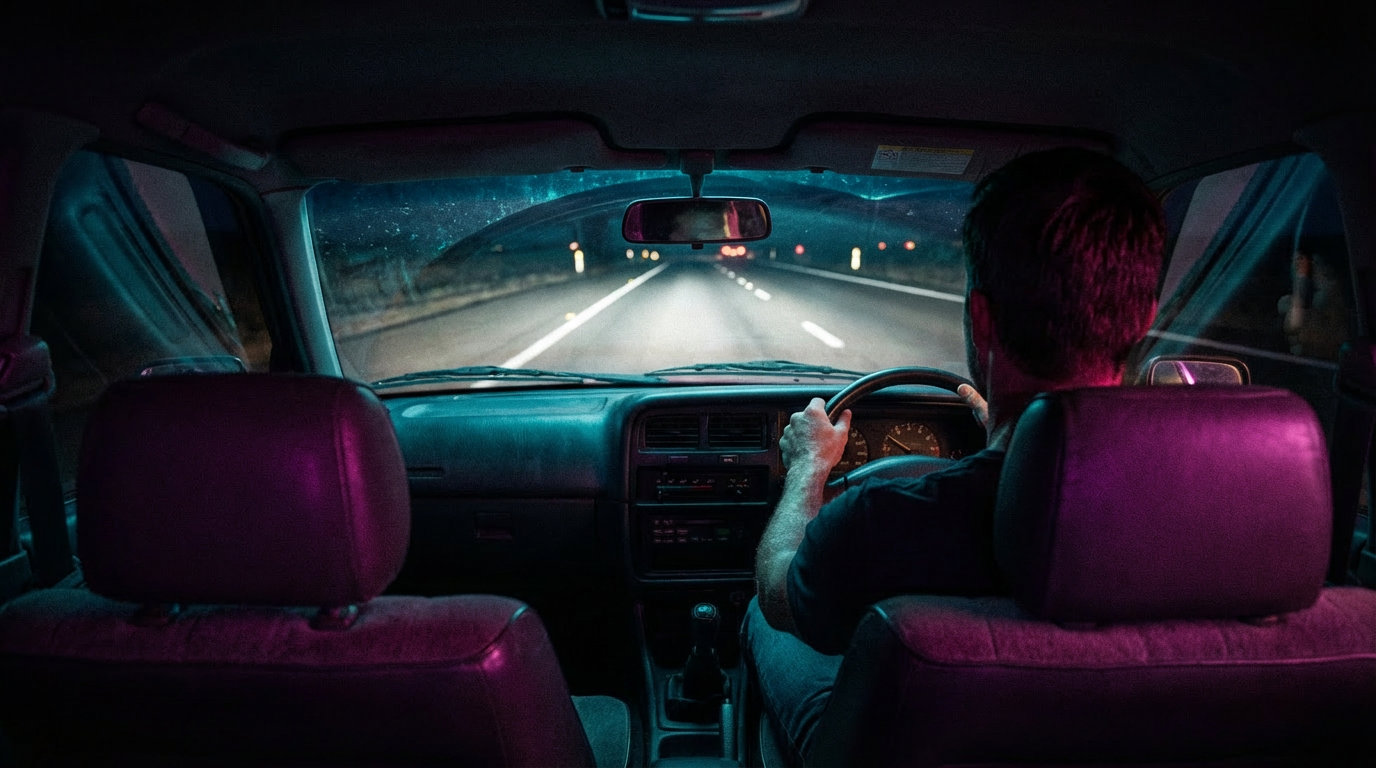
"There's something brutally honest about outback darkness—no streetlights to soften the edges, no distractions from the thoughts you're trying to outrun. Just you, the road, and thirteen missed calls you're pretending not to see."
The tyres hummed against the bitumen, a steady drone that became the baseline to every thought rattling through my head. The highway stretched ahead like a ribbon of ink, the darkness so complete it felt solid, punctured only by the twin cones of my headlights carving through the night. Out here, between Broken Hill and Adelaide, civilisation was more concept than reality—a service station every hundred kilometres if you were lucky, scattered homesteads set so far back from the road you'd never know they existed unless you were looking for them.
It had been nearly an hour since I'd escaped—there was no point pretending it was anything other than escape—through my bedroom window. An hour since I'd left Claire standing at that window, mouth moving in silent fury, words I was grateful not to hear dissolving into the space between us.
My arms still stung where the thorns had found flesh. Small, sharp reminders every time I adjusted my grip on the steering wheel. I'd checked them properly before leaving town—nothing serious, just scratches that would scab over and fade, leaving no permanent mark. Unlike other wounds. Unlike the ones Claire and I inflicted on each other daily with words and silences and the slow suffocation of a marriage that had died years ago but refused to stay buried.
What is Luke up to?
The question surfaced unbidden, mixing with the engine's low rumble. I'd been turning it over since we'd hung up, examining it from different angles like some puzzle I couldn't quite solve. Luke's voice had carried that seriousness, yes, but there was something else underneath it. Something I couldn't quite name. Not fear, exactly. Luke didn't do fear the way normal people did. But vulnerability, maybe. An edge that suggested he was standing at some precipice, looking down at something that scared him.
Luke and Jamie having problems. Major issues, he'd said. I tried to imagine what that might mean. Their relationship had always seemed solid to me, or at least as solid as any relationship could be. They'd built something together in Tasmania, carved out a life that was theirs. But then, I'd thought my marriage was solid once too. I'd stood at the altar with Claire and believed every word I'd said, meant every promise I'd made. Look how that had turned out.
Maybe that was the problem with relationships—they all looked solid from the outside until you were living inside them, feeling the foundation cracking beneath your feet.
Despite the concern gnawing at me, a smile tugged at my lips. Luke. My little brother. The dreamer, the mystic, the one who'd always seemed to float through life on some current I'd never been able to find. When we were kids, I'd worried constantly about him. Worried that his otherworldliness would get him hurt, that his refusal to conform would see him crushed by a world that demanded conformity. Worried that one day I'd get a call—the kind of call you never want to receive—telling me that Luke's luck had finally run out.
But Luke had survived. More than survived. He'd built a life on his own terms, refused to be moulded into the shape the church wanted, the shape Dad and Greta wanted, the shape that would have killed something essential in him. He'd left the faith, come out, moved to Tasmania, partnered with Jamie. Each step a small act of rebellion against everything we'd been raised to be.
I envied that sometimes. Envied his courage. I'd left the faith too, in my own way—or rather, I'd let it erode slowly, a gradual wearing away rather than a decisive break. But I'd never quite managed to leave the rest of it behind. The performance. The pretence. The careful maintenance of appearances that let everyone think I was still the Paul they expected me to be.
The headlights caught the reflective markers along the road's edge, little green eyes winking back at me from the darkness. The land out here was harsh—spinifex and saltbush clinging to red earth, the occasional ghost gum standing sentinel, its white bark luminous in the dark. Beautiful in its own severe way, if you had eyes for it. I'd grown to appreciate outback landscapes since moving to Broken Hill. There was an honesty to them, a refusal to be anything other than what they were.
My mind drifted back through the years, tracing the thread of my relationship with Luke. For all our differences—and they were stark, undeniable—we'd never let them drive a proper wedge between us. We argued, sure. Debated. Disagreed on everything from politics to music to the best way to cook a roast. But the anger never stuck. One of us would always crack first, find the humour in the argument, and we'd dissolve into laughter.
Sometimes, in the worst moments with Claire, I longed for those simpler times. Before marriage. Before mortgages and bills and children and all the crushing weight of adult responsibility. When it had been just Luke and me against the world—or at least against Dad's emotional distance and Mum’s absence and the constant, grinding pressure of the church's expectations.
But those days were gone. We were adults now, or at least we played them on television. Luke had his life in Tasmania, his problems with Jamie, whatever crisis had driven him to buy plane tickets he couldn't afford. I had my life in Broken Hill, my failing marriage, my business ventures that kept the lights on but never quite added up to anything that felt like success.
The highway rolled on beneath me, kilometre after kilometre of nothing. The monotony was almost meditative. Out here, there was just the road and the darkness and the thoughts I couldn't quite outrun.
Luke's decision to buy those tickets—no questions asked, no conditions attached—that meant something. Luke was careful with money. Not stingy, exactly, but aware of its limits in a way that came from never having quite enough of it. For him to drop that much money with less than twenty-four hours notice, that was significant. That was desperate.
Something was wrong. Really wrong. Not Luke's usual brand of chaos—the kind that looked dangerous from the outside but which he'd always navigated with surprising grace. This was different. I could feel it in the way he'd sounded on the phone, in the pauses between his words, in the rawness when he'd said he needed me.
"You know I don't really have anyone else here."
The words echoed in the car's interior. They were true, weren't they? Luke and Jamie in their little bubble in Tasmania, cut off from family, from the church community that would have rejected them anyway, from the support networks that most people took for granted. If things with Jamie were falling apart, where did that leave Luke? Alone. Isolated. Adrift.
And here I was, driving through the night to get to him, because that's what brothers did. That's what we'd always done for each other.
The memory surfaced unbidden—that ridiculous morning with the wasps. I couldn't help but laugh, the sound startling in the quiet car. God, what a disaster that had been. Me in my dressing gown, locked out, the dog going berserk, wasps everywhere. Breaking the laundry window in a panic and slicing my finger open, blood soaking into the terry cloth I'd used as a makeshift bandage.
And then Luke showing up with the spare key, taking one look at me—bloodied, half-dressed, surrounded by angry insects—and just losing it. That laugh. Not mocking, just pure amusement at the absurdity of it all. And somehow that laugh had been exactly what I needed. It had cut through the panic and embarrassment, reminded me that sometimes life's disasters were also its best stories.
Luke had that gift—the ability to find light in dark places, humour in chaos. I'd relied on it more times than I could count.
My hands tightened on the steering wheel. Whatever Luke was facing, whatever had put that edge in his voice, I'd be there. I'd made a silent promise to myself years ago, back when we were kids navigating the minefield of Dad and Mum’s divorce, of Greta's arrival, of the constant relocations and restructurings that defined our childhood. A promise that when Luke needed me, I'd answer. No matter what.
Maybe this was that moment. Maybe the time had come to repay all those instances when Luke had been the one showing up, spare key in hand, ready to rescue me from whatever mess I'd created.
The thought had barely formed when movement exploded in my peripheral vision.
"Shit!"
The word ripped from my throat as my body reacted before my mind caught up. Foot slamming the brake pedal, hands wrenching the wheel, every muscle tensing against the impact that seemed inevitable. The ABS kicked in immediately, that distinctive pulsing under my foot as the car's systems fought to keep me from skidding, from losing control completely.
A kangaroo, massive and dazed in the sudden wash of headlights, bounded directly across my path. Its movements were erratic, panicked—the dance of an animal caught between fight and flight, choosing neither, just pure reactive motion. I could see the confusion in its eyes, the way its ears swivelled trying to locate the source of danger whilst its body kept moving on instinct alone.
Time did that strange compression thing, stretching the seconds into something elastic whilst simultaneously speeding them up. The kangaroo was there, directly in front of me, closer than seemed possible. Then it was gone, veering off at the last moment, disappearing into the scrub at the roadside like it had never existed.
My heart hammered against my ribs hard enough to hurt. The car had stopped—somehow I'd stopped—sitting at an angle across the highway with the engine still running and my hands locked in a death grip on the wheel. The silence after the squeal of brakes was deafening.
"Bloody 'roos!"
The yell felt good, a release of the adrenaline flooding my system. I guided the car to the shoulder, my hands shaking now that the immediate danger had passed. Needed a moment. Just a moment to let my breathing return to normal, to convince my body that we were safe, that disaster had been avoided.
That's when I noticed my phone screen glowing in the console. Missed calls. A lot of missed calls. Thirteen, to be exact. All from Claire.
I stared at the screen, watching as another call came through, Claire's name appearing with a photo from three years ago—her smiling, hair caught in wind, genuinely happy. I'd taken that photo at the beach in Adelaide during one of our rare good weekends. Looking at it now felt like looking at strangers.
The call rang through to voicemail.
A wave of relief washed over me, profound and slightly shameful. Thank God I'd switched the phone to silent mode before leaving. The last thing I needed right now was Claire's fury pouring through the speaker, filling the car with recriminations and accusations that would probably be at least partially justified.
I'd left without properly explaining. Climbed out a window. Fallen into her roses. Driven away whilst she screamed at me from above. Looking at it objectively, I could understand why she might be upset.
But I couldn't deal with it. Not now. Not while I was still three hours from Adelaide, still processing Luke's strange call, still feeling the adrenaline aftermath of nearly hitting a kangaroo at one hundred and ten kilometres per hour.
I silenced the phone completely, switching it to do not disturb mode, and tucked it back into the console. Claire could wait. Whatever she needed to say, whatever fresh hell she wanted to unleash, it would still be there tomorrow. Or the day after. Or whenever I finally felt capable of facing it.
The road stretched ahead, empty and dark. I pulled back onto the highway, but slower this time. More carefully. The encounter with the kangaroo had shaken me more than I wanted to admit. Out here, disaster could appear without warning, materialise from the darkness in the space between one heartbeat and the next. You could do everything right and still end up as roadkill.
There was a metaphor there somewhere. Probably a depressing one.
The kilometres continued to disappear beneath my tyres. The landscape remained unchanging—darkness broken occasionally by the distant lights of homesteads, the reflection of eyes in the scrub (possums, probably, or maybe foxes), the endless stretch of road that seemed to lead nowhere and everywhere simultaneously.
My thoughts drifted back to Luke, as they kept doing despite my best efforts to think about anything else. Our childhood hadn't been easy. That was putting it mildly. Between Mum’s departure, Dad's emotional unavailability, and Greta's well-meaning but ultimately insufficient attempts to mother children who weren't really hers, we'd learned early that the only people we could truly rely on were each other.
Luke had borne the brunt of it in ways I didn't fully understand until later. Born through trauma, raised by a mother who couldn't quite connect, shuttled between households and expectations, always too sensitive, too otherworldly, too different for the rigid structures the church tried to impose. He should have been crushed by it. By all rights, he should have been broken.
But he wasn't. Luke had this resilience, this core of unshakeable optimism that seemed to defy logic. He'd take whatever life threw at him, process it through some internal alchemy I'd never understood, and emerge still himself. Still Luke. Still finding joy in small things, still believing in possibilities, still refusing to be diminished.
I'd marvelled at it, envied it, tried to understand it and failed. My own response to our childhood had been different—become responsible, become careful, become the one who caused no problems. Make myself small enough to fit into whatever space was available. Perform whatever role was required. Survive through compliance rather than resistance.
We'd both survived, but in such different ways.
And now Luke needed me. After all the times he'd been the one showing up, the one laughing at disasters, the one reminding me that chaos was survivable, he needed me to return the favour.
The unspoken vow I'd made years ago echoed in my mind. When Luke calls, I answer. No matter what.
Well, he'd called. And I was answering. Driving through the outback night towards Adelaide, towards a morning flight to Hobart, towards whatever crisis awaited in Tasmania. I didn't know what I was walking into. Didn't know if I'd be any help. Didn't know if my presence would make things better or worse.
But I was going. Because that's what brothers did. Because Luke would do the same for me—had done the same for me, more times than I could count. Because some bonds were fundamental, foundational, the bedrock on which everything else was built.
Whatever was happening with him and Jamie, whatever precipice he was standing on, I'd be there. I'd catch him if he fell. Or I'd fall with him. Either way, he wouldn't be alone.







