4338.207 · July 26, 2018 AD
The Quiet Switch
When Karen arrives home to find her house shrouded in silence and shadow, what begins as quiet concern escalates into something more unnerving. As Jane and Fern accompany her through the cold hush of a power-less home, the truth behind the eerie stillness turns out to be something far more mundane—and deeply familiar.
"It wasn't the darkness itself—it was the way the house seemed to wear it like it had chosen it."
The road steepened again as we rounded the final bend before the turn-off. The incline pulled at the engine, and I felt the shift in the vehicle's weight as we climbed—felt it in my knees, in the subtle brace of my feet against the floor mat. Out the window, the bush leaned in with a kind of solemn presence, the trees darker here, older somehow. This stretch of forest had always been different.
Even in daylight, it wore its history close—not haunted, exactly, but sentient in the way old ecosystems sometimes are. It wasn't just landscape—it was memory. Every trunk and fern felt as though it had seen more than it let on. Like it remembered things we didn't, and chose not to speak of them.
Jane eased her foot off the accelerator as we approached the turn-off, and the car responded with obedient drag. The familiar fork emerged from the dark with no warning—just the faint glint of a lopsided reflector post and a battered green sign, half-swallowed by scrub. She flicked the indicator anyway, muscle memory winning out over logic. No one was watching. That had never mattered.
She guided the car onto the gravel with careful precision, the tyres shifting immediately beneath us. The low hum of bitumen gave way to a softer, more fragmented sound—the irregular crunch of stone under rubber, like something chewing beneath us in the dark.
The driveway coiled ahead, flanked by tall banks of untamed bush. The kind that grew hard and fast in the dips where runoff collected, where rain clung stubbornly to the soil and fog overstayed its welcome. The overhead canopy had long since abandoned any pretence of tidiness. Branches knitted together like the ribs of a closing lung, obscuring the last traces of sky until the road became a tunnel of shapes and shadow. The kind of dark that didn't just limit your vision—it pressed on it.
Out here, the sound changed. It wasn't silent. It was quieter than that. Less absence, more suspension. The hush of a place holding its breath.
From the back seat, Fern gave a low grunt—half alertness, half protest—as the car jostled over a familiar patch of washout. Her claws shifted against the vinyl, steadying herself. Jane didn't flinch. Her hand stayed light on the wheel, the other poised near the gearstick, relaxed but ready. She was always calmest in motion.
Then, just beyond the next bend, the gate emerged—drawn slowly into the beams like a figure stepping onto a stage. Rough timber, slightly bowed from years of neglect, its lower hinge sagging just enough to make it stubborn in wet weather. The fenceposts leaned like old men in conversation, their lines long since surrendered to gravity and disinterest. Chris had meant to replace them. Two years ago. Possibly three. We'd had the discussion enough times that it no longer required words.
Jane pulled up beside the gate and let the engine idle, her foot easing back just enough that the car came to rest with a low, satisfied sigh. The bonnet ticked with heat contraction, a soft percussion marking the journey's end.
"I'll get it," I said, voice lowered, though I hadn't meant it to be. There was something about this place, after dark, that drew your tone down to a hush. I unclipped my seatbelt and stepped out.
The stillness met me immediately. Cold rose to greet my skin like a hand pressed gently across my face—sharp, but not hostile. The air here carried a purity I never quite found anywhere else. The scent of eucalyptus hung faintly beneath the frost, layered with the rich, granular perfume of damp bark and decomposing leaf mulch. It was the smell of something ungoverned. Less human. More honest.
I made my way to the gate, my feet sinking slightly into the softened earth beside the tyre ruts. The latch was stubborn, swollen with rust and the temperature drop. I gave it a firm tug, the metal protesting with a shudder, then relenting all at once. The gate swung wide on its tired hinges, letting out a long, reluctant creak that stirred something low in my chest—half warning, half welcome.
Then I saw the house.
No porch light.
No warm amber glow behind the curtains.
Just the dense silhouette of the roofline, slumped against the hillside, caught mid-thought. It hunched into the landscape, neither welcoming nor foreboding—just... waiting. Watching, maybe. The outline looked sharper than it should have in the cold air, as if the night itself had turned brittle.
The windows stared back blankly—black mirrors reflecting nothing but our headlights and the faint glint of frost spreading across the wire mesh of the garden fence. The frost gave everything a soft crust of silver, clean and precise, as though the house had been dusted in stillness while no one was looking.
I stood for a moment at the open gate, one hand resting on the timber. Waiting—for the familiar soft click of the car rolling forward, the gentle crunch of tyres nudging over the threshold. When I heard it, I swung the gate shut behind us. The latch resisted slightly, then gave with a reluctant clack, sharp in the cold. It sounded louder than it should have. A punctuation mark in an otherwise soundless paragraph.
I turned back, letting my gaze linger once more on the dark windows before slipping into the passenger seat.
Jane's eyes flicked towards the house, her face caught in the blue-grey shadows of the dash. Her expression was hard to read—something between concentration and caution. "Doesn't look like Chris is home."
"No," I said slowly, measuring each word before it left me. "I told him I might be late. Maybe he's out in the barn."
Even as I said it, my body disagreed. A resistance tightened low in my chest, just under the ribs. Not panic—just a hesitation, sharp and involuntary. The barn light wasn't on either. And Chris, despite his perpetual scatter of tools and half-finished projects, never forgot to switch it on when he was out there after dark. Not in winter. He'd learned the hard way about wolf spiders in toolboxes and what happens when you kick over a length of rebar in poor lighting.
Jane said nothing. She just eased the car forward up the last stretch of gravel, headlights sweeping across the curve of the woodshed and the long, still shadow of the rain tank. The beams caught on bits of wire and leaf litter, briefly illuminating a forgotten wheelbarrow leaning at an angle like it had fallen asleep mid-task.
We pulled in beside the garden beds—neat squares of soil bracketed by low timber borders. Winter brassicas filled some of them, hardy and stoic in the cold, while others sat bare, frames empty, the trellises skeletal against the dark. The tomatoes and beans were long gone, composted weeks ago, their roots now memory. What remained looked like scaffolding waiting for a purpose—like something left mid-ritual.
Jane cut the engine.
The hum faded with a small shudder, and in its absence came a kind of vacuum. An immediate, unnatural quiet.
Nothing moved.
No light from the kitchen.
No soft lamp glow from the bedroom.
Not even the faint blue spill from the old shed fridge that usually bled through its warping weatherboards. Just the darkness, whole and intact.
But the ute was there.
Chris's HiLux—still dusty white despite our best efforts—sat where it always did. Backed neatly in beside the stacked firewood. That familiar dent in the left door caught the edge of the moonlight, and a veil of frost had already begun to form across the windscreen. It made the glass shimmer faintly, a thin film of silver catching what little light there was.
We sat there for a moment. Neither of us reaching for the door. Neither of us breaking the stillness.
The quiet had changed.
It wasn't companionable, like earlier on Berriedale Road. This was thicker. Slower. The kind of silence that belonged to places with too much memory and not quite enough movement.
Around us, the bush felt close. Watching. Listening. Waiting.
Jane leaned forward slightly, the movement subtle but deliberate, her hands resting loose on the steering wheel. Her eyes didn't leave the house. "He's here?"
"He should be," I said. My gaze didn't waver from the ute. "That's his ute."
"And no lights?"
I didn't answer immediately. Something in me resisted the question, as though putting words to it would make the unease under my skin real. Instead, my eyes slid towards the house—that shape I knew so well it was practically muscle memory. But tonight, it was different.
The roofline, usually a comfort—even in storms, even in silence—seemed withdrawn. There was a coldness to its angles, a flat refusal in the set of the walls. It looked like something that had pulled in on itself, like a room where the fire's long gone out but the ash still holds heat no one wants to touch.
The shadows gathered thick around the eaves, clinging like wet cloth. They sank down the timber walls and pooled at the base, creeping into the trees until the line between house and bush dissolved entirely. It was hard to tell where home stopped and wilderness began.
Even knowing every inch of it—every warped board and slipped nail, every pane of glass we'd reglazed by hand—even with all that, the house didn't look like mine. Not tonight. It looked… closed. Like it was waiting to be let in on its own secret.
I reached for the door handle. The metal was cold beneath my fingers, bone-cold, as though it had been left out under frost rather than just forgotten for an hour. I'd just started to pull when Jane's voice cut across the motion—quiet but firm.
"Karen."
I turned to her, my hand still resting on the door.
She met my eyes directly, her face drawn tight at the edges. The line of her mouth was flat, controlled. "I don't love this."
Neither did I.
The house—normally so easy to return to, its windows lit with Chris's evening rituals, some radio murmuring in the background or the warm flicker of the lounge-room screen—stood blank and withholding. This wasn't just darkness. It was something else. The kind of dark that suggests something has chosen not to be seen.
"I'll come in with you," Jane said, already reaching for her seatbelt. The soft click of the buckle was final. Decided. "We'll take Fern."
There wasn't room to argue. I knew that tone, and I was grateful for it.
The back door creaked open and Fern hopped down with a grunt, landing solidly on the gravel. Her claws clicked briefly against the stone, and she shook herself once, a quick bristle of movement that seemed to reset her posture. Her tail wagged once—measured, not excitable—and then stilled.
She lowered her nose to the path, sniffed once at the edge of the garden beds, and then turned towards the house. Her ears pricked. Body tense. Not alarmed—but reading something.
Something I couldn't.
The three of us made our way up the stone path in a tight, unspoken formation—me slightly ahead, Jane at my side, Fern just behind, her nails clicking softly with each step. My shoes scuffed across the flagstones, the surface slick with a thin film of condensation that had yet to harden into ice. I felt it beneath me—treacherous, indecisive. The kind of damp that made each step feel like it was waiting to go wrong.
Jane pulled out her phone and flicked on the torch. The LED cut through the darkness with a narrow, clinical beam—harsh and precise. It jittered slightly as she walked, bouncing across the warped grain of the porch boards, catching the curling edge of a dried gum leaf half-welded to the timber, and illuminating the delicate frost feathering along the railing. Every detail felt too sharp, as though the world had stopped moving and only we were intruding.
I noticed, almost absently, that the security light hadn't triggered. Another unfinished task. Chris had mentioned the motion sensor weeks ago, standing right there beside me with a screwdriver in one hand and a head full of other jobs he'd never quite get to. Last month, maybe. Or the one before. I couldn't remember which conversation had been the last one.
At the top of the steps, I reached out again—my hand closing around the door handle, fingers prickling slightly from the cold.
It turned too easily. Unlocked.
I paused, the motion half-finished, my knuckles white against the metal. The kind of stillness that lets the cold seep deeper. Not just skin-deep. Bone-deep. I didn't look at Jane. I didn't need to. The pause said enough.
Inside, the house offered nothing back. Just a blank slab of black. Not merely unlit—this wasn't darkness waiting to be disturbed. It felt... inert. Inactive. As though the house itself had powered down, its systems gone quiet. No hallway lamp left on low. No hum from the fridge or creak of timber settling in the frame. No distant clink of a spoon left in a mug.
Just the air—cold and undisturbed. It rolled out to meet us, colder than the night behind us. I stepped across the threshold and felt it wrap around my legs, a cold that didn't just hang in the air, but seemed to sit in the walls.
Fern shifted beside us. She gave a soft huff—not a warning, not fear, but the low exhale of a creature that knows to be still. Her posture was different now. Not frozen, but gathered. Coiled like wire just before the spring. Her ears tipped forward. Her body alert. Listening with the kind of focus no human could fake.
Jane murmured beside me, her voice barely more than breath. "Call out."
I swallowed, mouth dry. My tongue felt thick, like I was borrowing someone else's voice. "Chris?"
Silence.
"Chris," I said again, louder this time. The name rang slightly, brushing the doorframe as I pushed the door open further. The hinges groaned—high and metallic, a sound too large for the space. It scraped across the stillness like a key dragged along glass.
Still nothing.
Jane raised her phone and swept the narrow torch beam across the hallway, the beam cutting a careful arc through the dark. It landed first on the entry mat, worn and familiar, then on the neat row of shoes by the door—ours. Mine. Chris's. Just as we'd left them. The hooks on the wall still held our coats and scarves, two of his, one of mine, a hat with the brim bent where it always was.
Everything in its place. Everything just as it should have been.
Except the warmth. Except the hum of life.
It wasn't just cold. It was absence. A hollow, uninhabited feeling that reached down the hallway like a draught from a door that had been left open to somewhere far emptier than night.
This wasn't the temperature of a house left empty for an hour.
It was the stilled silence of a space that had forgotten the sound of footsteps. A silence so deep it made you hesitate to speak. The kind that doesn't just wait—it listens. Like something had just slipped out of the room… but the door never opened.
We stepped inside.
The boards creaked softly beneath our shoes—more a whisper than a sound, but it echoed up through the bones of the house like a question. Too loud. Too lonely. As though the timber itself was surprised to be walked on again.
I reached for the hallway switch and flicked it. The click echoed, sharp and expectant.
Nothing.
"Power's out?" Jane asked behind me, her voice low but steady in the hush.
"Could be," I said, though even as I heard myself speak, the words felt brittle—an excuse, not an explanation. The air didn't carry the usual signs of a blackout. No subtle hum gone missing. No digital clocks blinking in confusion. No faint residual warmth from recently used appliances. This wasn't the absence of power.
It felt like the house had been... shut down.
Fern trotted ahead, moving with the practised grace of a creature who didn't rely on sight. Her paws made no sound on the timber, her body alert but composed. She paused at the threshold to the lounge, her tail lifted, ears flicking minutely. Her nose tilted, catching something we couldn't name. Reading the silence with tools I didn't have.
Jane's torch swung across the hallway, briefly illuminating picture frames, the hall runner, the corner of the shoe rack. She glanced at me, her profile carved in the narrow light. "Want me to check the fuse box with you?"
"No," I said, a little too quickly. Sharper than I meant to be. The word came out instinctively, like a reflex catching my breath before I could think it through. Something had prickled in my chest, a warning, low and wordless. Not panic. Just… edge. "Let's look around first. If he's here, he'll hear us."
We moved deeper in.
Jane's light swept across the kitchen first. Everything in order: benchtops cleared, the kettle untouched beside the stove. The air in the room felt still—not stagnant, exactly, just undisturbed. A tea towel hung from its hook by the sink, stiff at the edges with dried damp. Nothing amiss. But nothing lived-in either.
We crossed into the lounge.
Same story. The cushions were where we'd left them this morning. The blanket folded over the back of the couch, barely creased. A mug sat on the coffee table—half-full, the surface of the tea unbroken and long gone cold. The silence pooled around it. Chris's novel lay facedown on the armrest, its spine gently splayed. A bookmark peeking from between the pages had shifted slightly, as if it had been moved… or unsettled.
It looked like he'd just stepped away. Mid-chapter. Mid-sip. Mid-thought. Only he hadn't come back.
Fern paused again, this time in front of the rear hallway. Her nose lowered to the floorboards, tail lowering slightly as she tracked something invisible to us. Then, as if coming to a decision, she turned towards the back door.
It was ajar.
Only by a fraction, but enough. Just enough.
The cold was coming from there—steady and thin, bleeding in like water through a crack. It carried a different texture than the rest of the house: sharper, more insistent. A reminder that the dark beyond those walls was deeper, wilder. Uncontrolled.
I stepped forward. My fingers found the edge of the door, the surface slick with condensation. Slightly damp. Slightly wrong.
I wrapped my hand around it.
And pulled it open.
The garden beyond was silvered with frost, the grass shimmering under moonlight like a field dusted with ash. Shadows stretched long and deliberate across the lawn, cast by the porch railings and the bare-limbed fruit trees beyond—brushstrokes of ink painted by a hand that knew restraint. The door creaked wider on its hinges as I opened it, the sound startling in the stillness, too loud for the hour.
I squinted into the dark, letting my eyes adjust to the shift. The cold bit in sharper here, pulling at the edge of my coat, curling fingers up the back of my neck. It carried that biting clarity that only came with deep frost—the kind of air that caught at your chest.
Something sat at the edge of the porch. Right where timber ended and the paving stones began.
A pair of gumboots.
One standing. One on its side, resting in a damp patch like it had been dropped or discarded in a hurry.
Chris's.
Jane stepped up beside me, close enough that I felt the brush of her sleeve. She angled her phone downward, the LED torch cutting across the boots. "What in god's name is he doing?"
I stared at them—mud-caked, cracked at the heel, one of the soles worn so thin we'd joked it would become archaeological one day. Unmistakably his.
"Something stupid," I said, the words automatic, muscle memory. A placeholder for what I was actually feeling.
But I didn't move. My body stayed rooted to the spot, tense and listening, as if movement might fracture the moment into something more serious. The cold pressed tighter around me, slipping beneath the layers I'd put on hours earlier in a different frame of mind. My breath felt slow and too loud in my own ears.
I didn't know what I was waiting for.
An explanation?
A shape in the shadows that wasn't just gumboots?
A body?
The silence stretched thin—so brittle it felt like it might snap—and then it did.
A muffled curse drifted up from somewhere in the yard. Low. Human.
Unmistakably Chris.
Jane and I turned towards the sound at the same moment. Fern, already halfway down the steps, gave a short, satisfied whuff—the sort of sound dogs make when they've been right all along—and trotted forward with new purpose, tail lifted like a banner at a parade only she understood.
I followed.
The stones beneath my feet were slick, made treacherous by the frost. Each step was careful, controlled. The torchlight from Jane's phone swung across the garden in jittering arcs, catching first the metal edge of the compost bin, then the mossy curve of the water barrel. Everything looked sharper than it should have—blades and lines, edges and glinting frost. The sort of landscape that belonged to dreams right before they tip into nightmares.
Then the beam caught on the sloping roof of the shed—and the shape beneath it.
Another grunt. Louder. Followed by a dull thud and a hissed, exasperated: "Bugger."
We rounded the corner together, Fern just ahead, her pace steady but unhurried—alert, not alarmed. A soldier reporting for duty.
And there he was.
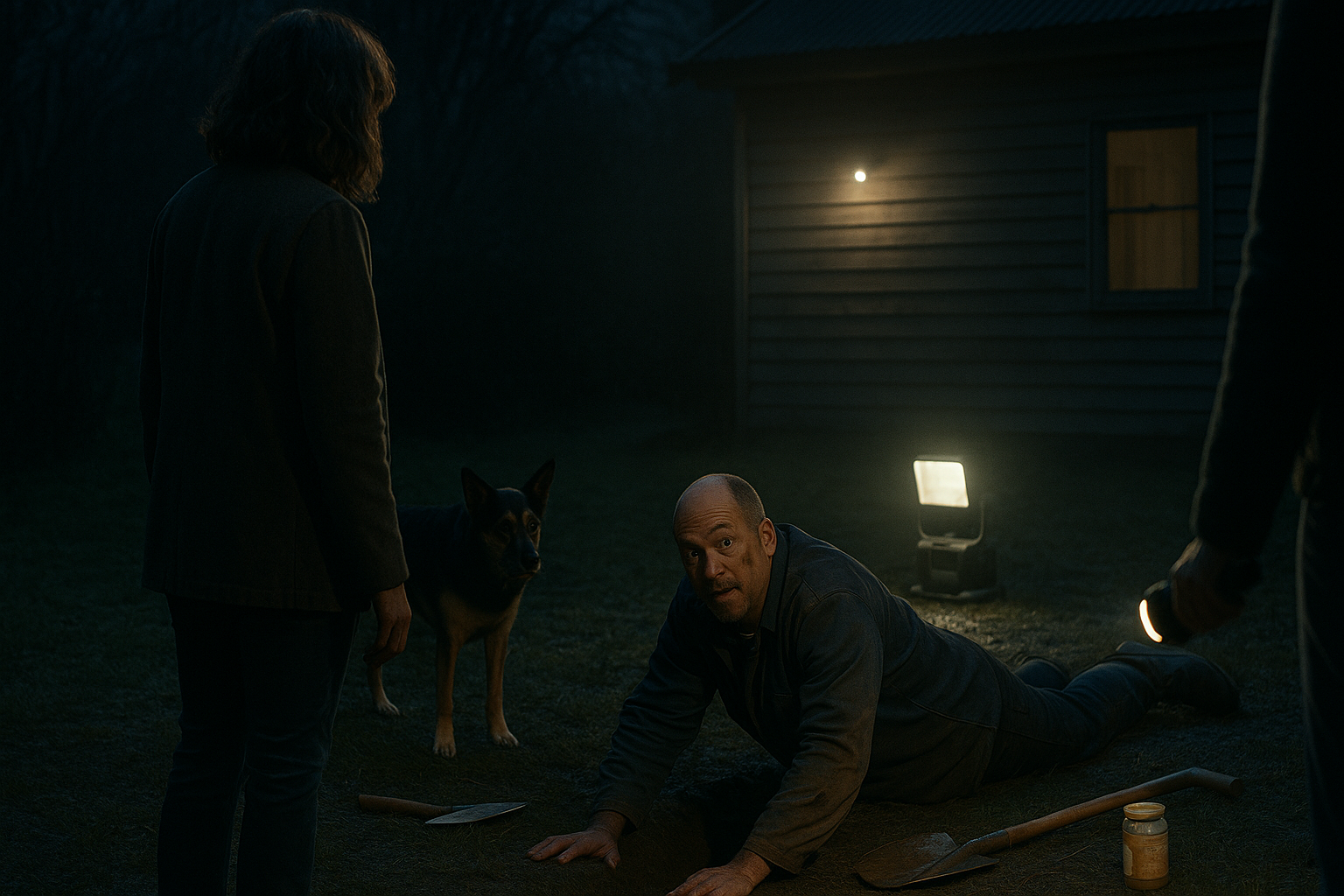
Flat on his stomach in the grass, which now sparkled with frost and the occasional smear of displaced earth. He was half-wedged beneath the shed's rear wall, legs sprawled behind him in a way that defied comfort or dignity. His feet were bare—gumboots nowhere in sight—and his jeans were soaked through at the knees, darkened by contact with the frozen soil.
One arm disappeared beneath the building, shoulder-deep in a narrow trench he'd clearly dug himself. His torso rose and fell in shallow, laboured breaths. A small floodlight balanced precariously on a brick to his left threw angular shadows across the space—long, strange shapes that distorted everything they touched. The whole scene looked like something dreamed feverishly, full of strange logic and dirt.
Beside him lay a short length of PVC pipe, a garden trowel with a splintered handle, and a half-empty container of silicone sealant leaking onto the frosted ground in slow, muddy trails.
Chris looked up—or tried to. The movement was sluggish, as though he were surfacing from some subterranean realm. His face, caught half in shadow and half in the harsh white flare of the floodlight, blinked towards us like a mole emerging into daylight. The beam hit his eyes full on, and he squinted hard, one hand reflexively lifting to shield the glare.
"Oh, brilliant," he said, blinking against the light. "You're home."
I didn't move.
My hands were still curled into half-fists at my sides, fingertips chilled and slightly numb, the skin stretched tight over the bones. My pulse hadn't caught up yet, unconvinced the danger was over, unsure whether it was meant to unravel now or wait for a cue that hadn't come.
"What the hell are you doing?" I asked, my voice low and taut. Not angry, not yet—just baffled. The kind of voice your body uses when it can't decide whether to laugh, cry, or sit down suddenly on cold earth and refuse further engagement.
Chris pushed himself up onto one elbow with a grunt, the movement sending flakes of dry grass skittering from his jacket. His face was streaked with dirt in long, uneven lines, like someone had started to sketch his expression and then given up. Patches of lawn clung to the sweat on his cheek, including one piece shaped so perfectly like a moustache that I had to blink to be sure it wasn't deliberate. The bare curve of his scalp caught the light beneath a film of soil and regret, gleaming like something half-unearthed.
"Fixing the runoff," he said, utterly matter-of-fact—as though this explained why we'd just found him prone in a trench, half-buried, tools scattered like forensic evidence. "Water keeps pooling under the shed. Thought I'd divert it."
"At seven o'clock at night?" I said, resisting the increasingly strong urge to gesture at the dark sky, the frost-laced lawn, and the whole insane picture of it—the kind only our life could provide without irony.
He frowned up at us, brow furrowed. "Is it seven?"
Jane let out a long breath beside me—half exasperation, half that helpless amusement that tends to follow Chris around like a loyal dog. "You've turned the whole house into a Hitchcock scene."
Chris blinked again, this time more slowly, as though trying to recalibrate. A smudge of mud curved through one eyebrow, giving his confused expression a cartoonish slant. "Power's off. Tripped the safety switch when I cut into the old conduit. Meant to fix it. Got sidetracked."
"By digging a trench in the dark?"
"Had the light," he said, gesturing with tired logic towards the floodlamp beside him—its chunky battery pack jutting from the back like a square tumour. He said it with the weary conviction of someone who truly believed this was a trump card.
Jane gave me a sidelong look, eyebrows raised. That look had a whole narrative in it—wry, fond, completely unsurprised.
"Mystery solved."
"Yeah," I said, finally letting the tension slip from my shoulders. My breath clouded in the cold between us, pale and curling. "Solved by mud and mild electrocution."
Chris smiled sheepishly, the way only he could. He wiped his hands on his trousers, smearing the dirt around in artistic spirals rather than removing any of it. "Didn't think you'd be home this early."
I stared at him for a long second. Then the absurdity of it, the ridiculousness, broke the last thread of tension in me. Not dramatically—just that inevitable tipping point into resignation.
"I'm actually far later than normal," I said.
Jane gave the trench one last look, her head tilted, the torchlight casting strange shadows across the uneven grass. Her mouth twitched into that dry, knowing half-smile—the kind that always felt like it came with its own rimshot. The beginning of a punchline you hadn't heard yet.
"Lucky Val sent you home with that loaf. Looks like it might be dinner."
I snorted, unable to help it. The absurdity was still clinging to me like the cold, but her tone made it manageable. Familiar. Human. "If it's still warm, it'll be a miracle."
"Even cold, it'll be better than what I've got waiting," she said, rubbing her hands briskly together against the night air. "We were doing freezer roulette tonight."
There was something in her voice—dry, wry, and worn around the edges—that did more to loosen the remaining tension in my chest than anything else had all evening. It was the sound of someone who'd seen their share of ridiculous and decided to keep showing up anyway.
"Well, come in," I said, the words leaving my mouth with surprising ease. Not a courtesy. A genuine offer. I was too tired to pretend it wasn't what I meant. "You may as well help me eat it. Even if we're doing it in the dark."
Behind us, Chris began extracting himself from the trench like some reluctant earth-dwelling creature returning to the surface. He grumbled under his breath as he moved, dragging flecks of mud behind him in a slow, incriminating trail. His sleeves were a mess, and when he tried to brush them off, he only succeeded in spreading the dirt around like some avant-garde camouflage.
"I'll just—"
"No," I cut in, spinning on my heel. My tone was sharper than I'd intended, but not unjustified. "You don't get anything until you've fixed the bloody power."
He blinked, eyes wide, as if genuinely affronted. "Even a slice?"
"Especially not a slice," I muttered, already turning away, shoes crunching over the stones. "You can eat the sealant if you're hungry."
Jane let out a short, bright laugh—crisp as breaking glass. It echoed briefly across the yard, clean, scattering the last dregs of unease. Fern gave a low, approving chuff, her tail giving a gentle wag, as though she too recognised the moment justice was served.
Behind us, Chris was already lurching into a muttered monologue, halfway between martyr and mischief. Something about trenchwork heroics, his unappreciated genius, and the cruel tyranny of women who withhold baked goods. But he trudged obediently towards the switchboard, floodlight swinging at his side, purpose newly restored.
At the back door, I slowed and glanced over my shoulder. The garden lay behind us, silvered and still, as though none of it had happened. I took a breath, cooler now, and let the absurdity settle.
"Sorry about the Hitchcock moment," I said, not quite sheepishly.
Jane shrugged, brushing her shoulder lightly against mine as she stepped past. "Honestly? I've had worse dinner invitations."
We stepped back inside. The house didn't greet us with warmth or light, only the arrangement of its shadows—familiar shapes in the dark, unchanged by the brief drama outside. The scent of damp earth still clung to our coats, sharp and grounding.
It wasn't cosy. Not exactly. But it was ours.
Quiet chaos. Half-fixed things. And the kind of company that turned up anyway.







