The Outback Crossroads Roadhouse, Yunta
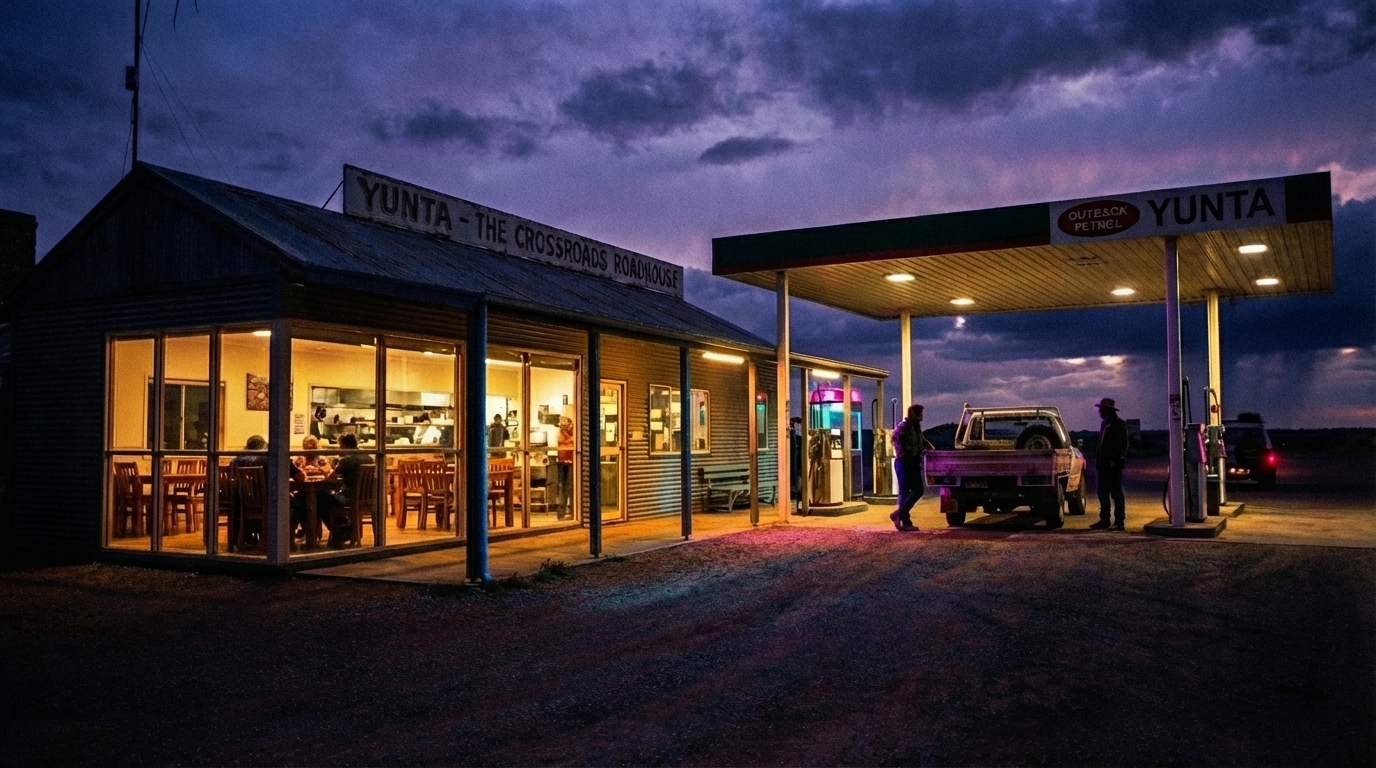
The Outback Crossroads Roadhouse stands as Yunta's vital lifeline, a beacon of fuel, food, and human connection in the vast South Australian wilderness. This weathered establishment embodies the town's role as sanctuary for travellers navigating the harsh stretch between Adelaide and Broken Hill. Under Marnie Tillett's stewardship since 2007, its forecourt has witnessed both mundane transactions and extraordinary moments—including Beatrix Cramer's animal rescue and covert Guardian operations.
Origins and Early Establishment
The Outback Crossroads Roadhouse emerged from necessity rather than ambition, its existence determined by the same geographical imperatives that had shaped Yunta's development since railway days. The settlement's position along the Barrier Highway—the arterial route connecting Adelaide to Broken Hill and beyond—guaranteed steady traffic requiring the services that roadhouses traditionally provide: fuel, sustenance, rest, and the reassurance of human presence in landscapes where such presence cannot be taken for granted.
The precise date of the roadhouse's establishment has become obscured through decades of informal record-keeping and successive ownership changes, though local memory places its origins sometime in the late 1970s or early 1980s. The site selected occupied the eastern approach to Yunta township, positioning it as the first substantial stop for travellers arriving from the New South Wales border and the last opportunity for those departing toward Broken Hill to acquire supplies before committing to the long stretch of emptiness ahead.
The original structure reflected the pragmatic architecture common to outback service facilities: a main building combining retail counter with basic kitchen facilities, fuel bowsers positioned under a corrugated iron canopy providing minimal shade, and storage sheds housing the inventory necessary to serve communities where resupply schedules measured in weeks rather than days. The design prioritised function over aesthetics, durability over comfort, the understanding that travellers stopping here sought essentials rather than experiences.
Early operators came and went with the regularity that characterised small business ventures in remote locations. The challenges proved formidable: irregular hours demanded by travellers whose schedules followed no predictable pattern, supply logistics complicated by distance and weather, the isolation that wore upon those accustomed to more populated environments. Staff turnover remained chronic, each departure requiring recruitment from an already limited pool of candidates willing to work under such conditions.
The Willerton Era
The Willerton family acquired the roadhouse sometime in the late 1990s, bringing stability that previous operators had struggled to maintain. Their tenure, lasting approximately a decade, established patterns of operation that subsequent management would inherit: opening hours structured around peak travel times, menu offerings calibrated to traveller preferences, relationships with suppliers refined through years of negotiation and mutual accommodation.
Under Willerton management, the roadhouse developed its character as community anchor alongside its commercial function. The establishment became gathering point for locals whose scattered residences precluded casual social interaction, a venue where news circulated and relationships maintained themselves through brief encounters accumulated over years. Truckers developed regular patterns of stopping, their faces becoming familiar, their preferences anticipated, their presence contributing to the sense that the roadhouse served constituencies beyond immediate commercial transaction.
The physical infrastructure evolved incrementally during these years. Bowsers were upgraded to handle increased fuel volumes and modern payment systems. The kitchen equipment received periodic replacement as components failed and repair became impractical. Storage facilities expanded to accommodate the inventory depth that distance from suppliers demanded. Each improvement represented investment in a future that the Willertons evidently believed the roadhouse possessed, despite the challenges that remote operation continued to present.
Yet the same factors that had challenged previous operators eventually wore upon the Willerton family as well. By the late 2000s, signs of strain had become apparent: maintenance deferred, staff positions unfilled, the accumulated fatigue of managing an enterprise whose demands never relented. The decision to move on, when it came around 2010, surprised few who had observed their gradual withdrawal from the intensity that successful roadhouse operation required.
Marnie Tillett's Arrival
Marnie Louise Tillett joined the roadhouse staff in 2007, initially accepting a part-time position on the morning shift. Her responsibilities at that stage remained modest: preparing breakfast for early travellers, restocking shelves, maintaining the fuel usage logs that documented each transaction in handwritten ledgers. The role suited someone seeking steady employment without the burden of ultimate responsibility, work that provided structure without demanding the total commitment that management required.
Her background had prepared her well for such work. Born in Yunta in 1966, she had spent her life accumulating the skills that outback existence demanded: mechanical aptitude inherited from her father Franklin, practical problem-solving developed through necessity, the emotional resilience that surviving in harsh environments cultivates. Previous employment at the Yunta Post Office, the local school, and various pastoral properties had demonstrated her reliability and adaptability—qualities that roadhouse work required in abundance.
As other staff departed and the Willertons' commitment wavered, Marnie's role expanded by default rather than design. She assumed additional shifts, learned additional systems, accepted additional responsibilities because someone had to and she remained while others left. By the time the Willertons formally departed around 2010, Marnie had become indispensable—the repository of operational knowledge, the familiar face that travellers expected, the person who simply knew how everything worked.
The transition to near-total operational responsibility occurred gradually through 2011 and 2012. Though never formally titled as manager, Marnie assumed the functions that management requires: ordering supplies from Port Augusta Fresh Distributors, coordinating LPG deliveries that kept the kitchen operational, handling the basic maintenance that ageing infrastructure constantly demanded. She became, in practical terms, the person upon whom the roadhouse's continued operation depended.
Physical Character and Facilities
The Outback Crossroads Roadhouse presents itself to approaching travellers as an oasis of human activity amid the flat, ochre monotony of the surrounding landscape. The fuel canopy's corrugated iron roof catches light in ways that signal presence from considerable distance, its industrial pragmatism offering reassurance that services await rather than aesthetic pleasure. The main building hunkers beneath the vast sky, its proportions modest, its surfaces weathered by decades of exposure to the elements that define this region.
The forecourt accommodates multiple vehicles simultaneously—a necessity given that road trains and tourist caravans may arrive in convoy, their occupants requiring service within reasonable timeframes before continuing journeys measured in hundreds of kilometres. The bowsers, upgraded over years of operation, handle diesel and unleaded petrol with the reliability that remote locations demand; breakdowns here would strand customers whose alternative options lie hours distant in either direction.
Inside, the establishment divides between retail space and kitchen facilities. The counter area displays the impulse purchases common to service stations everywhere: confectionery, chips, soft drinks, the small indulgences that travellers justify as rewards for distance covered or fuel for distance remaining. Behind the counter, shelving holds more substantial supplies: canned goods, basic tools, automotive fluids, the emergency provisions that stranded motorists might require when circumstances turn against them.
The kitchen produces meals characterised by simplicity and substance rather than culinary ambition. Hot chips feature prominently, their aroma greeting visitors before they've fully crossed the threshold. Pies and pasties sit warming in display cases, their fillings conventional, their purpose practical: sustenance for bodies that may not encounter another meal opportunity for hours. Coffee flows strong and black, prepared to specifications that assume customers seek caffeine rather than artisanal experience.
Marnie maintains additional resources that the roadhouse's official inventory doesn't encompass. A locked cabinet near the coolroom contains equipment accumulated through years of responding to traveller emergencies: jumper leads for flat batteries, a tyre repair kit for punctures that the outback's rough surfaces regularly inflict, a satellite radio providing communication when mobile networks fail, a laminated copy of the Royal Flying Doctor Service first-aid flowchart offering guidance for medical emergencies that the roadhouse's isolation might require addressing before professional help arrives.
Community Functions
The roadhouse's significance extends well beyond its commercial services into territories that no business plan would formally acknowledge. In a community where permanent population has dwindled to mere dozens, the establishment functions as de facto town centre—the place where information circulates, relationships maintain themselves, and the scattered residents of surrounding stations connect with the broader human community.
Locals gather here not because the coffee is exceptional or the menu particularly appealing, but because the roadhouse provides what isolation otherwise denies: casual human contact, the reassurance that neighbours exist even when kilometres separate their homes, the opportunity to exchange news and concerns in settings that don't require formal arrangement. Marnie's presence behind the counter offers consistency in an environment where most things prove transient; her familiar face and predictable manner create stability that the landscape itself refuses to provide.
The landline telephone has acquired particular significance in an era when mobile coverage remains unreliable across much of this region. When towers fail—as they do with frustrating regularity—Marnie's phone becomes the unofficial lifeline connecting Yunta to emergency services, distant family members, and the commercial networks upon which pastoral operations depend. During the 2019 dust storm that disabled mobile infrastructure for over eighteen hours, she coordinated multiple calls for assistance, including one that led to a successful airlift from Mount Victor Station.
The roadhouse also serves informal mentoring functions that contribute to community continuity. Marnie has guided younger residents through hospitality certifications, provided employment opportunities that kept young people connected to the district, and offered the kind of practical education that formal institutions cannot replicate. Her approach reflects the intergenerational knowledge transfer that has always sustained outback communities: skills passed from those who possess them to those who need them, regardless of official credentials or formal structures.
The Events of July 2018
The afternoon of 30 July 2018 transformed the Outback Crossroads Roadhouse from ordinary waystation into setting for events that would acquire significance beyond their immediate circumstances. Beatrix Evelyn Cramer, travelling from Hobart toward Broken Hill via the Barrier Highway, stopped for fuel and supplies—a routine pause on a journey whose ultimate purposes extended far beyond ordinary travel.
The low fuel light had forced her hand; Yunta was not a place she had intended to linger. Yet the conversation she overheard inside the roadhouse changed the trajectory of her day and, in retrospect, contributed to the larger pattern of events that would reshape her life entirely.
Two men stood at the counter discussing a goat named Vincent. The animal belonged to one of them—a weathered local named Bill whose tone carried the flat resignation of someone who had already made peace with an unpleasant decision. His new dog didn't like the goat. Had been nipping at Vincent's legs, drawing blood. Nobody wanted an old goat, and he couldn't keep managing the conflict.
He was probably just going to shoot him.
The words landed with quiet finality. The woman behind the counter didn't flinch—this was bush pragmatism delivered without drama, a problem identified, a solution implied, the conversation moving on to dog food and liquorice bullets. For Beatrix, whose recent experiences had included revelations about dimensional portals and her sister's transformation into something beyond ordinary human understanding, the casual discussion of Vincent's fate crystallised into moral imperative that bypassed deliberation entirely.
Outside, she located Bill's silver Toyota Land Cruiser parked along the fence line, Vincent visible within one of the dog cages bolted to its tray. Acting before calculation could intervene, she opened the cage, wrestled the surprisingly heavy animal toward her own vehicle, and deposited him among hastily gathered hay on the backseat.
The rescue expanded when half a dozen brown hens appeared around her car, their collective attention suggesting expectations that transcended their species' capacity for abstract thought. The ringleader advanced with swagger that brooked no argument. "Oh, come on then," Beatrix sighed, accepting her new role as farmyard liberation coordinator.
Vincent and his improvised poultry entourage accompanied Beatrix through a Portal into Clivilius, where they would find sanctuary within the developing community at Bixbus. The roadhouse had witnessed countless traveller stops over its decades of operation; this particular stop would prove unlike any other, though the establishment itself absorbed the event with the same weathered indifference it applied to everything that occurred within its forecourt.
Strategic Significance: The Fuel Tanker Interception
Eleven days after Beatrix's animal rescue, the roadhouse featured in a more calculated operation that demonstrated its strategic value for activities requiring distance from scrutiny. The Guardians' establishment of Bixbus in Clivilius demanded resources that the nascent community lacked legitimate means of acquiring—fuel foremost among them, essential for generators, vehicles, and the infrastructure sustaining human existence in a dimension where conventional supply chains didn't exist.
The decision to intercept a fuel tanker scheduled to resupply the Outback Crossroads Roadhouse emerged from desperate necessity rather than criminal inclination. Beatrix and Luke Smith, both newly recruited into Guardian operations, identified Yunta as optimal location for the interception. The settlement's remoteness minimised witnesses; its position along established transport routes guaranteed regular tanker deliveries; the sparse population reduced complications that might arise in more populated areas.
The operation unfolded on 10 August 2018 with precision that belied its improvisational origins. Beatrix staged a distraction that drew the tanker driver's attention whilst Luke secured the vehicle. The tanker was driven to a secluded location and transported through a Portal to Bixbus, its contents providing fuel supplies that sustained the community through its precarious early months.
The incident made local news and attracted police investigation, though authorities never identified the perpetrators or understood the destination of the stolen cargo. For the roadhouse, the event represented disruption to normal supply schedules—the expected delivery that never arrived, the explanations that proved insufficient, the adjustments required to maintain service until replacement supplies could be arranged.
Whether Marnie suspected connections between the tanker's disappearance and the unusual traveller who had stopped days earlier remains unrecorded. Her discretion regarding customer activities has always been absolute, her observations filed away in memory rather than shared with authorities whose questions might complicate the relationships upon which remote community survival depends.
Architecture of Survival
The Outback Crossroads Roadhouse embodies principles of survival architecture that decades of operation have refined. Every element serves multiple functions; redundancy protects against the failures that isolation makes catastrophic; simplicity enables repair with available resources when professional assistance lies hours or days distant.
The building's orientation responds to environmental demands rather than aesthetic preferences. Positioning relative to prevailing winds minimises dust infiltration during the storms that periodically sweep across this region. Roof angles facilitate water collection into tanks providing backup supply when mains pressure fails. Window placement balances light requirements against heat management, the fierce summer sun demanding respect that design choices acknowledge.
Power systems incorporate the redundancy that remote operation requires. Mains electricity provides primary supply, but generator backup stands ready for the outages that weather events and infrastructure failures regularly produce. The kitchen's gas supply operates independently of electrical systems, ensuring food preparation continues even when other services fail. Each system assumes its counterparts may fail; each failure mode has been experienced and addressed through accumulated operational wisdom.
Storage arrangements reflect the supply logistics that distance imposes. Inventory depth exceeds what urban establishments would consider necessary, the weeks between deliveries requiring buffer stocks that absorb demand fluctuations and supply disruptions. Rotation systems prevent spoilage; dating protocols ensure freshness; the disciplines of remote provisioning have been internalised through years of managing consequences when such disciplines lapse.
Marnie's Stewardship
Marnie Tillett's management philosophy reflects temperament forged through decades of outback living. She approaches the roadhouse with the same practical intelligence she applies to everything: problems are identified, solutions are implemented, complications are managed without excessive deliberation or emotional investment. Her manner with customers balances efficiency with the minimal warmth that commercial transaction requires; she is not unfriendly, merely focused on the work that each interaction represents.
Her days begin before dawn, the early hours devoted to preparation before travellers arrive seeking breakfast. Coffee brews to specifications refined through years of customer feedback—strong, hot, served without ceremony. Kitchen equipment receives inspection; inventory levels are assessed; the forecourt is checked for debris or hazards that overnight winds might have deposited. By the time the first customers arrive, the roadhouse presents the orderly functionality that Marnie's standards demand.
She maintains handwritten records that document patterns invisible to casual observation: trucker routines and vehicle descriptions, customer preferences accumulated over repeated visits, the informal credit arrangements that help regulars through difficult periods between pay cycles. These records serve practical purposes—anticipating demand, maintaining relationships, providing the personalised service that distinguishes adequate roadhouse operation from excellent—but they also represent institutional memory that ensures continuity regardless of what the future might bring.
The locked cabinet of emergency supplies reflects her understanding that the roadhouse serves functions beyond commercial transaction. She has used the jumper leads, the tyre repair kit, the satellite radio, the first-aid flowchart—each deployment representing a traveller assisted, a crisis managed, a demonstration that the outback's harshness need not prove fatal to those who encounter it unprepared. She rarely discusses these interventions unless directly asked; they represent simply what the work requires, not achievements warranting recognition.







