4338.209 · July 28, 2018 AD
The Offer
Nial Triffett’s morning begins in the quiet fog of routine — until a familiar name appears on his phone, offering a job that seems too good to be real. As curiosity wrestles with caution, Nial finds himself stepping beyond the safety of reason and into something far less certain.
“I used to think bad news came dressed in warning signs. Turns out, it just rings and asks for a favour.”
The warm water cascaded over me in a steady rhythm, a gentle hiss that filled the small bathroom and dulled the noise in my head. I lingered beneath it, letting the heat soak into my shoulders until the steam blurred the edges of everything — the tiles, the mirror, even my thoughts. My hand hovered near the tap, reluctant, as if turning off the shower might somehow turn on the rest of the day — the one I wasn’t ready to face. The one filled with phone calls I’d been avoiding, invoices marked with red reminders, and that hollow feeling in my chest that had become as familiar as my own reflection.
The sudden silence that followed was almost deafening, filled only by the soft drip of water sliding down the tiled wall. Each drop marked time like a metronome, counting off seconds I could ill afford to waste. Steam curled and twisted in the air around me, a living mist that clung to my skin like a comforting cloak, wrapping me in a false sense of security. For a fleeting moment, I wished I could stay there—suspended in that warmth and quiet—away from the world outside the bathroom door, where numbers didn't add up and every phone call felt like another demand I couldn't quite meet.
Where spreadsheets mocked me with their unforgiving columns. Where Jenny's eyes held questions she was too kind to ask aloud. Where my business—the thing I'd built from nothing, the legacy I'd imagined passing to Sammy one day—teetered on the edge of collapse because of one stupid accounting error that had snowballed into twelve months of barely keeping our heads above water.
The cool air bit at me the instant I stepped out, a sharp contrast to the heat I'd just left. It rushed against my skin like an accusation, as if the very atmosphere knew I'd been hiding. Goosebumps rose along my arms as I reached for the towel hanging on the rail, my fingers grasping for something solid, something real. Its rough weave rasped against my skin—familiar, grounding, almost abrasive in its honesty. It was a small reminder that comfort was temporary, that beyond this mist and solitude, reality waited: invoices overdue, suppliers chasing payment, Jenny's unspoken worry clouding every evening.
Her worry was the worst part. Not the creditors, not the sleepless nights running calculations in my head, trying to find money that simply wasn't there. No, it was the way she'd smile at me over breakfast, bright and reassuring, whilst her hands fidgeted with her coffee mug. The way she'd tell me everything would work out, her voice steady even as her eyes betrayed her fear. She believed in me. That's what killed me. She still believed in me, even when I'd stopped believing in myself.
I rubbed the towel briskly through my hair, shaking away droplets that spattered the tiles at my feet like tiny crystal explosions. The rhythmic motion was soothing, meditative almost, each pass of the towel through my hair a small act of normality in a life that felt increasingly uncertain. The room smelled faintly of eucalyptus shampoo and the faint metallic tang of old pipes—a scent that had become the signature of our modest Mount Nelson home. Somewhere beneath that, the scent of rain drifted in from the half-open window—that distinctive Hobart rain, cold and salt-edged, carrying with it the ghost of the Southern Ocean, promising more grey hours ahead.
July in Hobart. Winter settling in with that peculiar Tasmanian dampness that worked its way into your bones and stayed there. The kind of cold that made you think of heaters you couldn't afford to run all day, of Sammy bundling up in his oversized jumper, of Jenny wrapping her hands around tea mugs just to keep them warm.
Then came the sound—sharp and sudden.
The phone's shrill ring pierced through the haze, slicing cleanly through the soft patter of water still dripping from the showerhead. My pulse kicked, instinctively—ridiculous, perhaps, how that sound could unsettle me, but it did. It always did these days. Every ring carried the possibility of bad news: another supplier refusing credit, a client pulling out, the bank calling about the overdraft I'd maxed out three weeks ago. The ring echoed off the tiles, far too loud for such a small space, bouncing around like a warning, like something alive and insistent that wouldn't be ignored no matter how much I wanted to pretend I hadn't heard it.
I could let it go to voicemail. I'd done it before. Sometimes I'd stand there, frozen, whilst the phone buzzed and chirped and eventually fell silent, leaving only a notification I'd delete without listening to. Cowardice, maybe. Or self-preservation. It was hard to tell the difference anymore.
I moved towards the sink, feet padding softly on the cold floor, leaving damp footprints in my wake that would evaporate within minutes, as though I'd never been there at all. The mirror was fogged over, an opaque blur that only hinted at the shape of me—broad-shouldered, towel-draped, eyes dulled by too many late nights and worries I hadn't yet voiced. Worries I couldn't voice, because saying them aloud would make them real, would admit to Jenny and to myself that I'd failed.
That the business I'd poured eight years of my life into, the company that bore my name, might not survive another quarter.
I wiped a hand across the glass, revealing a partial reflection. For a moment, I barely recognised the man staring back: hair darkened with moisture, beard shadowing a face that looked older than thirty-two. There was fatigue in the lines at the corners of my eyes, and something else beneath that—uncertainty, perhaps. Or dread. The kind of dread that settles in your stomach and doesn't leave, that colours every interaction, every decision.
Dad would have been disappointed. Gerald Triffett, who'd built a life on the water through sheer bloody-minded determination, who'd never let a storm or a bad season stop him. What would he make of his son now, hiding in the bathroom, afraid of his own telephone?
The phone kept ringing.
Its persistence felt almost personal, as if it knew something I didn't, as if whatever was on the other end of that line couldn't wait, wouldn't wait. I turned towards it, the glow of the screen cutting through the dim light like a beacon. Luke Smith. The name seemed to hum on the display, insistent and oddly out of place—as though it had no right to appear after all this time.
Luke Smith.
I knew that name. Not well, but enough. I'd done a fencing job for him a few years back—2015, maybe early 2016—a decent bloke, from what I remembered. Paid on time, no drama, just a straightforward bit of work out near Berriedale. A good job, actually. One of those satisfying ones where everything went to plan, where the client was happy, where I'd driven away feeling competent and capable. There'd been nothing remarkable about it then, nothing that would explain why his name appearing now made my stomach clench.
And yet… seeing his name now made something twist low in my gut.
I hesitated, my hand hovering over the phone. The screen pulsed again as it vibrated in my grip, its urgency at odds with the stillness of the room. Water continued its steady drip from the showerhead behind me. Steam slowly dissolved into ordinary air. And still I stood there, frozen, staring at those two words as if they were a riddle I needed to solve before answering.
Luke Smith.
Why did I feel uneasy? There was no reason for it—no logical one, at least. He'd been fine before, pleasant even. His little Shih Tzu had been a menace, getting underfoot whilst I worked, but in that endearing way that made you laugh rather than curse. Luke had offered me cold drinks, asked about my family, paid in full the day I finished. A model client, really.
Maybe it was just the timing. Or maybe I was starting to see ghosts where there were none, mistaking opportunity for threat because I'd been living too long under the weight of near-failure. When you're drowning, you start to see every ripple as a wave, every shadow as something with teeth.
Still, I didn't answer. Not yet.
The phone continued to tremble in my palm, insistent, alive—as if it somehow knew that whatever waited on the other end of that call would change everything. My thumb hovered over the green button. One press. That's all it would take. One press and I'd know why Luke Smith, a man I hadn't thought about in years, was calling me on a Saturday morning in July, whilst I stood dripping and vulnerable in my own bathroom.
I took a breath. Pressed the button.
"Hello, this is Nial," I finally answered, my voice shaking off the momentary caution like droplets of water from my skin. The words came out steadier than I felt—a craftsman's reflex, polite but guarded. Professional. The voice I used for clients, for suppliers, for anyone who expected Nial Triffett to have his shit together even when he demonstrably didn't.
For a heartbeat, there was only static—the faint hum of a connection finding its place, searching for satellite signals or mobile towers or whatever invisible infrastructure held these fragile conversations together. Then came Luke's voice, soft and deliberate, that same tone I remembered from years ago. Measured. Thoughtful. The voice of someone who considered his words before speaking them.
"Hi, Nial. This is Luke Smith. Not sure if you remember me but you did a small fencing job for me a few years ago, out in Berriedale."
The memory surfaced instantly, unbidden and vivid, as if someone had tugged a thread at the back of my mind and unravelled an entire afternoon. The smell of sawdust and damp soil, rich and earthy. The sound of hammers on metal posts, ringing out in steady rhythm. The particular shade of green that Tasmanian bush takes on in overcast weather—deep and almost luminous. And there—the small Shih Tzu weaving between my legs, tail wagging like a metronome, utterly convinced it was helping, its warm little body bumping against my shins every time I moved.
What was its name? Something ridiculous and endearing. Biscuit? Muffin? I couldn't quite grasp it, but I could see the dog clearly, could feel the absurd affection I'd developed for the little pest over those three days of work.
"With the small dog that followed me like a shadow and had to keep poking his nose into everything, yeah?" I chuckled, the image arriving in full colour, complete with the memory of nearly tripping over the thing at least a dozen times.
"That's the one," Luke replied, his laughter a familiar melody—light, easy, and oddly reassuring. A sound that belonged to simpler times, to jobs that were just jobs, uncomplicated by desperation or doubt.
For the first time that morning, I felt something loosen in me. The tension that had been coiled in my shoulders since I'd woken at five-thirty, unable to sleep, running numbers through my head in the dark—it eased, just slightly. A genuine smile began to spread across my face, pulling at muscles that felt unpractised, as though I'd forgotten how. "I remember it well," I said, and I meant it. That job had been good. Clean. Honest. The kind of work that reminded you why you'd got into this business in the first place.
The motion felt almost foreign—muscles long trained to frown instead, to crease with worry, to hold the weight of everything that was going wrong. Still, the warmth of the recollection reached through the fog of stress like sunlight through cloud, like those rare winter mornings when the mist lifts and you remember that Hobart can be beautiful, that Tasmania can take your breath away with its sudden, unexpected glory.
"What can I do for you?" I asked, my tone brightening despite myself, despite everything.
There was a subtle shift in the line—a hitch in his breath, a faint rustle as if he'd moved away from someone or something before speaking again. A door closing, perhaps? Footsteps? The sound was indistinct but somehow significant, a change in atmosphere I couldn't quite identify. When he did speak again, his tone had changed; the politeness was still there, the friendliness, but now it carried a hint of strain, the hurried cadence of someone pressed for time.
Someone who needed something.
"I have an urgent job I need done in the next couple of days."
For a moment, I simply blinked at the wall opposite, watching a bead of condensation slide down the tile in a slow, meandering path. My mind struggled to catch up, caught between the pleasant memory I'd just been enjoying and this new information that didn't quite fit the pattern. A couple of days? The words seemed absurd, disconnected from reality. It wasn't how things worked. Not in my world, not anymore. Not in any world where materials needed to be ordered, where schedules had to be coordinated, where you needed time to measure, to plan, to do the job properly.
You didn't just throw up a fence over a weekend. Not if you wanted it to last, not if you had any pride in your work.
The scoff escaped before I could stop it—half reflex, half disbelief, carrying with it every lesson I'd learned about managing client expectations, about not overpromising, about maintaining the standards that had built Triffett Fencing Solutions' reputation in the first place. Even if that reputation was all I had left.
"Hmph. Sorry, that's not enough lead time. I need at least two weeks," I replied, my professional stance snapping into place like a fence post driven straight into the ground. The words were firm, measured—the tone of a man who had learned to draw lines and keep them, who knew that saying yes to impossible timelines was how you ended up with shoddy work and angry clients. It was the voice of someone who still had standards, even if he didn't have much else.
Two weeks was actually conservative. For a proper fencing job, depending on the scope, I'd normally quote three to four weeks. But two weeks was my absolute minimum, my rock-bottom "if everything goes perfectly" timeline. And things never went perfectly.
Yet beneath that veneer, a small flicker of something stirred—curiosity, perhaps. Or unease. Because there'd been something in Luke's voice—something urgent and not entirely ordinary—that didn't sound like any job I'd been asked to do before. In eight years of running my own business, I'd heard countless requests, endless variations on "can you do this" and "how much would that cost," but this… this was different.
This had the flavour of desperation I'd learned to recognise because I'd tasted it myself.
There was a desperate edge to his voice now. "You'll be well compensated for it."
The word compensated hung there, strange and deliberate—too formal for a quick fencing request, too rehearsed to sound natural. It echoed in my head, unsettlingly crisp, as though it didn't belong in an ordinary conversation between two blokes from Hobart. My faint smile faded into a furrowed frown. Compensated. Who even said that?
Clients usually talked about "quotes" or "payment," maybe even "a good rate" if they were being generous. Sometimes they'd say "we'll make it worth your while" or "name your price." But compensated? That word belonged in courtrooms, insurance claims, or situations where something had gone badly wrong. Where someone needed to be made whole after a loss. Where the transaction wasn't just business but something more complicated, more fraught.
It was the kind of word that made you think of lawyers and liability, of settlements and non-disclosure agreements. The kind of word that set off alarm bells if you were paying attention.
And I was paying attention now.
Curiosity began to gnaw through the thin shell of professionalism I'd tried to maintain. I could feel it, that small prickle of intrigue beneath the skin, warring with my better judgement, wrestling with the part of my brain that was screaming at me to be careful, to think this through, to remember that things that seemed too good to be true usually were.
But I'd been so careful for so long, and where had it got me? Drowning in debt, lying awake at night, avoiding phone calls, watching my wife pretend everything was fine whilst the shadows under her eyes grew darker.
"How much?" I asked, the words slipping out before I'd fully decided to ask them—propelled by a blend of scepticism and the faint, shameful hope that maybe, just maybe, there was a way out of the mess I'd been stewing in for months. That maybe this bizarre phone call on this grey Saturday morning was the lifeline I'd been too proud to pray for.
There was a pause—short, but loaded—and then Luke spoke, his voice lower now, as if the act of saying it aloud carried weight. As if the number itself was heavy, substantial, something that couldn't be spoken carelessly. "One hundred thousand dollars," he said.
Another beat. The silence stretched, pulled taut like wire.
"In cash."
My breath caught. "Shit!" The word slipped from my lips, barely audible, carried out with the same disbelief that tightened my chest and made my vision narrow to a single point on the fogged mirror. I stared into that clouded glass, the blurred reflection of my own wide eyes staring back, disbelieving, as though I were looking at a stranger who'd just been hit by something he never saw coming.
My heart thudded so hard I could hear it in my ears, could feel it in my throat, in my fingertips still gripping the phone. The bathroom seemed to shrink around me, the walls pressing in whilst simultaneously expanding, reality bending in that vertiginous way it does when something fundamentally doesn't make sense.
One hundred thousand dollars.
The number was so absurd it almost didn't register as real. It was the kind of figure you saw in lottery advertisements or news stories about executives' bonuses, not in conversations about fencing jobs in suburban Hobart. I tried to contextualise it, to fit it into my understanding of my industry, my work, my world, but it wouldn't go. It jutted out at wrong angles, refusing to conform to any pattern I recognised.
That amount of money wasn't just tempting—it was ludicrous. Astronomical for fencing, or any residential job for that matter. It was more than what I'd made in six months, maybe longer if I factored in the bills and the endless tide of debt nibbling at my ankles, threatening to pull me under entirely. It was more than the accounting error that had started this whole nightmare. It was more than I owed the bank, more than I owed my suppliers, more than enough to not just save Triffett Fencing Solutions but to give it breathing room, stability, a future.
It was more than I'd dare even dream about anymore.
Still, beneath the flicker of awe, red flags were beginning to rise like warning beacons through the mist of my thoughts, urgent and insistent and impossible to ignore no matter how much I wanted to.
Because nobody paid that kind of money for normal work. Nobody offered cash in that quantity for anything legitimate. This wasn't just unusual; it was wrong, fundamentally wrong, in ways I couldn't yet articulate but could feel in my bones, in that instinct honed by years of dealing with clients, of learning to spot the ones who'd cause problems, who'd refuse to pay, who'd make your life difficult.
I tightened the towel around my waist, grounding myself in the rough texture against my skin, in the solid reality of my own body, my own bathroom, my own life that suddenly seemed to be tilting on its axis. I needed something concrete, something real to hold onto whilst my mind spun through possibilities, through explanations, through scenarios ranging from providential to dangerous.
"What sort of job is it?" I asked, and my voice sounded distant to my own ears, as though someone else were speaking through me, asking the sensible question whilst the rest of me reeled from the impact of that number.
Even as the words left me, I knew curiosity had already won. Knew that whatever answer Luke gave, I'd find a way to justify hearing more, to justify that meeting he was about to propose. Because I was desperate, and desperate men make terrible decisions whilst convincing themselves they're being perfectly reasonable.
There was a faint crackle on the line before Luke answered, his voice strained, uncertain—as if each syllable had to fight its way through static, through distance, through his own reluctance to explain. "It's… uh… it's a pretty big job. Look why don't you meet me in Collinsvale and we can go over the rough plans. Tell me what you think before you give your yay or nay."
Collinsvale?
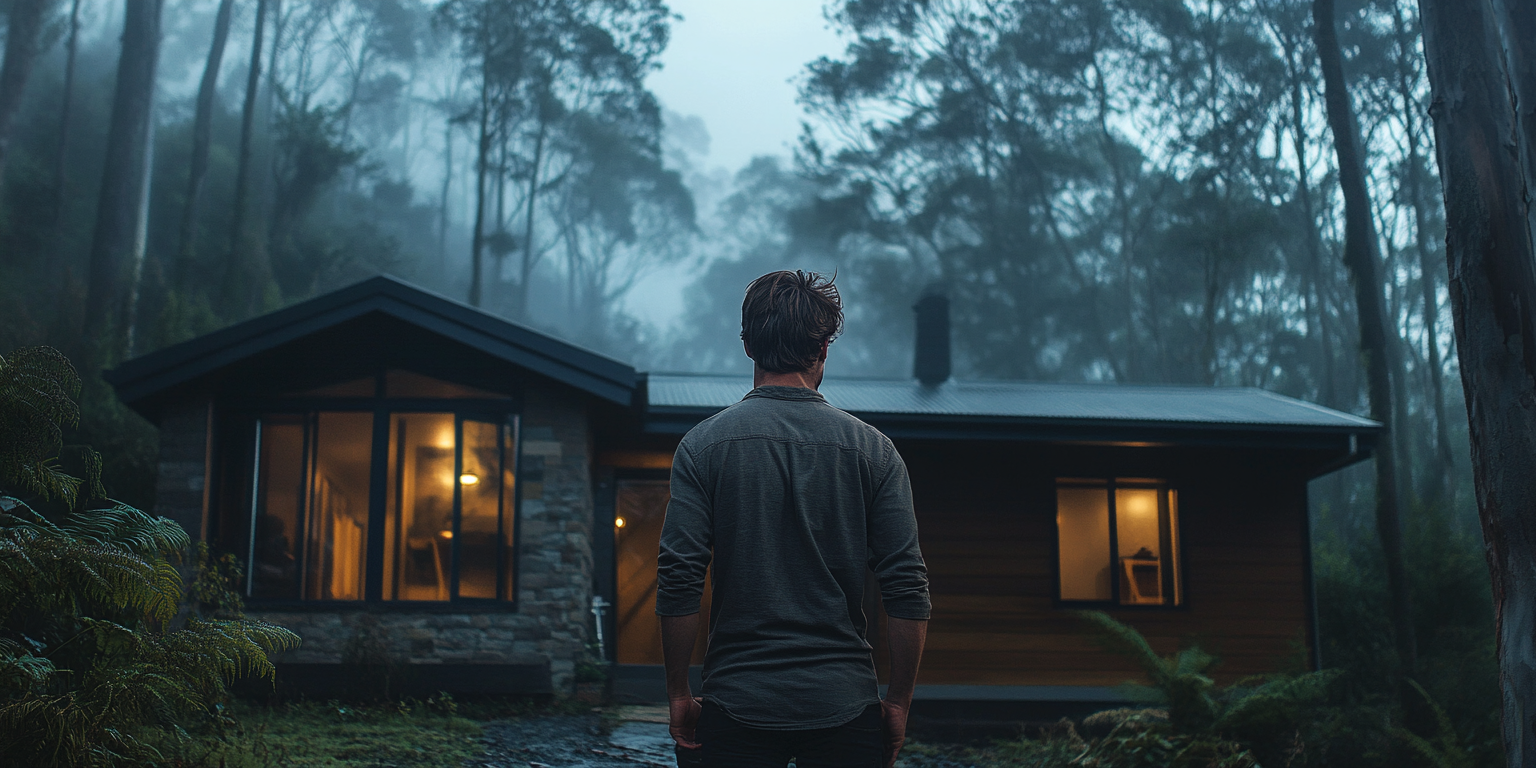
The name hit me with quiet force, settling into my awareness with a weight that felt disproportionate to a simple suburb name. It was a remote place—tucked up in the hills west of Hobart, all winding roads that narrowed as you climbed, damp forest pressing in from both sides, and that strange silence you only get in places too far from the main road. The kind of place where mobile reception came and went, where properties were measured in acres rather than square metres, where your nearest neighbour might be half a kilometre away.
The kind of place where, if something went wrong, no one would hear you call for help.
The mention of it added a new layer of mystery, one that pressed uneasily against my ribs, making my breath shallow. Why Collinsvale? Why not his place in Berriedale, which I'd already been to, which was familiar and relatively accessible? Why drag me up into the hills for a conversation about a fencing job?
Unless it wasn't just a fencing job.
Unless—
I forced the thought away, but it lingered at the edges of my mind like smoke you can't quite disperse.
"Oh, you're not in Berriedale anymore?" I asked, trying to sound casual, though my voice came out tighter than intended, stretched thin over the questions I wasn't asking, over the unease that was building with each new detail.
"Yeah, I'm still in Berriedale. Just helping a friend out," he replied. The tone was light, easy—but there was something beneath it. Something rehearsed, like he'd prepared this answer, anticipated this question and practised his response until it sounded natural.
Except it didn't sound natural. Not quite. There was a fractional pause before "friend," a slight emphasis that made me wonder if he was convincing himself as much as me.
My gut tightened. Helping a friend. It should've sounded harmless, the kind of thing people said all the time, the everyday currency of favours and connections that made communities work. But instead, the words rolled through me like a slow chill, raising goosebumps on my arms that had nothing to do with the cooling air.
I leaned against the sink, the cool porcelain biting into my palms, anchoring me. I stared at my reflection—clearer now as the steam dissipated—and saw a man at a crossroads, though I didn't yet understand what that meant or where the paths led.
A hundred thousand dollars. In cash.
My mind raced, thoughts colliding faster than I could sort them—Jenny's worried eyes across the breakfast table, pretending to read the news on her phone whilst actually just staring at the screen, seeing nothing. Sammy's daycare fees, which we'd nearly missed last month, which had required me to juggle three different credit cards like some desperate street performer. The overdue supplier invoices stacked like silent accusations on my desk at the office, each one a small failure, a tiny betrayal of the relationships I'd built over years of reliable business.
Bill Henderson at Tasmanian Timber, who'd extended me credit when he didn't have to, who'd known my dad, who'd said "pay me when you can, mate" in a tone that was kind but couldn't mask the concern.
Sam Lovell at Coastal Hardware, who'd stopped returning my calls after the last cheque bounced, who'd sent a formal letter through his solicitor that sat unopened in my truck because I couldn't bear to read it.
The bank manager—Christ, what was his name? Thompson? Thomson?—who'd been polite but firm about the overdraft limit, who'd used words like "unsustainable" and "risk management" whilst looking at me with something uncomfortably close to pity.
And over it all, one persistent question rose like a siren in the back of my head—the kind that warns of cliffs hidden beneath fog, of rocks lurking just below the waterline:
What kind of job pays that much, and why does it need to be done so quickly?
What kind of friend needs that kind of help? What kind of situation requires one hundred thousand dollars in cash, delivered within days, with no time for proper planning or permits or any of the normal procedures that governed legitimate construction work?
But instead of voicing my concerns, instead of asking the questions that might give me answers I didn't want to hear, I found myself asking, "Cash?"
The single word slipped out before I could stop it—blunt, almost suspicious in its brevity, carrying more weight than one syllable had any right to bear.
"That's right," Luke confirmed, his voice steady, too steady. Like he'd expected this question too, like he'd rehearsed this part of the conversation as well. "One hundred thousand of it. On top of cost of materials."
For a second, the world seemed to tilt. The bathroom floor felt unstable beneath my feet, as though the tiles had turned liquid, as though gravity had become a suggestion rather than a law. The words didn't just register; they landed with weight, heavy and solid, like a beam dropped onto concrete, like something that would leave a mark.
My stomach gave a faint twist, the kind that comes when you realise you've just crossed an invisible line—when curiosity turns into something more dangerous, when interest becomes commitment, when you can no longer pretend you're just casually considering something you have no intention of doing.
My eyes must have been bulging. I could feel them, wide and round, taking in too much light. One hundred thousand. And on top of materials? The addition was somehow more shocking than the original number, because it suggested scale, scope, something massive and complex that required substantial resources beyond just labour.
It was absurd—beyond reason, beyond sense, beyond anything that belonged in my world of residential fencing and small commercial contracts. My mind tried to wrap itself around the figure, to measure it against any framework I understood, but it just floated there, shimmering like something unreal, like a mirage you see on hot roads except this was winter and I was cold and this should have dissolved under scrutiny but instead only became more vivid, more impossibly present.
He can't be serious, can he?
But he sounded serious. He sounded perfectly, terrifyingly serious.
I caught my reflection in the misted glass again—the half-seen outline of a man suspended between disbelief and hunger, between caution and desperation. The number echoed in my head, colliding with every anxious thought I'd had over the last few months: overdue payments, dwindling contracts, the strained look in Jenny's eyes when she pretended not to worry, when she smiled and said "we'll be fine" in that tone that meant she was trying to convince herself as much as me.
The way she'd started checking our bank balance every morning, though she thought I didn't notice. The way she'd suggested we skip our annual trip to Bruny Island this year, as if it were her idea, as if she weren't sacrificing one of the few things we all looked forward to. The way she'd started buying the cheap mince at the supermarket, the one that was thirty per cent fat, because it was two dollars less per kilo.
Small indignities. Death by a thousand cuts. The slow erosion of everything we'd built.
It was madness, surely. This offer, this conversation, this whole bizarre situation was madness. Yet madness has a way of sounding reasonable when the bills are due, when you're waking up at three in the morning doing mental arithmetic that never quite adds up to solvency, when you're starting to realise that hard work and good intentions aren't enough, that sometimes the world just grinds you down regardless of how much you deserve better.
My towel had started to chill against my skin, damp and uncomfortable, but I barely noticed. My pulse was drumming in my ears, loud enough to drown out the dripping tap, the distant sound of traffic outside, the morning settling into its rhythm whilst I stood frozen in this moment of impossible decision.
The logical part of my mind screamed that it made no sense—nobody paid that kind of money for fencing, not even on a sprawling property, not even for some elaborate security installation or heritage restoration. The math didn't work. The timeline was wrong. The cash payment was a red flag so large it could be seen from space.
Everything about this was wrong.
But the other part—the desperate, tired, and quietly frightened part—whispered back: what if it's real?
What if this was one of those moments you heard about, where chance intervened, where opportunity knocked at the least expected time? What if Luke's friend was some eccentric millionaire who valued privacy and speed more than process, who had more money than sense and needed something done urgently for reasons that, whilst unusual, weren't necessarily sinister?
What if I walked away from this and spent the next year—the next decade—wondering if this could have been the thing that saved everything?
And Collinsvale... I knew the area. Had done a couple of jobs up there over the years. Big blocks of land, dense bushland that made properties feel like private kingdoms, long driveways that disappeared into mist and mountain shadow. It wasn't beyond imagination that someone out there might pay extravagantly for a rush job. Wealthy people did strange things, had strange priorities. Maybe this friend of Luke's was renovating before a big event, or selling the property and needed urgent security improvements, or had some time-sensitive situation that made perfect sense once you understood the context.
Meeting him wasn't a commitment—just a chat. Just talking couldn't hurt. Right?
I could drive up there, hear him out, look at the plans, assess the situation with professional detachment. I'd done hundreds of quotes over the years; I knew how to evaluate a job, how to spot problems, how to smell trouble. If it was dodgy, I'd know. I'd see it coming. I wasn't some naive kid fresh out of school; I was a business owner with eight years of experience, someone who'd dealt with difficult clients and complicated projects and come through it with my reputation intact.
I could handle this. I could go, listen, and walk away if it didn't feel right.
My throat felt dry as I heard myself say, "I'll meet you there in about thirty."
The words seemed to come from somewhere outside me, as though my mouth had made a decision my brain hadn't quite authorised. But there they were, spoken, real, impossible to unsay.
"Great. I'll text you the address," Luke responded, tone crisp and satisfied, like a salesman who'd just closed a deal, who'd navigated the negotiation successfully and could now relax.
"Okay," I replied, and my voice sounded small, distant, like it was coming from the bottom of a well.
The line clicked dead, leaving only the low hum of the bathroom fan and the slow patter of condensation hitting porcelain. I lowered the phone from my ear, holding it loosely, as if it were something fragile—or dangerous. As if it might explode, or vanish, or prove to be something I'd imagined entirely.
My gaze drifted back to the mirror. The figure staring back at me seemed unfamiliar, caught between worlds—one foot in the ordinary, the other inching towards something I couldn't yet define. The steam had begun to clear around the edges, revealing eyes wide with a mix of nerves and disbelief, with excitement and fear in roughly equal measure.
One hundred thousand dollars.
I whispered it to myself under my breath, as if testing the reality of it might somehow make it truer, might transform it from abstract concept to concrete possibility. The words felt strange in my mouth, too large, too significant.
Too good to be true. That was the saying, wasn't it? The warning every generation passed down, the wisdom earned through countless disappointments and scams and promises that evaporated like morning dew. And yet, here I was, towel wrapped around me, heart racing, mind spinning through a storm of doubts and what-ifs, preparing to drive up into the hills to meet a man I barely knew about a job that made no sense.
A scam?
The thought struck sharply, logical and grounding—but even that didn't stick. What kind of scam involved meeting in person? What could Luke possibly gain from getting me to drive to Collinsvale? It wasn't like he was asking for money upfront, wasn't requesting bank details or personal information. He was offering payment, not requesting it.
Unless this was some elaborate setup, some complicated con I was too unsophisticated to recognise. But to what end? I had nothing worth stealing, no assets worth the effort of an elaborate fraud. My business accounts were nearly empty, my personal savings depleted. I was, in the most literal sense, not worth robbing.
Instead, I found myself staring at my own reflection, wondering which version of me would walk out that bathroom door: the cautious tradesman who knew better, who'd built a business on reliability and careful planning and never overcommitting, or the desperate man who'd just agreed to follow a stranger's voice into the hills for a promise made in cash, for a lifeline that might be real or might be an anchor dragging him down to depths he hadn't yet imagined.
The man in the mirror didn't have an answer. He just stood there, dripping and uncertain, whilst a text message arrived with an address, and the day that had begun in warm water and steam moved inexorably towards whatever waited in Collinsvale.









