4338.10 · January 10, 2018 AD
The Note
Nathan arrives at his desk before eight to find a yellow Post-it centred on his monitor, and everything about it is wrong: the handwriting is Seth's, but the pressure of the pen isn't. A time, a place, and two instructions that no one who knows Seth would ever expect him to give. The text Nathan sends in reply is never delivered.
"You can tell how much trouble you're in by how much effort someone went to in order to reach you quietly."
The lobby's artificial lighting cast a sickly fluorescent glow across the polished marble floor, and I felt the familiar micro-adjustment ripple through my body as I crossed the threshold—that subtle recalibration from outdoor self to indoor self, from private citizen to government employee. The contrast with the golden morning I had just left behind was jarring, almost violent, as though I had stepped not merely into a building but into an entirely different quality of existence.
The air inside carried that distinctive institutional scent: recycled and filtered, stripped of anything resembling organic origin, faintly undercut by cleaning products and the ghost of yesterday's microwaved lunches. After the salt-tinged breeze off the Derwent, it felt like breathing through gauze. My lungs registered a small protest that I had long since learned to ignore.
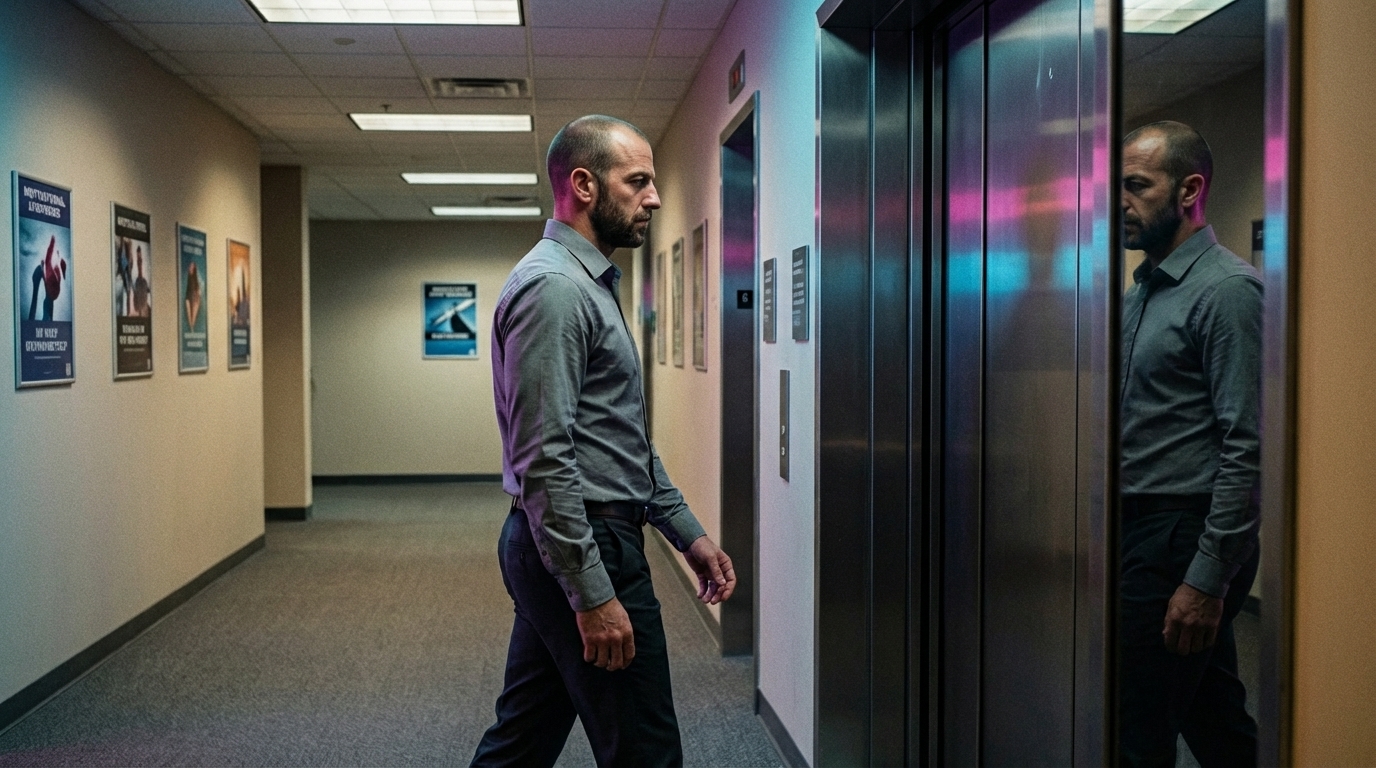
I made for the lifts. The caffeine from my morning coffee continued its electric dance through my system, and I jabbed the call button with perhaps more enthusiasm than the gesture warranted. The lift arrived with a soft chime, its doors parting to reveal an empty cabin lined with mirrors that multiplied my reflection into an infinite regression of Nathans, each one slightly smaller, slightly more distant, disappearing into some vanishing point I couldn't quite locate.
I stepped inside and pressed the button for the fourth floor, watching the doors slide closed with the pneumatic hiss of institutional efficiency. The lift began its ascent, and I caught myself humming—that infernal pop song from the café had lodged itself in my consciousness with the tenacity of a splinter, refusing to be dislodged. My foot tapped against the carpeted floor in unconscious rhythm, the morning's buoyancy still carrying me upward even as the lift did the same.
The corridor stretched before me as the doors opened, that long expanse of neutral carpet and neutral walls and neutral lighting that seemed specifically engineered to suppress any emotion more intense than mild professional satisfaction. Motivational posters lined the walls at precise intervals—photographs of mountain climbers and rowing teams accompanied by words like "Excellence" and "Collaboration" rendered in fonts that presumably tested well in focus groups. I had stopped seeing them years ago, my eyes sliding past their aggressive optimism with practised indifference.
My electronic fob granted me passage with its characteristic digital chirp, and I bounded through the office door with that same café tune still playing in my head, my body apparently determined to maintain its rebellious cheerfulness despite the environment's best efforts at suppression. The open-plan space sprawled before me, a meticulously arranged landscape of ergonomic chairs and dual monitors bathed in the soft morning light filtering through the floor-to-ceiling windows.
From this elevated vantage point, the Derwent River sparkled in the distance, its surface already adorned with early morning sailing boats—white specks against the blue—and the occasional cargo vessel making its laborious way towards the port. The view never failed to momentarily arrest me, this stunning natural panorama framed by the sterile geometry of office architecture. It felt like a promise the building couldn't quite keep, a reminder of the world that existed beyond these climate-controlled walls.
"Morning, Nathan," Sal called out from the far side of the office, her voice carrying across the mostly vacant space with a clarity that only existed in the early hours. She was invariably early, a fixture of these quiet morning interludes, as reliable as the coffee cart that established its temporary domain in the building's lobby each day at precisely seven-thirty. Her desk was already surrounded by neat stacks of paper, colour-coded folders, a small ceramic pot of succulents providing the only organic element in her workspace.
I returned the greeting with a cheerful "Good morning" of my own, offering a perfunctory wave as I hastened towards my desk along the back wall. Despite my outwardly pleasant disposition, I wasn't inclined towards casual conversation this morning. This was what I cherished most about arriving at the office before eight—the blessed solitude. The silence possessed a particular quality, broken only by the gentle hum of computers and the distant, almost subliminal whisper of the air conditioning.
These precious minutes before the office filled with the cacophony of ringing phones and impromptu meetings constituted the most productive time of my day. Or at least, the time when I could pretend to be productive without the constant interruption of colleagues who seemed constitutionally incapable of resolving even the smallest query without a fifteen-minute conversation.
Reaching my desk, I let my backpack drop to the floor with a soft thud—
And stopped.
My expression changed before I consciously registered what I was seeing, brows furrowing as my eyes locked onto a small yellow Post-it note that had been meticulously affixed to the top of my monitor. The paper seemed to glow against the dark screen, a rectangle of sunshine in this grey-toned landscape, demanding attention with an almost physical insistence. It sat there, perfectly centred, its edges aligned parallel to the monitor's frame with a precision that spoke of deliberate placement rather than casual afterthought.
I stood frozen, my hand still extended from releasing the backpack, my body caught in that peculiar suspension between one moment and the next. Something in me knew—before I read the words, before I processed their meaning—that this small yellow square was about to change something. The air in the office seemed to thicken, the ambient hum of electronics growing louder in the sudden stillness of my attention.
I read the note in silence.
Meet me for lunch today at Cornerstone Café 12pm sharp. Very important. Don't ask questions. Don't tell anyone. Seth.
I looked up at the air-conditioning vent above my desk, quite genuinely expecting to find it angled down and blasting directly onto the back of my neck, because that was the only explanation available to me for the thing that had just gone through my body and I wanted an explanation very badly indeed. The slats were turned away towards the windows. There was nothing coming out of it at all, not so much as a draught. Which meant that the cold had been manufactured somewhere on the inside of me, by me, in response to nineteen words on a square of adhesive paper, and I found that I did not care for that in the slightest.
My shoulders executed an involuntary shudder, a full-body response that I couldn't have suppressed if I'd tried. I read the note again, then a third time, as though repetition might somehow alter its contents, might transform these strange imperative sentences into something ordinary, something explicable.
The handwriting was unmistakably Seth's—that peculiar amalgamation of printed and cursive letters I'd observed countless times before on meeting notes and birthday cards, the capital letters standing rigid and upright while the lowercase tumbled into each other with schoolboy looseness. But there was something disconcertingly different about it this time, an urgency in the pressure of the pen strokes that seemed to telegraph anxiety. The normally fluid lines appeared jagged and rushed, the letters pressing hard enough into the paper to leave small indentations visible when I tilted the note towards the window light. The "S" of his signature was almost violent, the pen having nearly torn through the adhesive square.
And in ten years he had never left me a note. Not a note. Not once. Seth conducted his entire correspondence by text message at a rate of something like forty a day, most of them links to material I had no intention of reading, and in a decade of friendship he had not once put a pen to paper on my behalf about anything whatsoever.
I lowered myself into my chair slowly, the chair taking my weight with a small pneumatic complaint. My eyes remained fixed on the Post-it note, now resting between my fingers, the adhesive strip tacky against my thumb.
Why didn't he send a text?
The question surfaced immediately, urgent and obvious. I slipped my mobile from my pocket and set it on the desk, the screen dark and dormant. It looked innocent enough, this slim rectangle of glass and metal, but something about it now felt strangely loaded—like it was hiding a silence that didn't belong.
In an age where almost every interaction passed through a screen, a handwritten note wasn't just old-fashioned. It was intentional. Deliberate. As if Seth had gone out of his way to avoid anything that left a digital trace.
And that was what unsettled me most.
We didn't even work in the same office anymore—hell, not even the same building. For him to leave something on my desk meant he'd made a detour, crossed sites and floors, found a way past reception and security and the electronic fob system that tracked every entry and exit. It wasn't just a message. It was a gesture. A statement. The kind of effort that implied something couldn't be said through normal channels.
The morning light caught the edge of the Post-it, its yellow curl lifting slightly in the breeze from the overhead vent. I smoothed it flat with my thumb, studying the words again as though they might rearrange themselves into something less alarming.
12pm sharp.
That detail sat uneasily in my stomach, a small stone of wrongness that refused to dissolve. Seth was the kind of person who suggested "lunch-ish" or "around noon," his allergy to punctuality a running joke between us. I'd spent countless lunch breaks waiting at various cafés while he materialised fifteen or twenty minutes late, always with the same sheepish grin and the same excuse about losing track of time. For Seth to specify an exact time—to write "sharp," of all words—felt like receiving a ransom note written in a friend's handwriting.
Don't ask questions.
When had Seth ever discouraged questions? His entire personality was constructed around asking them, around peeling back layers of received wisdom to examine what lay beneath. The instruction felt antithetical to everything I knew about him, as though someone had studied Seth carefully and then produced a deliberate inversion.
Don't tell anyone.
I glanced across the office towards Sal, who remained absorbed in whatever task had commanded her early-morning attention. She hadn't noticed anything unusual. Why would she? It was just a Post-it note. People left Post-it notes all the time. There was nothing objectively alarming about a small yellow square adhered to a monitor.
And yet.
Yielding to the compelling urge to seek clarification, I picked up my phone and composed a text message to Seth. My thumbs hovered uncertainly over the keyboard for several moments, drafts forming and dissolving in my mind before I committed to words that felt simultaneously inadequate and necessary.
What's this all about? Are you okay?
The message disappeared into the digital ether with a soft swoosh, that small sound of transmission that usually preceded an almost immediate response. Seth was perpetually attached to his phone, one of those people who seemed to experience phantom vibrations when separated from the device for more than a few minutes. His reply time was typically measured in seconds rather than minutes.
I stared at the screen, willing those familiar three dots to appear—the universal signal that a response was being composed, that connection had been established, that I hadn't simply hurled my words into a void.
Nothing.
The screen remained static, my message sitting there with a single grey tick beneath it. Sent, but not delivered. As though Seth's phone had ceased to exist, had been switched off or destroyed or simply removed from the network entirely.
"Not even a delivered receipt," I muttered.
I had known Seth Holder for ten years by then, since the finance company, when he had the office next to my cubicle and five years of seniority that he had never once, in all that time, thought to use on me as a weapon. He would appear at my desk with printouts from forums I would never have gone looking for, bright-eyed and entirely convinced that he had located a pattern which everybody else had somehow contrived to miss. Fluoride in the water supply. The actual purpose of Pine Gap. Which politicians wore which colour tie for which category of announcement, and what all of that told a man who was paying attention, which nobody ever was. I humoured him, mostly, and I was dimly aware even at the time that there was something faintly condescending in the manner of my humouring, and I never once got round to doing anything about that.
But every so often—not often, perhaps three or four times in ten years—he would put something down in front of me that was simply too neat to be coincidence, and I would feel the floor of the ordinary world give very slightly beneath my feet, and down the hole the pair of us would go together, and we would emerge some hours later with considerably more questions than we had started out with, and with the peculiar and entirely unearned satisfaction of two men who had achieved absolutely nothing whatsoever.
And in the whole of that decade I had never seen the thing frighten him. Not once. It was a game, as far as I was ever able to tell—a way of insisting that the world was more interesting than it looked and that the surface of it was never the entire story—and he enjoyed it, and he enjoyed it enormously, and he would have been genuinely disappointed if any of it had ever turned out to be true.
Whatever had driven the pen that hard into the paper on my monitor had not been a game.
I stood abruptly, the chair rolling backward with a soft rumble against the commercial carpet. Movement felt necessary—essential, even—as though remaining stationary would allow the creeping unease to catch up with me. My feet carried me towards the kitchen on autopilot, my body executing the familiar route while my mind churned through a catalogue of possibilities, each more unsettling than the last.
The corridor felt elongated, each step drawing out the distance between my desk and the small sanctuary of the staff kitchen. The motivational posters I usually ignored seemed to watch my passage with their frozen athletes and their aggressive optimism. "Success is not final, failure is not fatal." "The only limit is the one you set yourself." The words felt mocking now, their certainty obscene in the face of my mounting uncertainty.
The kitchen was deserted when I arrived, thank God—I wasn't sure I could manage small talk in my current state. Morning sunlight streamed through the eastern window, creating geometric patterns on the worn linoleum floor, the light catching dust motes suspended in the air. The refrigerator hummed its constant low note. A tap dripped with metronomic persistence, each small splash marking time I suddenly felt I couldn't afford to waste.
I reached for the biscuit tin—that communal repository of comfort food that mysteriously never quite depleted, replenished by anonymous benefactors who understood the essential role of afternoon sugar in office survival. The tin was cool beneath my fingers, its faded tartan pattern depicting some Scottish scene that had been worn to ambiguity by years of handling. I pried off the lid. The Arnott's Assorted lay inside in their usual democratic jumble, and I stared at them without really seeing them.
A glimpse of my reflection caught my attention in the microwave door—my face distorted by the slight curve of the glass, eyes wider than I expected, the morning's buoyant mood effectively obliterated by those few enigmatic lines on yellow adhesive paper. I barely recognised the expression. This wasn't the face of someone who had been bouncing to pop music half an hour ago. This was the face of someone waiting for bad news they couldn't yet name.
I selected a Scotch Finger without conscious thought, the oblong biscuit sitting in my palm, and stood there for longer than was reasonable, dunking it into a cup of water from the cooler—coffee felt like too much effort, too much commitment to normality. The biscuit softened and threatened to collapse, and I ate it in three joyless bites before the structural integrity failed entirely. The sweetness registered somewhere distant, a flavour experienced by someone else.
I should go back to my desk. I should attempt to work. I should behave as though everything were normal, as though my oldest Tasmanian friend hadn't left me a message that read like something from a spy novel. The rational part of my mind understood this, could articulate all the sensible reasons why I should shelve my anxiety and proceed with my morning.
But rationality seemed to have taken temporary leave, replaced by something older and more insistent—the thing that comes up out of the floor of a man when the pattern of his ordinary life develops a crack in it, and he understands, for the first time, that there is something underneath the pattern.
I returned to my desk through corridors that felt somehow changed, as though the building had shifted subtly during my brief absence. Sal glanced up as I passed, and I manufactured something approximating a normal expression, though I suspected the result was closer to a grimace.
The Post-it note sat where I'd left it, that small yellow accusation waiting patiently beside my keyboard. I picked it up and turned it over in my fingers, half-expecting to find additional instructions on the reverse—coordinates, perhaps, or a coded message that would make everything clear. But the back was blank, just smooth yellow paper slightly tacky with adhesive residue.
Don't tell anyone.
Carefully, deliberately, I folded the note once and slipped it into my wallet, tucking it behind my driver's licence where it couldn't be accidentally glimpsed. The leather closed around it, hiding it from view, and I felt something settle in my chest—not quite acceptance, not quite calm, but something adjacent to both. Some part of me had evidently gone ahead and settled the matter without troubling to consult the rest of me about it, which was, as far as I had ever been able to establish, the way that nearly all of my decisions actually got made; and the upshot of it was that I would be at Cornerstone at twelve o'clock, and that there was no longer very much point in pretending otherwise.
I checked my phone once more—still nothing, that single grey tick unchanged, my message floating somewhere in the digital void between sent and received.
Four hours until noon. Four hours of pretending that everything was fine, that I could concentrate on OneGov requirements and stakeholder reports while that folded yellow paper pressed against my hip like a small, insistent heartbeat.
I powered up my computer and initiated my usual morning protocol, the familiar boot sequence providing a thin veneer of normality over the chaos quietly building in my mind.







