4128.59 · February 28, 1808 AD
The Night Speaks in Tongues
On his first night upon solid ground in ten months, William lies awake in a Sydney barracks as his sea-trained body rebels against the stillness—listening to the alien screams of creatures he cannot name, trading grim wisdom with a man who built a life here once and lost it all, and feeling something cold and patient take root where grief might have been.
"Sixty years old and starting over. The colony doesn't care about fair—only about what you do next."— Barracks Veteran
The world had stopped moving, and William could not decide whether this was blessing or curse.
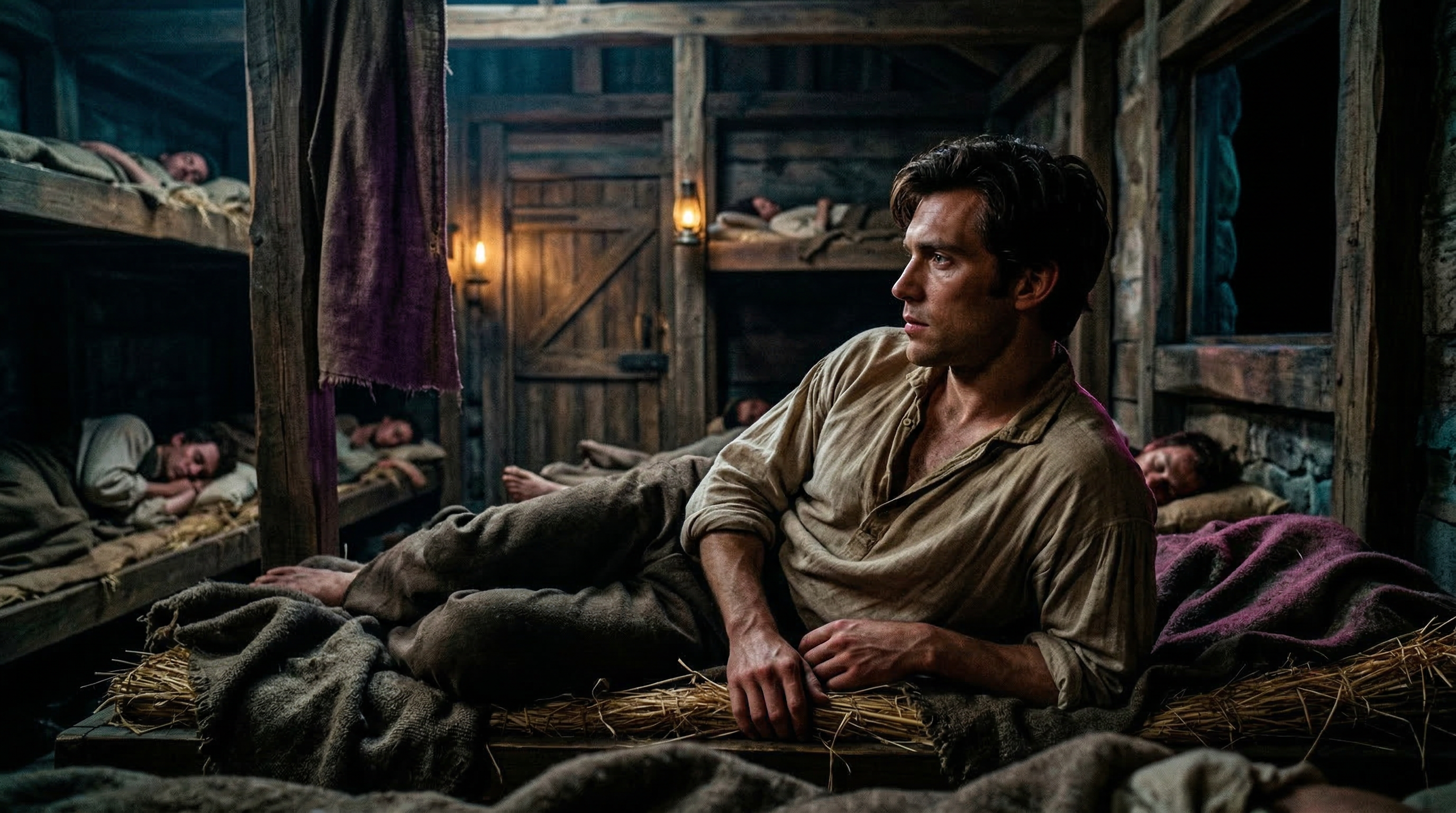
He lay upon his narrow bunk as the last light faded from the barracks window, his body stretched flat against a surface that refused to shift beneath him. For ten months, every moment of his existence had been accompanied by motion—the pitch and roll of the Resolution as she crossed fifteen thousand miles of ocean, the creak of timbers adjusting to wind and wave, the constant small compensations his muscles had learned to make without conscious thought. Now that motion had ceased, and its absence felt less like relief than amputation.
His inner ear, trained by months of seafaring, insisted that the stillness was wrong. It kept searching for the rhythm that should have been there, kept bracing for swells that never came, kept expecting the hammock's familiar sway that the hard wooden bunk could not provide. Several times during the first hour, William found himself gripping the edges of the mattress, convinced that the building had begun to tilt, only to realise that the sensation existed entirely within his own disordered perceptions.
The straw beneath him rustled with each small adjustment, releasing puffs of dust and the accumulated scents of previous occupants. He tried not to think about who had lain here before him—other convicts passing through on their way to assignments throughout the colony, some perhaps bound for the same government farm that awaited him, others destined for harsher fates. The mattress held their traces like a palimpsest of desperation, layer upon layer of sweat and fear and exhausted sleep.
The rations arrived as the sun touched the horizon, carried by convicts whose status as trustees granted them movement within the compound that the newer arrivals did not yet possess. They distributed the evening meal with the tired efficiency of men who had performed the same task countless times—a portion of salted beef for each prisoner, a chunk of coarse bread that might charitably be described as adequate, a ladle of water from a bucket that had clearly served many mouths before reaching William's.
He ate without tasting, his body recognising the necessity of sustenance even as his mind remained elsewhere. The beef was tough and oversalted, the bread dry enough to catch in his throat, but both represented improvement over the rations that had sustained him during the voyage. His stomach, shrunken by months of insufficient food, protested at even this modest abundance, cramping around the unfamiliar quantity with complaints he did his best to ignore.
Around him, the other convicts ate in relative silence. Exhaustion had claimed most of them, their bodies depleted by the voyage and the day's exertions, their spirits too low to sustain conversation. A few exchanged murmured words with their neighbours—observations about the food, speculation about what awaited them at their various assignments, the occasional dark joke that drew tired smiles from those near enough to hear. But mostly they simply ate, and when the eating was done, they returned to their bunks and surrendered to whatever rest the night might offer.
True darkness came swiftly in this hemisphere, William discovered. One moment the sky beyond the window held traces of gold and crimson; the next, or so it seemed, the light had fled entirely, replaced by a blackness more complete than any he had known in England. No streetlamps cast their glow through these windows. No neighbouring houses leaked candlelight through shuttered panes. There was only the dark, vast and uncompromising, pressing against the barracks walls like a living thing seeking entry.
A single lamp burned near the door, tended by a guard whose silhouette occasionally passed across its glow. The flame cast long fingers of illumination down the rows of bunks, touching the faces of sleeping men with amber light, leaving the spaces between in pools of impenetrable gloom. William watched the lamp's flicker play across the rough-hewn beams overhead, finding in its dance the only motion this still, strange night would provide.
The sounds began as the darkness deepened. Not the sounds of the barracks—the snoring and muttering of exhausted men, the creak of wooden frames as bodies shifted in uneasy sleep—but something beyond. Something outside. The night itself seemed to possess a voice in this country, and it spoke in tongues William had never heard.
First came the insects—a chorus so vast and so varied that it seemed impossible such sounds could emanate from creatures small enough to escape notice during the day. They chirped and whirred and buzzed and clicked, their voices overlapping in patterns that approached music, fell away into chaos, and somehow resolved again into harmonies no European ear had ever been trained to appreciate. The noise swelled and faded with rhythms governed by rules William could not begin to guess, rising to peaks that drowned all other sound, subsiding to whispers that left space for stranger voices to fill.
Something screamed in the distance—not a human scream, though it carried that quality of raw anguish that made such comparisons inevitable. The sound tore through the insect chorus and hung in the air for a long, frozen moment before trailing off into echoes that seemed to multiply as they faded. William's heart hammered against his ribs, his body responding to the cry with an instinctive terror that reason could not entirely dispel.
"Possum," said a voice from the neighbouring bunk. William turned his head to find a man watching him through the darkness—an older convict whose weathered features suggested long acquaintance with colonial life. "Or maybe a curlew. Hard to tell at night. You'll hear worse before you're done. The bush is full of creatures that sound like they crawled up from hell itself."
"You've been here before?" William asked, pitching his voice low to avoid disturbing those who had managed to find sleep.
"Twelve years." The man shifted on his bunk, straw crackling beneath him. "Came out on the Second Fleet, back in ninety. Served my time, got my ticket, built a decent life for myself in Parramatta. Had a farm, a wife, two children." He paused, and when he continued, his voice had flattened into something approaching indifference. "Then the wife died of fever and I fell in with some men I shouldn't have. Now I'm starting over, sixty years old and bound to break dirt until my back gives out."
"I'm sorry," he said, because nothing else seemed adequate.
The old man made a sound that might have been a laugh. "Don't be. I made my choices, same as everyone here. The colony doesn't much care about sorry. It only cares about what you do next." He turned away, presenting his back to William. "Get some sleep, lad. Tomorrow's a long walk, and Parramatta won't wait for tired feet."
Sleep, however, proved elusive. William lay in the darkness and listened to the alien symphony of the Australian night, his mind churning through the events of the day with an energy his body could not match. The faces of those he had seen paraded through his memory—Captain Haverford with his assessing grey eyes, the guards whose indifference marked convicts as beneath notice, the colonists who had watched the procession through Sydney's streets with expressions ranging from pity to contempt.
And Tom. Always, inevitably, his thoughts returned to Tom.
The old smuggler would be in the quarry barracks by now, assuming the transport had completed its journey before nightfall. He would be lying on a bunk much like this one, listening to sounds much like these, preparing for labour that would almost certainly kill him. Ten months of shared confinement, of whispered conversations and careful alliance, of wisdom offered without expectation of return—and now Tom was gone, separated from William by a bureaucratic notation in a captain's ledger, condemned by the stroke of a quill to a fate neither of them could alter.
William had not wept since his arrest. Not during the trial, when his mother's sobs had echoed through the courtroom. Not during the sentencing, when the magistrate's words had struck him like physical blows. Not during the endless voyage, when death had claimed his fellow prisoners with callous regularity. He had learned, somewhere in that progression of horrors, to seal away the parts of himself that might have found release in tears.
Now, in the darkness of the Sydney holding barracks, he felt that seal beginning to crack. Grief pressed against it from within—grief for Tom, for his parents, for the life he had lost, for the future that had been stolen from him by a copper-haired thief and a system that cared nothing for truth when conviction was so much more convenient. He clenched his jaw and pressed his forearm across his eyes, fighting the pressure with everything he had.
He would not weep. Tears changed nothing. They did not bring back the dead or free the condemned. They merely announced weakness to a world that fed upon the weak with the enthusiasm of wolves upon wounded deer. Whatever else this colony stripped from him, it would not take his composure. That, at least, he could control.
In the space where tears might have been, memories flooded instead. Portsmouth rose before his closed eyes—not the Portsmouth of docks and warehouses, of cargo and commerce, but the Portsmouth of his childhood. The narrow streets where he had learned to walk, guided by his mother's patient hand. The harbour where his father had pointed out the great ships and named their origins with the quiet pride of a man who understood his place in the machinery of empire. The modest dwelling that had contained everything he loved, its rooms grown larger in recollection than they had ever seemed in life.
He saw his mother bent over her needlework, squinting in the candlelight as her fingers guided thread through fabric with the practiced ease of decades. Elizabeth Whitehall, who had become Elizabeth Jeffries, who had raised a son she believed would amount to something more than a convict in chains. Did she know he had survived the voyage? Did she still pray for him each night, her voice rising toward a heaven that had apparently grown deaf to the pleas of the Jeffries family?
He saw his father at the kitchen table, hands wrapped around a cup of weak tea, shoulders slumped with the exhaustion that dock labour carved into bodies one day at a time. Edward Jeffries, who had never spoken of love because such words did not come easily to men of his station, but whose every action had proclaimed what his tongue could not express. The extra hours worked to pay for William's schooling. The quiet pride when William had mastered his letters. The silent devastation in the courtroom, more terrible for its restraint than any outburst could have been.
He saw the Portsmouth courthouse, rising like a temple to justice that was anything but just. He saw Magistrate Blackwood's implacable face, heard again the words that had ended his former life: seven years' transportation. He felt again the cold bite of manacles closing around his wrists, heard again his mother's scream as they led him away.
And he saw Jack Hawley.
The memory surfaced with the clarity of a fever dream, undimmed by the months of ocean that separated him from its origin. The marketplace in Portsmouth, crowded with the commerce of an ordinary afternoon. The brush of a shoulder against his own, unremarkable in the press of bodies. The sudden weight in his hand—cool metal, unfamiliar shape—pressed there before he could register what was happening.
And then Jack's face, already retreating into the crowd, copper hair catching the pale English light, lips curved in that smirk William would see in his dreams for years to come. Their eyes had met for the space of a heartbeat—time enough for William to read the calculation there, the complete absence of remorse or hesitation. Time enough to understand, in the instant before Constable Greaves' hand closed on his arm, that he had been chosen. Marked. Sacrificed to preserve someone else's freedom.
The trial had offered opportunity for redemption that never materialised. William had expected Jack to come forward, to confess, to show some fragment of the decency that must surely exist even in the most corrupt of souls. Instead, Jack had lounged in the courtroom gallery, watching the proceedings with the detached amusement of a spectator at a puppet show, and when the verdict was read, he had offered William nothing but that careless shrug—that gesture of absolute indifference that had seared itself into memory with the permanence of a brand.
Hatred was too simple a word for what William felt when he thought of Jack Hawley. Hatred implied heat, passion, the kind of burning emotion that consumed itself over time. What lived in William's chest was colder than that—a patient, enduring thing that could wait years for satisfaction. It did not flame; it froze. It did not rage; it calculated. It understood, with a clarity that ordinary hatred could never achieve, that revenge was a dish requiring careful preparation.
Seven years. In seven years, William's sentence would conclude, and he would be free to pursue whatever course his transformed circumstances permitted. Seven years to plan. Seven years to prepare. Seven years to become something more than the frightened young dockworker who had stood trembling before the magistrate's bench.
Jack Hawley had stolen more than a pocket watch in that crowded marketplace. He had stolen William's future, his family, his good name. But time, William was beginning to understand, had a way of collecting such debts. And this colony, for all its brutality, offered opportunities for reinvention that England's rigid hierarchies would never permit.
The thoughts circled back on themselves, serpents swallowing their own tails, until William could no longer distinguish planning from fantasy, determination from delusion. He forced his mind away from Jack, away from Portsmouth, away from everything that lay behind him. The past was a country he could not return to. Only the future remained, and the future began tomorrow, on the road to Parramatta.
Sleep came eventually, not as relief but as ambush. One moment William lay staring at the lamp-lit beams; the next, he found himself walking through streets that were Portsmouth and Sydney simultaneously, their architectures bleeding into one another in the way of dreams. His mother walked beside him, though when he turned to look at her, her face kept shifting—now Elizabeth, now some colonial woman he had glimpsed on the docks, now a stranger with eyes that held the entire ocean.
Tom appeared in the dream as well, younger than William had ever known him, standing at the prow of a ship that sailed through streets rather than water. He spoke words that William could not hear, gestured toward something in the distance that dissolved before William's dreaming eyes could identify it. Then the ship was sinking, the streets rising up to swallow it, and Tom was gone—vanished into depths that Portsmouth's cobblestones should never have possessed.
Jack Hawley's laughter echoed through the dream, sourceless and mocking. William chased the sound through alleyways that twisted impossibly, through buildings that rearranged themselves as he passed, through crowds whose faces all wore the same expression of amused contempt. He could not catch the laughter, could not find its origin, could not make it stop. It followed him like a curse, like a promise, like the truth he could never make anyone believe.
He woke gasping, the laughter still ringing in his ears, and found that it had transformed into the shriek of some nocturnal bird beyond the barracks walls. The lamp still burned near the door, its flame lower now, guttering toward exhaustion. The snores and murmurs of sleeping men surrounded him, a chorus of unconsciousness that offered no comfort.
William lay still, waiting for his heart to slow, waiting for the dream's grip to loosen. The straw mattress scratched against his skin. The wooden bunk pressed hard against his back. The night sounds of Australia continued their alien symphony, indifferent to human dreams and human suffering.
The hours between midnight and dawn stretched like taffy, each minute refusing to yield to the next. William drifted in and out of sleep, never quite achieving the depth that might have brought true rest. Every sound jerked him back to wakefulness—the screech of birds, the rustle of men turning in their bunks, the distant bark of dogs, the occasional shout from somewhere in the colony beyond the barracks walls.
During one of these wakeful intervals, he became aware of quiet voices nearby. Two men, conversing in whispers that barely rose above the ambient noise, their words reaching William's ears in fragments that he pieced together like a puzzle.
"...heard the overseer at Parramatta is a hard man..."
"...better than the quarries, though. My cousin went to Castle Hill. Lasted eight months before his lungs gave out..."
"...keep your head down, that's the secret. Don't give them reason to notice you. Work hard, don't complain, serve out your time..."
"...easy to say. Harder when you're breaking your back in the sun and some bastard with a whip is telling you you're not moving fast enough..."
The conversation faded as the speakers either fell asleep or noticed William's attention. He lay in the darkness and considered what he had heard. Keep your head down. Don't give them reason to notice you. The same advice Tom had offered, the same wisdom the old man in the neighbouring bunk had implied. Survival in this colony, it seemed, meant invisibility—becoming so unremarkable that authority's eye slid over you without pause.
It was good advice. Sound advice. The kind of advice that might carry a man through seven years of servitude with his body and mind more or less intact.
Yet even as William acknowledged its wisdom, something in him rebelled against it. He had not been transported to this distant shore merely to survive. Survival was the baseline, the minimum acceptable outcome, the floor beneath which lay only death. If seven years were to be taken from him—seven years of his youth, seven years that should have been spent building a life in England—then surely those years must purchase something more than mere continuation of existence.
He thought again of Jeremiah's words on the ship, of the opportunities this colony offered to those with wit and will. He thought of the settlement he had seen from the dock, the evidence of industry and ambition that had transformed a wilderness into something approaching civilisation in a mere twenty years. He thought of the future that might await him when his sentence concluded—not a return to Portsmouth's docks, to the same grinding labour his father had endured for decades, but something new. Something his own.
The thoughts carried him through the small hours, sustaining him when sleep would not.
The darkness began to thin so gradually that William did not immediately recognise the change. One moment the window at the end of the barracks showed only black; the next, or so it seemed, a hint of grey had crept into its frame. The grey deepened, acquired texture, resolved itself into the suggestion of sky and roofline beyond.
The birds noticed before the men did. Their chorus, which had never entirely ceased during the night, swelled with the approaching dawn, new voices joining the symphony until the sound became almost overwhelming. The cockatoos William had observed from the ship announced the sun's return with shrieks that seemed designed to wake the dead, let alone the merely sleeping. Other birds—species he could not name and might never learn to identify—added their contributions to the cacophony.
Around him, the barracks stirred to reluctant life. Men groaned and stretched, their bodies protesting the resumption of consciousness after such inadequate rest. Chains rattled as convicts rose from their bunks, the metal links cold in the pre-dawn chill that had settled over the building during the night. The air smelled of stale sweat and straw dust, of sleep and unwashed bodies, of all the accumulated misery that such places inevitably contained.
William swung his legs over the edge of his bunk and sat for a moment, gathering himself for the day ahead. His body ached from the unaccustomed stillness of the night—muscles that had spent ten months learning one set of movements now required to learn another. His feet, blistered from the previous day's march through Sydney, throbbed with dull pain that promised to sharpen considerably once he began walking again.
But he was alive. He had survived the voyage, survived the processing, survived his first night in the colony. Whatever awaited him on the road to Parramatta, whatever the government farm might demand of him, he would face it as he had faced everything since Jack Hawley had pressed a stolen watch into his hand—with the grim determination of a man who has already lost everything and therefore has nothing left to fear.
The morning rations arrived with the same worn efficiency that had characterised the evening meal. Bread again, harder than yesterday's if such a thing were possible, accompanied by a thin gruel that might charitably be described as porridge. William ate without complaint, understanding that the energy would be necessary for whatever the day required. Around him, other convicts did the same, their faces set in expressions of weary resignation that he suspected mirrored his own.
Guards moved through the barracks, calling out names and directing men toward the yard. The Parramatta transport was assembling, gathering those who had been assigned to the government farm for the march that lay ahead. William heard his name and rose to join them, leaving behind the bunk that had offered such poor rest, the straw mattress that would soon cradle some other condemned soul.
The yard had transformed in the early light. What had seemed merely bleak the previous afternoon now revealed itself in fuller detail—the worn paths where countless feet had traced the same circuits, the places where the fence posts had been reinforced against attempts to weaken them, the small patches of ground where determined convicts had scratched messages or pictures into the hard-packed earth. This place had seen thousands pass through on their way to assignments throughout the colony. It would see thousands more after William was gone, an assembly point for the broken and the desperate and the merely unlucky.
He found his place in the line forming near the gate and waited. The sun had cleared the horizon now, already beginning its daily assault upon the exposed skin of those who must labour beneath it. The heat would build as the morning advanced, would reach its crushing peak in the early afternoon, would not relent until evening brought its brief respite. This would be his life for the next seven years—work measured by the sun's arc, rest stolen in the hours of darkness, each day an endurance to be survived before the next began.
The gate swung open. The guards shouted their commands. And William Jeffries, convict, walked out of the Sydney holding barracks toward whatever awaited him on the road to Parramatta.






