4344.40 · February 9, 2024 AD
The Ney Player's Evening
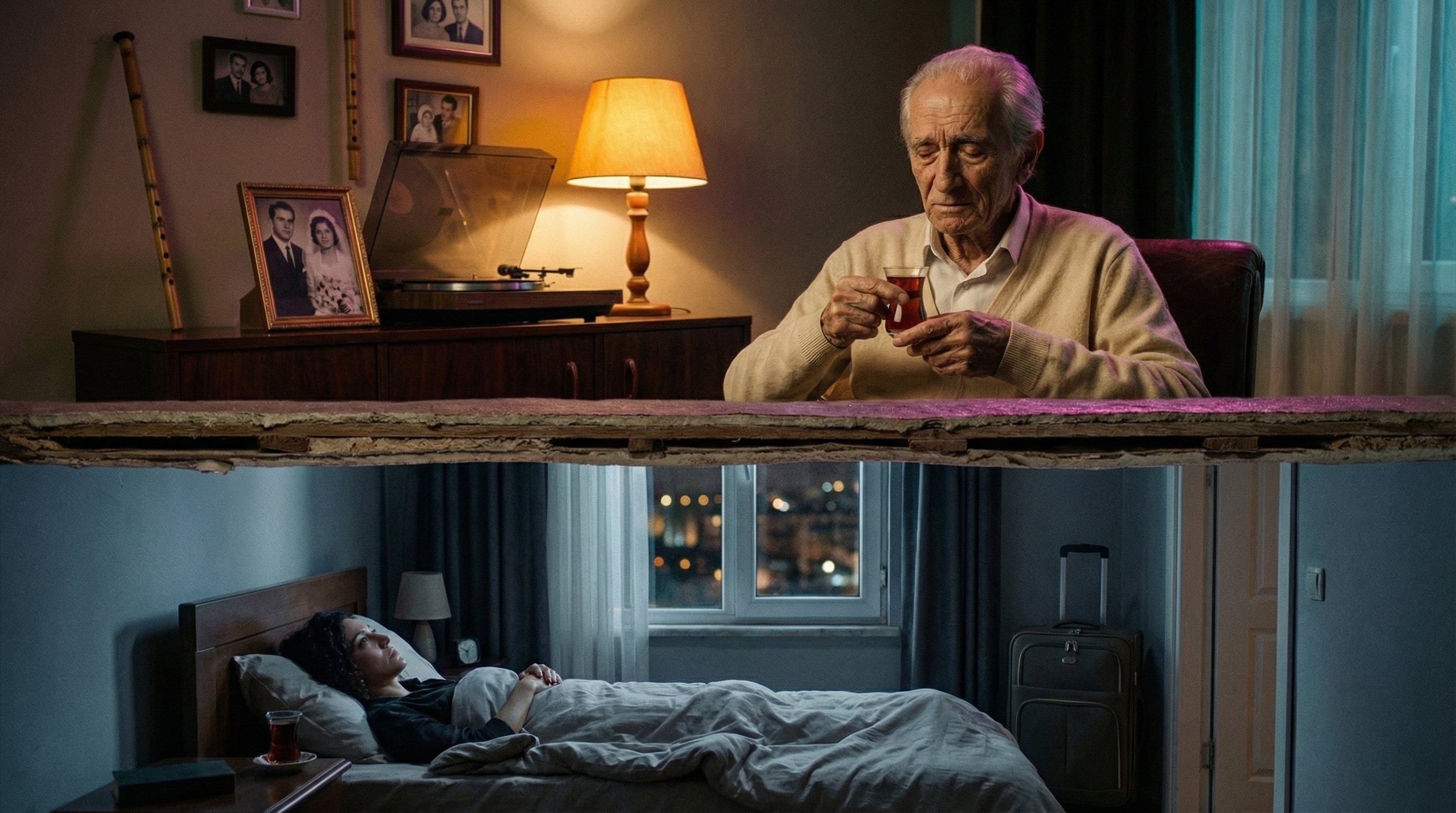
On the eve of departure for Cairo, a ney flute and a voice from 1962 seep through the ceiling of a Cihangir flat where a suitcase sits packed — equipment first, life fitted around it. Upstairs, Halil Rauf Erdem, eighty-one years old, retired after forty-three years teaching ney at the Istanbul Conservatory, plays Münir Nurettin Selçuk at a volume calibrated not for hearing but for filling the silence his wife's death has left. Two residents of the same 1890s building, each a custodian of something the world does not know they carry.
The building on the Cihangir hillside had stood since the 1890s, raised during the last flush of Ottoman-era construction in a neighbourhood that had housed foreign diplomats and wealthy Greek and Armenian families whose names survived now only in property records and the architectural flourishes they had commissioned — ornate metalwork on the banisters, plaster mouldings on the stairwell walls whose cracks mapped a century and a half of settlement and subsidence. The marble stairs had been worn smooth at the centre of each step by generations of ascending and descending feet, the stone carrying in its polished surface a record of habitation as legible as any archive's catalogue. The front door stuck in cold weather. It always had. Some quality of the frame — expansion or contraction, the physics of old wood responding to temperature in ways that modern materials had been engineered to avoid — required a shoulder's weight and a simultaneous turn of the key, a manoeuvre that rewarded familiarity and punished visitors.
The building held four floors. Halil Rauf Erdem occupied the third. He had lived there for over forty years — had moved in as a young husband with a wife who played the kanun and a career at the Istanbul Municipal Conservatory that would span four decades of teaching the ney to students whose names, taken collectively, constituted a significant portion of Turkey's living tradition in Ottoman classical music. The ney — a simple reed flute, end-blown, capable of producing a sound that the Sufi tradition considered the closest human-made approximation of divine breath — had been Halil Bey's instrument, his vocation, his means of connecting the present to a musical lineage that stretched back through centuries of Ottoman court practice to the lodges where Mevlana's followers had first understood that a hollow reed could carry grief.
He was eighty-one now. Retired since 2004. His wife had died — the photographs in his flat documented a marriage whose duration had exceeded that of many institutions, a woman with dark eyes who appeared in images ranging from a formal wedding portrait to informal snapshots that caught her mid-laugh, mid-sentence, mid-life. Her absence had reshaped the flat's acoustic character. Silence in a space that had held two people for decades was not the same silence that occupied a space built for one. It was subtracted presence. An outline where sound had been. And Halil Bey's response to this particular quality of quiet was the same response that musicians had always brought to emptiness: he filled it.
Münir Nurettin Selçuk's voice, recorded in 1962, rose from a wooden-cased amplifier and a pair of speakers positioned with the particular care of someone who understood that placement mattered — the sound filling the third-floor flat and seeping through the plaster and the century-old joists into the flat below, where Mira Osman had just zipped a carry-on suitcase packed in the order that Archive Keepers packed: equipment first, then life fitted around it. Camera, laptop, notebooks, printed photographs of two cuneiform tablets whose scribal hands matched across forty-five centuries and two continents. Then two changes of clothes, a spare headscarf, toiletries, and a pair of flat shoes that a man in Cairo had told her to bring.
The music arrived not as intrusion but as infusion — a slow saturation, the ney's breathy taksim threading through the building's fabric the way heat from a radiator filled a room. The nihavend makam: a modal structure whose intervals carried a particular quality of melancholy that Turkish musical tradition distinguished from the melancholy of other modes with a precision that Western tonal systems could not easily replicate. Each makam had its own emotional territory, its own time of day, its own relationship to the listener's interior weather. Nihavend belonged to evening. To reflection. To the particular weight of looking backward across a life and finding that what you remembered most clearly was not the achievements but the presences.
The volume was too high. Not aggressive — Halil Bey conducted every aspect of his existence with a courtesy so habitual it had become structural — but loud in the way that indicated ears whose lower registers no longer responded without assistance. He had acknowledged this when Mira climbed the stairs and knocked: a rueful tap against his ear, the concession that the organs of perception declined even when the need for what they perceived did not. But the volume was also, as he admitted over tea served in tulip glasses with stale biscuits arranged on a plate with more care than their packaging deserved, a defence against silence. The ears were an excuse. The fear was real. Quiet, in the flat where his wife had lived and laughed and played kanun and died, was something that required filling the way a wound required dressing — not because the treatment healed but because leaving it exposed was worse.
He had been a ney player. The framed photograph showed him at eighteen — 1961, the Istanbul Conservatory, the instrument resting against his shoulder with the natural ease of something that had been held so often it had become an extension of the body that held it. Forty-three years of teaching. Students who had gone on to perform in ensembles across Turkey and beyond, carrying the tradition forward through the particular chain of transmission that Turkish classical music depended on — teacher to student, breath to breath, the fingering and the embouchure and the understanding of how modal intervals should feel rather than merely sound, passed from one generation to the next in a continuity that no written notation could fully capture.
Preservation, in another form. The same impulse that had driven The Preservation to copy documents to clay before archives burned had driven Halil Bey to spend four decades ensuring that the ney tradition survived in living practitioners rather than museum collections. The difference was institutional: The Preservation operated in secrecy across millennia; the Conservatory operated in plain sight across semesters. The principle was identical. Things that mattered required custodians. Custodians required successors. And the chain of transmission, once broken, could not be repaired by any amount of subsequent effort — the knowledge that lived in Halil Bey's fingers, in his breath, in his understanding of how nihavend should be shaped by the particular acoustics of a room, would die with him if it had not already been planted in the hands and lungs of those he had taught.
He had planted it. Forty-three years of planting. And now he sat in a flat filled with photographs of a life whose other participant had departed, listening to a recording that preserved a voice from 1962 the way the Karaköy sub-levels preserved cuneiform from 2500 BCE — imperfectly, through technology that captured the signal but not the presence, the sound but not the breath that had produced it.
The tea was strong and properly brewed — steeped in the çaydanlık, dark amber, served with the automatic hospitality of a generation that did not conduct conversations in doorways. The flat was the mirror image of the one below it but felt like a different building: walls covered in photographs, furniture chosen decades ago and kept because replacing it would have meant acknowledging that the life it had been chosen for had changed, a sound system whose wooden-cased amplifier and carefully positioned speakers suggested a man who had spent his career understanding the relationship between sound and space and who applied that understanding to his evenings the way he had once applied it to his teaching.
Halil Bey spoke of his wife. Not extensively — a sentence, a glance at the wedding portrait, the observation that they had listened to this recording together every evening and that now he listened alone. The statement carried no self-pity. It was factual. The way an archivist might note that a document had been damaged — acknowledging the loss without dramatising it, recording the absence as information rather than complaint.
He mentioned Cairo when told of the morning's flight. His face brightened with the particular pleasure of the elderly when offered an opportunity to share experience — he and his wife had visited in 1977, and the ney collection at the Egyptian Museum was, in his assessment, extraordinary. The recommendation was delivered with the authority of a man for whom musical instruments constituted the primary lens through which foreign cities were evaluated, and it was received with the warmth of a neighbour who understood that the recommendation mattered more for its source than its content.
The music was turned down — not to silence, which Halil Bey could not tolerate, but to the gentler register that allowed the building's other residents to sleep. Münir Nurettin Selçuk's voice receded from the walls and became what it had always been: a private conversation between an old man and the recordings that preserved what the silence in his flat could not. The ney followed the voice downward, its breathy precision softening into something that could pass through plaster and old joists without disturbing the sleep of the woman one floor below who needed to be at the airport before dawn.
The 1890s building settled into its Friday evening. The marble stairs held their century of wear. The jasmine plant on the ground floor continued its gentle decline under Halil Bey's daily ministrations. And in the flat on the second floor, beside a suitcase packed with equipment for reading cuneiform tablets that had survived four and a half millennia of fire and neglect and indifferent cataloguing, Mira Osman set her alarm for half past four and lay in the dark listening to the last traces of a ney flute that an eighty-one-year-old widower on the floor above had turned down to the volume of memory — audible if you listened for it, invisible if you did not, persisting through the fabric of the building the way all preserved things persisted: quietly, imperfectly, and only for as long as someone remained who cared enough to keep them alive.







