4128.59 · February 28, 1808 AD
The Nail That Sticks Up
As William's sea-weakened legs betray him on a gangplank burning beneath the Australian sun, his fate and Old Tom's diverge with the scratch of a captain's quill—one man bound for the death sentence of the quarries, the other for the government farm at Parramatta, their brief farewell carrying the full weight of debts that can never be repaid.
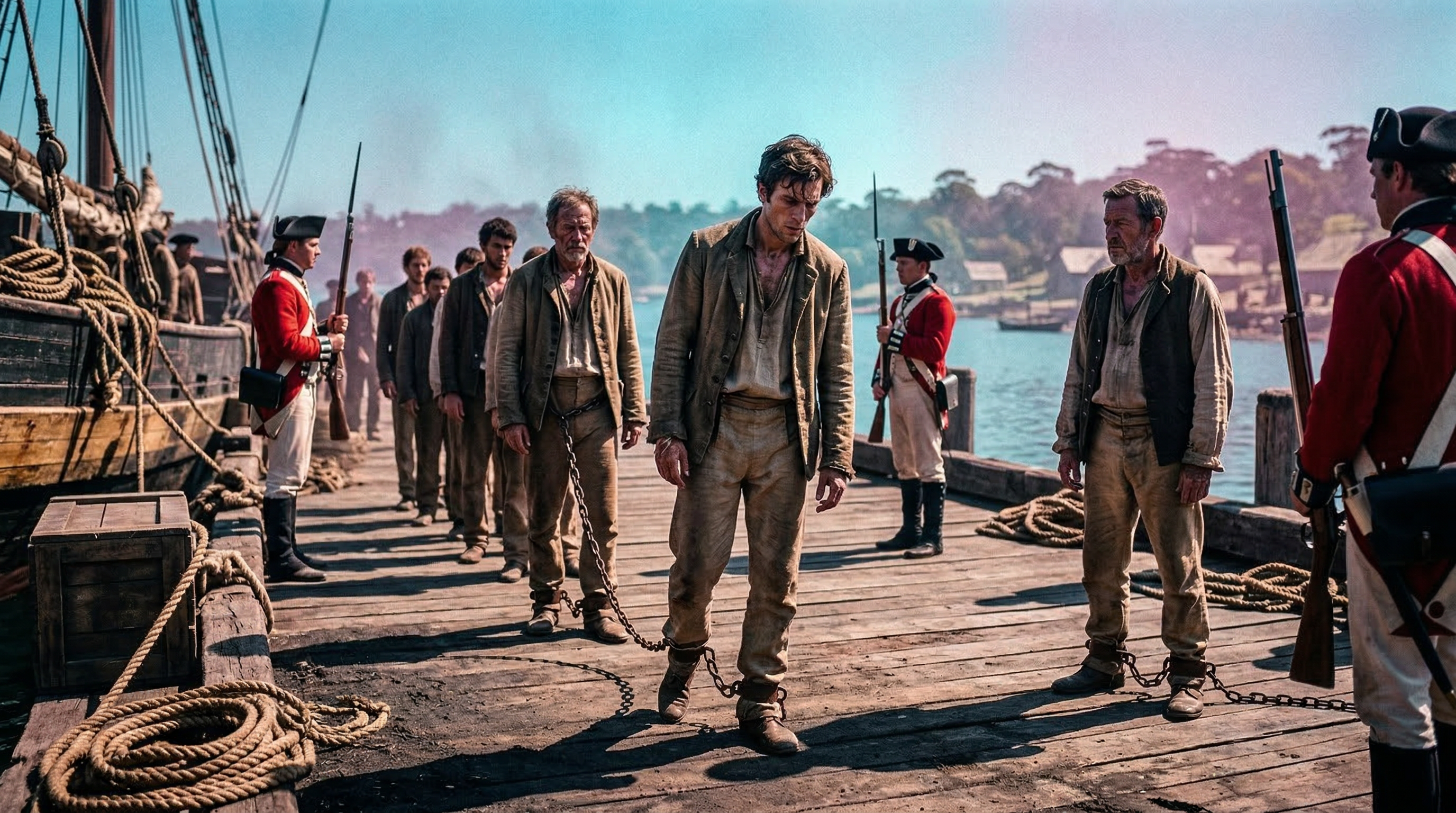
"Seven years or seventy—makes no difference if you're dead by summer." — Old Tom
The gangplank burned beneath William's bare feet. The timber had been baking in the Australian sun since dawn, and now, approaching midday, it radiated heat that seared through callused skin with each step. He gritted his teeth against the pain and kept moving, acutely aware of the men chained before and behind him, of the guards watching from the dock below, of the crowd that had gathered to witness this procession of the condemned.
Halfway down the plank, his legs betrayed him. The muscles that had spent ten months learning to compensate for the ship's endless motion now found themselves confronted with a surface that did not pitch or roll, that remained stubbornly, impossibly still. His knees buckled without warning, and he stumbled forward, catching himself on the shoulder of the man ahead only through desperate instinct. The chains connecting them jangled in discordant protest, and somewhere behind him a guard shouted something William could not comprehend through the roaring in his ears.
He forced himself upright. One step, then another. The plank seemed to stretch before him like some cruel jest, its far end retreating even as he advanced. The sun hammered down upon his head and shoulders, and sweat ran freely into his eyes, blurring the figures waiting below into smears of colour—red coats and brown faces and the pale flash of paper in someone's hands.
Then his foot struck something that did not yield, that did not shift with the rhythm of wind and wave, and William Jeffries stood upon Australian soil for the first time.
The dock was solid in a way the ship had never been. It transmitted the heat of the sun through the soles of his feet, transmitted the vibration of boots striking timber as the guards moved into position, transmitted what felt absurdly like the pulse of the land itself—a low, constant thrumming that might have been imagination or might have been the accumulated footfalls of everyone who had ever walked this shore. William stood frozen for a long moment, his body struggling to accept that the world had finally ceased its endless motion.
Then the smells hit him—not the salt-and-tar-and-bilge that had become as familiar as his own skin during the voyage, but something altogether different. Something alive. The harbour itself breathed out odours of mud and rotting fish and the green decay of vegetation he could not identify. From the shore came wood smoke, heavy and pungent, underlaid by the sharper scent of cooking meat that made his shrunken stomach clench with sudden, desperate hunger. And beneath it all, permeating everything, hung the strange perfume of this alien land—eucalyptus, though he did not yet know the word, sharp as turpentine yet somehow also sweet, carried on a breeze that felt like the breath of a furnace.
The sounds followed close behind. The cockatoos he had observed from the ship now revealed themselves in their full cacophonous glory, their shrieks splitting the air like rusty hinges on a gate to hell. Dogs barked somewhere in the settlement, their voices carrying clearly across the water. Human voices rose and fell in a babble of accents—English primarily, but threaded through with cadences William did not recognise, tongues that might have originated anywhere in the empire's far-flung possessions. A hammer struck metal in some unseen forge, the ringing blows creating a rhythm that seemed almost musical against the chaos.
And the light. Dear God, the light. William had thought he understood what sunshine meant, had spent his childhood beneath English skies that occasionally deigned to part their clouds and reveal the pale disc beyond. This was something else entirely. This was light as weapon, as physical force, as assault upon senses accustomed to the perpetual grey of a Portsmouth winter. It bounced from every surface—the harbour water, the white-painted walls of buildings along the shore, the brass buttons on the soldiers' coats—until William felt surrounded by a thousand small suns, each one determined to blind him where he stood.
He raised his manacled hands to shade his eyes and squinted at the scene before him. The crowd had pressed closer now that the convicts were disembarking, their faces resolving from blurs into distinct features. He saw curiosity there, and calculation, and in some cases something that might have been pity. A woman near the front clutched a small child against her hip, pointing toward the prisoners and speaking words that the child's expression suggested were cautionary. See what becomes of those who stray from the path of righteousness. See where crime leads. Let this be a lesson to you.
Guards herded the convicts into rough lines along the dock, their commands punctuated by the occasional prod of a musket butt against ribs that had grown prominent during months of shipboard rations. William found himself shuffled into position, the chains at his wrists connecting him to men he had come to know by smell and sound during the voyage, men whose faces had remained largely invisible in the perpetual darkness below decks. Now, in the brutal clarity of the Australian sun, he saw them clearly for the first time—gaunt features, hollow eyes, skin stretched taut over bones that seemed too close to the surface.
Old Tom stood three places ahead of him in the line. The older man had weathered the voyage better than most, his constitution hardened by previous experience of the journey, but even he showed the marks of their ordeal. His shoulders had acquired a permanent stoop during the months of confinement, and his hair—grey already when they departed Portsmouth—had thinned until his scalp gleamed pink beneath the merciless sun. Yet his eyes remained sharp, darting across the assembled crowd with the assessing gaze of a man taking stock of new territory.
"Steady, lads," Tom murmured, pitching his voice to carry only to those nearest him. "They'll process us one at a time. Name, crime, sentence—that's all they want. Don't volunteer anything. Don't argue. Don't give them reason to notice you. The nail that sticks up gets hammered down, and there's hammers aplenty in this colony."
William nodded, though Tom could not see the gesture. The advice aligned with everything he had learned during the voyage—keep your head down, attract no attention, survive. Simple rules for a situation that was anything but simple.
Captain Haverford had established himself at a makeshift desk near the head of the dock, its surface already cluttered with ledgers and documents that fluttered in the harbour breeze. He had exchanged his sea coat for the more formal attire appropriate to official colonial business—the red wool of the New South Wales Corps, brass buttons gleaming, stock tied with immaculate precision despite the heat that must have been suffocating within those layers of fabric. A clerk sat beside him, quill in hand, ready to record whatever information the captain deemed worthy of preservation.
The processing commenced with the grinding efficiency of a mill reducing wheat to flour. One by one, convicts were brought before the desk, their chains rattling accompaniment to the questions Haverford posed in his clipped, authoritative tones. Name. Crime. Sentence. Skills, if any. The responses were recorded in the ledger with scratching strokes of the clerk's quill, each man's existence in the colony thus inaugurated through the medium of ink and paper.
William watched the proceedings with careful attention, noting how the assignments were distributed. Some men were directed toward a group forming near the harbour's edge—bound, a guard announced, for the government quarries at Castle Hill. Others joined a cluster destined for road gangs, their labour to be spent carving passages through the bush that surrounded the settlement. A fortunate few received assignments to households of free settlers, their skills as servants or tradesmen earning them positions that might at least offer regular meals and shelter from the worst of the elements.
The quarries. William's gut tightened each time he heard that word. The reputation of Castle Hill had spread through the ship during the voyage, whispered tales of men worked until they dropped, of brutal overseers who counted convict lives cheaper than the stone they extracted. Assignment there was little better than a death sentence—slower than the gallows, perhaps, but no less certain.
Old Tom reached the head of the line. William found himself leaning forward, straining to hear the exchange despite the distance and the ambient noise of the dock. Tom approached the desk with the measured gait of a man who had faced such reckoning before, his chin raised, his bearing suggesting neither defiance nor submission—merely the patience of one who understood that certain outcomes lay beyond his power to influence.
"Name." Haverford's voice carried clearly in a momentary lull.
"Thomas Whitmore, sir. Called Tom by most."
"Crime."
"Receiving stolen goods, sir. Second offence."
Something shifted in Haverford's expression—a flicker of recognition, perhaps, or merely the calculation of a man weighing one factor against another. "Second offence. You've been transported before."
"Aye, sir. Served seven years at Norfolk Island. Earned my ticket and returned to England." Tom paused, and when he continued, his voice held a wry note that William recognised from their conversations in the hold. "Seems England didn't much want me back."
Haverford's quill scratched across the ledger. When he looked up again, his face had settled into lines of official neutrality. "Ten years this time, Whitmore. And given your previous... experience with colonial hospitality, I think the quarries will suit you best. Castle Hill. Report to the transport."
The words landed in William's chest like stones dropped into still water. The quarries. Tom, who had survived one transportation only to face another, who had shared his hard-won knowledge with a frightened young man from Portsmouth, who had spoken of opportunities in this new land even while knowing what awaited men of his circumstances. The quarries would kill him. Everyone knew it. Haverford knew it. Tom himself surely knew it, though his expression betrayed nothing as he nodded his acceptance and allowed the guards to lead him toward the group assembling near the harbour's edge.
Tom passed within arm's reach of William as he was escorted to his assigned group. For a moment—brief, stolen, insufficient—their eyes met. William saw no fear in the older man's gaze, no resentment, no accusation. Only a weary acceptance that spoke of a lifetime's acquaintance with the arbitrary cruelties of the world, and beneath it, something that might have been the faintest glimmer of warmth.
"Remember what I taught you, lad." Tom's voice was barely above a whisper, pitched for William's ears alone. "Keep your head down. Learn everything you can. And when your time comes—" He broke off as the guard's hand tightened on his arm, urging him forward. "When your time comes, don't waste it looking back."
Then he was gone, shuffling toward the cluster of men who would share his fate at Castle Hill. William watched him go, watched the stooped shoulders and the thinning grey hair disappear among the other condemned, and felt something crack in his chest—a fracture he would carry for years, a reminder of debts that could never be repaid.
He had known Tom for ten months. In the hierarchy of human relationships, ten months counted for little—less than the time William had spent learning his letters, less than a single year of his father's decades on the Portsmouth docks. Yet those ten months had been spent in circumstances that compressed time, that forged connections with an intensity ordinary life could never match. Tom had protected him when he was new to the hold's brutal politics. Had shared food when William's portion proved insufficient. Had offered wisdom without condescension, guidance without expectation of return.
And now Tom would die in a quarry, breaking rocks beneath the same sun that even now was searing the back of William's neck, and there was nothing to be done about it. Nothing at all.
The line moved forward. William shuffled with it, his mind still fixed on Tom's retreating figure even as his body carried him toward the captain's desk. The convict ahead of him—a horse thief from Kent whose name William had never learned—received his assignment and was led away. Then there was no one between William and the ledger that would record his colonial existence.
"Name." Haverford did not look up from the page before him.
"William Jeffries, sir." His voice emerged steadier than he had expected, roughened by months of disuse but clear enough.
"Crime."
"Theft of a pocket watch. Seven years."
Now Haverford looked up, and William found himself subjected to an assessment that seemed to strip away flesh and bone, to examine whatever lay beneath with a thoroughness that bordered on the invasive. The captain's grey eyes moved across William's face, lingered briefly on his hands—calloused from years of dock work, despite their current state of disrepair—and finally returned to meet his gaze.
"You've worked before," Haverford observed. It was not a question.
"The Portsmouth docks, sir. Since I was fourteen."
"Cargo handling? Rigging?"
"Both, sir. And some carpentry—basic repairs, nothing skilled."
Haverford's quill scratched against the paper. "Seven years for a pocket watch," he murmured, almost to himself. "The courts grow harsh in their old age." He looked up again, and something in his expression had shifted—not softened, precisely, but altered in some subtle way William could not identify. "Government farm at Parramatta. Agricultural labour. You'll depart tomorrow with the others assigned to that station."
William felt relief wash through him—not joy, nothing so elevated as that, but the simple easing of one particular dread. Not the quarries. Not the road gangs. The government farm, where at least the labour might teach him something useful, where survival seemed more possible than in the places where men were worked until their bodies simply gave out.
"Thank you, sir," he said, and the words emerged before he could consider whether gratitude was appropriate in such circumstances.
Haverford's eyebrow rose fractionally. "Don't thank me yet, Jeffries. Parramatta has broken better men than you. Whether you survive your sentence depends entirely on choices you have yet to make." He gestured to the guard at William's elbow. "Take him to the holding barracks. He'll join the Parramatta transport in the morning."
The guard's hand closed on William's arm—not roughly, but with a firmness that permitted no argument—and steered him away from the processing desk. He was directed toward a group of perhaps two dozen convicts who had received similar assignments, men who would share his journey to Parramatta and, presumably, his labour upon arrival. They stood in a loose cluster near the edge of the dock, watched over by guards whose expressions suggested profound boredom with the entire proceedings.
William took his place among them and allowed himself, for the first time since stepping off the gangplank, to simply observe his surroundings. The harbour stretched before him, its waters glittering beneath the afternoon sun, dotted with vessels whose masts created an irregular forest against the sky. The settlement climbed the gentle rise behind the cove, its buildings arranged in something approaching order—streets laid out in grids, structures of brick and timber standing shoulder to shoulder, the church spire rising above it all like a finger pointing toward the heaven that had apparently abandoned every soul standing on this dock.
He thought of Portsmouth, of the harbour he had known since childhood. The ships there had seemed wonders of human engineering, vast wooden worlds that carried the commerce of empire to every corner of the globe. These vessels looked smaller somehow, diminished by the scale of the harbour that contained them and the land that rose behind. Or perhaps it was merely his perspective that had changed—the accumulated effect of fifteen thousand miles and ten months of confinement, stripping away the illusions that had previously shaped his understanding of the world.
Near the harbour's edge, the quarry transport was preparing to depart. William watched the convicts being loaded aboard—shuffling figures in chains, their bodies already bent beneath burdens they had not yet begun to carry. He searched for Tom among them, found the older man near the rear of the group, and raised his manacled hands in a gesture of farewell that Tom might or might not see.
The distance was too great to read expressions, but William thought he saw Tom's head turn briefly in his direction. Then the guards shouted orders, and the transport began to move, and Old Tom disappeared from William's sight forever.
The march to the holding barracks carried William through streets he had only glimpsed from the ship. Sydney revealed itself in fragments—the orderly facades of official buildings giving way to rougher structures as they moved away from the waterfront, shops and taverns and dwellings of varying quality arranged along thoroughfares that were streets in aspiration if not yet in fact. Dust rose beneath their feet, coating tongues and stinging eyes. The smell of the settlement intensified as they moved inland—cooking fires and animal dung and the particular odour of human habitation concentrated in spaces too small to contain it.
The colonists they passed regarded the convict procession with reactions that spanned the full range of human sentiment. Some watched with open curiosity, their eyes tracking the shuffling figures as though cataloguing livestock at market. Others turned away, unwilling to acknowledge this reminder of the colony's origins, this parade of the damned through streets they had laboured to make respectable. A few—themselves bearing the weathered look of former convicts—offered nods of grim solidarity, recognition passing between those who had walked this path and those who walked it now.
Children proved the most forthright observers. They gathered at corners and in doorways, their eyes wide with a mixture of fear and fascination that they made no effort to conceal. Several ran alongside the procession for a time, calling out questions that the guards ignored and comments that ranged from innocent curiosity to cruelty that only the young can muster without self-awareness. William kept his gaze fixed forward, refusing to acknowledge their attention, though their voices followed him like stones thrown at his retreating back.
The heat had not relented. If anything, it had intensified as the afternoon advanced, the sun seeming to descend closer to the earth even as it tracked westward across the sky. William's shirt had long since soaked through, the rough linen clinging to his skin in sodden folds that chafed with every step. His throat burned with thirst, though the guards had provided water at the dock—a few mouthfuls each, barely enough to wet cracked lips and parched tongues. He thought of the rain that had plagued Portsmouth through so many grey winters and felt a desperate, irrational longing for cold English drizzle upon his upturned face.
The holding barracks announced themselves through smell before they came into view—the concentrated essence of too many bodies in too small a space, unwashed and unwell, their collective presence creating an atmosphere that the tropical heat did nothing to improve. The building itself emerged from behind a row of more reputable structures, a long, low construction of rough-hewn timber whose walls had been weathered to a silvery grey by years of sun and occasional rain.
A yard surrounded the barracks, enclosed by a fence of wooden stakes driven deep into the red earth. Guards stood at the gate, their postures suggesting men who had long since ceased to find their duties interesting but remained capable of violence should circumstances require it. They exchanged brief words with the escort, checked something on a list that one of them produced from his coat, and waved the convicts through into the compound.
Inside the fence, the yard revealed itself as a space designed for neither comfort nor dignity. Bare earth, packed hard by countless feet, stretched between the barracks building and a series of smaller structures that William took to be latrines and perhaps a cookhouse. A well occupied one corner, its wooden frame worn smooth by the hands of those who had drawn water from its depths. A few scraggly trees—the same grey-green species he had observed from the ship—provided inadequate shade along the fence line, their leaves hanging limp and dusty in the still air.
The barracks interior proved marginally better than the yard, if only because walls and roof provided some respite from the direct assault of the sun. Rows of wooden bunks lined both sides of the long room, each one barely wide enough to accommodate a man lying on his back, separated from its neighbours by gaps that would not have permitted a cat to pass comfortably. Thin straw mattresses provided the only concession to comfort, their coverings stained by the occupants of previous nights in patterns William chose not to examine too closely.
"Find a bunk," the guard announced, his voice flat with repetition. "Rations at sundown. Anyone causing trouble answers to me, and I've had a long day, so I'd recommend against it." He gestured vaguely toward the rows of beds. "Transport for Parramatta leaves at first light. I suggest you sleep while you can."
William found an empty bunk near the far end of the building, away from the door and its associated traffic. The mattress released a puff of dust and old straw as he lowered himself onto its surface, the wooden frame creaking in protest beneath even his reduced weight. He sat for a moment, his back against the rough timber of the wall, and allowed his eyes to adjust to the relative dimness of the interior.
Around him, the other convicts were claiming their own spaces, their movements accompanied by the rattle of chains and the low murmur of voices exchanged between those who had formed connections during the voyage. Some collapsed immediately onto their bunks, their bodies surrendering to exhaustion that had accumulated over months of deprivation. Others sat as William did, observing their surroundings with the wary attention of men who understood that survival often depended on knowing one's environment before it had opportunity to turn hostile.
The smells of the barracks wrapped around William like a second skin—sweat and unwashed bodies, straw and dust and the faint, pervasive undertone of illness that seemed to accompany any gathering of the dispossessed. He breathed through his mouth and tried to ignore it, knowing that soon enough his senses would dull, that what seemed unbearable now would become merely unpleasant, then unremarkable, then simply the air he breathed.
Through the small window at the end of the building, he could see a sliver of sky beginning to shade from blue toward gold as the afternoon aged. His first day in Australia was drawing to its close. He had survived the landing, the processing, the march through Sydney's streets. Tomorrow would bring new challenges—the journey to Parramatta, whatever awaited him at the government farm, the beginning of seven years that stretched before him like a road disappearing into fog.
But that was tomorrow. For now, there was only this narrow bunk, this straw mattress, this roof overhead that did not pitch and roll with the motion of the sea. For the first time in ten months, William Jeffries would sleep on solid ground.
He closed his eyes and waited for whatever dreams might find him in this strange land at the bottom of the world.






