4128.61 · March 1, 1808 AD
The March Westward Begins
Approximately thirty convicts assigned to the government farm at Parramatta departed Sydney at dawn, beginning a multi-day march through the Australian bush under armed guard. The brutal heat claimed one man to heat stroke before the column made camp beside a creek at nightfall, having covered perhaps fifteen miles of the rudimentary track.
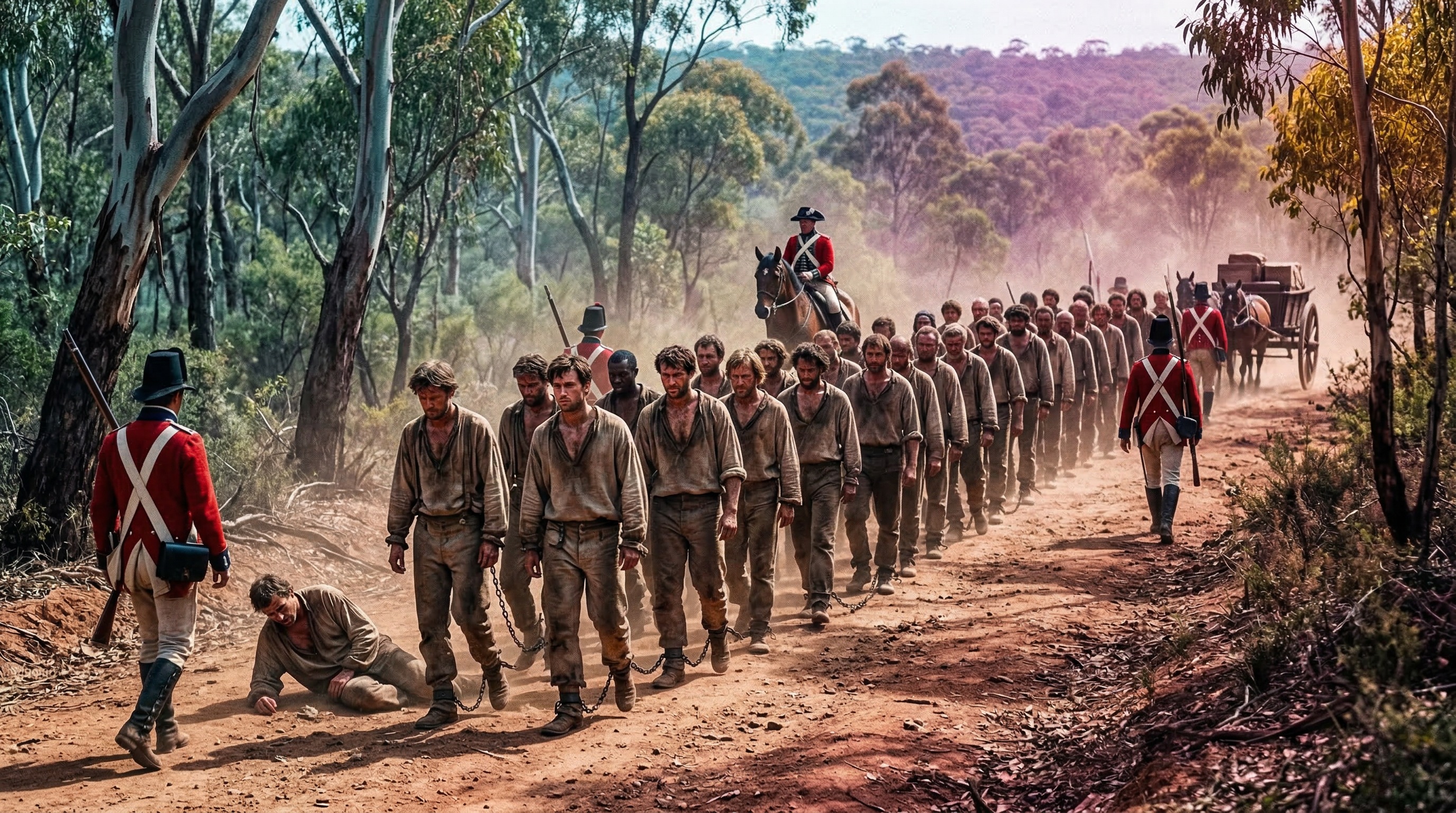
The column departed Sydney in the grey light before dawn, when the air still carried some memory of the night's coolness. Approximately thirty convicts walked in chains, their irons creating a discordant rhythm that accompanied every step along the track. Guards of the New South Wales Corps flanked the procession at intervals, their muskets held ready, whilst a sergeant rode at the head on a horse whose temperament matched its rider's. A supply cart brought up the rear, its wheels groaning over the rutted earth.
The road to Parramatta was less a road than an ambition—a suggestion of passage carved through the bush by the boots and carts of those who had preceded this particular column. It wound westward from the settlement, climbing gradually into country that grew wilder with each mile. The timber-and-brick buildings of the colony gave way first to scattered huts, then to cleared paddocks, and finally to nothing but the grey-green tangle of the Australian bush pressing close on either side.
The heat announced itself within an hour of sunrise. What had seemed merely warm became oppressive, then unbearable, as the sun climbed toward its zenith. This was not the heat of the settlement, tempered by harbour breezes and the shade of buildings. This was the heat of open country, of a sun with nothing between itself and the earth but air that magnified rather than filtered its fury. The convicts' clothing soaked through with sweat. Dust rose from beneath their shuffling feet, coating every surface it could find—skin, eyes, tongues, the raw flesh of blisters that burst and bled with each step.
The bush through which they passed bore no resemblance to any English landscape. Gum trees rose on every side, their trunks pale as bone where the bark had peeled away, their leaves not the verdant green of oak and elm but something more muted, more silver, as though generations of brutal sun had bleached the colour away. Resin oozed from wounds in the bark, hardening into amber tears that caught the filtered light. The smell was overwhelming—eucalyptus sharp and almost medicinal, underlaid by something earthier and more ancient that seemed to rise from the land itself.
Parrots flashed through the canopy in bursts of crimson and emerald. Cockatoos erupted from the trees at the column's approach, their white wings catching the sun, their shrieks splitting the air. Flies descended upon the sweating men in clouds, crawling across exposed skin with a persistence that bordered on malevolent. The insects provided constant commentary—buzzing, whirring, clicking in numbers that seemed impossible, their voices creating a wall of sound that pressed against the ears from every direction.
The first casualty fell sometime before midday. One moment he was walking; the next, his legs folded beneath him and he dropped to the dust like a puppet whose strings had been severed. The men chained to him stumbled, dragged sideways by his collapse. Guards shouted orders. Water was splashed on the unconscious man's face, held to his lips. His eyes, when they opened, saw nothing—glazed and unfocused, looking at something beyond the circle of concerned faces. The sergeant ordered him loaded onto the supply cart rather than left to die on the track, and the column lurched back into motion with the gap in its ranks closed by rearranged chains.
A brown snake crossed the path in the early afternoon, emerging from the undergrowth directly before the leading convicts. The creature was longer than a man was tall, its body marked with bands of brown and cream that rippled as it moved. The column froze. The snake considered its audience with apparent contempt, its tongue flickering out to taste the fear that hung upon the still air. For a long moment it remained motionless in the centre of the track, unhurried by the presence of creatures so much larger than itself. Then, with fluid indifference, it continued across and vanished into the bush. The leaves rustled briefly, marking its passage, and then there was nothing—no sign the encounter had occurred save the racing hearts of those who had witnessed it.
Dark figures moved through the bush at the edges of vision throughout the afternoon—Aboriginal people watching the column's progress from perhaps fifty yards distant. They appeared and vanished with a fluidity that made their presence seem almost dreamlike, melting into vegetation that evidently held no secrets from them. The guards grew watchful but issued no commands. The convicts learned quickly not to stare. This was country that had belonged to other peoples for thousands of years before the first convict ship dropped anchor in Sydney Cove, and those peoples had not ceased to exist simply because the empire had claimed their land.
The sergeant called a halt as the light began to soften, having reached a clearing where previous transports had evidently camped before. The ground bore the scars of old fire pits. A small creek trickled through one edge of the space, its water brown with tannins but drinkable. The convicts dispersed through the clearing with the weary relief of men who had pushed their bodies beyond reasonable limits and survived. Feet were washed in the creek—blistered, bleeding, torn by the miles of rough track. Rations were distributed as darkness fell. Small fires were lit once true night had claimed the bush.
The column had covered perhaps fifteen miles. The government farm at Parramatta lay somewhere ahead, its distance measured not in the abstract numbers of maps but in the concrete reality of steps yet to be taken, heat yet to be endured, ground yet to be covered by feet that had already given more than they possessed. The convicts slept where they fell, their exhaustion overwhelming whatever discomfort the hard earth might offer, whilst the strange sounds of the Australian night—the shrieks of possums, the chorus of unfamiliar insects, the calls of creatures that belonged to no European bestiary—provided accompaniment to dreams of homes they would never see again.
The first day of the march to Parramatta had concluded. The days that followed would bring more of the same—heat and dust and the slow accumulation of miles beneath bleeding feet. But that knowledge belonged to tomorrow. For now, there was only rest, however brief, beneath southern stars that traced patterns no English eye had been taught to read.







